 2018, Vol. 55


畜禽粪便因含有丰富的养分(N、P2O5、K2O)往往作为有机肥返还农田[1], 据估算, 2011年我国畜禽粪便的产生量已达到25.45×10⁸ t, 其中的氮、磷含量分别达1419.76×104 t和247.98×10⁴ t[2], 畜禽粪便带来的氮、磷总量约为全年施用化肥中所含氮磷的78.9%和57.4%[3]。2017年, 全国畜禽粪尿量已高达38×104 t[4], 为了加快推进畜禽养殖废弃物资源化利用, 促进农业可持续发展, 2017年6月12日, 国务院办公厅发布了《关于加快推进畜禽养殖废弃物资源化利用的意见》并明确提出, 到2020年, 全国畜禽粪污综合利用率达到75%以上。因此, 利用好畜禽粪便不但可以减少化学肥料的用量, 有效降低畜禽养殖带来的面源污染, 还能增加土壤有机质, 实现减肥增效和农田可持续利用。但是, 当一定区域内畜禽产生的粪便超过作物生长需要和土壤的自净能力时, 就会出现土壤N、P盈余[5-6], 过量的N、P便会通过地表径流和淋溶进入河流、湖泊和地下水, 造成水体污染。为了控制畜禽粪便污染, 欧盟委员会明确规定每年投入农田的粪便氮素不得超过170 kg·hm-2[7], 挪威、瑞典和爱尔兰还分别规定了每年粪便磷的最高施用量为35、22和40 kg·hm-2[8]。
目前国内外有关畜禽养殖的研究主要集中在畜禽粪便组分、环境风险评估以及畜禽养殖承载力研究等方面[9-12], 而基于土壤氮磷平衡的畜禽养殖承载力研究则相对较少。为了合理控制畜禽养殖规模, 有效防治畜禽养殖污染, 保障农业可持续发展, 本研究以江门市新会区为研究对象, 选取水田、菜地、园地和林地4种农用地类型, 测定土壤N、P养分以及As、Cu、Zn等重金属含量, 基于养分平衡模型, 通过量化核算区域N、P的输入和输出项, 判断氮、磷盈余或缺损, 并将区域内能承受的输入量间接转化为猪当量畜禽数量, 即适宜的养殖量, 以期为其他地区的畜禽养殖污染防治规划提供借鉴和参考。
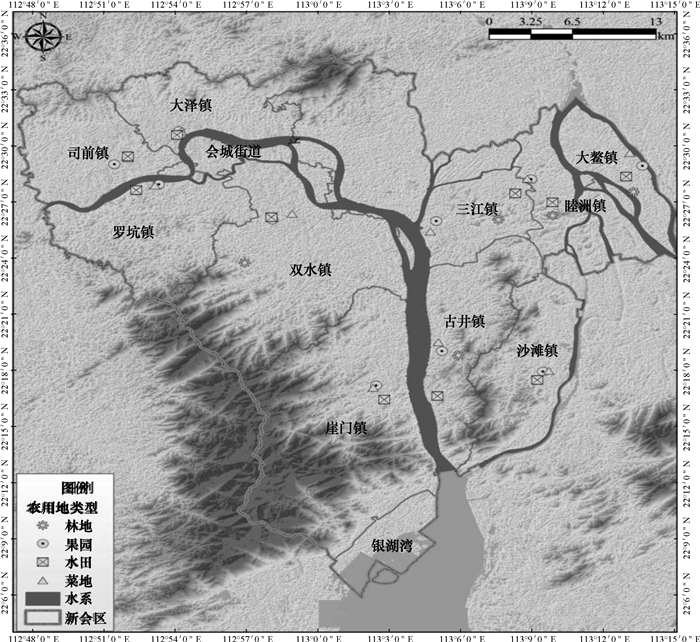
1 材料与方法 1.1 样品采集与数据收集2017年8月26-29日, 在广东省江门市新会区选择水田、菜地、园地、林地四种农用地土壤类型, 按照《农田土壤环境质量监测技术规范》(NY/T 395-2012)和《土壤检测第1部分:土壤样品的采集、处理与贮存》(NY/T 1121.1-2006)的要求, 采用梅花布点和四分法共采集土壤样品35个, 其中水田、菜地、园地各10个, 林地5个, 采样点分布见图 1。监测指标包括pH、土壤电导率(EC)、有机质、全氮、全磷、速效氮、有效磷以及Cu、Zn、As等重金属共10个指标, 其中, pH和EC采用电极法测定, 有机质采用重铬酸钾滴定法测定, 全氮和速效氮分别采用凯氏法和碱解法进行测定, 全磷和有效磷分别采用分光光度法和钼锑抗比色法进行测定, Cu、Zn、As采用分光光度法测定。
|
图 1 土壤采样点分布 Fig. 1 Soil sampling sites |
本研究中各种农作物的种植面积和产量数据来源于新会区统计年鉴, 每形成100 kg作物的N、P需求量见表 1。

|
表 1 作物形成100 kg产量需要的养分量 Table 1 Nutrients required per 100 kg crop produced |
根据土壤中养分的平衡原理, 即:盈余量=输入量-输出量, 本研究通过量化核算区域内氮、磷元素的输入和输出项, 判断氮、磷盈余或缺损, 并将区域内能承受的输入量间接转化为猪当量畜禽数量, 即为适宜的养殖量。
在一定的土地供肥能力和单位面积农作物产量条件下, 考虑由畜禽粪便提供一定比例的农业生产需肥量的情况下, 计算获得的土地当量畜禽的承载量, 计算公式如下:
| $ N = \frac{{A - S}}{{d \times r}} \times f $ | (1) |
式中, N为需要施加的畜禽粪便量, t·hm-2; A为单位面积产量作物需要吸收的养分量; 即需肥量, t·hm-2; S为单位面积土壤的供肥量, t·hm-2; d为畜禽粪便(干基)中营养元素的含量(N为1%, P为0.9%); r为畜禽粪便的当季利用率, %, 本研究取30%;f为畜禽粪便的施用量占施肥总量的比例, %。
根据《2015年新会区统计年鉴》, 新会区主要种植的农作物包括水稻、玉米、薯类、大豆、花生、蔬菜以及柑桔橙、香大蕉、荔枝、龙眼、番石榴等水果, 主要的林产品为蒲葵, 农作物的产量分别见表 2, 结合单位产品N、P需求量, 便可计算出农业生产需肥量A。
|
|
表 2 2015年新会区主要农产品产量(吨, 蒲葵单位为万柄) Table 2 Yields of the main agricultural crops in Xinhui in 2015(t, the unit for Chinese fan palm is 104 plant) |
采用《畜禽粪便农田利用环境影响评价准则》(GBT26622-2011)和《畜禽粪便还田技术规范》(GB/T 25246-2010)中推荐的方法计算单位面积土壤供氮和供磷量(S):
| $ S = 2.25 \times {10^{ - 3}} \times C \times t $ | (2) |
式中, 2.25×10⁻³表示土壤养分(N、P)的换算系数, 土壤耕作层深度通常为20 cm, 其每hm2土壤总重约为225×104 kg, C表示土壤中N、P元素的测定值, mg·kg-1, t表示校正系数, 因土壤具有缓冲能力, 测定值只是代表供肥潜力, 实际能被作物吸收的量只占测定值的一部分, 可取0.5[18]。
2 结果与讨论 2.1 土壤肥力水平新会区农用地土壤的有机质、N、P含量结果见表 3。从该表中可看出, 新会农用地土壤中有机质平均含量在3.57%~3.80%之间, 全氮平均含量在1.70~1.91 g·kg-1之间, 有效氮平均含量在97.21~149.9 mg·kg-1之间, 全磷平均含量在0.88~1.41 g·kg-1之间, 有效磷平均含量在49.7~166.5 mg·kg-1之间。在水田、菜地、园地和林地四种农用地中, 水田的有机质、全磷和有效磷的平均含量最低, 林地的有机质、全氮、有效氮和全磷的平均含量最高, 果园的全氮平均含量最低, 菜地的有效磷平均含量最高。
|
|
表 3 新会区农用地土壤有机质、N、P测定结果(速效氮、有效磷单位为mg·kg-1,其余为g·kg-1) Table 3 Organic matter, nitrogen and phosphorus contents in farmland soils of Xinhui (the unit for available N and P is mg·kg-1, and for the rest, g·kg-1) |
本研究按照《畜禽粪便还田技术规范》(GB/T 25246-2010)推荐的土壤肥力分级标准, 根据土壤全氮含量进行新会区农用地土壤肥力水平评价, 结果显示, 在所监测的点位中, 新会区土壤肥力等级较高, 水田和林地肥力全为Ⅰ级, 菜地除崖门镇为Ⅲ级外, 其余全为Ⅰ级, 果园除大泽和双水为Ⅱ级外, 其余也为Ⅰ级, Ⅰ级点位数占所有监测点位的91.4%。
2.2 土壤Cu、Zn、As含量根据土壤采样监测结果, 按照《农用地土壤环境质量标准》(三次征求意见稿), 采用单因子指数法对新会区土壤中Cu、Zn、As污染情况进行评价, 结果见表 4。在所监测的所有菜地中, 未出现Cu、Zn、As超标, 部分果园土壤出现As超标, 这可能与果园曾经使用含砷农药有关, 超标的点位分别为罗坑、沙堆、古井三个镇, 超标倍数分别为0.25、1.32、0.49此外, 双水和司前的水田、古井的林地也出现了As超标, 超标倍数分别为0.15、0.08和0.23。
|
|
表 4 新会区土壤重金属评价结果 Table 4 Heavy metal concentrations in the soils of Xinhui/(mg·kg-1) |
为了促进畜禽生长和提高免疫力, 动物饲料中往往加入含Cu、Zn、As等重金属的添加剂, 然而, 由于动物对Cu、Zn、As添加剂的利用率较低, 导致这些重金属随畜禽粪便进入环境, 引起土壤重金属污染, 尤其是As污染。有研究表明, 猪饲料中As、Cu、Zn的平均含量分别为6.5、119.4、486.2 mg·kg-1, 经过禽畜消化吸收后还会在禽畜粪中富集[19]。另有调查表明, 广东集约化养殖场猪粪中As、Cu、Zn的平均含量分别达89.3、765.1、1128 mg·kg-1; 鸡粪中As、Cu、Zn的平均含量分别达21.6、107.5、366.6 mg·kg-1[20]。因此, 施用畜禽粪肥可能会导致土壤重金属污染。
2.3 土壤养分供需平衡根据新会区土壤中N、P含量监测结果, 利用式(2)分别计算各镇街单位面积农用地供氮量和供磷量, 并与农作物生产需要的养分量进行比较, 以需要施肥量来表征土壤养分的盈亏状况("-"表示盈, "+"表示亏), 见表 5。从这些表可看出, 除大泽外, 其余10个镇街的部分土壤均出现了供肥能力大于作物需肥量的情况, N、P肥料过量施用, P肥最为突出, 其中, 会城、三江和大鳌的所有农用地均存在土壤P肥或N肥过剩现象, 会城园地和大鳌水田还同时出现N肥和P肥过剩, 这与前人的研究结论[5-6]一致, 因此, 畜禽粪便中P2O5是限制畜禽粪便农田施用的主要限制因素。
|
|
表 5 2015年新会区农用地土壤养分供需表 Table 5 Soil nutrient budgeting of the farmlands of Xinhui /(t·hm-2) |
根据调查, 目前新会区有机肥施用比例约为20%, 畜禽粪便收集率为70%(流失率30%), 利用式(1)和式(2)计算出新会各镇街适宜的养殖量(见表 6), 全区总的养殖量为27万头猪当量。同时, 根据新会区农林局提供的畜禽养殖种类和数量, 结合广东省地方标准《畜禽养殖业污染物排放标准》, 按30只蛋鸡、30只鸭(蛋鸭和肉鸭)、30只兔、3只羊、15只鹅、60只肉鸡折算成1头猪; 1头奶头折算10头猪, 1头肉牛折算成5头猪的折算标准, 按猪当量计算各镇街畜禽养殖量, 全区现状养殖总量为125.7万头猪当量。此外, 根据《广东国民经济和社会发展统计公报》(2016), 获得年人均肉类消耗量为37.8kg, 按每出栏1头猪产肉75kg计, 结合新会区人口数据, 可算出基于新会区肉类需求的养殖量, 为38万头猪当量。由此可见, 现状全区的养殖总量已经远远超出了适宜的养殖量和肉类需求量, 需要大幅度削减养殖规模。基于承载力的畜禽养殖量分布不均衡, 其中, 会城、三江、大鳌三个镇已经没有养殖空间, 适宜养殖的区域主要分布在双水和司前两个镇。
|
|
表 6 2015年新会区畜禽养殖量分析(单位:头猪当量) Table 6 Livestock and poultry feeding loads in Xinhui (2015, pig equivalent) |
新会区部分农用地土壤存在过量施肥现象, 2015年全区化肥平均施用强度为367 kg·hm-2(按种植面积计算), 超出了发达国家提出的警戒线(225 kg·hm-2)。新会区现状畜禽养殖总量大, 远远超出了畜禽养殖承载力, 除崖门和睦州两个镇外, 其余8个镇都需要大幅削减养殖量才能满足畜禽养殖承载力的要求。此外, 部分农用地土壤出现As超标, 畜禽粪肥农用的环境风险不容忽视。因此, 新会区在施用畜禽粪肥时除了要考虑土壤的养分平衡, 防止N、P盈余和累积外, 还需关注粪肥带来的As污染风险。
| [1] |
李书田, 刘荣乐, 陕红. 我国主要畜禽粪便养分含量及变化分析. 农业环境科学学报, 2009, 28(1): 179-184. Li S T, Liu R L, Shan H. Nutrient contents in main animal manures in China (In Chinese). Journal of Agro-Environment Science, 2009, 28(1): 179-184. DOI:10.3321/j.issn:1672-2043.2009.01.033 (  0) 0) |
| [2] |
朱建春, 张增强, 樊志民, 等. 中国畜禽粪便的能源潜力与氮磷耕地负荷及总量控制. 农业环境科学学报, 2014, 33(3): 435-445. Zhu J C, Zhang Z Q, Fan Z M, et al. Biogas potential, cropland load and total amount control of animal manure in China (In Chinese). Journal of Agro-Environment Science, 2014, 33(3): 435-445. ( 0) |
| [3] |
牛俊玲, 秦莉, 郑宾国, 等. 河南省规模化养殖发展中的耕地污染负荷及风险评价-以河南省长垣县为例. 农业环境科学学报, 2008, 27(5): 2105-2108. Niu J L, Qin L, Zheng B G, et al. Waste load of farmland and risk assessment for the development of scale breeding in Henan Province (In Chinese). Journal of Agro-Environment Science, 2008, 27(5): 2105-2108. DOI:10.3321/j.issn:1672-2043.2008.05.076 ( 0) |
| [4] |
郝常宝, 李洪田. 浅谈畜禽养殖粪便处理和资源化利用. 山东畜牧兽医, 2017(3): 54-55. Hao C B, Li H T. Review on the treatment and reuse of livestock manure (In Chinese). Shandong Journal of Animal Science and Veterinary Medicine, 2017(3): 54-55. DOI:10.3969/j.issn.1007-1733.2017.03.037 ( 0) |
| [5] |
陈敏鹏, 陈吉宁. 中国区域土壤表观氮磷平衡清单及政策建议. 环境科学, 2007, 28(6): 1305-1310. Chen M P, Chen J N. Inventory of regional surface nutrient balance and policy recommendations inChina (In Chinese). Environmental Science, 2007, 28(6): 1305-1310. DOI:10.3321/j.issn:0250-3301.2007.06.025 ( 0) |
| [6] |
李帷, 李艳霞, 张丰松, 等. 东北三省畜禽养殖时空分布特征及粪便养分环境影响研究. 农业环境科学学报, 2007, 26(6): 2350-2357. Li W, Li Y X, Zhang F S, et al. The spatial and temporal distribution features of animal production in three northeastprovinces and the impacts of manure nutrients on the local environment (In Chinese). Journal of Agro-Environment Science, 2007, 26(6): 2350-2357. DOI:10.3321/j.issn:1672-2043.2007.06.062 ( 0) |
| [7] |
Schröder J J, Aarts H F M, TenBerge H F M, et al. An evaluation of whole-farm nitrogen balances and relatedindices for efficient nitrogen use . EuropeanJournal of Agronomy, 2003, 20: 33-44.
( 0) |
| [8] |
Ulen B, Bechmann M, Folster J, et al. Agriculture as a phosphorussource foreutrophication in the north-west European countries, Norway, Sweden, United Kingdom and Ireland:A review . Soil Use andManagement, 2007, 23(Suppl. 1): 5-15.
( 0) |
| [9] |
单英杰, 章明奎. 不同来源畜禽粪的养分和污染物组成. 中国生态农业学报, 2012, 20(1): 80-86. Shan Y J, Zhang M K. Contents of nutrient elements and pollutants in differentsources of animal manures (In Chinese). Chinese Journal of Eco-Agriculture, 2012, 20(1): 80-86. ( 0) |
| [10] |
Peng L, Bai Y. Numerical study of regional environmental carrying capacity for livestock andpoultry farming based on planting-breeding balance . Journal of Environmental Sciences, 2013, 25(9): 1882-1889. DOI:10.1016/S1001-0742(12)60244-7
( 0) |
| [11] |
阎波杰, 赵春江, 潘瑜春, 等. 规模化养殖畜禽粪便量估算及环境影响研究. 中国环境科学, 2009, 29(7): 733-737. Yan B J, Zhao C J, Pan Y C, et al. Estimation of the amount of livestock manure and its environmental influence of large-scaled culture based on spatialinformation (In Chinese). China Environmental Science, 2009, 29(7): 733-737. DOI:10.3321/j.issn:1000-6923.2009.07.012 ( 0) |
| [12] |
王立刚, 李虎, 王迎春, 等. 小清河流域畜禽养殖结构变化及其粪便氮素污染负荷特征分析. 农业环境科学学报, 2011, 30(5): 986-992. Wang L G, Li H, Wang Y C, et al. Changes in livestock operation systems and their contributions to manure nitrogen pollution loading inXiaoqinghe watershed, China (In Chinese). Journal of Agro-Environment Science, 2011, 30(5): 986-992. ( 0) |
| [13] |
高祥照, 申朓, 郑义, 等. 肥料实用手册. 北京: 中国农业出版社, 2002. Gao X Z, Shen T, Zheng Y, et al. Fertilizers manual (In Chinese). Beijing: China Agriculture Press, 2002. ( 0) |
| [14] |
李荣昌. 荔枝的主要矿质营养生理与施肥技术. 广西热作科技, 1994(1): 14-18. Li R C. The nutrients and fertilizers of litchi (In Chinese). Guangxi Tropical Crops Technology, 1994(1): 14-18. ( 0) |
| [15] |
徐炯志. 龙眼养分资源综合管理研究. 南宁: 广西大学, 2006. Xu J Z. Comprehensive management of nutrient resources in Longan (In Chinese). Nanning: Guangxi University, 2006. ( 0) |
| [16] |
臧小平, 雷新涛. 番石榴的营养与施肥. 中国南方果树, 2000, 29(6): 29-31. Zang X P, Lei X T. The nutrients and fertilizers of guava (In Chinese). China Southern Fruit Tree, 2000, 29(6): 29-31. DOI:10.3969/j.issn.1007-1431.2000.06.020 ( 0) |
| [17] |
陈振鑫, 李锦泽, 李海先, 等. 新会蒲葵的特性与栽培技术. 农业科技通讯, 2005(8): 33. Chen Z X, Li J Z, Li H X, et al. The character and planting of Chinese fan palm in Xinhui (In Chinese). Bulletin of Agricultural Science and Technology, 2005(8): 33. ( 0) |
| [18] |
易湘琳, 宋李思莹, 李汪晟, 等. 不同有机肥占比率下的湖南省畜禽养殖承载力研究. 现代农业, 2015, 11(11): 86-89. Yi X L, Song L S Y, Li W S, et al. Study on the livestock carrying capacity of Hunan Province (In Chinese). Modern Agriculture, 2015, 11: 86-89. DOI:10.3969/j.issn.1008-0708.2015.11.059 ( 0) |
| [19] |
姚丽贤, 黄连喜, 蒋宗勇, 等. 动物饲料中砷、铜和锌调查及分析. 环境科学, 2013, 34(2): 732-739. Yao L X, Huang L X, Jiang Z Y, et al. Investigation of As, Cu and Zn species and concentrations in animal feeds (In Chinese). Environmental Science, 2013, 34(2): 732-739. ( 0) |
| [20] |
姚丽贤, 李国良, 党志. 集约化养殖禽畜粪中主要化学物质调查. 应用生态学报, 2006, 17(10): 1989-1992. Yao L X, Li G L, Dang Z. Major chemical components of poultry and livestock manures under intensive breeding (In Chinese). Chinese Journal of Applied Ecology, 2006, 17(10): 1989-1992. DOI:10.3321/j.issn:1001-9332.2006.10.041 ( 0) |