 2025, Vol. 62


2. 中国科学院大学, 北京 100049;
3. 中国科学院南京土壤研究所, 南京 211135;
4. 江西农业大学国土资源与环境学院, 南昌 330045;
5. 桂林理工大学广西岩溶地区水污染控制与用水安全保障协同创新中心, 广西桂林 541004;
6. 黑龙江省农业科学院, 哈尔滨 150081
2. University of Chinese Academy of Sciences, Beijing 100049, China;
3. Institute of Soil Science, Chinese Academy of Sciences, Nanjing 211135, China;
4. College of Land Resources and Environment, Jiangxi Agricultural University, Nanchang 330045, China;
5. Guangxi Collaborative Innovation Center for Water Pollution Control and Safety in Karst Area, Guilin University of Technology, Guilin, Guangxi 541004, China;
6. Heilongjiang Academy of Agricultural Sciences, Harbin 150081, China
白浆土是我国东北地区主要的土壤类型之一,主要分布在黑龙江省和吉林省东部,占地面积527.2万hm2,粮食年总产量为554~791万吨,产量低而不稳[1-5]。白浆土的土体构型主要为黑土层、白浆层和淀积层[6-7]。白浆层是一种诊断性的土壤层次,其埋深(黑土层厚度)与厚度是白浆土较为宏观的物理特征。白浆土区域属于薄层(< 30 cm)黑土区,白浆层埋深即黑土层厚度对判断黑土的退化程度具有重要意义,其能够反映土壤的发育程度,是鉴别土壤肥力和衡量黑土退化程度的重要指标[8-9]。白浆层作为白浆土的关键土层,粉粒和砂粒组成比例达到70%,黏粒为30%,三者组成比例在土体内达到致密堆积状态[10],成为了土壤中水分、养分的“阻断”障碍层。该层次具有容重高、强度大、通气透水性质差等物理特性[11-12],致使白浆土僵硬板结、易旱易涝,其厚度状况与作物根系穿插深度及生长状况关系紧密,是量化白浆土障碍程度关键指标。因此分析白浆层的埋深与厚度状况对进一步摸清白浆土障碍特征,进行白浆土改良,具有重要意义。
白浆层是由于上层土壤存在季节性滞水,导致土体内部干湿交替现象剧烈,在亚表层土壤中发生黏粒的机械淋洗和严重的氧化还原反应条件下形成的[13-14]。在淹水状态下,黏粒和被还原成低价态的铁锰离子随着水流淋失;在干旱状态下,低价态离子被氧化成高价态就地形成结核同黏粒一起淀积,从而形成白浆层[15]。区域环境即母质、气候、地形、植被等成土条件的不同,使得白浆层埋深与厚度也不同[16]。王秋兵等[17]研究发现特殊地形显著影响白浆土的发育程度。分布在不同海拔高度的白浆土的白浆层埋深与厚度存在差异,其埋深随海拔的降低而增大,厚度则与海拔呈现正效应[18]。此外,降水也会直接作用于土体内的白浆化过程[15]。降水较多时,白浆层内的化学淋溶作用越强,白浆层得到进一步发育;降水较少时,白浆层底部开始淀积。前人研究表明了白浆土白浆化过程及发生条件,并未明晰典型区域白浆层埋深与厚度的空间分布及其与影响因素之间的关系。
在白浆土改良技术研究中,主要集中在打破白浆层的机械改良方面,包括深翻和心土混拌等[19]。不同改良方式涉及的扰动深度不同,当白浆层埋深较浅且厚度较大时,深翻可能导致大量的白浆层与黑土层混拌,降低耕层的肥力水平,从而降低改良效果;而心土混拌则可以通过混拌白浆层和淀积层,取得更好的改良效果[20]。当白浆层埋深较大时,则可以考虑深翻,将少量的白浆层与黑土层混拌,取得较好的改良效果。因此了解白浆层埋深与厚度空间分布状况,对指导白浆土的改良具有重要意义。但是,目前关于白浆土的研究主要集中在农田尺度[21-23],针对区域尺度白浆层的埋深与厚度的空间分布以及其驱动因素研究还存在不足。因此,本文采用地统计学和经典统计学空间变异方法,分析了三江平原东南部白浆层埋深与厚度的空间分布格局,结合气候因素、地形因素、土壤矿物以及人为因素与白浆层埋深与厚度空间分布的关系,解析影响白浆层埋深与厚度的驱动因素,以期为白浆土机械精准改良提供理论支持。
1 材料与方法 1.1 研究区概况三江平原是我国白浆土的主要分布区域(43°49′55″—48°27′20″N、129°11′20″—135°5′10″E),该区属于温带湿润、半湿润大陆性季风气候,多年平均气温为2.8℃,年降雨量为383~886 mm[24],海拔为34~1 100 m,它以宽阔的冲积低平原、阶地和河流密集的洪积平原为主[25],由西南向东北倾斜,地貌广阔较平坦,土壤肥沃,成土母质主要为第四纪河湖黏土沉积物[26]。三江平原白浆土面积达到88.4万hm2,主要农作物为大豆、玉米和水稻。本文以三江平原东南部呈块状分布的典型白浆土为研究对象,南起鸡西市鸡东县(JD)经密山市(MS)、虎林市(HL)至双鸭山市宝清县(BQ)(44°56′40″—46°29′26″N,130°51′1″—133°17′5″E),海拔变化为57~686 m,区域内典型白浆土的总面积为4070 km2。
1.2 样点布设与土壤剖面信息采集结合2020年黑龙江省精细地表覆盖数据(比例尺为1︰100万,分辨率为30 m)(http://data.casearth.cn/)、现有各级公路图(https://openmaptiles.org)以及黑龙江省1︰100万土壤类型图(2018年)(https://www.geodata.cn/),选取靠近公路的种植玉米的旱作岗地为样地。样点呈现西南至东北走向,田间实际调查共51个样点(2022年调查46个,2023年调查5个),点位之间间隔不等,利用手持GPS记录各采样点的经纬度坐标,如图 1所示。此外通过查阅《土系志·黑龙江卷》获取11个点数据,共计62个样点。
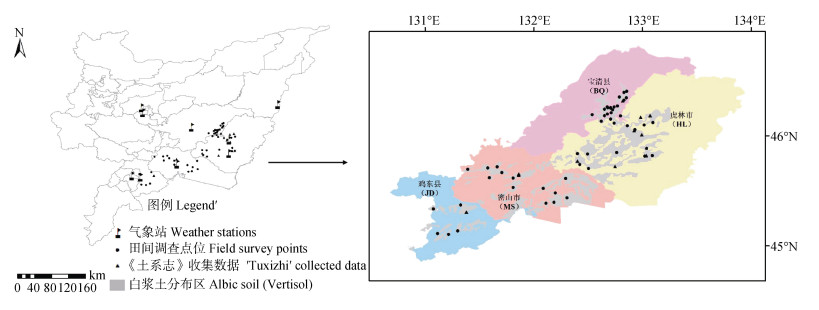
|
图 1 三江平原白浆土区样点分布图 Fig. 1 Distribution of sampling points in the albic soil area of Sanjiang Plain |
野外调查时间为2022年9月下旬—10月上旬及2023年9月27日,在各个点位选取地面较为平坦、玉米长势均匀有代表性的区域,在玉米垄间,采用铁锹挖取宽度为60~70 cm,深度为60~70 cm的土壤剖面。根据白浆土白浆层的颜色、硬度和质地等性质与上层黑土层和下层淀积层存在明显差异[15],判别白浆层的上下边界,当白浆层上下界面呈现波状或者不规则的分界时,取曲线顶端与底端1/2处作为界线[27]。将卷尺置于剖面中部,将垄上与垄沟中部作为零点,采用目视法读取记录白浆层埋深(即黑土层厚度)与厚度数据,如图 2所示。
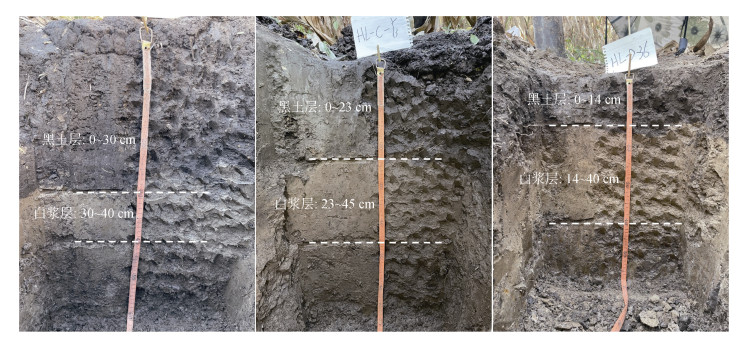
|
图 2 典型样点土壤剖面(部分) Fig. 2 Soil profiles of representative sampling sites |
挖取剖面时,分别采集黑土层和白浆层3个不同位置混合土样各1 kg,自然风干,过10目筛后采用X射线衍射法(XRD)测定土壤矿物组成[28]。
在土壤样品采集的同时,每个样点田块随机选取10个点采用紧实度仪(CP 40II,RIMIK,澳大利亚)田间原位测定0~65 cm土壤穿透阻力(kPa),每2.5 cm读取一次土壤紧实度数据。根据Zhuo等[29]提出的方法,通过田间测定的紧实度数据判定调查样点的耕作深度,具体步骤为:对田间土壤紧实度数据采用一阶差分法消除数据集中的自相关性,采用Mann-Kendall突变检验确定数据集中发生突变的位置[30],结合样点土壤剖面信息即黑土层与白浆层分界状况判断耕作深度,将紧实度突变点位置大于或等于25 cm深度的样点以及田间存在明显黑土层与白浆层混拌现象的样点判断为翻耕(DT),其余为旋耕(XT)。据统计,具有紧实度数据的32个点位中,翻耕有20个点位,旋耕12个。
1.4 气象、地形和母质数据以样带所在区域9个气象观测站(图 1)1967—2021年逐月气象数据为基础(中国气象数据网,http://data.cma.cn/ ),采用径向基函数(RBF)插值的方法获取区域尺度多年平均降水量(MAP)、多年平均气温(MAT)、多年平均蒸发量(MAE)、多年平均地表温度(MAST)、多年平均日照数(MAS)分布图(r=1,RMSE=0.0032~0.6094)。其中降水插值结果与“1901—2022年中国1 km分辨率逐月降水量数据集合”[31]具有极显著正相关性(r=0.601,P=2.36562E-7)。通过分辨率为90 m的DEM(Digital Elevation Model)数据提取研究区域海拔、坡向、坡度数据(地理空间数据云,gscloud.cn)。用ArcGIS提取各样点的气象数据、地形数据。研究区域母质数据来源于国家科技基础条件平台—国家地球系统科学数据共享服务平台—土壤科学数据中心(http://soil.geodata.cn/)。
湿润指数是结合降水与潜在蒸散发的影响来表征气候干湿程度[32],多年平均湿润指数(MAHI)计算方式如下[33]:
| $ {\text{MAHI}} = \frac{{{\text{MAP}}}}{{{\text{MAE}}}} $ |
式中,MAHI多年平均湿润指数,为无量纲数;MAP为多年平均降水量(mm);MAE为多年平均潜在蒸发量(mm)。
1.5 数据处理综合利用数理统计和地统计空间变异分析方法,采用GS+9.0软件对白浆层埋深、厚度、气象因子数据进行最优半方差函数拟合,基于ArcGIS(ESRI® Arc MapTM 10.8)软件采用普通克里格插值方法构建白浆土白浆层埋深及厚度的空间分布图。
在分析白浆土埋深和厚度与气象和地形等因素的相关关系时,剔除人为影响强烈的8个点位(黑土层与白浆层混拌)以便降低人为因素干扰。采用IBM Statistics SPSS 19.0对数据进行基本统计特征、相关性分析等,利用R软件对影响因子进行随机森林模型重要性排序,制图软件为Origin 2021软件。
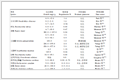
2 结果 2.1 白浆层埋深与厚度分布特征表 1显示不同区域白浆层埋深和厚度特征的描述性统计结果。整个采样区域,白浆层埋深最大值为37 cm,最小值为13 cm,平均值为23.7 cm,其中宝清县埋深最大(平均25.2 cm),而鸡东县最小(平均20.7 cm);然而,白浆层埋深的变异系数中鸡东县最大(29.1%),而宝清县最小(11.9%)。白浆层平均厚度为18.5 cm,最大为35.0 cm,最小为8.0 cm。虎林市厚度最大(平均23.2 cm),为鸡东县的2倍以上。不同区域白浆层的埋深与厚度变异系数不等,可以看出黑土层和白浆层的厚度空间上存在较大变异性,整个区域白浆层厚度的变异性相较埋深更大。
|
表 1 研究区不同县(市)白浆层埋深与厚度描述性统计特征 Table 1 Descriptive statistical characteristics of buried depth and thickness of albic layer in different counties(cities)of the study area(n = 62) |
研究区域内白浆层的埋深与厚度数据均符合正态分布。埋深在20~25 cm范围内出现的频次最多(44%),其次为25~30 cm(27%),少有出现10~15 cm(5%)以及35~40 cm(2%)深度。厚度在15~20 cm范围内出现的频次最多(32%),其次为10~15 cm(26%)和20~25 cm(21%),5~10 cm(3%)和30~40 cm(6%)范围内较少。
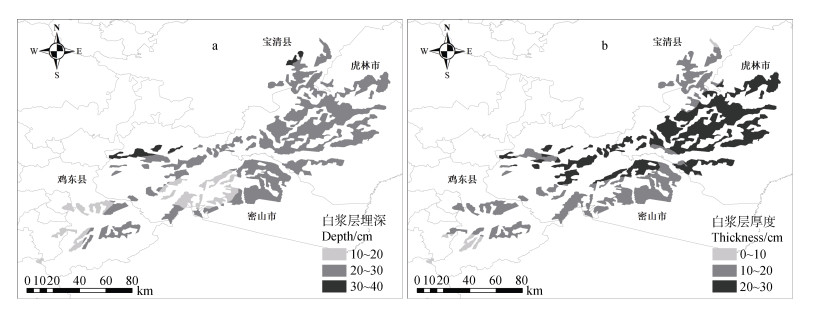
2.2 白浆层埋深与厚度的空间分布格局采用普通克里格插值方法进行白浆层埋深和厚度的点面空间拓展。白浆层埋深与厚度的半方差函数拟合精度均较高(R2 > 0.75),表明埋深与厚度均存在显著的空间自相关。二者的空间相关性均属于中等水平(25% < 块基比 < 75%),表明其空间变异性是由结构性因素和随机因素共同导致的。基于各自半方差函数,针对白浆层埋深和厚度进行空间预测制图(图 3),交叉验证结果表明,埋深的精度相对较低(R2为0.30,MAE为4.04 cm,RMSE为4.82 cm);厚度的精度相对较高(R2为0.54,MAE为5.99 cm,RMSE为5.63 cm)。但考虑到白浆层分布受到结构性因素和随机因素共同影响,因此该结果可以一定程度支持其空间格局分析。
|
图 3 白浆层埋深(a)与厚度(b)空间分布特征 Fig. 3 Spatial distribution characteristics of buried depth(a)and thickness(b)of albic layer |
空间分布结果表明,白浆层埋深(图 3a)与厚度(图 3b)在整个区域中部的空间分布规律近似,均呈现自西南向东北方向增加的趋势。而从区域中部向西北方向存在相反的分布规律,即白浆层埋深中部区域较西北部埋深浅,呈现向周围递增的趋势;白浆层厚度在中间区域较西北方向厚度大,呈现向周围减小的趋势。埋深介于20~30 cm的区域分布最广,其广泛分布在密山市、虎林市和宝清县境内;埋深在10~20 cm的区域主要分布在鸡东县和密山市内;宝清县和密山市的西北部白浆层埋深达到30 cm以上。白浆层厚度较埋深区域变异性更大,斑块化分布的现象较为突出,白浆层厚度为10~20 cm的区域主要分布在鸡东县和宝清县;密山市内白浆层厚度主要介于10~20 cm和20~30 cm之间;虎林市内厚度较大,均为20~30 cm;鸡东县和宝清县内存在小范围的0~10 cm厚度分布。
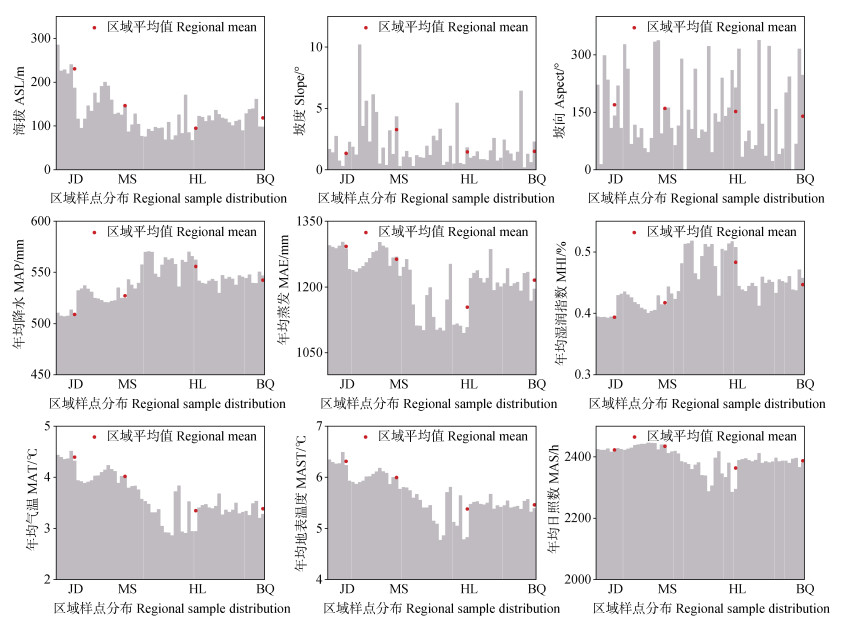
2.3 地形、气象及土壤性质的空间分布特征图 4为研究区域内西南至东北方向上各样点的地形和气象数据图。区域地形与气候各因子均存在明显的梯度变化:从西南至东北方向,海拔(67~285 m)、坡度(0°~10°)和坡向(0°~338°)呈现减小趋势,其中坡度波动变化较大。年均降水量(507~570 mm)、年均湿润指数(0.39~0.52)呈现增加趋势,在密山、虎林市内呈现大幅度波动;年均蒸发量(1 094~1 303 mm)、年均气温(2.9~4.5℃)、年均地表温度(4.8~6.5℃)和年均日照数(2 285~2 446 h)呈减小趋势,于鸡东县达到最大值,区域平均气温为3.6℃,较为寒冷,其中虎林市内地形较为平坦、降水较多、气温较低。
|
图 4 西南至东北方向样点的地形和气象空间分布特征 Fig. 4 Spatial distribution characteristics of topography and meteorology in the southwest-northeast transect(n = 62) |
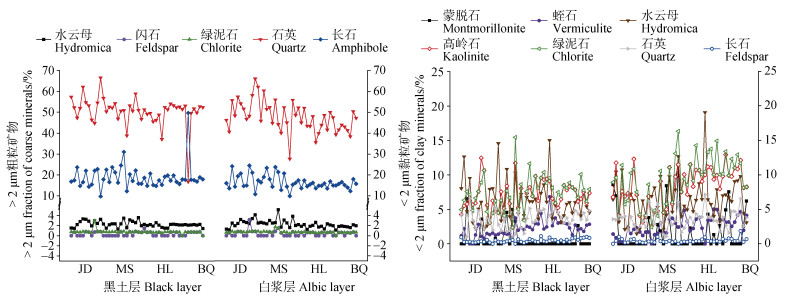
从图 5可以看出,白浆土中 > 0.002 mm的土壤矿物在黑土层与白浆层中组成比例最大的为石英(51.4%和48.3%)和长石(18.2%和16.6%),其次为水云母(2.3%和2.2%),呈波动减小的趋势。< 0.002 mm的土壤矿物主要为绿泥石(7.3%和9.2%),其次是高岭石(7.0%和8.4%),蒙脱石、长石组成比例较小。在黑土层中,黏粒矿物绿泥石、高岭石、石英及蛭石从西南至东北方向均呈现逐渐增加的趋势。在白浆层中,绿泥石、高岭石、水云母、蛭石均呈现逐渐增大的趋势,且增加的梯度变化较黑土层明显。
|
图 5 西南至东北方向样点的土壤性质空间分布特征 Fig. 5 Spatial distribution characteristics of soil properties from southwest to northeast transect(n = 46) |
表 2为利用Pearson相关分析得出的白浆层埋深与厚度和地形因子、气象因子和土壤矿物之间相关系数。由分析结果可以看出,各类影响因素对白浆层埋深与厚度的影响程度存在较大差异。
|
|
表 2 白浆层埋深和厚度与地形、气象(n = 54)以及土壤性质(n = 46)之间的相关性 Table 2 Relationships between the buried depth and thickness of the albic layer and its influencing factors |
地形因子和气象因子与白浆层埋深无显著相关性。在土壤矿物中,其中埋深与粗粒矿物水云母之间具有显著负相关性(P < 0.05),与粗粒长石之间具有显著正相关性(P < 0.01)。
在地形因子中,白浆层厚度与海拔呈极显著负相关关系(P < 0.01)。气象因子中,白浆层厚度与年均降水和年均湿润指数之间具有极显著正相关性(P < 0.01),与年均蒸发量和年均气温之间呈现显著负相关性(P < 0.01和P < 0.05)。土壤矿物中,白浆层厚度与粗粒矿物水云母和粗粒石英呈显著正相关性(P < 0.01和P < 0.05),与黏粒蒙脱石之间具有极显著负相关关系(P < 0.01)。
上述因子对白浆层埋深影响较为微弱,为了进一步量化各主要影响因素对厚度的影响程度,确定影响厚度的主控因素,根据表 3的相关性分析结果,利用随机森林模型评估不同因子的相对重要性。结果表明区域气象条件(74%)对白浆层厚度影响的重要性明显高于地形条件(16%)和土壤矿物(10%)。
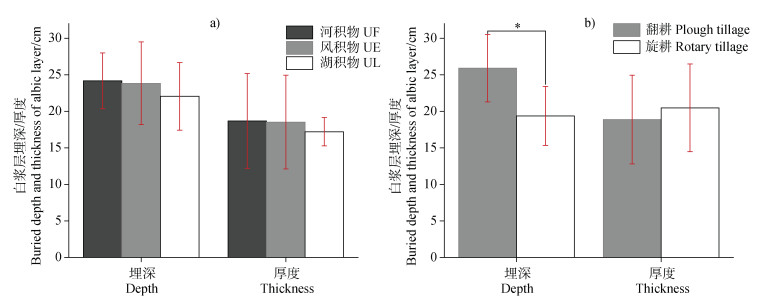
图 6为研究区域内不同成土母质和耕作方式下白浆层埋深与厚度的分布状况。采集样点的母质主要为河积、风积以及湖积母质。分析发现,白浆层埋深与厚度均表现为河积 > 风积 > 湖积,但是不同母质之间白浆层埋深与厚度的差异均不显著。研究区耕作方式不同,埋深与厚度差异显著性不同,深耕下白浆层埋深显著大于旋耕(P < 0.05),旋耕下白浆层厚度略大于深耕,但两者之间差异不显著。
|
注:*表示在0.05水平下差异显著。 Note:* indicate significant levels at the P < 0.05,respectively. 图 6 白浆层埋深与厚度在不同成土母质(a)(n = 62)及耕作方式(b)(n = 32)上的分布 Fig. 6 Distribution of buried depth and thickness of the albic layer in different parent materials(a)(n = 62)and tillage methods(b)(n = 32) |
本研究发现,气象因子、地形参数与土壤母质对白浆层埋深(黑土层厚度)无显著影响(表 3、图 6a),而与受环境条件影响较弱相反,人为耕作方式显著影响了白浆层的埋深(图 6b):与旋耕相比,翻耕显著增加了白浆层的埋深。研究表明,与自然土壤相比,耕作后的土壤表土层厚度性质可能产生较大变化[34]。翻耕和旋耕是东北黑土区常见的两种耕作方式[35]。通常而言,翻耕对土层的扰动较大,会翻转土壤层,土壤剖面中的亚表层土壤被翻转至表层[36],导致土层混拌。当前东北黑土区大型农机翻耕的作业深度可达25~35 cm[37],而本研究调查数据显示约60%白浆层的埋深低于25 cm,因此,翻耕会导致部分白浆层与黑土层混拌(图 2),增厚耕作层的厚度,导致白浆层埋深增加。同时,翻耕将上下土层混合形成大量孔隙[38],使得土壤紧实度减小,结合肥料施用和秸秆还田等措施可以促进耕层土壤的熟化和增厚[34,37,39-41]。旋耕的耕作深度大多在15 cm以内,一般不会将下层土壤带至上层[37],据调查数据显示约95%白浆层的埋深大于15 cm,因此旋耕一般不会增加白浆层埋深。同时,旋耕使得亚表层土壤长期受到农机具的压实作用,使土壤结构变劣,土壤紧实度增大[42-44],不利于耕作层的增厚[34]。在我国东北地区,个体农户翻耕作业面积越来越少,主要以小型动力的浅旋耕为主[44],而国营农场多采用翻耕秸秆还田的方式[45-48]。研究区域内,虎林市和宝清县境内的白浆层埋深相对较深,可能与该区域内国营农场广泛分布以及大型农机翻耕作业频繁有关。白浆层埋深(黑土层厚度)随气候变化而发生改变[49-51],但由于人类活动的参与,土壤发生过程的准稳态从根上被破坏[52],从而影响白浆层的埋深。
调查区域埋深平均值为23.7 cm,相较于第二次全国土壤普查(https://www.geodata.cn )中获取的耕作层厚度(埋深)18.2 cm增厚5.5 cm,其主要原因可能有两个方面,一是二普采样区域(密山、虎林、宝清、尚志、延寿、方正等县市内的自然林地和耕地)与本文的调查区域不重合,白浆层埋深存在较大的空间变异性;二是二普以来较长时间的耕种管理可能导致白浆层埋深增加。
3.2 白浆层厚度的驱动因素本研究发现,白浆层的厚度与气象因素关系最为密切,与年均降水和年均湿润指数呈极显著正相关性(P < 0.01),与年均蒸发量和年均气温之间呈显著负相关性(P < 0.01和P < 0.05)。这一结果表明,在湿润低温区域,更有利于白浆层的形成和厚度增加。白浆层是经过长时间机械淋洗和化学淋溶作用的产物[17]。在湿润条件下土体内为还原状态,由于表层土壤有机质含量丰富,结构较好,因此淋溶作用主要发生于下层土壤。淋溶作用受到水体垂直通量的控制[53],王霞等[54]表明土壤淋溶强度随降水量的增加呈现对数增长。即土体中的黏粒以及高价着色离子被还原成低价态随水流下漏或者侧渗[55],且该层内土壤着色离子与黏粒的损失量随着降水强度的增加而增加,导致白浆层脱色变厚。同时,温度是土壤水分蒸发的主要驱动力之一[56],温度越低,土壤水分蒸发量越少,进一步增强土体内的淋溶作用即白浆层的发育程度,土层越厚。这与本研究结果一致,从研究区域的西南到东北方向,随着降雨量的增加和温度的降低,白浆层厚度总体也呈现增加趋势,于虎林市内厚度达到最大(图 3)。
此外,本研究也发现白浆层厚度与海拔呈极显著负相关(P < 0.01),随着海拔升高,白浆层厚度变薄。这主要受两个方面的影响,一方面海拔较高的区域,由于自然环境制约,导致土壤成土作用较弱,土层较薄[18];另一方面,地形对区域气候具有再分配作用[57]。本研究区内,随着海拔的升高,气温与蒸发量越大,而降水减少,不利于白浆层的机械淋溶作用;同时,高海拔区土体由于所处地形的坡度较大,排水状况通常较好,使得土体内的还原强度较弱,不利于白浆化过程[17,58]。因此海拔越高,白浆层越薄。
黏粒矿物的蚀变也是白浆层的形成过程之一[13]。研究发现白浆层厚度与黏粒蒙脱石含量呈极显著负相关(P < 0.01),与粗粒水云母呈极显著正相关(P < 0.01)。研究区内水云母与黏粒蒙脱石含量少,而黏粒矿物绿泥石和高岭石含量高,这是由于季节性干旱导致云母失去阳离子向着蒙脱石转换[59],蒙脱石在又淹水状态下失去Fe3+和Mg2+,形成黏粒绿泥石,或者经过地带性风化和淋溶,Fe3+扩散进层间形成高岭石[60-63]。矿物含量受到气候作用而变化,反映了白浆层形成过程中的氧化还原过程。
综上所述,第四纪河湖黏土沉积物为白浆土形成提供了物质基础,三江平原冷凉的气候条件以及具有起伏的地势为白浆层的发育提供驱动力,其中区域水热条件是影响白浆层厚度的关键因子。同时人为因素不可忽视,不同耕作方式会改变上层土体构型,因而是影响埋深的主控因素。
4 结论基于以上对三江平原东南部样带白浆层埋深与厚度的空间分布及其驱动因素的分析表明:(1)白浆层埋深多介于20~30 cm,在西南至东北方向上呈现增加趋势,在虎林市和宝清县区域埋深较厚,整体在区域内变异较小;(2)白浆层厚度在西南部及宝清县内多介于10~20 cm之间,东北区域多介于20~30 cm之间,整体变异较埋深大,在西南至东北方向上呈现逐渐增加的趋势;(3)人为耕作方式是影响白浆层埋深空间分布的关键因子,翻耕增加了白浆层埋深;水热条件与海拔是影响白浆层厚度空间分布的重要因素,湿润多雨、低温和低海拔区域更有利于白浆层的发育。
| [1] |
Zeng Z S, Zhuang J P, Li M P. On the formation and classification of albic soil (In Chinese)[J]. Acta Pedologica Sinica, 1963, 11(2): 3-21. [曾昭顺, 庄季屏, 李美平. 论白浆土的形成和分类问题[J]. 土壤学报, 1963, 11(2): 3-21.]
(  0) 0) |
| [2] |
Gao Z Q, Song Y F, Guan X M. Studies on some physical and chemical properties of albic soil during its formation (In Chinese)[J]. Acta Pedologica Sinica, 1988, 25(1): 13-21. [高子勤, 宋玉芳, 关熙铭. 白浆土形成过程中某些物理、化学性质的研究[J]. 土壤学报, 1988, 25(1): 13-21.]
( 0) |
| [3] |
Huo Y P, Liu X J, Zhang H. Discussion on the problem of Baijiang soil improvement based on the study of its physical property of moisture (In Chinese)[J]. Journal of Northeast Agricultural University, 1983, 14(3): 69-75. [霍云鹏, 刘兴久, 张宏. 白浆土的水分物理性质与白浆土的改良[J]. 东北农学院学报, 1983, 14(3): 69-75.]
( 0) |
| [4] |
Liu F, Zhang Y L, Jia H B, et al. Three-stage subsoil mixing plough and its improvement of planosol (In Chinese)[J]. Transactions of the Chinese Society of Agricultural Engineering, 2001, 17(3): 57-61. DOI:10.3321/j.issn:1002-6819.2001.03.013 [刘峰, 张玉龙, 贾会彬, 等. 三段式心土混层犁及其改良白浆土效果的研究[J]. 农业工程学报, 2001, 17(3): 57-61.]
( 0) |
| [5] |
Lu X C, Zheng Y Z, Chen X, et al. Effects of biochar and organic fertilizer on soil physic-chemical properties and maize yields in albic soil (In Chinese)[J]. Journal of Maize Sciences, 2021, 29(6): 137-143. [陆欣春, 郑永照, 陈旭, 等. 施生物炭和有机肥对白浆土理化性质和玉米产量的影响[J]. 玉米科学, 2021, 29(6): 137-143.]
( 0) |
| [6] |
Liu T T, Gao Z C, Kuang E J, et al. Study on physical characteristics of planosol Ⅲ. Microstructure and porosity features (In Chinese)[J]. Heilongjiang Agricultural Sciences, 2012(6): 45-48. DOI:10.3969/j.issn.1002-2767.2012.06.015 [刘婷婷, 高中超, 匡恩俊, 等. 白浆土某些物理性质的研究Ⅲ. 白浆土微结构及孔隙特征[J]. 黑龙江农业科学, 2012(6): 45-48.]
( 0) |
| [7] |
Wang Q J, Jiao F, Liu F, et al. Changes of soil physical and chemical properties of albic soil in the meadow of Sanjiang Plain after rice planting (In Chinese)[J]. Chinese Journal of Applied Ecology, 2018, 29(12): 4056-4062. [王秋菊, 焦峰, 刘峰, 等. 三江平原草甸白浆土种稻后土壤理化性质变化[J]. 应用生态学报, 2018, 29(12): 4056-4062.]
( 0) |
| [8] |
Liu K, Wei M H, Dai H M, et al. Spatiotemporal variation of black soil layer thickness in black soil region of Northeast China (In Chinese)[J]. Geology and Resources, 2022, 31(3): 434—442, 394. [刘凯, 魏明辉, 戴慧敏, 等. 东北黑土区黑土层厚度的时空变化[J]. 地质与资源, 2022, 31(3): 434—442, 394.]
( 0) |
| [9] |
Zhang Z Y. The thickness changes of Ah horizon after the phaeozems cultivated (In Chinese)[J]. Journal of Heilongjiang Bayi Agricultural University, 2010, 22(5): 1-3. DOI:10.3969/j.issn.1002-2090.2010.05.001 [张之一. 黑土开垦后黑土层厚度的变化[J]. 黑龙江八一农垦大学学报, 2010, 22(5): 1-3.]
( 0) |
| [10] |
Jia H B, Liu F, Zhao D L, et al. Research on some physical-chemical properties and improvement of planosols (In Chinese)[J]. Acta Pedologica Sinica, 1997, 34(2): 130-137. DOI:10.3321/j.issn:0564-3929.1997.02.003 [贾会彬, 刘峰, 赵德林, 等. 白浆土某些理化特性与改良的研究[J]. 土壤学报, 1997, 34(2): 130-137.]
( 0) |
| [11] |
Liu T T, Gao Z C, Kuang E J, et al. Study on physical characteristics of planosol Ⅰ. Some physical characteristics about soil compaction and permeability (In Chinese)[J]. Heilongjiang Agricultural Sciences, 2012(4): 49-52. [刘婷婷, 高中超, 匡恩俊, 等. 白浆土某些物理性质的研究Ⅰ. 与土壤紧实和通透性质相关的几个物理特性[J]. 黑龙江农业科学, 2012(4): 49-52.]
( 0) |
| [12] |
Wang Q J, Chang B C, Zhang J S, et al. Effects of albic soil physical properties and rice yields after long-term straw incorporation (In Chinese)[J]. Scientia Agricultura Sinica, 2017, 50(14): 2748-2757. [王秋菊, 常本超, 张劲松, 等. 长期秸秆还田对白浆土物理性质及水稻产量的影响[J]. 中国农业科学, 2017, 50(14): 2748-2757.]
( 0) |
| [13] |
Brinkman R. Ferrolysis, a hydromorphic soil forming process[J]. Geoderma, 1970, 3(3): 199-206. DOI:10.1016/0016-7061(70)90019-4
( 0) |
| [14] |
Xu Q. The geographical distribution law of white soil in the middle and lower reaches of the Yangtze River and the characteristics of its formation process (In Chinese)[J]. Acta Pedologica Sinica, 1962, 10(1): 44-54. DOI:10.11766/trxb199403140203 [徐琪. 长江中下游白土的地理分布规律及其形成过程的特点[J]. 土壤学报, 1962, 10(1): 44-54.]
( 0) |
| [15] |
Zeng Z S. China albic soil (In Chinese). Beijing: Science Press, 1997. [曾昭顺. 中国白浆土[M]. 北京: 科学出版社, 1997.]
( 0) |
| [16] |
Bockheim J G. Classification and distribution of soils with albic horizons in the USA: A preliminary analysis[J]. Geoderma, 2016, 262: 85-93. DOI:10.1016/j.geoderma.2015.08.010
( 0) |
| [17] |
Wang Q B, Wang Y P, Sun Z X, et al. Characteristics of the pale color horizon in albic soils in Liaoning Province and their forming processes (In Chinese)[J]. Soils, 2017, 49(2): 400-407. [辽宁省白浆化土壤中白土层的特征及其形成[J]. 土壤, 2017, 49(2): 400-407.]
( 0) |
| [18] |
Zhang F R. Pedogeography (In Chinese). 2nd ed[M]. Beijing: China Agriculture Press, 2016. [张凤荣. 土壤地理学[M]. 2版. 北京: 中国农业出版社, 2016.]
( 0) |
| [19] |
Feng H Y, Zhang C F. Research progress and prospect on improvement effect of albic soil (In Chinese)[J]. Heilongjiang Agricultural Sciences, 2022(11): 104-109. [白浆土改良研究进展及展望[J]. 黑龙江农业科学, 2022(11): 104-109.]
( 0) |
| [20] |
Liu F, Gao P, Wang Q J, et al. Research progress in improvement of subsoil (In Chinese)[J]. Soil and Fertilizer Sciences in China, 2015(1): 7-11. [心土改良的研究进展[J]. 中国土壤与肥料, 2015(1): 7-11.]
( 0) |
| [21] |
Chen B Z, Cai D L, Wang F Q, et al. Spatial variability of available phosphor of meadow albic bleached soil (In Chinese)[J]. Chinese Agricultural Science Bulletin, 2009, 25(6): 159-161. [草甸白浆土有效磷的空间变异性[J]. 中国农学通报, 2009, 25(6): 159-161.]
( 0) |
| [22] |
Hou Y H, Wang X, Zhao Y H, et al. Spatial heterogeneity of available kalium in cultivated layer of typical albic soil (In Chinese)[J]. Journal of Henan Agricultural Sciences, 2022, 51(11): 65-72. [典型白浆土区耕层土壤速效钾空间异质性研究[J]. 河南农业科学, 2022, 51(11): 65-72.]
( 0) |
| [23] |
Zhang D, Jiang B Z, Liu G H, et al. Applicability of spatial interpolation methods to predict total phosphorus in the typical irrigated areas of the Sanjiang Plain (In Chinese)[J]. Chinese Journal of Eco-Agriculture, 2021, 29(8): 1405-1416. [基于不同插值方法的三江平原白浆土磷素空间分布预测及其适用性分析[J]. 中国生态农业学报, 2021, 29(8): 1405-1416.]
( 0) |
| [24] |
Qiu Y T, Chen J, Shu L C, et al. Response of groundwater level to precipitation and river stage in the typical district of Sanjiang Plain (In Chinese)[J]. South-to-North Water Transfers and Water Science & Technology, 2022, 20(6): 1076—1083, 1127. [三江平原典型区地下水位对降水及河水位变化的响应[J]. 南水北调与水利科技, 2022, 20(6): 1076—1083, 1127.]
( 0) |
| [25] |
Liu D, Chen W F, Li L N. Disentangling the relative effects of climate change and anthropogenic activities on paddy expansion in the northern Sanjiang Plain of China[J]. Ecological Indicators, 2023, 154: 110543.
( 0) |
| [26] |
Lin N, Jiang R Z, Liu Q, et al. Spatiotemporal characteristics and driving factors of surface evapotranspiration in Sanjiang Plain in recent 20 years (In Chinese)[J]. Geology in China, 2021, 48(5): 1392-1407. [近20年三江平原地表蒸散发时空特征及驱动因素分析[J]. 中国地质, 2021, 48(5): 1392-1407.]
( 0) |
| [27] |
Zhang G L, Li D C. Manual of soil description and sampling (In Chinese). Beijing: Science Press, 2016. [张甘霖, 李德成. 野外土壤描述与采样手册[M]. 北京: 科学出版社, 2016.]
( 0) |
| [28] |
Lu R K. Analytical methods for soil and agro-chemistry (In Chinese). Beijing: China Agricultural Science and Technology Press, 2000. [鲁如坤. 土壤农业化学分析方法[M]. 北京: 中国农业科技出版社, 2000.]
( 0) |
| [29] |
Zhuo Z Q, Xing A, Cao M, et al. Identifying the position of the compacted layer by measuring soil penetration resistance in a dryland farming region in Northeast China[J]. Soil Use and Management, 2020, 36(3): 494-506.
( 0) |
| [30] |
Han L, Zhu H L, Zhao Y H, et al. Analysis of variation in river sediment characteristics and influential factors in Yan'an City, China[J]. Environmental Earth Sciences, 2018, 77(13): 479.
( 0) |
| [31] |
Peng S Z. 1-km monthly precipitation dataset for China(1901-2021) (In Chinese)[J]. A Big Earth Data Platform for Three Poles, 2020. DOI:10.5281/zenodo.3185722 [中国1km分辨率逐月降水量数据集(1901-2021)[J]. 时空三极环境大数据平台, 2020.]
( 0) |
| [32] |
Zhu B, Zhang Q, Li C H, et al. Characteristics of climate change in arid and semi-arid areas of China and its influence on climatic dry-wet fluctuation (In Chinese)[J]. Transactions of Atmospheric Sciences, 2023, 46(1): 42-54. [我国干旱半干旱区气候变化特征及其对干湿波动的影响[J]. 大气科学学报, 2023, 46(1): 42-54.]
( 0) |
| [33] |
Hulme M, Marsh R, Jones P D. Global changes in a humidity index between 1931-60 and 1961-90[J]. Climate Research, 1992, 2: 1-22.
( 0) |
| [34] |
Han X Z, Zou W X. Research perspectives and footprint of utilization and protection of black soil in Northeast China (In Chinese)[J]. Acta Pedologica Sinica, 2021, 58(6): 1341-1358. DOI:10.11766/trxb202102280114 [东北黑土地保护利用研究足迹与科技研发展望[J]. 土壤学报, 2021, 58(6): 1341-1358.]
( 0) |
| [35] |
Yan L, La Y P, Dong T H, et al. Soil physical properties and vertical distribution of root systems affected by tillage methods in black soil slope farmlands in Northeast China (In Chinese)[J]. Transactions of the Chinese Society of Agricultural Engineering, 2021, 37(1): 125-132. [耕作方式对东北黑土坡耕地土壤物理性状及根系垂直分布的影响[J]. 农业工程学报, 2021, 37(1): 125-132.]
( 0) |
| [36] |
Schneider F, Don A, Hennings I, et al. The effect of deep tillage on crop yield–What do we really know?[J]. Soil and Tillage Research, 2017, 174: 193-204.
( 0) |
| [37] |
Liu H F. Effects of tillage measures and straw incorporation on nutrient uptake and maize yield in thin layer black soil region[D]. Harbin: Northeast Agricultural University, 2022.[刘鸿飞. 薄层黑土区不同耕作措施与秸秆还田对玉米养分吸收及产量的影响[D]. 哈尔滨: 东北农业大学, 2022.]
( 0) |
| [38] |
Zou W X, Han X Z, Yan J, et al. Effects of incorporation depth of tillage and straw returning on soil physical properties of black soil in Northeast China (In Chinese)[J]. Transactions of the Chinese Society of Agricultural Engineering, 2020, 36(15): 9-18. [耕翻和秸秆还田深度对东北黑土物理性质的影响[J]. 农业工程学报, 2020, 36(15): 9-18.]
( 0) |
| [39] |
Song K, Zheng X Q, LüW G, et al. Effects of tillage and straw return on water-stable aggregates, carbon stabilization and crop yield in an estuarine alluvial soil[J]. Scientific Reports, 2019, 9(1): 4586.
( 0) |
| [40] |
Liu H J, Xi X Y, Liu C K, et al. Effect of deep plowing and continuous cropping on nutrient level and biological activity in soil for tobacco plantation (In Chinese)[J]. Fujian Journal of Agricultural Sciences, 2011, 26(2): 298-303. [深翻耕和连作对植烟土壤养分及其生物活性的影响[J]. 福建农业学报, 2011, 26(2): 298-303.]
( 0) |
| [41] |
Luo A, Cui H Q, Yang F J, et al. Research advance on different cultivated soil physical chemistry properties and agronomy (In Chinese)[J]. Journal of Heilongjiang August First Land Reclamation University, 2008, 20(3): 34-36. [不同耕法的土壤理化及农艺学效应研究进展[J]. 黑龙江八一农垦大学学报, 2008, 20(3): 34-36.]
( 0) |
| [42] |
Wang L C, Ma H, Zheng J Y. Research on rational plough layer construction of spring maize soil in Northeast China (In Chinese)[J]. Journal of Maize Sciences, 2008, 16(4): 13-17. [东北春玉米耕地合理耕层构造研究[J]. 玉米科学, 2008, 16(4): 13-17.]
( 0) |
| [43] |
Wei Y H, Zhao X, Zhai Y L, et al. Effects of tillages on soil organic carbon sequestration in North China Plain (In Chinese)[J]. Transactions of the Chinese Society of Agricultural Engineering, 2013, 29(17): 87-95. [耕作方式对华北农田土壤固碳效应的影响[J]. 农业工程学报, 2013, 29(17): 87-95.]
( 0) |
| [44] |
Yuan Y, Wang H, Luo Y, et al. Evaluation of tillage practices on the soil quality of black soil farmland based on the minimum data set (In Chinese)[J]. Journal of Maize Sciences, 2023, 31(4): 148-157. [基于最小数据集评价耕作方式对黑土农田土壤质量的影响[J]. 玉米科学, 2023, 31(4): 148-157.]
( 0) |
| [45] |
Ma C Y. Mechanization technology and equipment of straw returning to field of Heilongjiang Provincial Agricultural Reclamation Hongxinglong Administration (In Chinese)[J]. Modernizing Agriculture, 2018(12): 57-58. [黑龙江省农垦红兴隆管理局秸秆还田机械化技术及装备[J]. 现代化农业, 2018(12): 57-58.]
( 0) |
| [46] |
Wang Z W. Analysis on application status and popularization direction of straw crushing and returning technology in reclamation area (In Chinese)[J]. China State Farm, 2019(12): 39-41. [垦区秸秆粉碎还田技术应用现状及推广方向浅析[J]. 中国农垦, 2019(12): 39-41.]
( 0) |
| [47] |
Xue X J. Study on the mode of returning corn stalks to fields and the selection of key machines for building farms[D]. Daqing: Heilongjiang Bayi Agricultural University, 2020.[薛香杰. 建设农场玉米秸秆还田模式及关键机具选型研究[D]. 大庆: 黑龙江八一农垦大学, 2020.]
( 0) |
| [48] |
Zhan Y, Du J S. Investigation and analysis on influencing factors of agricultural machinery adaptability in Heilongjiang Province (In Chinese)[J]. Modernizing Agriculture, 2012(7): 47-48. [黑龙江省农业机械适应性影响因素调查分析[J]. 现代化农业, 2012(7): 47-48.]
( 0) |
| [49] |
Gu S Y, Guo A L, Wang R, et al. Soil-forming factor analysis of mollisols in China and Ukraine (In Chinese)[J]. Journal of Northeast Agricultural University, 2012, 43(5): 152-156. [中国与乌克兰黑土成土因素分析[J]. 东北农业大学学报, 2012, 43(5): 152-156.]
( 0) |
| [50] |
Heilongjiang Provincial Land Administration Bureau. Heilongjiang soil (In Chinese). Beijing: Agriculture Press, 1992. [黑龙江省土地管理局黑龙江省土壤普查办公室. 黑龙江土壤[M]. 北京: 农业出版社, 1992.]
( 0) |
| [51] |
Qiao J, Shen S M, Zhou S Q. Study on water status of black soil in the north of Northeast China i. The basic characteristics of water status in black soil and its relationship with soil formation process (In Chinese)[J]. Acta Pedologica Sinica, 1963, 11(2): 35-51. [东北北部黑土水分状况之研究Ⅰ. 黑土水分状况的基本特征及其与成土过程的关系[J]. 土壤学报, 1963, 11(2): 35-51.]
( 0) |
| [52] |
Amundson R, Heimsath A, Owen J, et al. Hillslope soils and vegetation[J]. Geomorphology, 2015, 234: 122-132.
( 0) |
| [53] |
Quénard L, Samouëlian A, Laroche B, et al. Lessivage as a major process of soil formation: A revisitation of existing data[J]. Geoderma, 2011, 167: 135-147.
( 0) |
| [54] |
Wang X. Study about the rule of gravel-sand chemical elements leaching simulation test of Ningxia Zhongwei area[D]. Yinchuan: Ningxia University, 2018.[王霞. 宁夏中卫地区压砂砾石元素淋溶规律模拟实验研究[D]. 银川: 宁夏大学, 2018.]
( 0) |
| [55] |
Geng G Q, Xu Q, Hseung Y. The relationship between the formation of lime concretion black soil and albic soil and the evolution of ecological environment in Northern Jiangsu (In Chinese)[J]. Acta Pedologica Sinica, 1987, 24(4): 369-377. [苏北砂姜黑土与白浆土的形成与生态环境演变的关系[J]. 土壤学报, 1987, 24(4): 369-377.]
( 0) |
| [56] |
Hao Z C, Chen X, Wang J H, et al. Trend and impact factors of evaporation from shallow phreatic groundwater of bare soil on Huaibei Plain in China (In Chinese)[J]. Transactions of the Chinese Society of Agricultural Engineering, 2011, 27(6): 73-78. [淮北平原裸土潜水蒸发趋势及其影响因素分析[J]. 农业工程学报, 2011, 27(6): 73-78.]
( 0) |
| [57] |
Li M M. Formation factors and classification of soil in China (In Chinese)[J]. The Earth, 2014(6): 31-35. [中国土壤的形成因素与分类[J]. 地球, 2014(6): 31-35.]
( 0) |
| [58] |
Zhang J M. Progress in classification of albic soil in China (In Chinese)[J]. Progress in Soil Science, 1995, 23(4): 19-24. [我国白浆土分类研究的进展[J]. 土壤学进展, 1995, 23(4): 19-24.]
( 0) |
| [59] |
Kapoor B S, Singh H B, Goswami S C, et al. Weathering of micaceous minerals in some salt-affected soils[J]. Journal of the Indian Society of Soil Science, 1981, 29(4): 486-492.
( 0) |
| [60] |
Furlan S, Clauer N, Chaudhuri S, et al. K transfer during burial diagenesis in the mahakam delta basin(Kalimantan, Indonesia)[J]. Clays and Clay Minerals, 1996, 44(2): 157-169.
( 0) |
| [61] |
He Y, Li D C, Velde B, et al. Clay minerals in a soil chronosequence derived from basalt on Hainan Island, China and its implication for pedogenesis[J]. Geoderma, 2008, 148(2): 206-212.
( 0) |
| [62] |
Vogt T, Clauer N, Larqué P. Impact of climate and related weathering processes on the authigenesis of clay minerals: Examples from circum-Baikal region, Siberia[J]. Catena, 2010, 80(1): 53-64.
( 0) |
| [63] |
Xie H X. The Characateristic of soil clay minerals in mountain and basin of north slope of Tianshan mountain and their responses for soil-forming environments[D]. Wuhan: Huazhong Agricultural University, 2019.[谢海霞. 天山北坡山盆系统土壤黏土矿物特征及其对成土环境的响应[D]. 武汉: 华中农业大学, 2019.]
( 0) |
| [64] |
Xie H X. The Characateristic of soil clay minerals in mountain and basin of north slope of Tianshan mountain and their responses for soil-forming environments[D]. Wuhan: Huazhong Agricultural University, 2019.[谢海霞. 天山北坡山盆系统土壤黏土矿物特征及其对成土环境的响应[D]. 武汉: 华中农业大学, 2019.]
( 0) |