 2025, Vol. 62


2. 农业农村部华北耕地保育重点实验室, 北京 100193
2. Key Laboratory of Arable Land Conservation (North China), Ministry of Agriculture and Rural Affairs, Beijing 100193, China
我国拥有丰富的农作物秸秆资源,截至2021年,玉米、小麦和水稻秸秆总量达629 Mt,自2010年以来这些秸秆用于还田的比例均超60%[1],秸秆还田已然成为农作物秸秆的主要利用方式。因为秸秆还田不仅能够改良土壤并增加作物产量,而且也是影响农田土壤有机碳固定的关键措施之一[2]。例如秸秆直接还田会影响微生物群落结构,从而影响有机碳的矿化作用以及温室气体的排放等[3]。然而也有研究报道了秸秆还田的负面影响,例如这些大量秸秆还田后容易导致土壤泡沫化进而影响作物生长[4]。因此,近年来陆续有研究通过与微生物菌剂结合进行秸秆还田以及堆肥或者腐解后再还田等方式降低或者避免其潜在的危害[5-6]。了解和掌握秸秆的腐解特性在提高秸秆还田效益和保护农田土壤有机碳中起到关键作用。
秸秆腐解受秸秆理化性质和环境条件等多种因素影响[7],其中碳氮比和木质素含量等秸秆理化性质被认为是影响腐解的关键[8-9]。例如芳香碳含量较低的有机物料腐解效果更好[10]。然而不同农作物秸秆的木质素(8.2%~21.3%)、纤维素(34.8%~60.4%)和半纤维素(20.8%~32.8%)含量差异较大[11],这可能直接影响腐解过程。因此,探明农作物秸秆腐解的规律是更好推行秸秆还田措施的重要前提。目前秸秆腐解研究局限于计算土壤有机质矿化或者监测土壤酶活性从而间接观测秸秆腐解规律[12]。也有研究通过FTIR监测秸秆腐解过程中的表面官能团变化从而推测其物质降解状况[13],然而由于许多分子信号重叠导致FTIR无法提供准确的物质降解信息[14]。虽然Gao等[15]通过FTIR结合2D-COS分析技术成功揭示了堆肥过程中腐殖质的形成机制,但是该技术应用于秸秆腐解特性的相关研究则鲜有报道。
腐解秸秆释放的DOM是秸秆还田影响土壤DOM含量和组成的关键,也是评价秸秆腐解程度的重要指标[16]。但不同腐解秸秆释放的DOM均表现出明显的差异性[17],最终不同程度地影响着土壤碳循环过程。因此,研究不同秸秆腐解规律及其释放的DOM特征对于调查秸秆还田对农田土壤固碳的影响非常重要。本文选用玉米、小麦、大豆和油菜等农作物秸秆作为研究对象通过有机物料腐解剂进行室内腐解,并利用2D-COS-FTIR、UV-Vis、3D-EEM以及PARAFAC等技术研究秸秆在腐解过程中的物质变化特性以及释放的DOM腐殖化特性,研究结果将为科学合理的推行土壤改良和秸秆还田举措提供重要科学依据和理论指导。
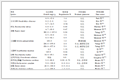
1 材料与方法 1.1 供试材料供试玉米和小麦秸秆于2020年收获自中国农业大学桓台实验站,大豆和油菜秸秆采购自连云港秸秆加工厂。实验前将秸秆分别于室温下用去离子水洗净风干,粉碎至小于0.5 cm。不同秸秆的碳氮元素含量如表 1所示。“VT”有机物料腐熟剂(产品登记证号:微生物肥(2014)准字(1368)号)获取自北京沃土天地生物科技股份有限公司,主要包括真菌、酵母菌、放线菌和细菌等多种菌株构成。尿素采购自国药集团化学试剂有限公司。数显温度计购自武强县红星仪表厂。
|
表 1 不同秸秆的碳氮元素含量以及碳氮比 Table 1 The content of carbon, nitrogen, and C/N ratio in different straw |
分别准确称取1.00 kg玉米、小麦、大豆和油菜秸秆于泡沫箱(30.5 cm× 19.5 cm× 14.5 cm)中,与20.00 g秸秆腐解剂均匀混合;随后添加适量尿素将腐解堆C/N调节为25~30;最后添加蒸馏水将秸秆含水量调节至60%后充分混合开始腐解发酵。腐解实验在能够控制环境温度的密闭实验室内进行(设置为30 ℃±2 ℃),腐解期间定期翻料以保证氧气环境,并于每次翻料后调节含水量(60%)。秸秆腐解期间,在腐解堆中心位置插入数显温度计探头用于监测秸秆腐解过程中的温度变化。每个秸秆腐熟处理设置3个重复。
1.3 样品采集与分析为了研究秸秆腐解过程中的性质变化,分别在每次翻料调节含水量之后采集腐解秸秆鲜样,并保存在–20 ℃冰箱中。取2.00 g鲜样在烘箱中60.0℃烘干至恒重,测定其含水量,并通过式(1)计算不同腐解阶段的秸秆质量变化。称取鲜样2.00 g于20 mL蒸馏水中,充分搅拌20 min后静置30 min,采用电导率仪测定腐解过程中的电导率(EC)变化。称取2.00 g鲜样于20 mL蒸馏水中,于室温下180 r·min–1振荡2 h后,过0.45 μm滤膜,采用总有机碳分析仪(Vario TOC cube,Elementar,德国)测定滤液中的可溶性有机碳(DOC)含量以表征滤液(浸提液)中的DOM浓度。采用紫外可见光分光光度计(TU1900,普析,中国)分别在波长250、254、260和365 nm测定吸光度,并用λ = 254 nm和λ = 260 nm处测量的紫外可见光吸光度除以样品的DOC浓度(mg·L–1)来确定254 nm(SUVA254)和260 nm(SUVA260)处的特定UV吸光度DOM的芳香性和疏水性分数的指标,二者均表示为L·mg–1 C·m–1[18]。计算250 nm与365 nm处的吸收比(E2/E3)作为DOM的芳香性和平均分子量的代表[19]。其中,根据式(2)可基于SUVA254计算DOM的芳香百分比(Aromaticity,%)[20]。
| $ {M_{\text{e}}} = \frac{{{m_{\text{1}}} - {m_{\text{2}}}}}{{{m_{\text{1}}}}} \times {\text{100% }} $ | (1) |
式中,Me为不同腐解阶段的质量损失率,%;m1为秸秆的初始质量,g;m2为秸秆腐解e天的质量,g。
| $ y = 6.3x + 1.4 $ | (2) |
式中,y为芳香碳含量百分比,即芳香性,%;x为SUVA254,L·mg–1 C·m–1。
1.4 光谱表征分析分别在秸秆腐解实验开始的0~69 d称取约5.0 g秸秆鲜样采用冷冻干燥机(Alpha 1-4 LD plus,Marin Christ,德国)进行干燥处理,随后通过球磨仪(MM400,莱驰,德国)在25 Hz条件下球磨1.5 min得到磨细且均匀的秸秆样品。随后采用配备有金刚石晶体的衰减全反射-红外光谱仪(ATR-FTIR,Nicolet iS 10,赛默飞世尔,美国)对磨细后的秸秆样品粉末进行测定,其中波数范围设定为4 000~400 cm–1,每次扫描分辨率为4.0 cm–1,每个样品扫描30次求取平均值以获得稳定的测试结果。针对腐解0~69 d时秸秆的FTIR光谱构建的二维相关光谱(2D-COS)进行分析,利用RStudio统计软件(版本1.2.5042,2020,Integrated Development for R. RStudio,Inc.,Boston,MA URL)的“cor2d”软件包进行计算和绘图。
首先采用蒸馏水将上述已测DOC浓度的腐解秸秆浸提液稀释至浓度为10 mg·L–1,随后分别采用荧光分光光度计(LS-55,珀金埃尔默,美国)测定四种作物秸秆在腐解过程中下释放的DOM三维激发和发射矩阵荧光光谱(3D-EEM),其中激发波长(Ex)设定的扫描范围为200~400 nm,扫描间隔为5 nm;发射波长(Em)的扫描范围为270~550 nm,扫描间隔5 nm,并测定蒸馏水进行空白校正以去除光谱中散射的影响。基于四种农作物秸秆在不同腐解时间浸出的DOM三维激发和发射矩阵荧光光谱分析结果,利用Matlab2015b结合drEEM工具箱采用平行因子分析(Parallel factor analysis,PARAFAC)识别其荧光组分,并通过拆半分析和残差分析验证结果的可靠性。
1.5 统计分析使用Excel 2019和SPASS 25.0进行对实验数据进行处理和分析,使用SigmaPlot 14.0和RStudio统计软件进行绘图。
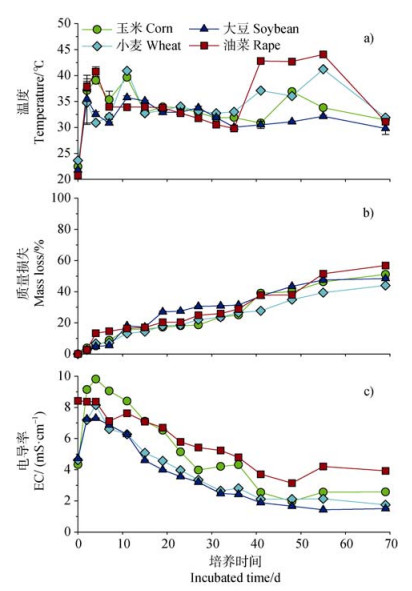
2 结果与讨论 2.1 腐解过程对秸秆的理化性质的影响温度是影响微生物活性和降解速率的关键因素之一[21],也是反应秸秆腐解阶段的重要指标。图 1a显示,秸秆腐解过程的温度变化主要分为升温期、降温期和成熟期三个阶段。其中玉米、小麦和油菜秸秆在腐解过程中,均表现出两次升温的情况:0~10 d为第一次升温;11~35 d为降温期;36~57 d为第二次升温;58~64 d为第二次降温;65~69 d为成熟期。Zhou等[22]关于生物炭对水稻秸秆堆肥影响的研究中,其温度也出现了类似的变化。这可能是秸秆腐解过程中,优势微生物种群发生演替导致的。而大豆秸秆在腐解过程中则没有发生两次升温的现象:其中0~16 d为升温期;17~31 d为降温期;32~69 d为成熟期。此外,大豆秸秆在腐解过程中的整体温度也低于玉米、小麦和油菜秸秆,这可能是同等质量条件下,大豆秸秆的腐解堆体积小于玉米、小麦和油菜秸秆,从而导致大豆腐解堆的高温持续时间也相对较短[23]。图 1b显示了秸秆腐解过程中不同秸秆的质量损失均随时间的增加而增大,其中,腐解完成时质量损失从大到小顺序为油菜(56.8%)、玉米(51.1%)、大豆(48.5%)和小麦(44.0%)。图 1c结果表明,玉米、小麦、大豆和油菜秸秆腐解过程中的电导率(EC)变化表现出一致的趋势,在第4天达到最大值后一直降低,Wang等[24]也观察到了类似的结果。其中前期EC的升高可能是有机质的降解导致无机盐离子浓度的增加[25],而随后的持续减小则可能是无机氮的挥发导致的[20]。
|
图 1 不同秸秆在腐解过程中温度(a)、腐解(b)和电导率(c)随腐解时间的变化 Fig. 1 The changes of temperature(a), mass loss(b), and EC(c)in the decomposition time of different straws in the process of decomposition |
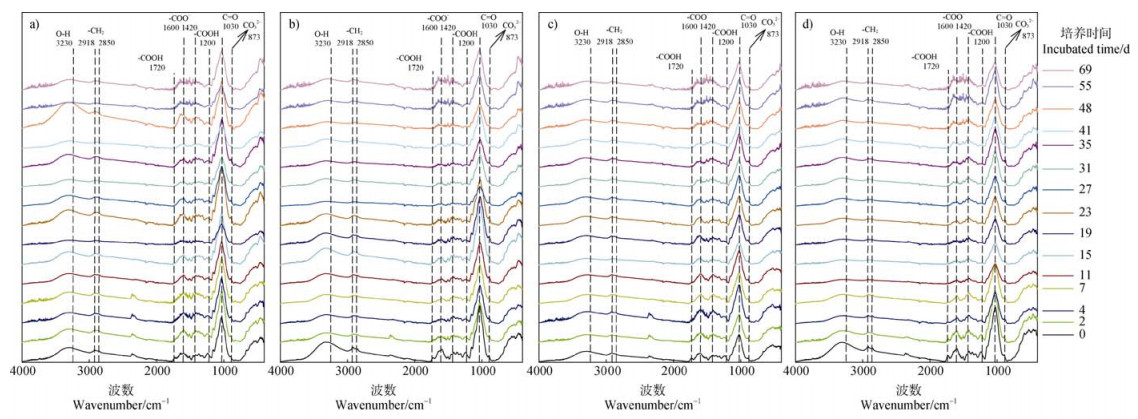
FTIR是表征有机质表面官能团和分子构象的一种相对简单、低成本的光谱分析技术,近年来也用于监测作物秸秆降解过程中的物质组成变化[13,15]。玉米、小麦、大豆和油菜秸秆在腐解过程中其残体的表面官能团种类保持一致,并未观测到新的特征峰出现或者原有特征峰消失的现象(图 2),Pan等[26]和曹莹菲等[13]关于不同农作物秸秆腐解的实验也得到了相似的结果。其中3 230 cm–1处附近的吸收峰为O-H的伸缩振动,2 918 cm–1和2 850 cm–1处的吸收峰分别主要为-CH2-和末端甲基,这些基团主要来自秸秆中的碳水化合物和脂肪族化合物[26],1 720 cm–1和1 200 cm–1处的吸收峰为-COOH[27],1 600 cm–1处的吸收峰则为-COO–[26],1 420 cm–1处吸收峰为木质素和脂肪族化合物等C-N的伸缩[13],1 030 cm–1处吸收峰为多糖和碳水化合物C=O的伸缩振动[24],873 cm–1处的吸收峰为CO32–[26]。另一方面,随着腐解的进行,不同秸秆残体的特征峰表现出的强弱变化可能表明其腐解过程物质组成的变化。例如,O-H、-COOH、-COO–和C=O等特征峰强度的逐渐减小可能指示了秸秆中易降解的碳水化合物、羧酸、多糖和酰胺类物质随着腐解的进行逐渐减少[28]。此外,四种农作物秸秆中的O-H和C=O等特征峰强弱变化在腐解过程中呈现出先增大后减小、再增大再减小等起伏变化的趋势。曹莹菲等[13]认为这种吸收峰的起伏变化可能是秸秆在腐解过程中形成了新化合物随后又发生了降解所引起的。然而仅根据FTIR研究秸秆腐解过程中的物质变化得到的信息有限,为进一步研究不同秸秆在腐解过程中的物质降解强度及其先后变化顺序,对不同腐解阶段秸秆的FTIR光谱进行了二维相关光谱分析。
|
图 2 玉米(a)、小麦(b)、大豆(c)和油菜(d)秸秆在腐解过程中的傅式红外光谱(FTIR)随时间的变化规律 Fig. 2 FTIR spectra of corn (a), wheat (b), soybean (c), and rape (d) straws in the varied decomposition time |
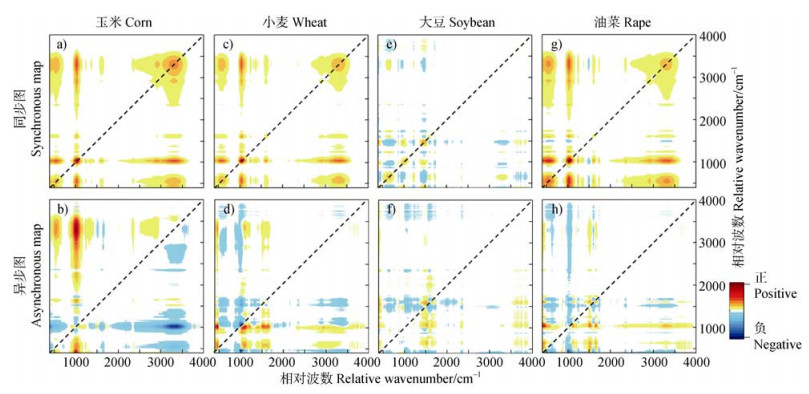
在同步二维相关光谱中,沿对角线的自峰强弱表示光谱强度变化的整体程度[29],其中特征峰(表示为Φ(v1,v2))的强度越高,腐解过程中的结构变化越大。图 3不同秸秆的2D-COS-FTIR同步光谱分析结果显示,玉米、小麦和油菜秸秆的自峰均含有O-H、-CH2和C=O,仅玉米中没有出现-COO–,强弱顺序分别为C=O、O-H、-CH2和-COO–,这表明在腐解过程中多糖、碳水化合物或酰胺类物质等降解最为显著,脂肪族和羧酸盐次之。而大豆的自峰则为-COO–、C-N和C=O,明显区别于玉米、小麦和油菜秸秆同步光谱中的自峰数目和强度,这可能是其本身木质化程度较其他秸秆更高所导致[30]。异步二维光谱仅由位于非对角线位置的交叉峰(表示为Ψ(v1,v2))组成,如果二维相关光谱中Φ(v1,v2)和Ψ(v1,v2)的符号相同,则v1的变化先于v2的变化;如果Φ(v1,v2)和Ψ(v1,v2)的符号相反,则v1的变化发生在v2之后[15,29]。不同秸秆的2D-COS-FTIR异步光谱分析图谱见图 3,分解过程中的FTIR特征峰在二维相关光谱中的变化先后顺序见表 2。可以看出,玉米秸秆在腐解过程中反应的先后顺序依次为C=O、-CH2、O-H、-COO–;小麦秸秆为-COO–、C=O、-CH2及O-H;大豆秸秆为-COO–、C-N、C=O;油菜秸秆为-CH2及O-H、-COO–、C=O。四种秸秆在腐解过程中其降解特性有鲜明差异,曹莹菲等[13]对不同秸秆的腐解实验均得到了相似的结果。这可能是因为虽然一开始使用的微生物腐熟剂是一样的,但不同秸秆的物质组成存在差异导致腐解过程中微生物群落的差异性演替,最终导致秸秆降解特性的不同[31]。
|
注:红色表示该峰为正,蓝色则为负。 Note: Red means the peak is positive, and blue is negative. 图 3 玉米、小麦、大豆和油菜秸秆的二维相关傅式红外同步光谱(a、c、e和g)和异步光谱图(b、d、f和h) Fig. 3 2D-COS-FTIR analysis of maize, wheat, soybean and rape straws with synchronous(a, c, e and g), and asynchronous(b, d, f and h)spectra |
|
|
表 2 不同秸秆降解过程中二维相关光谱中特征峰响应顺序 Table 2 The response order of characteristic peaks in the 2D-COS spectrum during the decomposition of different crop straw |
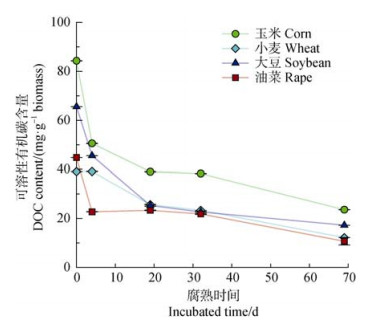
玉米、小麦、大豆和油菜秸秆在腐解过程中浸出的DOC含量均随时间变化而逐渐减小(图 4),其他研究也发现了相似现象[32],这可能是腐解过程中的四种秸秆DOC浸出均小于其微生物分解消耗导致的[17]。其中腐解20 d后,小麦、大豆和油菜秸秆的DOC含量趋于稳定,而直至腐解69 d时四种秸秆DOC的含量均达到稳定。其中小麦、大豆和油菜秸秆的DOC含量分别为12.2、17.2和10.7 mg·g–1,均小于玉米秸秆的DOC含量(23.6 mg·g–1),这可能与秸秆的初始碳氮比相关(表 1)。玉米秸秆DOC达到稳定状态需要的时间更长且DOC含量变化幅度也更大的原因可能是玉米秸秆在腐解过程中为微生物提供了更为持久的能量[17]。另一方面,这些较难降解的DOC主要来源于腐殖酸的生成,其腐殖化程度也是评价腐解阶段的关键指标[33]。本研究中的SUVA254值和芳香性表现出相同的趋势,这表明SUVA254一般与DOC的芳香性成正比[34]。随着腐解的进行,玉米和大豆秸秆DOC的SUVA254值均随时间变化而逐渐增加,其中玉米秸秆DOC的SUVA254值为0.78~3.04 L·mg–1 C·m–1,大豆为0.53~2.55 L·mg–1 C·m–1(表 3)。而小麦和油菜秸秆DOC的SUVA254值则均表现出先增加后降低的趋势,但均高于未腐解的SUVA254值。四种作物秸秆DOC的SUVA254值变化趋势与其腐解过程中的温度变化表现出一致性(图 1),表明小麦和油菜秸秆在腐解过程中微生物菌群的复杂演替过程。余旭芳等[35]认为秸秆腐解前期SUVA254值的降低可能是由于微生物大量繁殖导致了芳构化腐殖质的降解,而在腐解后期的再次降低则可能与pH的降低促进了DOM的去官能团和质子化过程有关。SUVA260值一般与DOC的疏水组分成正比[16],本研究中的SUVA260值和SUVA254值呈现相同的趋势(表 3),这表明DOC的芳构化程度与其疏水性组分的含量密切相关。此外,在254 nm和365 nm处的吸光度比(E2/E3)与DOM的分子量呈负相关[36]。本研究中,玉米和大豆DOC的E2/E3值均呈现降低的趋势,而小麦和油菜秸秆DOC的E2/E3值则表现出了波动变化(表 3),这和SUVA254值的变化趋势是相似的,进一步说明了小麦和油菜秸秆在腐解过程中微生物菌群的复杂演替过程。
|
图 4 不同秸秆腐解过程中的可溶性有机碳(DOC)含量变化 Fig. 4 The content of dissolved organic carbon(DOC)released from varied decomposing times of the corn, wheat, soybean, and rape straw |
|
|
表 3 玉米、小麦、大豆和油菜秸秆不同腐解时间下浸出的DOM腐殖化性质 Table 3 The humification properties of DOM released from varied decomposing times of the corn, wheat, soybean, and rape straw |
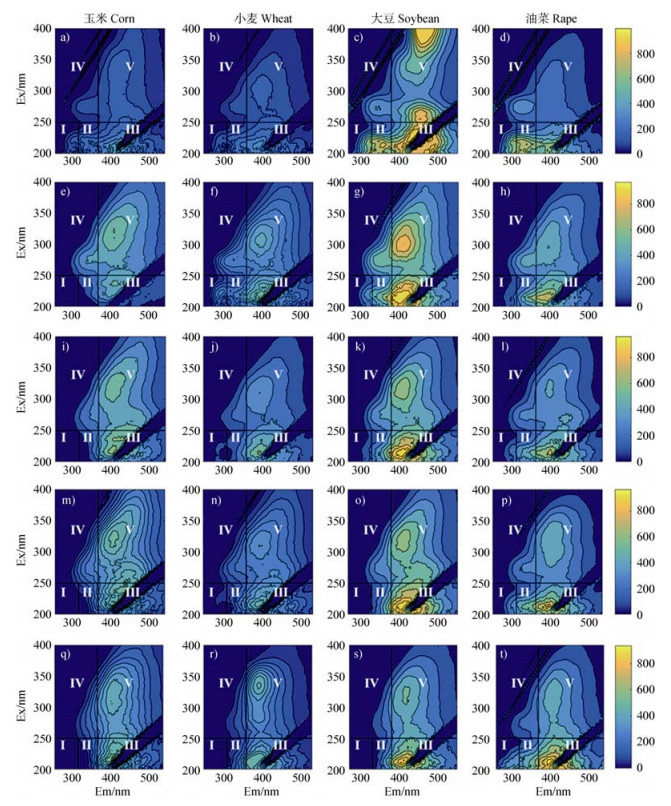
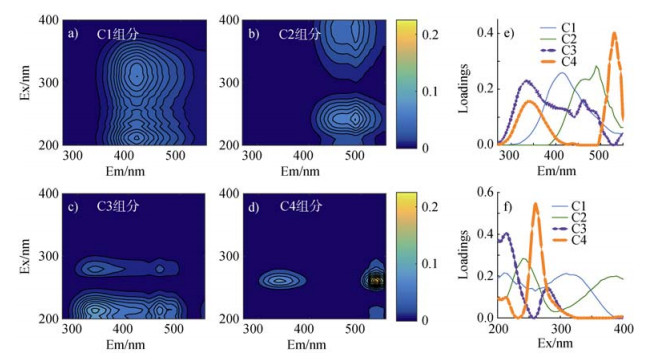
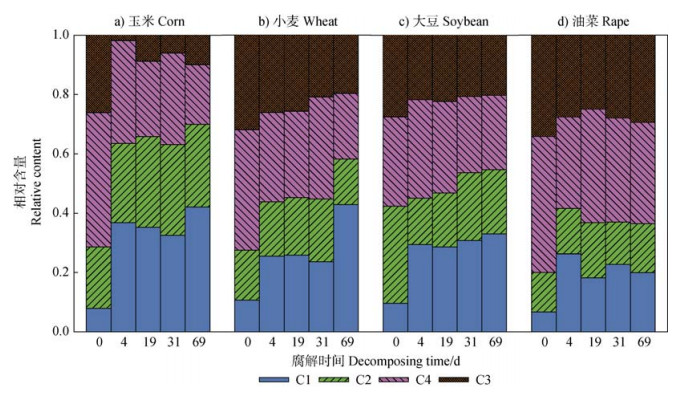
三维荧光光谱是表征DOM腐殖化程度的一种非破坏性分析手段,一般将荧光物质所在区域分为5个区域[37],其中Ⅰ和Ⅱ区域均表示芳香性蛋白质(如酪氨酸),Ⅲ区域表示类富里酸物质,Ⅳ区域表示可溶性微生物副产物,Ⅴ区域表示类胡敏酸物质。虽然本研究中四种秸秆在腐解过程中释放的DOM荧光强度表现出明显差异(大豆、油菜、玉米和小麦),但其在腐解过程中的变化趋势保持一致,均为由小分子类蛋白物质(Ⅰ和Ⅱ)向大分子的类富里酸和类胡敏酸(Ⅲ和Ⅴ)转化(图 5)。为了更为准确分析DOM组成变化,使用平行因子分析模型拟合识别了4种荧光组分(图 6),并计算其在DOM中的组分占比从而量化四种秸秆在腐解过程中释放的DOM荧光区域组成变化(图 7)。其中C1组分(Ex=210 nm,Em=415 nm)为类富里酸物质[38]、C2组分(Ex=240 nm,Em=490 nm)为长波段类腐殖酸[38]、C3组分(Ex=215 nm,Em=335 nm)为类色氨酸物质[38]、C4组分(Ex=260 nm,Em=530 nm)为类腐殖酸[39]。四种秸秆DOM中类蛋白组分(C3)含量在未腐解时均较高(26.1%~34.1%),腐解69 d时则减少为10.0%~29.4%,其中玉米秸秆最低而油菜秸秆最高。而类富里酸物质由未腐解时的6.6%~10.7%增加至腐解69 d的19.9%~42.9%。玉米、小麦和大豆秸秆DOM中类腐殖质类物质(C2和C4)由46.8%~60.3%减少为35.0%~41.9%,而油菜秸秆DOM中类腐殖质类物质含量则无明显变化。本研究中荧光区域划分和平行因子分析的结果表现出了相似的物质变化过程,这可能是秸秆在腐解过程中其大量类蛋白物质被微生物转化为各种代谢物,并产生了大量腐殖质,其他类似的研究也观察到了相似的状况[17]。此外,本研究也发现小麦和油菜秸秆DOM的荧光物质在腐解过程中其荧光强度也出现了波动变化的趋势,与SUVA254值和E2/E3值一致。
|
注:a、b、c和d为腐解0天;e、f、g和h为腐解4天;i、j、k和l为腐解19天;m、n、o和p为腐解32天;q、r、s和t为腐解69天。 Note: The a, b, c and d were 0 days of decomposition; e, f, g, and h were decomposed for 4 days; i, j, k, and l were decomposed for 19 days; m, n, o, and p represent 32 days of decomposition. q, r, s, and t were 69 days of decomposition. 图 5 玉米、小麦、大豆和油菜秸秆不同腐解时间下浸出DOM的三维荧光光谱组成状况 Fig. 5 The composition of dissolved organic matter(DOM)released from different decomposing times of the corn, wheat, soybean, and rape straw as determined by fluorescence spectrometry |
|
图 6 平行因子分析模型识别的秸秆可溶性有机质(DOM)中4种荧光组分 Fig. 6 Four fluorescence components in the straw DOM identified by the parallel factor analysis model |
|
图 7 玉米、小麦、豆类和油菜秸秆在腐解期间释放的溶解有机质(DOM)中4组分组成变化 Fig. 7 Composition changes of 4 fractions of dissolved organic matter(DOM)released from maize, wheat, soybean, and rape straws decomposed at 0, 4, 19, 32, and 69 days |
四种碳氮比差异较大的农作物秸秆在整个腐解过程中的物质降解顺序、可溶性有机碳含量及其芳香性和分子量、可溶性有机质的荧光物质强度及其组成均表现出可观的差异。但秸秆腐解过程中物质的降解强弱以及可溶性有机质中物质间的转化趋势表现出一致性。虽然四种秸秆的物质降解的先后顺序不同,但各种物质的降解强度高低表现出一致性:多糖、碳水化合物或酰胺类物质等降解最为显著,脂肪族和羧酸盐次之。腐解完成时,玉米和大豆秸秆释放的可溶性有机质含量较高,分别为23.6和17.2 mg·g–1秸秆,小麦和油菜则为12.2和10.7 mg·g–1秸秆。其中玉米和大豆秸秆腐解后释放的可溶性有机质表现出相对较高的芳香性和相对较大的分子量,小麦秸秆次之,油菜秸秆则表现出相对较高的蛋白组分含量。
| [1] |
Shi W J, Fang Y R, Chang Y Y, et al. Toward sustainable utilization of crop straw: Greenhouse gas emissions and their reduction potential from 1950 to 2021 in China[J]. Resources, Conservation and Recycling, 2023, 190: 106824. DOI:10.1016/j.resconrec.2022.106824
(  0) 0) |
| [2] |
Liu C, Lu M, Cui J, et al. Effects of straw carbon input on carbon dynamics in agricultural soils: A meta-analysis[J]. Global Change Biology, 2014, 20(5): 1366-1381. DOI:10.1111/gcb.12517
( 0) |
| [3] |
Martins M R, Angers D A, Corá J E. Co-accumulation of microbial residues and particulate organic matter in the surface layer of a no-till Oxisol under different crops[J]. Soil Biology & Biochemistry, 2012, 50: 208-213.
( 0) |
| [4] |
Mai Y C, Bu R Y, Han S, et al. Effects of adding different exogenous nitrogen on rice straw decomposition and nutrient release (In Chinese)[J]. Transactions of the Chinese Society of Agricultural Engineering, 2021, 37(22): 210-219. [麦逸辰, 卜容燕, 韩上, 等. 添加不同外源氮对水稻秸秆腐解和养分释放的影响[J]. 农业工程学报, 2021, 37(22): 210-219.]
( 0) |
| [5] |
Kalkhajeh Y K, He Z F, Yang X R, et al. Co-application of nitrogen and straw-decomposing microbial inoculant enhanced wheat straw decomposition and rice yield in a paddy soil[J]. Journal of Agriculture and Food Research, 2021, 4: 100134. DOI:10.1016/j.jafr.2021.100134
( 0) |
| [6] |
Hao M, Guo L J, Du X Z, et al. Integrated effects of microbial decomposing inoculant on greenhouse gas emissions, grain yield and economic profit from paddy fields under different water regimes[J]. Science of the Total Environment, 2022, 805: 150295. DOI:10.1016/j.scitotenv.2021.150295
( 0) |
| [7] |
Cai A D, Liang G P, Zhang X B, et al. Long-term straw decomposition in agro-ecosystems described by a unified three-exponentiation equation with thermal time[J]. Science of the Total Environment, 2018, 636: 699-708. DOI:10.1016/j.scitotenv.2018.04.303
( 0) |
| [8] |
Liang X Y, Song M D, Han M, et al. Prediction and evaluation of different crop straw decomposition laws and models (In Chinese)[J]. Journal of Nuclear Agricultural Sciences, 2023, 37(6): 1244-1252. [梁鑫宇, 宋明丹, 韩梅, 等. 不同农作物秸秆腐解规律及模型预测评价[J]. 核农学报, 2023, 37(6): 1244-1252.]
( 0) |
| [9] |
Ma X, Xu M G, Zhao H L, et al. Decomposition characteristics and driving factors of organic materials in typical farmland soils in China (In Chinese)[J]. Scientia Agricultura Sinica, 2019, 52(9): 1564-1573. [马想, 徐明岗, 赵惠丽, 等. 我国典型农田土壤中有机物料腐解特征及驱动因子[J]. 中国农业科学, 2019, 52(9): 1564-1573.]
( 0) |
| [10] |
Carvalho A M, Bustamante M M C, Alcântara F A, et al. Characterization by solid-state CPMAS 13C NMR spectroscopy of decomposing plant residues in conventional and no-tillage systems in Central Brazil[J]. Soil & Tillage Research, 2009, 102(1): 144-150.
( 0) |
| [11] |
Ghaffar S H, Fan M Z. Lignin in straw and its applications as an adhesive[J]. International Journal of Adhesion and Adhesives, 2014, 48: 92-101. DOI:10.1016/j.ijadhadh.2013.09.001
( 0) |
| [12] |
Ouyang H W, Ou J X, Lin Z L, et al. Advances in the decomposition of straw from returned crops (In Chinese)[J]. Chinese Agricultural Science Bulletin, 2023, 39(30): 74-81. [欧阳鸿伟, 欧金秀, 林兆里, 等. 还田作物秸秆腐解研究进展[J]. 中国农学通报, 2023, 39(30): 74-81.]
( 0) |
| [13] |
Cao Y F, Zhang H, Zhao C, et al. Changes of organic structures of crop residues during decomposition (In Chinese)[J]. Journal of Agro-Environment Science, 2016, 35(5): 976-984. [曹莹菲, 张红, 赵聪, 等. 秸秆腐解过程中结构的变化特征[J]. 农业环境科学学报, 2016, 35(5): 976-984.]
( 0) |
| [14] |
Czarnik-Matusewicz B, Pilorz S. 2DCOS and MCR-ALS as a combined tool of analysis of β-lactoglobulin CD spectra[J]. Journal of Molecular Structure, 2006, 799(1/2/3): 211-220.
( 0) |
| [15] |
Gao X T, Tan W B, Zhao Y, et al. Diversity in the mechanisms of humin formation during composting with different materials[J]. Environmental Science & Technology, 2019, 53(7): 3653-3662.
( 0) |
| [16] |
Tian X, He T R, Yin D L, et al. Responses of soil dissolved organic matter properties to the amendment of straw, cow manure, or their composting products (In Chinese)[J]. Journal of Agricultural Resources and Environment, 2022, 39(3): 556-566. [田翔, 何天容, 尹德良, 等. 土壤溶解性有机质结构和组成对秸秆、牛粪及其堆肥产品输入的响应特征[J]. 农业资源与环境学报, 2022, 39(3): 556-566.]
( 0) |
| [17] |
Ren L H, Yan B H, Kumar Awasthi M, et al. Accelerated humification and alteration of microbial communities by distillers' grains addition during rice straw composting[J]. Bioresource Technology, 2021, 342: 125937.
( 0) |
| [18] |
Liu C, Li Z W, Berhe A A, et al. Characterizing dissolved organic matter in eroded sediments from a loess hilly catchment using fluorescence EEM-PARAFAC and UV–Visible absorption: Insights from source identification and carbon cycling[J]. Geoderma, 2019, 334: 37-48.
( 0) |
| [19] |
McKay G, Korak J A, Erickson P R, et al. The case against charge transfer interactions in dissolved organic matter photophysics[J]. Environmental Science & Technology, 2018, 52(2): 406-414.
( 0) |
| [20] |
Abbt-Braun G, Lankes U, Frimmel F H. Structural characterization of aquatic humic substances–The need for a multiple method approach[J]. Aquatic Sciences, 2004, 66(2): 151-170.
( 0) |
| [21] |
Nakasaki K, Hirai H. Temperature control strategy to enhance the activity of yeast inoculated into compost raw material for accelerated composting[J]. Waste Management, 2017, 65: 29-36.
( 0) |
| [22] |
Zhou G X, Xu X F, Qiu X W, et al. Biochar influences the succession of microbial communities and the metabolic functions during rice straw composting with pig manure[J]. Bioresource Technology, 2019, 272: 10-18.
( 0) |
| [23] |
Xu Z, Zhang L L, Liang L N, et al. Impacts of different sized lab-based reactors on the aerobic composting of chicken manure (In Chinese)[J]. Transactions of the Chinese Society of Agricultural Engineering, 2008, 24(10): 205-208. [徐智, 张陇利, 梁丽娜, 等. 不同体积堆肥装置下的鸡粪堆肥效果研究[J]. 农业工程学报, 2008, 24(10): 205-208.]
( 0) |
| [24] |
Wang G Y, Yang Y, Kong Y L, et al. Key factors affecting seed germination in phytotoxicity tests during sheep manure composting with carbon additives[J]. Journal of Hazardous Materials, 2022, 421: 126809.
( 0) |
| [25] |
Li X, Shi X S, Feng Q, et al. Gases emission during the continuous thermophilic composting of dairy manure amended with activated oil shale semicoke[J]. Journal of Environmental Management, 2021, 290: 112519.
( 0) |
| [26] |
Pan X Y, Shi R Y, Hong Z N, et al. Characteristics of crop straw-decayed products and their ameliorating effects on an acidic Ultisol[J]. Archives of Agronomy and Soil Science, 2021, 67(12): 1708-1721.
( 0) |
| [27] |
Chen H L, Zhou J M, Xiao B H. Characterization of dissolved organic matter derived from rice straw at different stages of decay[J]. Journal of Soils and Sediments, 2010, 10(5): 915-922.
( 0) |
| [28] |
Wu J G, Lv Y, Wang M H, et al. Study on decomposition of organic fertilizers by FTIR (In Chinese)[J]. Plant Nutrition and Fertilizing Science, 2004, 10(3): 259-266. [吴景贵, 吕岩, 王明辉, 等. 有机肥腐解过程的红外光谱研究[J]. 植物营养与肥料学报, 2004, 10(3): 259-266.]
( 0) |
| [29] |
Tian Z H, Wu K, Liu W T, et al. Two-dimensional infrared spectroscopic study on the thermally induced structural changes of glutaraldehyde-crosslinked collagen[J]. Spectrochimica Acta Part A: Molecular and Biomolecular Spectroscopy, 2015, 140: 356-363.
( 0) |
| [30] |
Wang H D, Wang Y S, Gao F J, et al. Feasibility analysis on corn and soybean straw combined silage (In Chinese)[J]. Feed Research, 2019, 42(5): 90-92. [王宏栋, 王玉赛, 高凤菊, 等. 玉米大豆秸秆联合青贮可行性分析[J]. 饲料研究, 2019, 42(5): 90-92.]
( 0) |
| [31] |
Awasthi M K, Zhang Z Q, Wang Q, et al. New insight with the effects of biochar amendment on bacterial diversity as indicators of biomarkers support the thermophilic phase during sewage sludge composting[J]. Bioresource Technology, 2017, 238: 589-601.
( 0) |
| [32] |
Zhang L H, Zhu Y, Zhang J C, et al. Impacts of iron oxide nanoparticles on organic matter degradation and microbial enzyme activities during agricultural waste composting[J]. Waste Management, 2019, 95: 289-297.
( 0) |
| [33] |
Yu Z, Liu X M, Zhao M H, et al. Hyperthermophilic composting accelerates the humification process of sewage sludge: Molecular characterization of dissolved organic matter using EEM–PARAFAC and two-dimensional correlation spectroscopy[J]. Bioresource Technology, 2019, 274: 198-206.
( 0) |
| [34] |
Chen H, Zheng B H, Song Y H, et al. Correlation between molecular absorption spectral slope ratios and fluorescence humification indices in characterizing CDOM[J]. Aquatic Sciences, 2011, 73(1): 103-112.
( 0) |
| [35] |
Yu X F, Zhou J, Ren L T, et al. Compositional and structural evolutions of dissolved organic compounds during composting of wheat straw (In Chinese)[J]. Spectroscopy and Spectral Analysis, 2021, 41(4): 1199-1204. [余旭芳, 周俊, 任兰天, 等. 小麦秸秆堆肥水溶性有机物的结构和组成演变[J]. 光谱学与光谱分析, 2021, 41(4): 1199-1204.]
( 0) |
| [36] |
Zhou Z C, Chen B N, Qu X L, et al. Dissolved black carbon as an efficient sensitizer in the photochemical transformation of 17β-estradiol in aqueous solution[J]. Environmental Science & Technology, 2018, 52(18): 10391-10399.
( 0) |
| [37] |
Chen W, Westerhoff P, Leenheer J A, et al. Fluorescence excitation-emission matrix regional integration to quantify spectra for dissolved organic matter[J]. Environmental Science & Technology, 2003, 37(24): 5701-5710.
( 0) |
| [38] |
Zhang D P, Zhang L S, Meng F S, et al. Fluorescence characteristics analysis of DOM in typical section of Heilongjiang River Basin (In Chinese)[J]. Research of Environmental Sciences, 2021, 34(5): 1099-1110. [张道萍, 张铃松, 孟凡生, 等. 黑龙江流域典型断面水体DOM荧光特性分析[J]. 环境科学研究, 2021, 34(5): 1099-1110.]
( 0) |
| [39] |
Peng J, Wang Y N, Lin S X, et al. Spectral characteristics of dissolved organic matter and its correlation with PFASs in Caohai wetland, Guizhou (In Chinese)[J]. Research of Environmental Sciences, 2020, 33(4): 885-892. [彭洁, 王娅南, 林绍霞, 等. 贵州草海湿地溶解性有机物的光谱特征及其与PFASs的相关性分析[J]. 环境科学研究, 2020, 33(4): 885-892.]
( 0) |