 2025, Vol. 62


2. 气象灾害教育部重点实验室、气象灾害预报预警与评估协同创新中心, 南京信息工程大学, 南京 210044;
3. 土壤生态系统健康与调控福建省高校重点实验室, 福州 350002;
4. 福建农林大学菌草与生态学院(碳中和学院), 福州 350002;
5. 福建省农田建设与土壤肥料技术总站, 福州 350003
2. Key Laboratory of Meteorological Disaster (KLME), Ministry of Education & Collaborative Innovation Center on Forecast and Evaluation of Meteorological Disasters (CIC-FEMD), Nanjing University of Information Science & Technology, Nanjing 210044, China;
3. University Key Laboratory of Soil Ecosystem Health and Regulation in Fujian Province, Fuzhou 350002, China;
4. College of Juncao Science and Ecology (College of Carbon Neutrality), Fujian Agriculture and Forestry University, Fuzhou 350002, China;
5. Fujian Cropland Construction and Soil and Fertilizer Station, Fuzhou 350003, China
全球变暖已成为当今世界面临最大的环境问题之一。根据政府间气候变化专门委员会第六次评估报告(IPCC AR6)显示,在经济快速增长情景下(SSP5-8.5),全球平均地表气温到21世纪中叶将升高1.5℃[1]。全球变暖背景下,趋强趋频的极端高温事件强烈地影响着陆地生态系统,对陆地碳循环的影响尤为突出[2-3]。土壤是陆地生态系统中最大的有机碳库,土壤有机碳(Soil Organic Carbon,SOC)不仅为植物生长提供碳源并维持土壤良好的物理结构,也以二氧化碳等温室气体形式向大气释放碳,对全球碳平衡起关键作用[4]。SOC不是一种单一化合物,其储量是进入土壤的有机物残体量与微生物分解损失量之间平衡的结果,因此受气候、植被、土壤理化特性及人类活动等诸多因素影响[5];且其周转速率相对缓慢,通常只有在较长时间尺度上(几十甚至百年)才能被发现或充分表现出来[6]。相较而言,气候变暖也是一个缓慢持续的过程,但极端高温事件的发生却具有极强的随机性和破坏力,且土壤在未来遭受极端高温的影响更为严重[7],使得陆地碳循环过程对极端高温事件的响应更加敏感。因此,全面准确理解气候长期变暖与极端高温影响下SOC的变化过程及其主控因子,不仅有助于正确评估SOC的变化方向和速率,对于预测气候变化及制定适应性策略均具有重要意义。
尽管众多研究结果表明SOC随温度升高而降低,但其对气候变化的响应仍不明确[8-14]。一方面,气候变暖有利于陆地生态系统中植物的生长,使得植物来源有机碳输入量增加,促进SOC积累[15];但新产生的碳可能通过激发效应加速或限制原始SOC分解,从而增加气候变暖与土壤碳库之间反馈预测的不确定性[16-17]。另一方面,微生物对温度较为敏感,变暖会使微生物更加活跃,刺激微生物对微生物残体碳的利用[18],土壤呼吸增加,导致土壤碳损失[19];但长期变暖会使植物及微生物产生适应性,一定程度上抑制了土壤碳损失[20]。相比长期变暖,极端高温对土壤有机碳影响的研究较为有限。研究表明,极端高温会在植物个体、器官和组织细胞不同水平上影响其功能[21],导致植物的光合作用减弱甚至植物生长停滞,且呼吸作用增强,进而加剧生态系统碳汇功能下降[2,22]。此外,极端高温会对土壤中微生物活性、酶活性和SOC稳定性及其分解速率产生复杂而重要的影响[23-25]。虽然极端高温会抑制微生物及酶的活性[26-28],降低土壤中有机质的分解速率;但同时也会降低土壤中SOC的稳定性[29-30],导致土壤中长期储存的有机碳得以释放,还可能直接促进SOC的分解速率,加速碳循环过程,从而影响土壤碳储存和生态系统的碳平衡。
农田生态系统是陆地生态系统碳循环过程中最为活跃的碳库,极易受到人类活动、气候变化等因素的强烈干扰,碳源/汇反馈机制复杂,引起学者的广泛关注[31-32]。目前,其研究方法主要包括地面观测调查、生态系统碳通量监测、大气反演和模型模拟等[33]。现场实测虽然可以获取SOC的准确数据,但很大程度上受限于监测成本和复杂的环境参数;且生态系统具有高度复杂和不确定性,仅根据点尺度、离散时间段的监测数据难以满足当前对生态系统碳循环动态变化研究的需求[34]。因此,通过建立不同界面元素与水热库,基于生理和生态过程表达不同库之间动态交换的生物地球化学过程模型被广泛应用于评估气候变化对SOC影响的研究中[9,11]。其中,DeNitrification-DeComposition(DNDC)模型是目前开发历史最长、应用广泛、扩展丰富、且在我国得到较好结果验证的一种生物地球化学模型[34]。例如,Jia等[11]利用DNDC模型估算了在不同气候情景下,我国北方干旱绿洲区焉耆盆地农田SOC的变化情况,结果表明在RCP 2.6(下降3%)、RCP 4.5(下降9.17%)及RCP 8.5(下降16%)情景下SOC储量均显示出快速下降趋势,且在高排放情景中下降得更快。车燕等[8]同样利用DNDC模型估算了在温度上升2、4、6℃情景下,福建省水田年均固碳速率分别为141、106和74 kg·hm–2,说明随着未来气温升高,福建省水田固碳速率虽将逐步下降,但整体仍呈“碳汇”状态。
目前,关于气候变化对SOC影响的研究主要集中于长期变暖的贡献[11,35],但在长期变暖影响下,农田生态系统是碳源还是碳汇仍不明确,主要取决于影响有机碳分解造成的碳损失和净初级生产力提高带来的碳增益之间的竞争与平衡结果[36]。此外,据气象资料显示,我国极端高温事件呈多发重发态势[37]。考虑到极端高温事件发生的强随机性、复杂性及SOC响应的较长周转时间,短时间尺度的观测难以完全捕捉SOC对其响应的长期演变规律,因此通过科学合理的气候情景设置,利用生物地球化学模型准确模拟SOC的动态变化,进而量化及区分长期变暖与极端高温对农田SOC的影响,对于保障我国粮食安全和实现农业领域碳中和具有重要意义。本研究以我国东南沿海典型亚热带地区——福建省漳州市水田土壤为研究对象,基于1980年第二次全国土壤普查数据建立的1:5万大比例尺土壤数据库、1980—2016年农业管理资料及气象站点数据,采用DNDC模型对漳州市农田SOC进行长期动态模拟,旨在(1)评估气候变化背景下漳州市水稻土有机碳储量及密度的动态变化;(2)区分并量化漳州市农田SOC对极端高温和长期变暖的响应。
1 材料与方法 1.1 研究区域概况漳州市(23°32′-25°13′N,116°53′-118°09′E)地处福建省闽南金三角腹地,其水稻种植区具有南亚热带季风气候特点,无霜期长(320~365d),气候温暖湿润(年均气温23.5℃、年均降雨量1 160 mm),热量、日照条件优越(年活动积温6500~7800℃、年均日照数2142.5 h),水稻土约占耕地总面积的74.81%,是福建省主要粮食产区之一。根据海拔和坡度,全市可划分为三种主要地貌类型区:丘陵山地区、谷地盆地区和平原台地区。漳州平原是福建省第一大平原,主要分布于东南沿海地带,其次为西北部的丘陵山地,谷地盆地零散分布[38]。
1.2 模型介绍DNDC模型[39-41]是由美国New Hampshire大学的李长生教授等基于生物地球化学概念发展起来,用于模拟预测陆地生态系统中碳氮循环的生物地球化学模型,由气候土壤、农作物生长、土壤有机质分解、硝化作用、反硝化和发酵作用等6个子模块构成。该模型自1992年首次发表以来,受到国内外学者广泛关注[42-44],并对其不断改进发展[45-46],在福建省农田生态系统研究中也得以应用和验证[47-49]。模型验证主要通过对模拟值与观测值二者的均方根误差(RMSE)、平均绝对误差(MAE)和皮尔逊相关系数(r)等统计指标进行评估。模型整体的不确定性主要来源于两个方面,一方面是由各项输入数据(如初始土壤属性、气象要素、农田管理措施等)的不确定性带来的随机误差(εr),另一方面是由模型内部结构或过程参数设定引起的系统误差(εs)[50]。
1.3 数据来源本研究基于水稻土图斑进行模拟,所使用的漳州市1︰5万土壤数据库由空间数据库和属性数据库两部分组成。土壤空间数据是利用ArcGIS软件数字化1980年第二次全国土壤普查的漳州市1︰5万比例尺土壤图制作而成(含14 126个水稻土图斑)。漳州市土壤属性数据分别来源于1980年第二次全国土壤普查(119个)、2008年农业农村部测土配方施肥(3 832个)及2016年农业农村部耕地地力调查(3 802个)的水田土壤实测样点,其中包含DNDC模型运行所需的土壤有机质(Soil Organic Matter,SOM)、黏粒、pH和容重等数据。通过采用Shi等[51]提出的“PKB(pedological professional knowledge based method)”法将土壤空间数据和属性数据进行连接。对于2008年、2016年缺失的土壤容重,本研究采用罗玉叶等[49]根据2018年福建省水田土壤容重与SOM含量的回归模型y=2.033–0.234×ln(SOM)计算求得。
模型运行所需的农业管理资料来自1980—2016年漳州市农业统计年鉴,主要包括水稻的种植面积、播种/收获期、氮肥和有机肥数据、耕作制度及农业人口资料等。本研究的气象数据来源于漳州市两个国家基本站提取的日最高温、最低温和降雨量。极端高温阈值采用研究时段内多年同日百分位法,定义日最高温大于90%分位数即极端高温日(TX90p)。
1.4 气候情景设置为定量化研究极端高温(Extreme Heat,EH)和长期变暖(Long-term Warming,LW)对福建省水田SOC的影响,本研究以1980—2016年气象数据为基础,设置了4种不同气候情景(1个控制组与3个试验对照组):控制组试验(CTRL)将1980—2016年每日最高气温设为当日去趋势气候态均值;试验组1(EXP_EH)在CTRL日最高温设置基础上,还原极端高温日的观测值;试验组2(EXP_LW)在CTRL日最高温设置基础上,还原非极端高温日的观测值;试验组3(EXP_obs)直接采用实际观测的日最高温数据。
1.5 数据统计分析不同气候情景下1980—2016年漳州全市及其不同区县、地貌类型的水稻土有机碳总变化量(TSOC,Gg),面积加权年均有机碳变化速率(dSOC,kg·hm–2·a–1)计算公式如下:
| $ \begin{array}{c}\text{ APS=}\sum\limits_{\text{i=1}}^{\text{n}}{\text{APS}}_{\text{i}}\end{array} $ | (1) |
| $ \begin{array}{c}\text{ AMSC=}\sum\limits_{\text{f=1}}^{\text{h}}{\text{ASC}}_{\text{f}}\end{array} $ | (2) |
| $ \begin{array}{c}\text{ TSOC=}\sum\limits_{\text{i=1}}^{\text{n}}{\text{(APS}}_{\text{i}}\times {\text{AMSC}}_{\text{i}})\end{array} $ | (3) |
| $ \begin{array}{c}\text{ dSOC=TSOC/APS/37}\end{array} $ | (4) |
式中,APS为研究区水田土壤总面积,hm2;APSi为第i个水田土壤图斑面积,hm2;AMSC为某个图斑单位面积上1980—2016年期间SOC的总变化量,kg·hm–2;ASCf为某个图斑单位面积上第f年的SOC变化量,kg·hm–2;h为模拟年份(h=1,2,3,…,37);AMSCi为第i个图斑单位面积上1980—2016年期间SOC的总变化量,kg·hm–2;n为图斑编号。
1980—2016年各气候条件(极端高温、长期变暖及二者协同作用)对漳州市水稻土固碳速率变化的贡献量和贡献率计算公式如下:
| $ \begin{array}{c}\Delta {\text{dSOC}}_{\text{EH}}{\text{=dSOC}}_{\text{EXP_EH}}-{\text{dSOC}}_{\text{CTRL}}\end{array} $ | (5) |
| $ \begin{array}{c} \Delta {\text{dSOC}}_{\text{LW}}{\text{=dSOC}}_{\text{EXP_LW}}-{\text{dSOC}}_{\text{CTRL}}\end{array} $ | (6) |
| $ \begin{array}{c} \Delta {\text{dSOC}}_{\text{LW+EH}}{\text{=dSOC}}_{\text{EXP_obs}}-{\text{dSOC}}_{\text{CTRL}}\end{array} $ | (7) |
| $ \begin{array}{c} 贡献率=\frac{\Delta {\text{dSOC}}_{\text{t}}}{{\text{dSOC}}_{\text{CTRL}}}\times \text{100%[ }\end{array} $ | (8) |
式中,
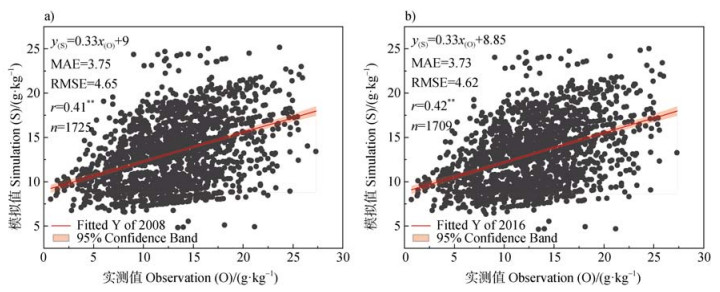
本研究分别采用漳州市2008、2016年水稻土SOC模拟值与经三倍标准差筛选的同年实测样点值(n2008=1725,n2016=1709)做模型验证(图 1)。2008、2016年水稻土SOC实测样点值分布范围分别为0.70~27.31 g·kg–1、0.70~27.31 g·kg–1,模拟的同期SOC结果分布范围为4.81~25.13 g·kg–1、4.63~25.00 g·kg–1,均落在实测样点值范围区间内。此外,模拟值与实测样点值呈显著相关(r2008=0.41,r2016=0.42,P < 0.01),平均绝对预测误差和均方根预测误差均较小(MAE2008=3.75,MAE2016=3.73;RMSE2008=4.65,RMSE2016=4.62),说明DNDC模型适用于漳州市水稻土有机碳的动态变化模拟监测。经计算,本研究中DNDC模型的系统误差εs为–0.063,随机误差εr为0.643,不确定性为–0.063±0.643 g·kg–1。
|
图 1 漳州市2008年(a)和2016年(b)两期水田土壤有机碳模拟值与实测值线性回归 Fig. 1 Linear regressions between simulated and observed SOC values in paddy fields across Zhangzhou in 2008(a)and 2016(b), respectively |
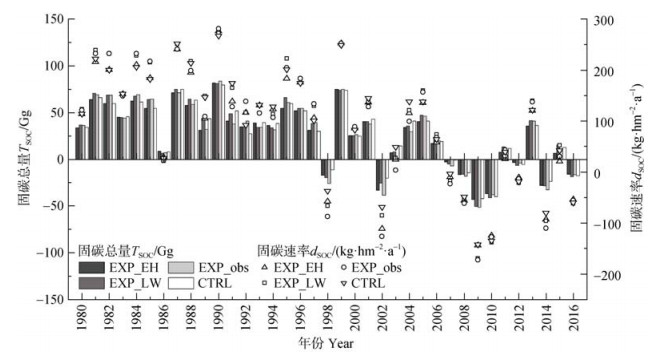
本研究利用DNDC模型估算出1980—2016年漳州市水田土壤在去趋势气候态(CTRL)、仅受极端高温影响(EXP_EH)、仅受长期变暖影响(EXP_LW)及实际观测温度(EXP_obs)四种气候情景下固碳总量分别为1 032.17、952.15、1 045.98和966.03 Gg,年均固碳速率分别为93.98、86.70、95.24和87.96 kg·hm–2。漳州市水稻土受极端高温、长期变暖和二者协同影响量分别为–80.02、13.81和–66.14 Gg。与气候态(CTRL)相比,极端高温影响下水田土壤年均固碳速率下降7.75%,长期变暖影响下固碳速率则上升1.34%,二者协同影响下固碳速率下降6.41%。结果表明长期变暖总体上促进漳州市水田土壤碳固持,但极端高温不利于土壤固碳,且极端高温对漳州市水田土壤固碳的负面效应远大于长期变暖带来的促进作用。
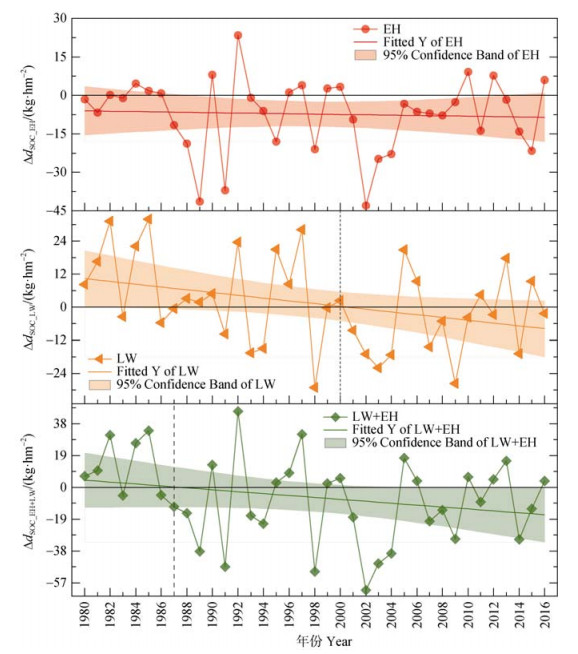
从时间序列看(图 2),漳州市固碳总量和固碳速率整体上呈现明显的年际变化特征,1998年之前呈碳汇状态(即固碳总量和固碳速率均为正值);而1998年之后,许多年份表现为碳源状态,并与碳汇年份交替出现,二者存在1~4年的振荡周期,这可能与21世纪以来极端高温事件频发对SOC累积带来的负面效应有关。对比不同气候情景下,各气象条件对1980—2016年漳州市水田土壤逐年SOC累积的影响结果可知(图 3),极端高温常年对漳州市水稻土固碳起负作用(均为负值),而长期变暖的影响则在2000年左右由正转负,但总体呈现下降趋势,这可能与长期变暖对生态系统中植物源碳的促进作用随持续时间减弱有关[52]。长期变暖和极端高温二者协同作用的影响在1987年由正转负,较长期变暖单一影响下的转折年份提前约13年,进一步证明极端高温的负效应在漳州市水田土壤固碳过程中起主导作用。
|
图 2 1980—2016年不同气候情景下漳州市水田土壤固碳总量及其固碳速率年际变化 Fig. 2 Interannual variation of the total amount of soil carbon sequestration and carbon sequestration rate in paddy fields across Zhangzhou from 1980 to 2016 under different climate scenarios |
|
图 3 1980—2016年极端高温(a)、长期变暖(b)及二者协同作用(c)对漳州市水田土壤固碳速率的影响 Fig. 3 Changes in the soil carbon sequestration rate in paddy fields across Zhangzhou from 1980 to 2016 caused by extreme high temperatures(a), long-term warming(b), and their synergistic effect(c), respectively |
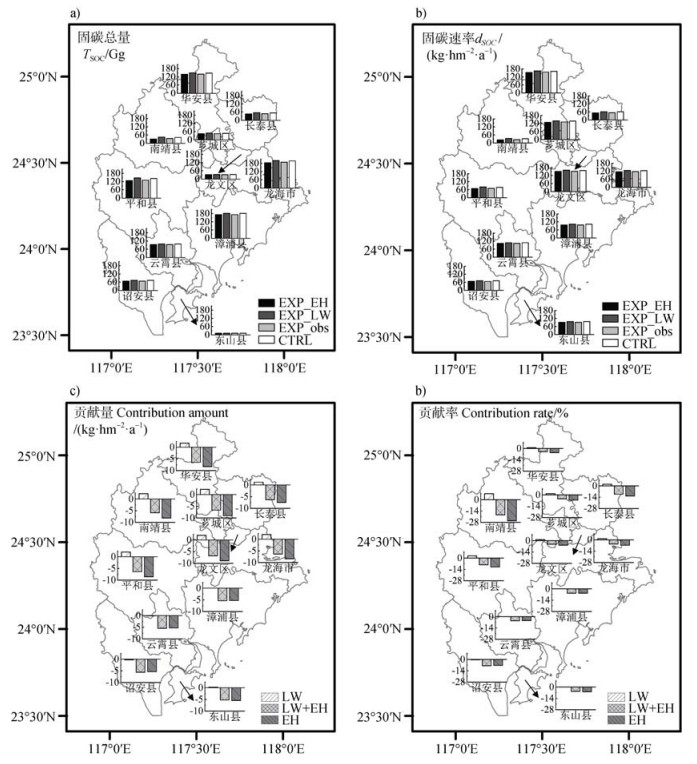
模拟结果显示(图 4a),不同气候情景下漳州市各行政区中漳浦县和龙海市水稻土固碳总量较大,分别约占全市的17.8%(172.14~181.71 Gg)和19.5%(184.71~201.20 Gg);东山县固碳总量最小,仅占1.22%(11.73~12.47 Gg)。与控制组相比,极端高温与实测组固碳量均减少,长期变暖情景下则略微增长。就固碳速率而言(图 4b),华安县和龙文区水稻土年均固碳速率较高(分别为154.15~164.32 kg·hm–2和149.54~160.40 kg·hm–2),南靖县最低(23.02~33.47 kg·hm–2)。
|
注:LW代表长期变暖;EH代表极端高温;LW+EH代表长期变暖和极端高温协同作用。下同。 Note: LW represents the long-term warming; EH represents the extremely high temperature; LW+EH represents the synergistic effect of long-term warming and extremely high temperature. The same as below. 图 4 1980—2016年不同气候情景下漳州市各县级行政区水稻土固碳总量(a)和固碳速率(b),以及长期变暖、极端高温和二者协同作用对固碳速率影响的总贡献量(c)及贡献率(d) Fig. 4 Distribution of the total amount of carbon sequestration(a)and carbon sequestration rate(b)of paddy soils under different climate scenarios in each administrative district across Zhangzhou from 1980 to 2016, and the contribution amount(c)and contribution rate(d)caused by long-term warming, extreme high temperatures, and their synergistic effect, respectively |
图 4c和图 4d显示了气候条件对各地区固碳速率的影响情况,其中南靖县受气候条件影响最大,极端高温影响下固碳速率降低8.18 kg·hm–2·a–1,贡献率达26.23%,长期变暖影响下固碳速率提高了2.27 kg·hm–2·a–1,贡献率达7.27%;其余各地极端高温影响下固碳速率降幅介于5.33~9.00kg·hm–2·a–1,贡献率为4.93%~12.39%,长期变暖影响下升幅介于0.04~2.32 kg·hm–2·a–1,贡献率为0.04%~2.73%。由此可知,极端高温对SOC累积的贡献率(绝对值)远大于长期变暖结果,二者协同贡献率均为负值。
2.4 各地貌类型区水稻土有机碳累积对不同气候情景的响应模拟结果显示(图 5a),不同气候情景下漳州市各地貌类型区中平原台地区固碳总量最大,约占全市的42.62%(406.91~441.43 Gg);其次是丘陵山地区,占漳州市固碳总量的32.08%(303.57~339.64 Gg);谷地盆地区最小,约占25.30%(241.66~265.25 Gg)。就年均固碳速率而言(图 5b),不同气候情景下平原台地区最高(96.82~105.04 kg·hm–2);谷地盆地和丘陵山地的固碳速率分别介于81.30~89.24 kg·hm–2和79.73~89.02 kg·hm–2。与控制组相比,各地貌类型区在极端高温和实测组情景中固碳量和固碳速率均下降,长期变暖情景下有所增加。
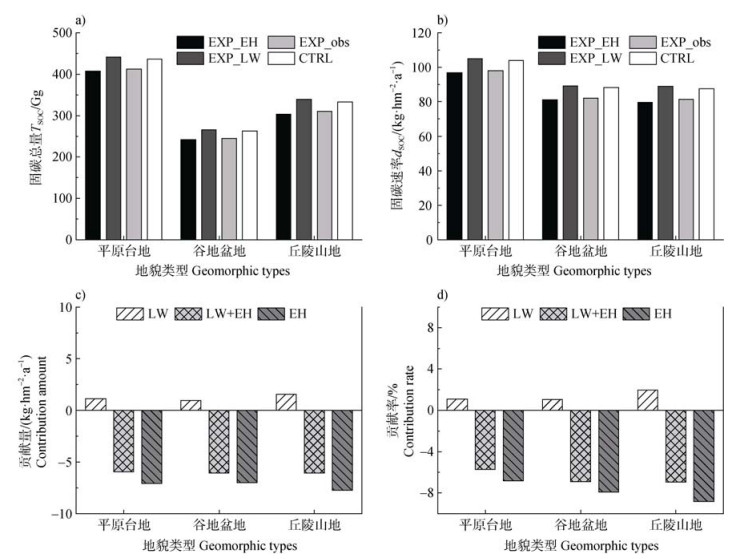
|
图 5 1980—2016年不同气候情景下漳州市各地貌类型区固碳总量(a)和固碳速率(b),以及长期变暖、极端高温和二者协同作用对固碳速率影响的总贡献量(c)及贡献率(d) Fig. 5 Distribution of the total amount of carbon sequestration(a)and carbon sequestration rate(b)of paddy soils under different climate scenarios in each landform type across Zhangzhou from 1980 to 2016, and the contribution amount(c)and contribution rate(d)caused by long-term warming, extreme high temperatures, and their synergistic effect, respectively |
图 5c和图 5d显示了气候条件对不同地貌类型区固碳速率的影响。其中,丘陵山地区受极端高温和长期变暖影响最大,相比于控制组,其在极端高温影响下固碳速率下降7.74 kg·hm–2,贡献率为8.84%,长期变暖影响使其固碳速率提高1.55 kg·hm–2,贡献率为1.98%;谷地盆地区受气候条件影响也较大,极端高温导致其固碳速率下降7 kg·hm–2,贡献率为7.93%,长期变暖效应则致其固碳速率提高了0.93 kg·hm–2,贡献率为1.06%;平原台地区最小,极端高温影响下固碳速率降幅为6.81%,长期变暖影响下升幅为1.09%。
3 讨论1980—2016年漳州市水稻土固碳总量和年均固碳速率均呈现明显的年际变化特征,且1998年之后,漳州市水稻土许多年份表现为碳源状态,并与碳汇年份交替出现,二者呈1~4年的振荡周期,几乎与厄尔尼诺-南方涛动(El Niño-Southern Oscillation,ENSO)气候振荡同频。此外,有机肥施用量对水稻土固碳的影响也不容忽视。据统计,1980—2016年漳州市有机肥施用量前期持续增长,2006年起施用量显著减少。因此,2000年后漳州市水田土壤频繁呈碳源状态极可能由于此时段内极端高温频发、后期有机肥施用量减少共同导致。据Wang等[53]通过利用空间代替时间耦合Meta分析的最新研究结果表明,极端高温对全球平均SOC的变化表现出显著的消极影响,且随着极端热浪频率的增加,SOC的减少从2%增加至21%,本研究结果也与之相符。
前人研究表明[49],影响福建省水稻土固碳速率的主导因素为初始有机碳、黏粒含量和有机肥施用量。一般而言,初始有机碳水平较低的土壤固碳潜力较大[54-55];增施有机肥通过高碳投入直接影响SOC储量[56],改善土壤物理性质,促进土壤团聚体形成和稳定,保护SOC免受微生物和酶的分解[57];而黏粒是影响SOC积累和矿化的主导因素之一,通过提供物理和化学方面的保护,黏粒含量高的土壤可以有效减缓SOC分解并降低其矿化速率[58]。由于漳州市华安县、龙文区和龙海市的初始有机碳处于全市平均水平,黏粒含量较高,加上较高的有机肥投入量,故固碳速率居漳州市各县级行政区前列。
从不同气候情景看,气候条件变化对漳州市水稻土固碳速率的影响在空间分布上整体呈西北高-东南低的规律(图 4c,图 4d),主要原因可能是地势和纬度差异导致其温度敏感性(Q10)不同。漳州市西北部主要分布海拔和坡度较高的丘陵山地,东南部主要分布地势较低的平原台地,统计结果也表明(图 5d),气候变化对丘陵山地区的影响最大,谷地盆地区次之,平原台地最小。相关研究表明,Q10随海拔升高而增大[50],较高海拔地区(如丘陵山地)对极端高温和长期变暖均有较高的温度敏感性,土壤可能以更高的速率释放CO2[59-60]。另一方面,在一定海拔高度范围内,有机碳的含量随海拔升高而增加,且海拔较高,温度较低,进一步降低了有机碳的矿化速率[61],因此导致更高的SOM分解率而不利于土壤碳固存。
4 结论DNDC模型能够较好地模拟评估气候变化背景下漳州市水田土壤有机碳的动态变化。本研究通过四种不同气候情景设置,对SOC累积情况进行模拟监测,区分并量化其对极端高温和长期变暖的响应程度。结果显示,在气候平均态、长期变暖、极端高温和实测温度四种不同气候情景下,1980—2016年漳州市水田土壤仍表现出较好的固碳能力,固碳总量分别为1 032.17、1 045.98、952.15和966.03 Gg。其中,仅受长期变暖情景影响的水田土壤固碳量最大,而仅受极端高温影响的固碳量最小。此外,极端高温频发年份对应固碳能力低值年,且存在1~4年振荡周期,几乎与厄尔尼诺-南方涛动气候振荡同频,说明其对极端高温较为敏感。总体而言,长期变暖有利于土壤有机碳的固定,而极端高温则明显抑制农田生态系统土壤碳汇功能的发挥,且极端高温的负面影响远大于长期变暖的累积效益。虽然在气候变暖背景下土壤仍具有较强的固碳能力,但未来频发的极端高温事件可能在一定程度上造成更大的碳损失。
| [1] |
Zhou T J, Chen Z M, Chen X L, et al. Interpreting IPCC AR6: Future global climate based on projection under scenarios and on near-term information (In Chinese)[J]. Climate Change Research, 2021, 17(6): 652-663. [周天军, 陈梓明, 陈晓龙, 等. IPCC AR6报告解读: 未来的全球气候——基于情景的预估和近期信息[J]. 气候变化研究进展, 2021, 17(6): 652-663.]
(  0) 0) |
| [2] |
Piao S L, Zhang X P, Chen A P, et al. The impacts of climate extremes on the terrestrial carbon cycle: A review (In Chinese)[J]. Scientia Sinica: Terrae, 2019, 49(9): 1321-1334. [朴世龙, 张新平, 陈安平, 等. 极端气候事件对陆地生态系统碳循环的影响[J]. 中国科学: 地球科学, 2019, 49(9): 1321-1334.]
( 0) |
| [3] |
Ciais P, Reichstein M, Viovy N, et al. Europe-wide reduction in primary productivity caused by the heat and drought in 2003[J]. Nature, 2005, 437(7058): 529-533. DOI:10.1038/nature03972
( 0) |
| [4] |
Hutchinson J J, Campbell C A, Desjardins R L. Some perspectives on carbon sequestration in agriculture[J]. Agricultural and Forest Meteorology, 2007, 142(2/3/4): 288-302.
( 0) |
| [5] |
Zhou L, Li B G, Zhou G S. Advances in controlling factors of soil organic carbon (In Chinese)[J]. Advance in Earth Sciences, 2005, 20(1): 99-105. [周莉, 李保国, 周广胜. 土壤有机碳的主导影响因子及其研究进展[J]. 地球科学进展, 2005, 20(1): 99-105.]
( 0) |
| [6] |
Feng X J, Wang S M. Plant influences on soil microbial carbon pump efficiency[J]. Global Change Biology, 2023, 29(14): 3854-3856. DOI:10.1111/gcb.16728
( 0) |
| [7] |
García-García A, Cuesta-Valero F J, Miralles D G, et al. Soil heat extremes can outpace air temperature extremes[J]. Nature Climate Change, 2023, 13: 1237-1241. DOI:10.1038/s41558-023-01812-3
( 0) |
| [8] |
Che Y, Qiu L X, Wu L Y, et al. Response of soil organic carbon accumulation in paddy fields in Fujian Province to future temperature increases (In Chinese)[J]. Environmental Science, 2023, 44(5): 2775-2785. [车燕, 邱龙霞, 吴凌云, 等. 福建省水田土壤有机碳积累对未来温度升高的响应[J]. 环境科学, 2023, 44(5): 2775-2785.]
( 0) |
| [9] |
Lembaid I, Moussadek R, Mrabet R, et al. Modeling soil organic carbon changes under alternative climatic scenarios and soil properties using DNDC model at a semi-arid Mediterranean environment[J]. Climate, 2022, 10(2): 23. DOI:10.3390/cli10020023
( 0) |
| [10] |
Chen H X, Zhao Y, Feng H, et al. Assessment of climate change impacts on soil organic carbon and crop yield based on long-term fertilization applications in Loess Plateau, China[J]. Plant and Soil, 2015, 390(1): 401-417.
( 0) |
| [11] |
Jia H X, Wang X, Xiao J J, et al. Simulated soil organic carbon stocks in Northern China's cropland under different climate change scenarios[J]. Soil and Tillage Research, 2021, 213: 105088. DOI:10.1016/j.still.2021.105088
( 0) |
| [12] |
Zhang L M, Zhuang Q L, He Y J, et al. Toward optimal soil organic carbon sequestration with effects of agricultural management practices and climate change in Tai-Lake paddy soils of China[J]. Geoderma, 2016, 275: 28-39. DOI:10.1016/j.geoderma.2016.04.001
( 0) |
| [13] |
Day T A, Ruhland C T, Xiong F S. Warming increases aboveground plant biomass and C stocks in vascular-plant-dominated Antarctic tundra[J]. Global Change Biology, 2008, 14(8): 1827-1843. DOI:10.1111/j.1365-2486.2008.01623.x
( 0) |
| [14] |
Bokhorst S, Bjerke J W, Melillo J, et al. Impacts of extreme winter warming events on litter decomposition in a sub-Arctic heathland[J]. Soil Biology and Biochemistry, 2010, 42(4): 611-617. DOI:10.1016/j.soilbio.2009.12.011
( 0) |
| [15] |
Sun Y, Wang C T, Chen H Y H, et al. A global meta-analysis on the responses of C and N concentrations to warming in terrestrial ecosystems[J]. Catena, 2022, 208: 105762. DOI:10.1016/j.catena.2021.105762
( 0) |
| [16] |
Luo Z K, Luo Y Q, Wang G C, et al. Warming-induced global soil carbon loss attenuated by downward carbon movement[J]. Global Change Biology, 2020, 26(12): 7242-7254. DOI:10.1111/gcb.15370
( 0) |
| [17] |
Dong H X, Lin J J, Lu J Y, et al. Priming effects of surface soil organic carbon decreased with warming: A global meta-analysis[J]. Plant and Soil, 2022, 1-10.
( 0) |
| [18] |
Huang W G, Ni H W, Huang R L, et al. Driving mechanism of soil organic carbon response to increase hydrothermal conditions in different climatic regimes (In Chinese)[J]. Acta Pedologica Sinica, 2024, 61(5): 1260-1270. [黄伟根, 倪浩为, 黄瑞林, 等. 不同气候条件下土壤有机碳水热响应驱动机制研究[J]. 土壤学报, 2024, 61(5): 1260-1270.]
( 0) |
| [19] |
Chen J, Elsgaard L, van Groenigen K J, et al. Soil carbon loss with warming: New evidence from carbon-degrading enzymes[J]. Global Change Biology, 2020, 26(4): 1944-1952. DOI:10.1111/gcb.14986
( 0) |
| [20] |
Robinson S I, O'Gorman E J, Frey B, et al. Soil organic matter, rather than temperature, determines the structure and functioning of subarctic decomposer communities[J]. Global Change Biology, 2022, 28(12): 3929-3943. DOI:10.1111/gcb.16158
( 0) |
| [21] |
Teskey R, Wertin T, Bauweraerts I, et al. Responses of tree species to heat waves and extreme heat events[J]. Plant, Cell & Environment, 2015, 38(9): 1699-1712.
( 0) |
| [22] |
Salvucci M E, Crafts-Brandner S J. Inhibition of photosynthesis by heat stress: The activation state of Rubisco as a limiting factor in photosynthesis[J]. Physiologia Plantarum, 2004, 120(2): 179-186. DOI:10.1111/j.0031-9317.2004.0173.x
( 0) |
| [23] |
Li S C, Tang S M, Chen H Y, et al. Soil nitrogen availability drives the response of soil microbial biomass to warming[J]. Science of the Total Environment, 2024, 917: 170505. DOI:10.1016/j.scitotenv.2024.170505
( 0) |
| [24] |
Chalchissa F B, Kuris B K. Modelling soil organic carbon dynamics under extreme climate and land use and land cover changes in Western Oromia Regional state, Ethiopia[J]. Journal of Environmental Management, 2024, 350: 119598. DOI:10.1016/j.jenvman.2023.119598
( 0) |
| [25] |
Acosta-Martinez V, Moore-Kucera J, Cotton J, et al. Soil enzyme activities during the 2011 Texas record drought/heat wave and implications to biogeochemical cycling and organic matter dynamics[J]. Applied Soil Ecology, 2014, 75: 43-51. DOI:10.1016/j.apsoil.2013.10.008
( 0) |
| [26] |
Mooshammer M, Hofhansl F, Frank A H, et al. Decoupling of microbial carbon, nitrogen, and phosphorus cycling in response to extreme temperature events[J]. Science Advances, 2017, 3(5): e1602781. DOI:10.1126/sciadv.1602781
( 0) |
| [27] |
Pérez-Guzmán L, Acosta-Martínez V, Phillips L A, et al. Resilience of the microbial communities of semiarid agricultural soils during natural climatic variability events[J]. Applied Soil Ecology, 2020, 149: 103487. DOI:10.1016/j.apsoil.2019.103487
( 0) |
| [28] |
Acosta-Martínez V, Cotton J, Gardner T, et al. Predominant bacterial and fungal assemblages in agricultural soils during a record drought/heat wave and linkages to enzyme activities of biogeochemical cycling[J]. Applied Soil Ecology, 2014, 84: 69-82. DOI:10.1016/j.apsoil.2014.06.005
( 0) |
| [29] |
Vos C, Jaconi A, Jacobs A, et al. Hot regions of labile and stable soil organic carbon in Germany–Spatial variability and driving factors[J]. Soil, 2018, 4(2): 153-167. DOI:10.5194/soil-4-153-2018
( 0) |
| [30] |
Poeplau C, Barré P, Cécillon L, et al. Changes in the Rock-Eval signature of soil organic carbon upon extreme soil warming and chemical oxidation - A comparison[J]. Geoderma, 2019, 337: 181-190. DOI:10.1016/j.geoderma.2018.09.025
( 0) |
| [31] |
Zhenke Z, Mouliang X, Liang W, et al. Key biogeochemical processes of carbon sequestration in paddy soil and its countermeasures for carbon neutrality[J]. Chinese Journal of Eco-Agriculture, 2022, 30(4): 592-602.
( 0) |
| [32] |
Qian X Y. Spatial-temporal variation and impact factor of carbon source and sink of farmland ecosystem in Shanghai, China (In Chinese)[J]. Journal of Agro-Environment Science, 2011, 30(7): 1460-1467. [钱晓雍. 上海农田生态系统碳源汇时空格局及其影响因素分析[J]. 农业环境科学学报, 2011, 30(7): 1460-1467.]
( 0) |
| [33] |
Yang Y H, Shi Y, Sun W J, et al. Terrestrial carbon sinks in China and around the world and their contribution to carbon neutrality (In Chinese)[J]. Scientia Sinica: Vitae, 2022, 52(4): 534-574. [杨元合, 石岳, 孙文娟, 等. 中国及全球陆地生态系统碳源汇特征及其对碳中和的贡献[J]. 中国科学: 生命科学, 2022, 52(4): 534-574.]
( 0) |
| [34] |
Zhang Z, Xin X P. Research progress of biogeochemistry model DNDC in carbon dynamic modeling (In Chinese)[J]. Acta Agrestia Sinica, 2017, 25(3): 445-452. [张钊, 辛晓平. 生物地球化学模型DNDC的研究进展与碳动态模拟应用[J]. 草地学报, 2017, 25(3): 445-452.]
( 0) |
| [35] |
Liu X J, Lie Z Y, Reich P B, et al. Long-term warming increased carbon sequestration capacity in a humid subtropical forest[J]. Global Change Biology, 2024, 30(1): e17072. DOI:10.1111/gcb.17072
( 0) |
| [36] |
Bardgett R D. The biology of soil: A community and ecosystem approach . New York: Oxford University Press, 2005.
( 0) |
| [37] |
Wang J, Chen Y, Tett S F B, et al. Storyline attribution of human influence on a record-breaking spatially compounding flood-heat event[J]. Science Advances, 2023, 9(48): eadi2714. DOI:10.1126/sciadv.adi2714
( 0) |
| [38] |
Xing S H. Cropland resources in Fujian (In Chinese). Xiamen, China: Xiamen University Press, 2003. [邢世和. 福建耕地资源[M]. 厦门: 厦门大学出版社, 2003.]
( 0) |
| [39] |
Li U C, Frolking S, Frolking T A. A model of nitrous oxide evolution from soil driven by rainfall events: 2. Model applications[J]. Journal of Geophysical Research: Atmospheres, 1992, 97(D9): 9777-9783. DOI:10.1029/92JD00510
( 0) |
| [40] |
Li C S, Frolking S, Harriss R. Modeling carbon biogeochemistry in agricultural soils[J]. Global Biogeochemical Cycles, 1994, 8(3): 237-254. DOI:10.1029/94GB00767
( 0) |
| [41] |
Zhang Y, Li C S, Zhou X J, et al. A simulation model linking crop growth and soil biogeochemistry for sustainable agriculture[J]. Ecological Modelling, 2002, 151(1): 75-108. DOI:10.1016/S0304-3800(01)00527-0
( 0) |
| [42] |
Jiang R, Yang J Y, Drury C F, et al. Assessing the impacts of diversified crop rotation systems on yields and nitrous oxide emissions in Canada using the DNDC model[J]. Science of the Total Environment, 2021, 759: 143433. DOI:10.1016/j.scitotenv.2020.143433
( 0) |
| [43] |
Zhang J, Hu K L, Li K J, et al. Simulating the effects of long-term discontinuous and continuous fertilization with straw return on crop yields and soil organic carbon dynamics using the DNDC model[J]. Soil and Tillage Research, 2017, 165: 302-314. DOI:10.1016/j.still.2016.09.004
( 0) |
| [44] |
Abdalla M, Wattenbach M, Smith P, et al. Application of the DNDC model to predict emissions of N2O from Irish agriculture[J]. Geoderma, 2009, 151(3/4): 327-337.
( 0) |
| [45] |
Gao M F, Qiu J J, Li C S, et al. Modelling nitrogen pollution from livestock breeding using Manure-DNDC model (In Chinese)[J]. Transactions of the Chinese Society of Agricultural Engineering, 2012, 28(9): 183—189, 294. [高懋芳, 邱建军, 李长生, 等. 应用Manure-DNDC模型模拟畜禽养殖氮素污染[J]. 农业工程学报, 2012, 28(9): 183—189, 294.]
( 0) |
| [46] |
Han J, Jia Z K, Wu W, et al. Modeling impacts of film mulching on rainfed crop yield in Northern China with DNDC[J]. Field Crops Research, 2014, 155: 202-212. DOI:10.1016/j.fcr.2013.09.004
( 0) |
| [47] |
Long J, Zhang L M, Mao Y L, et al. Study on the difference of contributions made by various cropland soil and land use types to carbon source/sink in Fujian Province, China (In Chinese)[J]. Acta Pedologica Sinica, 2013, 50(4): 664-674. DOI:10.11766/trxb201209030342 [龙军, 张黎明, 毛艳玲, 等. 福建省不同耕地土壤和土地利用类型对"碳源/汇" 的贡献差异研究[J]. 土壤学报, 2013, 50(4): 664-674.]
( 0) |
| [48] |
Ding W H, Chang N J, Zhang G L, et al. Soil organic carbon changes in China's croplands: A newly estimation based on DNDC model[J]. Science of the Total Environment, 2023, 905: 167107. DOI:10.1016/j.scitotenv.2023.167107
( 0) |
| [49] |
Luo Y Y, Qiu L X, Long J, et al. Research on the carbon sink contribution of subtropical paddy field soil under different straw return rates (In Chinese)[J]. Acta Pedologica Sinica, 2023, 60(5): 1442-1455. DOI:10.11766/trxb202112280700 [罗玉叶, 邱龙霞, 龙军, 等. 不同秸秆还田率情境下亚热带水田土壤的"碳汇" 贡献模拟研究[J]. 土壤学报, 2023, 60(5): 1442-1455.]
( 0) |
| [50] |
Xiang D F, Wang G S, Tian J, et al. Global patterns and edaphic-climatic controls of soil carbon decomposition kinetics predicted from incubation experiments[J]. Nature Communications, 2023, 14(1): 2171. DOI:10.1038/s41467-023-37900-3
( 0) |
| [51] |
Shi X Z, Yu D S, Warner E D, et al. Cross-reference system for translating between genetic soil classification of China and soil taxonomy[J]. Soil Science Society of America Journal, 2006, 70(1): 78-83. DOI:10.2136/sssaj2004.0318
( 0) |
| [52] |
Han H, Li C J, Liu R, et al. Warming promotes accumulation of microbial- and plant-derived carbon in terrestrial ecosystems[J]. Science of the Total Environment, 2023, 905: 166977. DOI:10.1016/j.scitotenv.2023.166977
( 0) |
| [53] |
Wang M M, Zhang S, Guo X W, et al. Responses of soil organic carbon to climate extremes under warming across global biomes[J]. Nature Climate Change, 2024, 14: 98-105. DOI:10.1038/s41558-023-01874-3
( 0) |
| [54] |
Repullo-Ruibérriz de Torres M A, Carbonell-Bojollo R M, Moreno-García M, et al. Soil organic matter and nutrient improvement through cover crops in a Mediterranean olive orchard[J]. Soil and Tillage Research, 2021, 210: 104977. DOI:10.1016/j.still.2021.104977
( 0) |
| [55] |
Zhang Y C, Wang P, Liu Y L, et al. Effects of long-term crop cultivation on soil organic carbon in China's farmland: A Meta-Analysis (In Chinese)[J]. Acta Pedologica Sinica, 2024, 61(6): 1628-1638. [张迎春, 王萍, 刘亚龙, 等. 长期种植作物对中国农田土壤有机碳影响的Meta分析[J]. 土壤学报, 2024, 61(6): 1628-1638.]
( 0) |
| [56] |
Kirkby C A, Richardson A E, Wade L J, et al. Nutrient availability limits carbon sequestration in arable soils[J]. Soil Biology and Biochemistry, 2014, 68: 402-409. DOI:10.1016/j.soilbio.2013.09.032
( 0) |
| [57] |
Li Y, Li Z, Cui S, et al. Microbial-derived carbon components are critical for enhancing soil organic carbon in no-tillage croplands: A global perspective[J]. Soil and Tillage Research, 2021, 205: 104758.
( 0) |
| [58] |
Rakhsh F, Golchin A, Beheshti Al Agha A, et al. Mineralization of organic carbon and formation of microbial biomass in soil: Effects of clay content and composition and the mechanisms involved[J]. Soil Biology and Biochemistry, 2020, 151: 108036.
( 0) |
| [59] |
Gutiérrez-Girón A, Díaz-Pinés E, Rubio A, et al. Both altitude and vegetation affect temperature sensitivity of soil organic matter decomposition in Mediterranean high mountain soils[J]. Geoderma, 2015, 237: 1-8.
( 0) |
| [60] |
Kong J, He Z B, Chen L F, et al. Elevational variability in and controls on the temperature sensitivity of soil organic matter decomposition in alpine forests[J]. Ecosphere, 2022, 13(4): e4010.
( 0) |
| [61] |
Zhang Y Q, Ai J J, Sun Q W, et al. Soil organic carbon and total nitrogen stocks as affected by vegetation types and altitude across the mountainous regions in the Yunnan Province, south-western China[J]. Catena, 2021, 196: 104872.
( 0) |