 2025, Vol. 62


2. 农业农村部华北耕地保育重点实验室, 北京 100193;
3. 农业水资源高效利用全国重点实验室, 北京 100083
2. Key Laboratory of Arable Land Conservation in North China, Ministry of Agriculture and Rural Affairs, China Agricultural University, Beijing 100193, China;
3. State Key Laboratory of Efficient Utilization of Agricultural Water Resources, China Agricultural University, Beijing 100083, China
胶体是纳米或微米大小的颗粒,其直径一般在0.001~2 μm之间,主要包括悬浮黏土矿物、微塑料、金属氧化物、细菌和病毒等类型,其是农田土壤中最活跃的组分之一,对土壤整体性质和功能均有重要影响[1-4]。胶体具有巨大的比表面积和表面能,带有大量电荷,吸附能力极强,土壤颗粒的分散与凝聚、离子吸附与交换、酸碱度、缓冲性、黏结性和可塑性等性质均与农田土壤中广泛分布的各种胶体紧密相关[5-7]。此外,胶体通过专性吸附、静电引力等作用还会在其表面富集污染物(有机物、重金属等)而形成“胶体-污染物”复合体[8-11]。在降雨、灌溉和排污等自然和人为因素引发的饱和-非饱和带水循环中,“胶体-污染物”复合体可能通过共迁移方式进行广泛扩散,严重影响地下水质量[12-18]。例如,全氟和多氟化物在胶体中的浓度高于土壤,更容易与土壤胶体结合共同垂直迁移至深层土壤[12]。此外,胶体还会显著促进内分泌干扰物如类固醇雌激素的迁移,使其迁移量增加16%至36%[19]。在铅、铀与硅藻土的复合体系中,由于竞争吸附作用,高岭土胶体与铀形成的复合体具有更强的迁移能力[20]。研究农田土壤中“最活跃组分”胶体的运移规律,是摸清降雨、灌溉和排污等自然和人为因素条件下农田污染物在饱和-非饱和带中时空分布特征的关键,对认识农田土壤水循环伴生环境效应以及指导农田地下水环境污染防治意义重大。
影响胶体运移过程的主要因素包括:聚集(agglomeration)、沉积/吸附(deposition)、释放/解吸(release)、阻塞(straining)、堵塞(blocking)、熟化(ripening)以及尺寸排阻(size exclusion)等[21-22]。胶体的聚集、阻塞、熟化和沉积等过程已有过系统的研究,在其机制解析和数值模拟上也取得了大量成果[23-28]。尺寸排阻效应作为影响胶体运移行为的主要机制之一,目前对其发生机制、影响因素和数学模型尚没有系统的综述性文章。因此,明确胶体在多孔介质中运移的尺寸排阻机制,系统分析影响胶体尺寸动态变化和运移速度的关键因素,梳理描述胶体运移行为及其尺寸排阻效应的数学模型构建方法,对深入理解胶体在多孔介质中的运移行为以及准确评估胶体运移伴生环境效应均具有重要的指导意义。
1 胶体在多孔介质中运移的尺寸排阻机制沉积、物理阻塞、堵塞、熟化、聚集和尺寸排阻等过程是目前公认的胶体在多孔介质中运移时所发生的主要机制[29-31]。沉积是胶体在固液界面发生的转移,物理阻塞则是胶体在两个及以上固液界面发生的拦截,这两个过程是胶体滞留在多孔介质中的主要机制[32-33]。堵塞的产生是因为介质表面对于胶体的附着具有有限的点位,一旦这个点位被填满,先前附着的胶体就会阻碍后来胶体的附着。熟化与堵塞相反,胶体与胶体间的相互作用较胶体与介质表面的相互作用更强,先前吸附在介质表面的胶体可以作为新的位点提供给后来的胶体附着。聚集是胶体尺寸增加的过程,其会改变胶体的运移特性,影响与尺寸相关的动力学过程。例如,较小的胶体聚集会促进胶体聚集体尺寸的变大,从而增加尺寸排阻的可能性,同时还可能发生物理化学滞留和通过阻塞引起的滞留[34]。尺寸排阻是较大颗粒胶体的运移速度快于小颗粒胶体和保守性溶质的现象(其本质是取决于胶体尺寸和孔径的比值)。与前面提到的运移机制不同,尺寸排阻大多被认为是胶体运移的增强机制,会促进胶体的运移[21]。
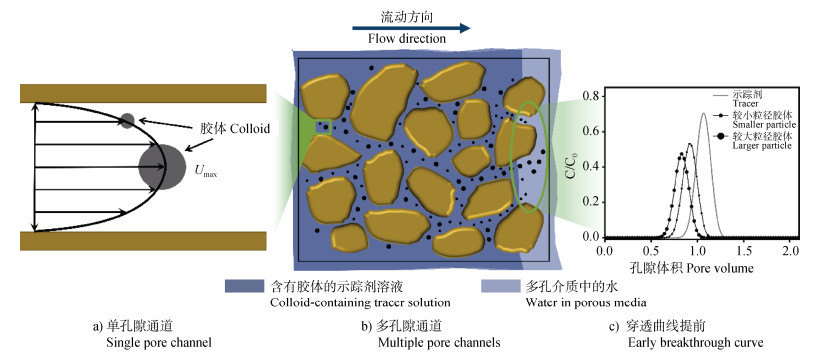
尺寸排阻效应又被称为孔隙排阻(Pore exclusion)或体积排阻(Volume exclusion)效应[35],一般认为胶体在多孔介质中运移时会被排除在小于胶体尺寸或不易接近的孔隙以及停滞域之外,这使得较大尺寸的胶体位于流速高于平均孔隙水流速的主流中,并且胶体在运移过程中由于聚集所引发的尺寸变化也会对这一效应产生影响。尺寸排阻效应主要表现为在迁移试验中胶体的穿透曲线会较保守性溶质加速或提前到达,这种现象在大量研究中已被证实[36-40]。具体而言,尺寸排阻一方面是由于布朗运动随着颗粒尺寸的增加而减弱,较大颗粒的胶体不太容易在靠近孔隙壁面的流线区域(较慢流线区)移动,而更倾向于在孔隙中间的区域(高速流线区)移动,因此理论上胶体的平均运移速度是孔隙水流速均值的1.5倍(图 1b)[41]。另一方面,由于大粒径胶体不能通过较小孔隙而只能在较大孔隙中运移,而保守溶质和较小粒径胶体则几乎可以通过全部孔隙,这导致保守溶质和较小粒径胶体在多孔介质中的运移路径更曲折(几乎通过全部孔隙),而大粒径胶体的运移路径更为单一(只能通过某些大孔隙),使得大粒径胶体更早地从多孔介质中穿出(图 1a)[42]。综上所述,具有一定尺寸的胶体在多孔介质中运移会表现出较离子更早的穿透现象,且不同尺寸的胶体在穿透曲线上也有明显的差异(图 1c)。
|
图 1 胶体在多孔介质中运移的尺寸排阻机制以及穿透曲线特征[41-42] Fig. 1 Size exclusion effect of colloids transport in porous media and characterization of breakthrough curves[41-42] |
影响胶体运移尺寸排阻效应的因素是多方面的。一方面是胶体自身性质,包括胶体类型、尺寸及表面电荷等,此外还包括多孔介质性质、背景溶液和达西流速等方面[43-45]。从机制解析上而言,胶体运移尺寸排阻效应是多因素共同作用的结果[37-42]。胶体尺寸与孔隙尺寸的比值一般被认为是判断是否发生尺寸排阻效应的关键指标,因此胶体由于聚集而引起的尺寸动态变化会对尺寸排阻效应产生重要影响,而胶体聚集又与其表面性质(电荷类型及数量)和背景溶液性质(离子类型及浓度)密切相关。达西流速(渗流速度)作为胶体在多孔介质中运移的驱动力,较快的流速可能直接增强大孔隙中的流速而促进大粒径胶体的排出。此外,达西流速的大小还间接决定了胶体在多孔介质和背景溶液中存留时间的长短。胶体在背景溶液中存留时间越长,其通过聚集而引发胶体尺寸动态变化的概率越大。
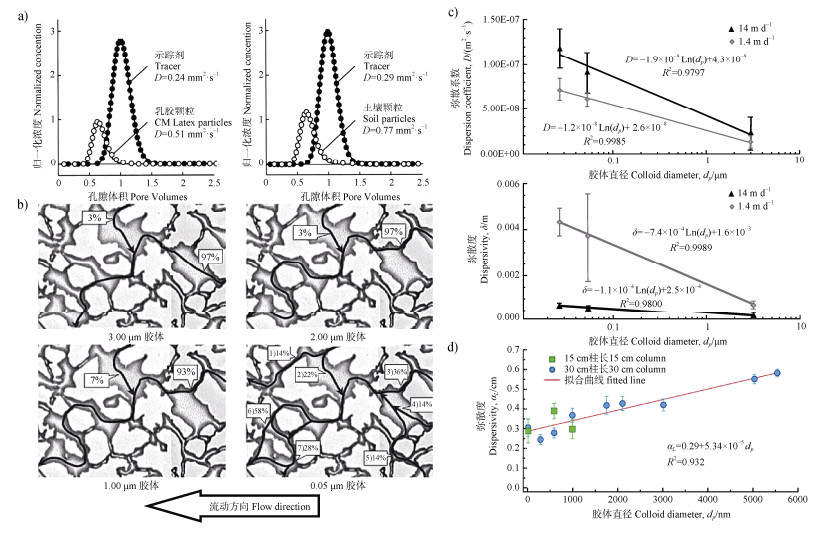
2.1 胶体性质的影响胶体类型、表面电荷、表面粗糙度和形状尺寸等性质是影响其在多孔介质中运移尺寸排阻效应的重要因素。在胶体类型方面,Kretzschmar等[46]在砂土介质中分别注入了乳胶胶体和具有腐殖质涂层的针铁矿胶体,两种胶体穿透曲线均显示出早期穿透现象,但它们的穿透行为存在差异。Grolimund等[47]在柱迁移试验中测试了直径相似的乳胶胶体和土壤胶体的运移特性,结果显示两种胶体均表现出尺寸排阻效应,其移动速度较保守示踪剂(NO3–)快大约1.45倍,且土壤颗粒的弥散系数更大(图 2a)。Weisbrod等[48]在岩心中的迁移试验发现,胶体颗粒早于保守示踪剂(Br–和Li+)穿出,其中噬菌体T4的到达时间为4.7 min,而同样大小的200 nm荧光乳胶微球到达时间为5 min。在胶体形状方面,You等[49]比较了多个噬菌体在土柱中的迁移行为,结果表明,粒径相近的三种噬菌体PSA-HM1(173 nm)、PSA-HS2(210 nm)和T4(203 nm)先于保守示踪剂Br–穿透,三种噬菌体相对于Br–的穿透时间缩短了31%~65%,这可能是因为不同的噬菌体的尾部不同。在胶体尺寸方面,Sirivithayapakorn和Keller[50]通过微观模型试验直接观测胶体的运移速度与轨迹,发现相较于保守性溶质,胶体运移速度提高了4倍~4.5倍,且胶体粒径越大,路径越简单,弥散性越低(图 2b)。随后Keller和Sirivithayapakorn[51]在柱试验中得到了与微观模型试验一致的结果,胶体(MS2和聚苯乙烯微球)早于保守示踪剂(KCl)穿出,胶体的弥散性较保守示踪剂更低,胶体的弥散系数和弥散度随其粒径增大而减小(图 2c)。但Chrysikopoulos和Katzourakis[37]的研究得出了不同结果,他们的柱试验结果表明,与保守示踪剂相比,胶体(荧光聚苯乙烯微球)的弥散度更大,并随着胶体粒径的增加而增加(图 2d)。他们认为这是胶体在多孔介质中运移所受两种机制拮抗作用的结果,即胶体在流线中央快速区域移动会导致其弥散度减小,而具有大尺寸的胶体只能通过部分较大孔隙,会导致其弥散度增加,这两种效应的强弱最终决定了胶体的弥散度。
|
注:a)乳胶颗粒和土壤胶体与对应保守示踪剂的穿透曲线[47];b)4种不同粒径胶体在微模型中的移动路径与占比[50];c)弥散系数和弥散度与胶体直径之间的关系曲线[51];d)弥散度和胶体直径之间的关系曲线[37]。 Note: a)Breakthrough curves of latex particles and soil colloids compared to their corresponding conservative tracers[47]; b)Movement paths and proportions of four different-sized colloids in a micro-model[50]; c)Relationship curve between the dispersion coefficient and dispersivity with colloid diameter[51]; d)Relationship curve between dispersivity and colloid diameter[37]. 图 2 胶体性质对胶体运移尺寸排阻效应的影响 Fig. 2 Influence of colloid properties on the size exclusion effect during colloid transport |
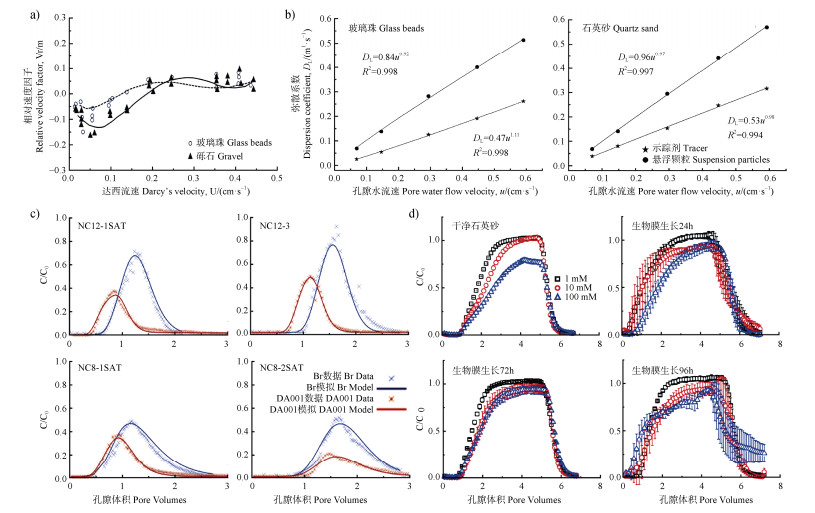
介质类型以及表面粗糙度和涂层等性质会影响多孔介质的孔隙结构组成以及孔隙尺寸大小、电荷性质和连通性,其与胶体粒径的对比关系对胶体运移的尺寸排阻效应产生关键性影响。在介质类型方面,Ahfir等[52]比较了淤泥颗粒(2~30 μm)在玻璃珠和砾石介质中的运移特性,发现淤泥颗粒在玻璃珠和砾石中发生提前穿透的临界速度分别为0.135 cm·s–1和0.16 cm·s–1(图 3a)。在玻璃珠中,胶体的尺寸排阻现象更为明显,这是因为玻璃珠具有更均匀的形状、更低的表面粗糙度以及更均匀的孔隙分布。同样,张鹏远等[39]的研究也得出了类似的结论,研究发现天然硅粉(3~69 μm)在玻璃珠中的尺寸排阻现象更明显,天然硅粉在石英砂中运移的弥散系数约为玻璃球的1.14倍(图 3b)。在介质表面性质方面,Dong等[53]进行了细菌(DA001,1.2×0.6 μm,电泳迁移率为–0.45×10⁻⁸ m2·V–1·s–1)的迁移试验,发现在岩心上涂层的数量与促进胶体运移的能力呈正相关性,这是因为介质的涂层减小了介质孔隙尺寸,提高了孔隙水速度,使得胶体早于保守示踪剂(Br–)穿出(图 3c)。Mitzel和Tufenkji[54]通过试验也观察到了类似现象,他们测试了银纳米颗粒(86~134 nm)在石英砂(表面涂覆不同生长期的生物膜)柱中的运移性能,发现当生物膜涂层生长时间更长时,银纳米颗粒运移出现了早期穿出现象,他们认为这是由于生物膜涂层减小了孔隙尺寸,从而产生了尺寸排阻效应(图 3d)。孙慧敏等[55]研究了水洗和烘烤处理得到的表面粗糙度不同的石英砂介质对胶体运移的影响,发现介质表面粗糙度会显著影响蒙脱石胶体的运移过程,胶体粒径大小则是决定胶体运移过程是否受介质表面影响的主要因素。阙智林等[44]进行了一组柱迁移试验,通过降低背景溶液的离子强度来释放沉积在介质上的胶体。结果显示,当介质中的土壤胶体释放后,会改变介质的孔隙结构,所释放的带负电胶体与介质表面的静电斥力诱发了尺寸排阻效应,促进了胶体的迁移。
|
注:a)玻璃珠介质和砾石介质中,淤泥颗粒与示踪剂的相对速度因子(Vr)与达西流速的关系,其中Vr =(V颗粒-V示踪剂)/V示踪剂,V颗粒和V示踪剂分别为淤泥颗粒的速度和保守示踪剂的速度[52];b)玻璃珠和石英砂中硅颗粒与示踪剂的弥散系数和孔隙水流速关系曲线[39];c)细菌和示踪剂在四种岩心介质中的穿透曲线[53];d)银纳米颗粒在不同生物膜涂层砂中的穿透曲线[54]。 Note: a)Relationship between the relative velocity factor(Vr)of silt particle and tracers with Darcy's velocity in glass beads and gravel media, where Vr =(Vparticle - Vtracer)/Vtracer, with Vparticle and Vtracer being the velocities of silt particles and conservative tracers, respectively[52]; b)Relationship curves between the dispersion coefficient and pore water flow velocity of silica particles and tracers in glass beads and quartz sand[39]; c)Breakthrough curves of bacteria and tracer in four types of core media[53]; d)Breakthrough curves of silver nanoparticles in different biofilm-coated sands[54]. 图 3 多孔介质性质对胶体运移尺寸排阻效应的影响 Fig. 3 Influence of porous media properties on the size exclusion effect during colloid transport |
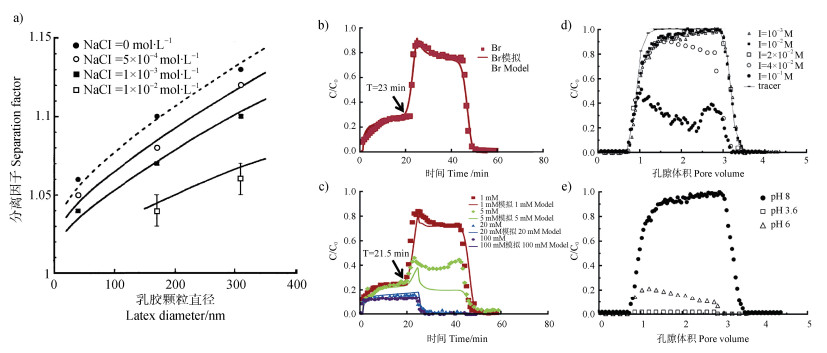
溶液类型、离子浓度和pH等背景溶液性质通过改变胶体的聚集-分散动力学行为、介质表面阳离子交换以及胶体与介质之间的静电力等来影响胶体在多孔介质中运移的尺寸排阻效应[56]。在溶液类型方面,Shen等[57]研究了不同阳离子类型(Na+和Ca2+)组成对乳胶胶体(30和1156 nm)在玻璃珠介质中运移行为的影响后发现,Ca2+可以通过桥键作用将胶体吸附在固相颗粒表面而减弱胶体的运移能力。这一结论得到了Chen等[58]和Wang等[59]研究结论的支持,他们分别比较了松木屑生物炭胶体和小麦秸秆生物炭胶体在两种背景溶液(Na+和Ca2+)下的运移规律,发现Ca2+溶液具有更高的电荷屏蔽效应和阳离子桥接作用,其对胶体运移能力的抑制作用明显强于Na+溶液,促进了胶体在介质上的附着。在离子浓度方面,Nagasaki等[60]发现乳胶颗粒在石英砂介质中的分离因子(乳胶颗粒和氚水的平均速度之比)不仅随着胶体粒径的增加而增加,而且随着NaCl浓度的降低而增加(图 4a)。类似的现象在无机胶体和生物胶体的研究中也被证实,邵珍珍等[61]研究发现高离子浓度下二氧化硅胶体出流量很小,而低离子浓度时胶体全部或部分出流。Wang等[62]的研究也表明在低离子浓度时(1 mM)大肠杆菌(1.84 μm)会早于保守示踪剂1.5 min穿出石英砂介质,表现出明显的尺寸排阻现象(图 4b和图 4c)。然而,胶体在高离子浓度溶液中也并非只表现出运移受阻。Solovitch等[63]的研究发现小粒径胶体(150 nm)在砂柱中运移时与保守示踪剂没有明显区别,但在高离子浓度(20 mM)中会聚集成较大颗粒,此时通过砂柱后表现出尺寸排阻效应(图 4d)。研究认为,高离子强度首先促进胶体的聚集,增加颗粒的沉积,然后沉积在介质表面的颗粒会改变柱中的孔隙结构,没有沉积的聚集体会更快地从介质中穿出,从而发生尺寸排阻现象。溶液的pH可以通过改变胶体和固相颗粒的表面电荷量来影响胶体在多孔介质中的运移行为。Schulze-Makuch等[64]发现,在碱性条件(pH为8.1)下,噬菌体MS2在含水层介质中的运移速度快于Br–,而在中性和酸性条件(pH为7.5和6.1)下,MS2的运移速度则减慢。类似地,Walshe等[65]的研究也表明,随着pH的升高(pH从6到7.5),MS2相较于Br–更早穿透介质的现象变得更加显著。孙慧敏等[66]的研究发现,高岭石胶体在石英砂柱中的穿透曲线在不同pH条件下(pH从3.75到9.40)差异明显,酸性条件下(pH为3.86)会显著阻碍高岭石的迁移,而不同pH条件对蒙脱石胶体运移基本无影响,这是由于不同类型胶体表面所带电荷性质决定的。Solovitch等[63]的研究则发现,在pH为6时,TiO2胶体从柱中穿透的速度较pH为8时更快(图 4e)。
|
注:a)不同离子强度下,分离因子与乳胶颗粒直径之间的关系[60];b)保守示踪剂Br的穿透曲线[62];c)不同离子强度下大肠杆菌的穿透曲线[62];d)不同离子强度下TiO2纳米颗粒的穿透曲线[63]和e)不同pH下TiO2纳米颗粒的穿透曲线[63]。 Note: a)Relationship between the separation factor and latex particle diameter under different ionic strengths[60]; b)Breakthrough curve of the conservative tracer Br[62]; c)Breakthrough curve of Escherichia coli under different ionic strengths[62]; d)Breakthrough curve of TiO2 nanoparticles under different ionic strengths[63]; and e)Breakthrough curve of TiO2 nanoparticles under different pH values[63]. 图 4 背景溶液对胶体运移尺寸排阻效应的影响 Fig. 4 Influence of background solution on the size exclusion effect during colloid transport |
达西流速主要通过改变流场作用于胶体的水动力力矩来影响胶体在多孔介质中的运移行为,胶体受到的水动力力矩随着达西流速的增大而变强。Ahfir等[52]在柱迁移试验中发现,在较高的达西流速(0.3483 cm·s–1)下,淤泥悬浮颗粒早于保守示踪剂(荧光素)穿出多孔介质,而在较低达西流速(0.0134 cm·s–1)下,淤泥悬浮颗粒更容易在多孔介质中沉积,因而保守示踪剂更先穿出(图 5a)。Zhang等[67]的研究也发现了类似的结果,只有当达西流速高于某一数值时,淤泥颗粒才会出现早于保守示踪剂(荧光素)穿出多孔介质的尺寸排阻现象(图 5b)。Sen和Khilar[68]也指出,达西流速变大能使胶体受到的水动力力矩变大,促进大粒径胶体克服黏附力矩从介质上解吸回溶液中,从而增强胶体的运移能力。与他们研究结果不同的是,白冰等[69]在渗透试验(自上而下)中观察到,随着渗流速度的增加(从0.087 cm·s–1增加至0.260 cm·s–1),天然硅粉颗粒提前穿出的现象减弱。Massei等[70]研究发现随着达西流速的增加,淤泥颗粒相对于保守示踪剂的提前穿出现象逐渐减弱,当达西流速大于0.073 cm·s–1时,淤泥颗粒的提前穿出现象消失。他们认为这是因为当流速较低时,一部分胶体会沉积在孔隙水流速较低的区域,无法穿出,一部分胶体颗粒被排除在狭窄的孔隙之外,沿着优先路线移动;当流速较高时,孔隙流速也会相应增加,从而会有更多的孔隙体积参与到胶体的迁移过程中,使得尺寸排阻现象减弱。Göppert和Goldscheider[71]的研究也发现,随着流速的增加,荧光聚苯乙烯微球(1 μm和3 μm)优先于保守示踪剂迁出的时间有所缩短。在低流速(24.8 m·h–1)时,微球通过多孔介质的时间较保守示踪剂短1 h,而在高流速(136.9 m·h–1)时,微球的平均迁移时间仅较保守示踪剂短0.4 h(图 5c和图 5d)。他们则认为,这可能是由于达西流速增加导致水动力力矩逆转,使水从高流速的大通道流向低流速的小裂隙和孔隙中,降低了胶体流速,增加了胶体沉积的可能性。
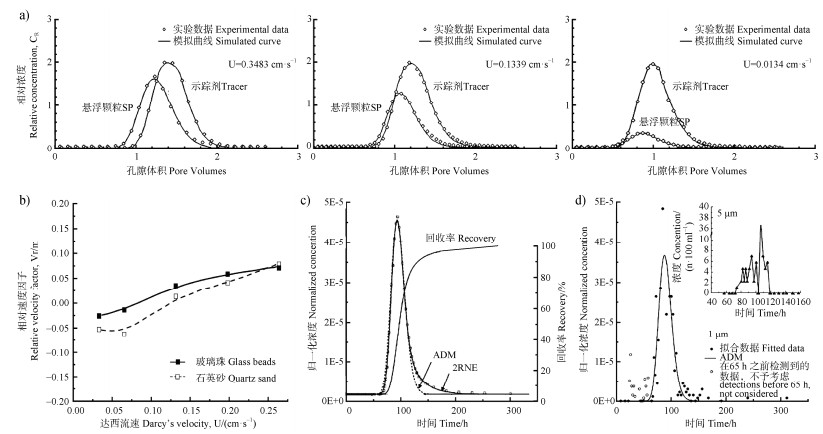
|
注:a)悬浮颗粒和示踪剂在不同流速下的穿透曲线[52];b)达西流速与相对速度因子的关系,其中相对速度因子Vr =(V颗粒-V示踪剂)/V示踪剂,V颗粒和V示踪剂分别为淤泥颗粒的速度和保守示踪剂的速度[67];c)低流速(24.8 m·h–1)下荧光素钠的实测值、拟合值和回收率[71];d)低流速(24.8 m·h–1)下1 μm微球的实测值、拟合值和回收率以及5 μm微球的实测值[71]。 Note: a)Breakthrough curves of suspended particles(SPs)and tracers at different flow velocities[52]; b)Relationship between Darcy's velocity and relative velocity factor(Vr), where Vr =(Vparticles - Vtracer)/ Vtracer. Vparticles and Vtracer represent the velocities of silt particles and conservative tracers, respectively[67]; c)Measured values, fitted values, and recovery rates of sodium fluorescein at low flow velocity(24.8 m·h⁻¹)[71]; d)Measured values, fitted values, and recovery rates of 1 μm microspheres, as well as measured values of 5 μm microspheres at low flow velocity(24.8 m·h⁻¹)[71]. 图 5 达西流速对胶体运移尺寸排阻效应的影响 Fig. 5 Influence of Darcy velocity on the size exclusion effect during Colloid Transport |
在多孔介质中,胶体因受到对流和弥散作用而发生运移,同时由于表面沉积和筛滤作用等而滞留在多孔介质中。一般而言,研究人员通常采用简化的柱迁移试验,并在特定环境化学条件下来研究胶体的运移规律,基于连续性原理(即质量守恒定律或胶体颗粒数/体积平衡),采用含有滞留项的对流-弥散方程来对其运移行为进行描述[72]。
| $ \frac{{\partial C}}{{\partial t}} + \frac{{{\rho _b}}}{\theta }\frac{{\partial S}}{{\partial t}} = D\frac{{{\partial ^2}C}}{{\partial {x^2}}} - \frac{U}{\theta }\frac{{\partial C}}{{\partial x}} $ | (1) |
式中,C为液相胶体浓度,mg·L−1;S为沉积在介质上的胶体浓度,mg·g–1;D为弥散系数,cm2·s−1;
在此基础上,Bradford等[25–33]引入了沉积释放动力学模型,以描述胶体在介质上的沉积与释放,并采用沉积速率修正系数来模拟柱迁移试验的穿透曲线。与此类似,孙小璐等[73]采用了一维对流-弥散-沉积模型,研究了不同水力特性对胶体运移过程的影响。根据胶体在迁移和沉积过程中所出现的动力阻碍或动力淤堵现象,以及滞留曲线随距离的均匀型或超指数型变化特征,Ko和Elimelech[74]、Tosco和Sethi[75]以及Bradford等[24]学者认为其沉积速率修正系数需要进行适当调整,并提出了不同的修正方法。Ko和Elimelech[74]认为介质表面存在一个不利于沉积的阴影区,进而解释颗粒在不同流速和颗粒尺寸下的非线性沉积行为;Tosco和Sethi[75]开发了双位点模型,用于描述非牛顿流体中的颗粒传输;Bradford等[24]提出了一种与深度相关的幂函数形式,描述了胶体在迁移过程中的物理阻塞现象,即柱入口处沉积量最大,并随着距离的增加而减小的现象。Bradford和Bettahar [32]随后还在模型中加入熟化系数和堵塞系数来描述胶体在多孔介质中的动态沉积行为。张琳和程亚平[76]则通过构建胶体阻塞-线性吸附模型,研究了离子强度、流量大小和植被类型等因素对不同粒径胶体运移的影响。
3.2 胶体运移尺寸排阻效应的数值模拟在研究胶体在多孔介质中运移可能出现的相较于保守示踪剂提前穿出(尺寸排阻效应)或滞后穿出(沉积现象)现象时,研究者一般是基于前述的连续体模型框架(即考虑吸附、沉积、堵塞等行为过程的对流-弥散方程),通过调整或修改基本的运移或状态参数(弥散系数、孔隙水流速、分配系数和体积含水量等)来描述胶体运移的尺寸排阻效应[24,41,77]。Ahfir等[52]使用不可逆吸附的对流-弥散方程(式(4))拟合保守示踪剂和胶体的穿透曲线来获得对应的弥散系数,揭示了胶体由于尺寸排阻效应导致的胶体弥散性增加的现象。在后续研究中,Chrysikopoulos和Katzourakis[37]在构建基于对流-弥散方程模型过程中,他们考虑了胶体的吸附和失活(式(5))来描述胶体的运移行为,他们同样通过获得胶体和保守示踪剂的弥散系数来描述胶体早期穿透的规律。而Bradford等[24]基于对流-弥散方程,考虑了胶体的沉积、阻塞和尺寸排阻行为,将体积含水量替换为胶体可进入的体积含水量来描述尺寸排阻效应(式(6))。与Bradford等的研究类似,陈星欣等[36]同样将体积含水量替换为胶体可进入的体积含水量来描述尺寸排阻效应,建立了考虑胶体的吸附解吸行为的尺寸排阻方程,并将数值结果与试验得到的结果进行对比分析(式(7))。
在基于连续体模型框架的基础上,一些学者不再通过拟合穿透曲线来获取水力学参数(比如:水力弥散系数),而是直接构建理论模型来计算胶体弥散度,从而模拟胶体的尺寸排阻行为。例如,James和Chrysikopoulos[41]修改了最初用于溶解性物质的泰勒弥散系数,证明了速度曲线中最慢移动部分的排阻增加了胶体运移的有效速度,降低了其运移整体的弥散性,并以此构建了模型(式(8))。相反,Scheibe和Wood[77]则认为增加孔隙水流速会增大弥散系数,这与胶体不易进入低流速区域的情况是不一致的,因此他们在模型构建时忽略了胶体在孔壁附近低流速区域的运动,并从速度分布曲线中借助参数f去除了较低的流速区域(式(9))。
此外,基于胶体运移沉积、尺寸排阻与胶体穿出浓度的量化关系,研究者引入了一个速度因子(R)来修改对流-弥散方程中的胶体浓度分布项,将式(1)改写为[23,50]:
| $ R\frac{{\partial {C_c}}}{{\partial t}} + \frac{{{\rho _b}}}{\theta }\frac{{\partial S}}{{\partial t}} = D\frac{{{\partial ^2}{C_c}}}{{\partial {x^2}}} - \frac{U}{\theta }\frac{{\partial {C_c}}}{{\partial x}} $ | (2) |
式中的速度因子R一般描述为:
| $ R = 1 + \frac{{{\rho _b}}}{\theta }{K_d} $ | (3) |
式中,Kd为胶体在水相和固相之间的分配系数(cm3·s–1)。
式(3)可用于描述胶体相较于保守示踪剂的滞后穿出(沉积滞留效应)现象,此时分配系数Kd取正值,速度因子R大于1,称为“速度阻滞因子”[72];式(3)若用于描述胶体相较于保守示踪剂的提前穿出(尺寸排阻效应)现象,此时分配系数Kd取负值,速度因子小于1,称为“速度加速因子”。Babakhani[23]在此公式基础上进行了数值试验,考虑了加速因子中Kd值恒为定值和随颗粒聚集现象可变等的情况下,模拟了穿透曲线的变化规律(式(10))。
4 结论与展望胶体在多孔介质中的运移行为受多种机制影响,主要包括沉积、物理阻塞、堵塞、熟化、聚集和尺寸排阻等。尺寸排阻效应是胶体一种特殊的运移加速现象,会导致胶体在多孔介质中加速扩散,这种胶体的加速扩散还可能通过共迁移的方式增强污染物的扩散,对地下水质造成不利影响。总体而言,胶体运移的尺寸排阻效应可大致归因于两个方面。一方面,相较于小颗粒胶体和溶液离子,较大颗粒胶体只能通过大孔隙,无法通过复杂的小孔隙通道,因此相对而言其运移路径更为单一,能更早地从多孔介质中穿出。另一方面,布朗运动导致较小颗粒胶体贴近孔壁运动而促进较大颗粒胶体在孔隙通道中间区域的高速流线区移动,因而较大颗粒胶体其运移速度更快。这两种机制共同决定了胶体运移的尺寸排阻效应。背景溶液化学性质、胶体尺寸、介质孔径和达西流速等因素均会对胶体在多孔介质中运移的尺寸排阻行为产生影响,且这种影响往往是多种因素共同作用的结果。胶体尺寸与孔隙尺寸的比值一般被认为是影响胶体尺寸排阻效应的关键量化指标,当二者尺寸的比值达到一定阈值时才会产生尺寸排阻效应,而胶体表面性质、背景溶液性质和达西流速可以通过影响胶体在多孔介质中的聚集和分散行为而间接影响胶体的尺寸大小,进而影响胶体运移的尺寸排阻行为。因此,在分析胶体在多孔介质中运移的尺寸排阻行为时应充分考虑不同因素造成的影响,定量化区分不同因素的贡献有利于深入认识尺寸排阻效应的发生机理。就数学描述模型而言,目前对于胶体运移所涉及的吸附、沉积、阻塞等行为过程的模拟,研究者开发了阻塞-线性吸附模型、胶体沉积释放动力学模型和对流-弥散-沉积模型等多种物理描述模型;对于胶体运移尺寸排阻行为的模拟,其模型构建过程与描述胶体运移其他行为有相似之处,即一般也是基于连续体模型框架建立基本控制方程,继而结合实测的胶体穿透曲线进行参数反演,通过调整或修改运移或状态参数(弥散系数、孔隙水流速、体积含水量、分配系数和速度因子等)来对胶体运移的尺寸排阻行为进行模拟。目前直接基于胶体运移尺寸排阻机制构建物理模型的研究很少,且构建方法还存在一些争议,需要在今后的研究工作中取得突破。
准确刻画胶体在多孔介质中的运移行为是研究其尺寸排阻效应的关键。然而,真实环境中的胶体类型多样、粒径组成复杂,现有的示踪技术无法精准区分多类型多粒径胶体混合条件下的尺寸排阻行为。常用的保守性惰性离子示踪剂(氯化物、溴化物和硝酸盐等)无法准确示踪胶体运移的尺寸排阻行为,因为胶体在多孔介质中的穿透曲线往往会早于保守性离子示踪剂出现。示踪胶体的尺寸排阻行为,需要将示踪剂标记到胶体上,与胶体一起运动。比较有效的手段是采用荧光染料(尼罗蓝、罗丹明和铕螯合物等)或人造DNA片段(一段人为设计的特异性DNA片段)来对胶体进行标记,以实现同步示踪[79-83]。值得注意的是,当荧光染料浓度过低时,其信号检测将变得困难;并且荧光染料的种类有限,当胶体混合过于复杂时,由于荧光检测信号可能会重叠,难以对复杂胶体体系进行有效区分。采用人造DNA片段对胶体进行标记是新近出现的高精度示踪技术[84-85]。DNA分子以其独特的生物化学特性赋予了其海量种类和高特异性的突出优势。人为设计DNA的序列组合,比如设计一段包含100个碱基的DNA片段从理论上可以产生4100个DNA示踪剂,并且由于这些DNA具有不同的序列组成,通过实时荧光定量PCR(qPCR)测试技术可以高灵敏地识别出每一个DNA序列。这样就确保了既能获得海量的种类,又能让每一个种类具备高特异性。并且DNA分子可以经由聚合酶链式反应被扩增,极大地增强了其检测信号,即使极低浓度的DNA分子也可以被精确地检测出来。总体而言,应用人造DNA示踪(标记)技术进行包括尺寸排阻效应的胶体运移行为研究极具前景。
|
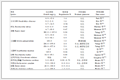
表 1 描述胶体在多孔介质中运移尺寸排阻行为的数学模型 Table 1 Mathematical models describing size exclusion behavior of colloid transport in porous media |
另一方面,未来还应在胶体运移尺寸排阻行为数学模型构建方面加强研究。目前,一般是从连续体模型框架出发,通过实测的胶体穿透曲线来拟合运移或状态参数来对胶体的尺寸排阻行为进行刻画[24,36-37,39,51-52,78]。这类模型虽然可以描述胶体尺寸排阻效应,但并没有从胶体的尺寸排阻机制上(即胶体尺寸、介质孔径和流速之间的关系)对其运移行为进行刻画。目前,直接基于尺寸排阻机制构建数学模型的做法可以从两个方面入手[23,41,77],一是基于孔隙尺度的胶体运移分布规律或孔隙模型观测试验结果建立尺寸排阻效应的发生与胶体尺寸、介质孔径和流速之间的关系,结合模型推导,修改描述尺寸排阻效应的水力参数(比如弥散系数)数学方程,并将该修改的参数耦合进连续体模型框架以对胶体运移尺寸排阻行为进行直接模拟。二是可以在连续体模型框架中的胶体浓度分布项中引入“速度因子(R)”来直接刻画胶体的排阻行为,并建立“尺寸-流速”量化关系,即“速度因子(R)”的表达式应包含胶体尺寸(dc)、介质尺寸(dm)和达西流速(U)等与尺寸和流速相关的参数。比如,可构建“速度因子(Rse)”的“尺寸-流速”数学描述方程为Rse=1+f(dc,dm)f(U)。式中f(dc,dm)为尺寸描述项,反映由尺寸因素导致的胶体运移规律变化。f(U)为流速描述项,表征由于流速导致胶体运移行为的变化。在尺寸描述项中存在一个尺寸排阻的阈值,可以通过胶体尺寸和介质尺寸的比值大小及其同该阈值的关系来表征胶体运移的尺寸排阻(正值)和沉积滞留(负值)行为。通过排阻阈值的量化来替换以往构建的速度因子方程中的分配系数(Kd),可以有效降低人为因素的影响,使模拟结果更加客观。此外,在尺寸描述项中,尺寸排阻还受胶体初始尺寸由于聚集过程而发生变化的影响,可以被描述为胶体尺寸与背景溶液离子类型、浓度以及时间的动态关系。
| [1] |
Lin D T, Hu L M, Shen C Y. Review on modeling the transport and retention of colloids in saturated porous media (In Chinese)[J]. China Environmental Science, 2022, 42(2): 914-924. [林丹彤, 胡黎明, 沈重阳. 饱和多孔介质中胶体运移模拟方法研究进展[J]. 中国环境科学, 2022, 42(2): 914-924.]
(  0) 0) |
| [2] |
Meng L, Guo B C, Li C F, et al. Migration and deposition mechanism of microorganisms in porous media (In Chinese)[J]. Journal of Tianjin Normal University(Natural Science Edition), 2024, 44(1): 13-21. [[孟利, 郭炳池, 李长发, 等. 微生物在多孔介质中的运移与沉积机制[J]. 天津师范大学学报(自然科学版), 2024, 44(1): 13-21.]
( 0) |
| [3] |
Zhou J M, Shen R F. Dictionary of soil science (In Chinese). Beijing: Science Press, 2013. [周健民, 沈仁芳. 土壤学大辞典[M]. 北京: 科学出版社, 2013.]
( 0) |
| [4] |
Yuan Y, Cai L, Tong M P. Influence of bacteria on the transport behaviors of lead and chromium in porous media (In Chinese)[J]. Acta Scientiarum Naturalium Universitatis Pekinensis, 2015, 51(3): 539-546. [原野, 蔡荔, 童美萍. 细菌对铅和铬在多孔介质中迁移行为的影响[J]. 北京大学学报(自然科学版), 2015, 51(3): 539-546.]
( 0) |
| [5] |
Pan D Q, Xu Z, Wei X Y, et al. Interaction of environmental colloids and radionuclides: A brief review (In Chinese)[J]. Scientia Sinica: Chimica, 2019, 49(1): 12-26. [潘多强, 徐真, 魏小彦, 等. 环境胶体与放射性核素相互作用研究进展[J]. 中国科学(化学), 2019, 49(1): 12-26.]
( 0) |
| [6] |
Xie B Y, Jiang Y J, Sun H M, et al. Effect of different colloids in irrigation water on the desorption and migration of heavy metals in Lou soil (In Chinese)[J]. Journal of Agro-Environment Science, 2016, 35(11): 2094-2100. [谢冰怡, 姜延吉, 孙慧敏, 等. 不同胶体类型灌溉水对塿土中重金属解吸及运移的影响[J]. 农业环境科学学报, 2016, 35(11): 2094-2100.]
( 0) |
| [7] |
Zhang W, Tang X Y, Xian Q S. Field-scale study of colloid transport in fracture flow from a sloping farmland of purple soil (In Chinese)[J]. Advances in Water Science, 2015, 26(4): 543-549. [张维, 唐翔宇, 鲜青松. 紫色土坡地泥岩裂隙潜流中的胶体迁移[J]. 水科学进展, 2015, 26(4): 543-549.]
( 0) |
| [8] |
Gu X F, Pan H, Zhang L Y, et al. Effects of different conditions on the co-transport of soil colloid and Cr(Ⅵ) (In Chinese)[J]. Environmental Pollution & Control, 2023, 45(1): 7-13. [顾鑫锋, 潘慧, 张连毅, 等. 不同条件对土壤胶体与Cr(Ⅵ)共运移的影响[J]. 环境污染与防治, 2023, 45(1): 7-13.]
( 0) |
| [9] |
Liu G N, Liu X H. A review on the impact of soil colloids on heavy metal transport (In Chinese)[J]. Environmental Chemistry, 2013, 32(7): 1308-1317. [刘冠男, 刘新会. 土壤胶体对重金属运移行为的影响[J]. 环境化学, 2013, 32(7): 1308-1317.]
( 0) |
| [10] |
McCarthy J F, Zachara J M. Subsurface transport of contaminants[J]. Environmental Science & Technology, 1989, 23(5): 496-502.
( 0) |
| [11] |
Tan B, Liu S G, Dai C M, et al. A review of colloid transport behaviors based on coastal groundwater interaction (In Chinese)[J]. Advances in Water Science, 2017, 28(5): 788-800. [谭博, 刘曙光, 代朝猛, 等. 滨海地下水交互带中的胶体运移行为研究综述[J]. 水科学进展, 2017, 28(5): 788-800.]
( 0) |
| [12] |
Chen X, Sun X, Shan G, et al. Vertical transportation behavior of per- and polyfluoroalkyl substances(PFAS)in soil column around a fluorochemical industrial park (In Chinese)[J]. Environmental Chemistry, 2025, 44(1): 1-9. [陈新, 孙霄, 单国强, 等. 全氟与多氟化合物在场地土壤中的垂直迁移行为[J]. 环境化学, 2025, 44(1): 1-9.]
( 0) |
| [13] |
Dai C M, Zhou H, Liu S G, et al. Review on research on co-transport of contaminants and colloids in the porous media of groundwater (In Chinese)[J]. Journal of Water Resources and Water Engineering, 2017, 28(5): 15-23. [代朝猛, 周辉, 刘曙光, 等. 地下水多孔介质中胶体与污染物协同运移规律研究进展[J]. 水资源与水工程学报, 2017, 28(5): 15-23.]
( 0) |
| [14] |
Meng Q T, Zhou S, Jiang Y J, et al. Effects of clay mineral colloids on the transport of graphene oxide and As(Ⅴ)in porous media (In Chinese)[J]. Journal of Agro-Environment Science, 2020, 39(8): 1683-1691. [孟庆涛, 周时, 姜延吉, 等. 黏土矿物胶体对氧化石墨烯和As(Ⅴ)在多孔介质中迁移的影响[J]. 农业环境科学学报, 2020, 39(8): 1683-1691.]
( 0) |
| [15] |
Ren J H, Packman A I. Coupled stream-subsurface exchange of colloidal hematite and dissolved zinc, copper, and phosphate[J]. Environmental Science & Technology, 2005, 39(17): 6387-6394.
( 0) |
| [16] |
Wang Z, Yang G H, Chen X, et al. Groundwater contamination caused by wastewater irrigation and its controlling countermeasures (In Chinese)[J]. Hydrogeology & Engineering Geology, 2008, 35(3): 99-103. [王昭, 杨国华, 陈玺, 等. 污灌对地下水的污染及防治对策[J]. 水文地质工程地质, 2008, 35(3): 99-103.]
( 0) |
| [17] |
Yang Y S, Zhu Y D, Zhang W Q, et al. Co-migration of nickel and natural colloids in groundwater system (In Chinese)[J]. Journal of Jilin University: Earth Science Edition, 2020, 50(1): 226-233. [杨悦锁, 朱一丹, 张文卿, 等. 地下水系统中镍污染和天然胶体共迁移特征[J]. 吉林大学学报(地球科学版), 2020, 50(1): 226-233.]
( 0) |
| [18] |
Zhang B Z, Yan J Y, Zhang Y Q, et al. Efficient water-saving and non-point source pollution prevention and control technology for agriculture in Hetao Irrigation District (In Chinese)[J]. Water Resources Development Research, 2024, 24(5): 1-7. [张宝忠, 闫晋阳, 张彦群, 等. 河套灌区农业高效节水与面源污染防控技术[J]. 水利发展研究, 2024, 24(5): 1-7.]
( 0) |
| [19] |
Wang Y Y, Zhong L R, Song X M, et al. Natural colloids facilitated transport of steroidal estrogens in saturated porous media: Mechanism and processes[J]. Environmental Pollution, 2022, 315: 120315. DOI:10.1016/j.envpol.2022.120315
( 0) |
| [20] |
Yin Q F, Li J, Li S Y, et al. Influence and mechanism of Kaolin colloid on remediation of Pb, U contaminated diatomaceous earth by nZVI (In Chinese)[J]. Chinese Journal of Environmental Engineering, 2023, 17(7): 2286-2295. [殷旗风, 李晶, 李水云, 等. 高岭土胶体对nZVI修复Pb、U污染硅藻土的影响及机制[J]. 环境工程学报, 2023, 17(7): 2286-2295.]
( 0) |
| [21] |
Babakhani P, Bridge J, Doong R A, et al. Continuum-based models and concepts for the transport of nanoparticles in saturated porous media: A state-of-the-science review[J]. Advances in Colloid and Interface Science, 2017, 246: 75-104. DOI:10.1016/j.cis.2017.06.002
( 0) |
| [22] |
Liu S, Liang Y, Wang S Y. Research progress in soil colloid transport behavior and its mediated pollutant migration (In Chinese)[J]. Chemistry, 2023, 86(7): 824-832. [刘胜, 梁媛, 王思雨. 土壤胶体迁移行为及其介导污染物迁移模拟与研究进展[J]. 化学通报, 2023, 86(7): 824-832.]
( 0) |
| [23] |
Babakhani P. The impact of nanoparticle aggregation on their size exclusion during transport in porous media: One- and three-dimensional modelling investigations[J]. Scientific Reports, 2019, 9(1): 14071. DOI:10.1038/s41598-019-50493-6
( 0) |
| [24] |
Bradford S A, Simunek J, Bettahar M, et al. Modeling colloid attachment, straining, and exclusion in saturated porous media[J]. Environmental Science & Technology, 2003, 37(10): 2242-2250.
( 0) |
| [25] |
Bradford S A, Wang Y S, Kim H, et al. Modeling microorganism transport and survival in the subsurface[J]. Journal of Environmental Quality, 2014, 43(2): 421-440. DOI:10.2134/jeq2013.05.0212
( 0) |
| [26] |
Camesano T A, Unice K M, Logan B E. Blocking and ripening of colloids in porous media and their implications for bacterial transport[J]. Colloids and Surfaces A: Physicochemical and Engineering Aspects, 1999, 160(3): 291-307.
( 0) |
| [27] |
Shen C Y, Huang Y F, Li B G, et al. Effects of solution chemistry on straining of colloids in porous media under unfavorable conditions[J]. Water Resources Research, 2008, 44(5): W05419.
( 0) |
| [28] |
Zhao K, Zheng X L, Chen C, et al. Effects of heterogeneity on migration of tracer and montmorillonite colloid in saturated porous medium (In Chinese)[J]. Journal of Soil and Water Conservation, 2018, 32(3): 140-145. [赵康, 郑晓丽, 陈冲, 等. 非均质性对保守溶质及蒙脱石胶体在饱和多孔介质中运移的影响[J]. 水土保持学报, 2018, 32(3): 140-145.]
( 0) |
| [29] |
Li Y, Yu C R, Sun Y F, et al. Effect of rainfall intensity on colloid migration in vegetation filter strips (In Chinese)[J]. Water Resources Protection, 2020, 36(6): 112-116. [李颖, 庾从蓉, 孙钰峰, 等. 降雨强度对植被过滤带中胶体迁移过程的影响[J]. 水资源保护, 2020, 36(6): 112-116.]
( 0) |
| [30] |
Zhang Z T, Jin G Q, Chen H X, et al. Deposition process and mechanism of colloidal particles in hyporheic zone (In Chinese)[J]. Advances in Water Science, 2021, 32(5): 738-750. [张中天, 金光球, 陈鹤翔, 等. 胶体颗粒在潜流带中沉积过程及机制[J]. 水科学进展, 2021, 32(5): 738-750.]
( 0) |
| [31] |
Zhao W, Lin Q, Xu S H. Effect of colloidal particle on permeability of saturated porous media different in particle size (In Chinese)[J]. Acta Pedologica Sinica, 2020, 57(2): 336-346. [赵伟, 林青, 徐绍辉. 胶体颗粒对不同粒径饱和多孔介质渗透性的影响[J]. 土壤学报, 2020, 57(2): 336-346.]
( 0) |
| [32] |
Bradford S A, Bettahar M. Concentration dependent transport of colloids in saturated porous media[J]. Journal of Contaminant Hydrology, 2006, 82(1/2): 99-117.
( 0) |
| [33] |
Bradford S A, Yates S R, Bettahar M, et al. Physical factors affecting the transport and fate of colloids in saturated porous media[J]. Water Resources Research, 2002, 38(12): 63—1-63—12.
( 0) |
| [34] |
Phenrat T, Kim H J, Fagerlund F, et al. Empirical correlations to estimate agglomerate size and deposition during injection of a polyelectrolyte-modified Fe0 nanoparticle at high particle concentration in saturated sand[J]. Journal of Contaminant Hydrology, 2010, 118(3/4): 152-164.
( 0) |
| [35] |
Bales R C, Gerba C P, Grondin G H, et al. Bacteriophage transport in sandy soil and fractured tuff[J]. Applied and Environmental Microbiology, 1989, 55(8): 2061-2067. DOI:10.1128/aem.55.8.2061-2067.1989
( 0) |
| [36] |
Chen X X, Bai B, Cai Q P. Analytical solutions for accelerated transport of particles in porous media with considering adsorption-desorption effect (In Chinese)[J]. Rock and Soil Mechanics, 2015, 36(6): 1698-1706. [陈星欣, 白冰, 蔡奇鹏. 考虑吸附-解吸效应的多孔介质中颗粒加速迁移问题解析解[J]. 岩土力学, 2015, 36(6): 1698-1706.]
( 0) |
| [37] |
Chrysikopoulos C V, Katzourakis V E. Colloid particle size-dependent dispersivity[J]. Water Resources Research, 2015, 51(6): 4668-4683. DOI:10.1002/2014WR016094
( 0) |
| [38] |
Mikutis G, Deuber C A, Schmid L, et al. Silica-encapsulated DNA-based tracers for aquifer characterization[J]. Environmental Science & Technology, 2018, 52(21): 12142-12152.
( 0) |
| [39] |
Zhang P Y, Bai B, Jiang S C. Coupled effects of hydrodynamic forces and pore structure on suspended particle transport and deposition in a saturated porous medium (In Chinese)[J]. Rock and Soil Mechanics, 2016, 37(5): 1307-1316. [张鹏远, 白冰, 蒋思晨. 孔隙结构和水动力对饱和多孔介质中颗粒迁移和沉积特性的耦合影响[J]. 岩土力学, 2016, 37(5): 1307-1316.]
( 0) |
| [40] |
Zhang Z Y, Chen Y, Mandler D, et al. Transport of hydroxyapatite nanoparticles coated with polyacrylic acid under unsaturated water flow in soil columns[J]. Soil Science and Plant Nutrition, 2023, 69(2): 124-136. DOI:10.1080/00380768.2022.2163457
( 0) |
| [41] |
James S C, Chrysikopoulos C V. Effective velocity and effective dispersion coefficient for finite-sized particles flowing in a uniform fracture[J]. Journal of Colloid and Interface Science, 2003, 263(1): 288-295. DOI:10.1016/S0021-9797(03)00254-6
( 0) |
| [42] |
Donath A, Kantzas A, Bryant S. Opportunities for particles and particle suspensions to experience enhanced transport in porous media: A review[J]. Transport in Porous Media, 2019, 128(2): 459-509. DOI:10.1007/s11242-019-01256-4
( 0) |
| [43] |
Zhang W J, Zhou J J, Liu D, et al. A review: Research methods that describe the environmental behavior of colloids in groundwater (In Chinese)[J]. Advances in Water Science, 2016, 27(4): 629-638. [张文静, 周晶晶, 刘丹, 等. 胶体在地下水中的环境行为特征及其研究方法探讨[J]. 水科学进展, 2016, 27(4): 629-638.]
( 0) |
| [44] |
Que Z L, Zhuang W H, Tan B. Study on pore size exclusion effect of colloid release in aquifer driven by salinity gradient (In Chinese)[J]. Acta Scientiae Circumstantiae, 2024, 44(2): 248-254. [阙智林, 庄文化, 谭博. 盐分梯度驱动含水层胶体释放过程中的孔隙尺寸排阻效应研究[J]. 环境科学学报, 2024, 44(2): 248-254.]
( 0) |
| [45] |
Xu S H, Liu Q L. Colloid deposition and release in saturated porous media: Experiments and simulations (In Chinese)[J]. Geological Journal of China Universities, 2010, 16(1): 26-31. [徐绍辉, 刘庆玲. 饱和多孔介质中胶体沉淀释放过程的数值模拟[J]. 高校地质学报, 2010, 16(1): 26-31.]
( 0) |
| [46] |
Kretzschmar R, Barmettler K, Grolimund D, et al. Experimental determination of colloid deposition rates and collision efficiencies in natural porous media[J]. Water Resources Research, 1997, 33(5): 1129-1137. DOI:10.1029/97WR00298
( 0) |
| [47] |
Grolimund D, Elimelech M, Borkovec M, et al. Transport of in situ mobilized colloidal particles in packed soil columns[J]. Environmental Science & Technology, 1998, 32(22): 3562-3569.
( 0) |
| [48] |
Weisbrod N, Meron H, Walker S, et al. Virus transport in a discrete fracture[J]. Water Research, 2013, 47(5): 1888-1898. DOI:10.1016/j.watres.2013.01.009
( 0) |
| [49] |
You X, Kallies R, Hild K, et al. Transport of marine tracer phage particles in soil[J]. Science of the Total Environment, 2022, 814: 152704. DOI:10.1016/j.scitotenv.2021.152704
( 0) |
| [50] |
Sirivithayapakorn S, Keller A. Transport of colloids in saturated porous media: A pore-scale observation of the size exclusion effect and colloid acceleration[J]. Water Resources Research, 2003, 39(4): 1109.
( 0) |
| [51] |
Keller A A, Sirivithayapakorn S, Chrysikopoulos C V. Early breakthrough of colloids and bacteriophage MS2 in a water-saturated sand column[J]. Water Resources Research, 2004, 40(8): W08304.
( 0) |
| [52] |
Ahfir N D, Wang H Q, Benamar A, et al. Transport and deposition of suspended particles in saturated porous media: Hydrodynamic effect[J]. Hydrogeology Journal, 2007, 15(4): 659-668. DOI:10.1007/s10040-006-0131-3
( 0) |
| [53] |
Dong H L, Onstott T C, DeFlaun M F, et al. Relative dominance of physical versus chemical effects on the transport of adhesion-deficient bacteria in intact cores from South Oyster, Virginia[J]. Environmental Science & Technology, 2002, 36(5): 891-900.
( 0) |
| [54] |
Mitzel M R, Tufenkji N. Transport of industrial PVP-stabilized silver nanoparticles in saturated quartz sand coated with Pseudomonas aeruginosa PAO1 biofilm of variable age[J]. Environmental Science & Technology, 2014, 48(5): 2715-2723.
( 0) |
| [55] |
Sun H M, Yin X Q, Wang Y Q. Effect of surface roughness and Pb pollution on the transport of mineral colloids in saturated porous media (In Chinese)[J]. Journal of Agro-Environment Science, 2012, 31(12): 2361-2366. [孙慧敏, 殷宪强, 王益权. 介质粗糙度和铅污染对粘土矿物胶体运移的影响[J]. 农业环境科学学报, 2012, 31(12): 2361-2366.]
( 0) |
| [56] |
Liu X W, Shao M Y, Xu S H, et al. Effect of pH and cations on co-transport of ciprofloxacin and soil colloids (In Chinese)[J]. China Environmental Science, 2023, 43(9): 4768-4779. [刘晓雯, 邵明艳, 徐绍辉, 等. pH值和阳离子对环丙沙星与土壤胶体共运移的影响[J]. 中国环境科学, 2023, 43(9): 4768-4779.]
( 0) |
| [57] |
Shen C Y, Lazouskaya V, Jin Y, et al. Coupled factors influencing detachment of nano- and micro-sized particles from primary minima[J]. Journal of Contaminant Hydrology, 2012, 134: 1-11.
( 0) |
| [58] |
Chen M, Wang D J, Yang F, et al. Transport and retention of biochar nanoparticles in a paddy soil under environmentally-relevant solution chemistry conditions[J]. Environmental Pollution, 2017, 230: 540-549.
( 0) |
| [59] |
Wang Y, Zhang W, Shang J Y, et al. Chemical aging changed aggregation kinetics and transport of biochar colloids[J]. Environmental Science & Technology, 2019, 53(14): 8136-8146.
( 0) |
| [60] |
Nagasaki S, Tanaka S, Suzuki A. Fast transport of colloidal particles through quartz-packed columns[J]. Journal of Nuclear Science and Technology, 1993, 30(11): 1136-1144.
( 0) |
| [61] |
Shao Z Z, Lin Q, Xu S H. Effect of silica colloids on adsorption and migration of sulfadiazine in soil relative to ionic intensity (In Chinese)[J]. Acta Pedologica Sinica, 2018, 55(2): 411-421. [邵珍珍, 林青, 徐绍辉. 不同离子强度下SiO2胶体对磺胺嘧啶土壤吸附迁移行为的影响[J]. 土壤学报, 2018, 55(2): 411-421.]
( 0) |
| [62] |
Wang Y S, Bradford S A, Šimůnek J. Transport and fate of microorganisms in soils with preferential flow under different solution chemistry conditions[J]. Water Resources Research, 2013, 49(5): 2424-2436.
( 0) |
| [63] |
Solovitch N, Labille J, Rose J, et al. Concurrent aggregation and deposition of TiO2 nanoparticles in a sandy porous media[J]. Environmental Science & Technology, 2010, 44(13): 4897-4902.
( 0) |
| [64] |
Schulze-Makuch D, Guan H D, Pillai S D. Effects of pH and geological medium on bacteriophage MS2 transport in a model aquifer[J]. Geomicrobiology Journal, 2003, 20(1): 73-84.
( 0) |
| [65] |
Walshe G E, Pang L P, Flury M, et al. Effects of pH, ionic strength, dissolved organic matter, and flow rate on the co-transport of MS2 bacteriophages with kaolinite in gravel aquifer media[J]. Water Research, 2010, 44(4): 1255-1269.
( 0) |
| [66] |
Sun H M, Yin X Q, Wang Y Q. The effect of pH on the transport of clay mineral colloid in saturated porous media (In Chinese)[J]. Acta Scientiae Circumstantiae, 2012, 32(2): 419-424. [孙慧敏, 殷宪强, 王益权. pH对粘土矿物胶体在饱和多孔介质中运移的影响[J]. 环境科学学报, 2012, 32(2): 419-424.]
( 0) |
| [67] |
Zhang P Y, Bai B, Jiang S C, et al. Transport and deposition of suspended particles in saturated porous media: Effect of hydrodynamic forces and pore structure[J]. Water Supply, 2016, 16(4): 951-960.
( 0) |
| [68] |
Sen T K, Khilar K C. Review on subsurface colloids and colloid-associated contaminant transport in saturated porous media[J]. Advances in Colloid and Interface Science, 2006, 119(2/3): 71-96.
( 0) |
| [69] |
Bai B, Zhang P Y, Song X M, et al. Transport processes of suspended particles in saturated porous media by column seepage tests (In Chinese)[J]. Chinese Journal of Geotechnical Engineering, 2015, 37(10): 1786-1793. [白冰, 张鹏远, 宋晓明, 等. 渗透作用下多孔介质中悬浮颗粒的迁移过程研究[J]. 岩土工程学报, 2015, 37(10): 1786-1793.]
( 0) |
| [70] |
Massei N, Lacroix M, Wang H Q, et al. Transport of particulate material and dissolved tracer in a highly permeable porous medium: Comparison of the transfer parameters[J]. Journal of Contaminant Hydrology, 2002, 57(1/2): 21-39.
( 0) |
| [71] |
Göppert N, Goldscheider N. Solute and colloid transport in Karst conduits under low- and high-flow conditions[J]. Groundwater, 2008, 46(1): 61-68.
( 0) |
| [72] |
Harvey R W, Garabedian S P. Use of colloid filtration theory in modeling movement of bacteria through a contaminated sandy aquifer[J]. Environmental Science & Technology, 1991, 25(1): 178-185.
( 0) |
| [73] |
Sun X L, Yu C R, Sun Y F. Effects of surface hydraulic characteristics on migration of colloidal particulate matter in vegetative filter strips (In Chinese)[J]. Journal of Yangtze River Scientific Research Institute, 2022, 39(3): 60-66. [孙小璐, 庾从蓉, 孙钰峰. 地表水力特性对植被过滤带中胶体迁移的影响[J]. 长江科学院院报, 2022, 39(3): 60-66.]
( 0) |
| [74] |
Ko C H, Elimelech M. The "shadow effect" in colloid transport and deposition dynamics in granular porous media: Measurements and mechanisms[J]. Environmental Science & Technology, 2000, 34(17): 3681-3689.
( 0) |
| [75] |
Tosco T, Sethi R. Transport of non-Newtonian suspensions of highly concentrated micro- and nanoscale iron particles in porous media: A modeling approach[J]. Environmental Science & Technology, 2010, 44(23): 9062-9068.
( 0) |
| [76] |
Zhang L, Cheng Y P. Modeling of blockage-adsorption convective dispersion equations for colloid migration processes in soils (In Chinese)[J]. Ground Water, 2023, 45(5): 7-10, 88. [张琳, 程亚平. 土壤中胶体迁移过程的阻塞—吸附对流弥散方程建模研究[J]. 地下水, 2023, 45(5): 7-10, 88.]
( 0) |
| [77] |
Scheibe T D, Wood B D. A particle-based model of size or anion exclusion with application to microbial transport in porous media[J]. Water Resources Research, 2003, 39(4): 1080.
( 0) |
| [78] |
Ikni T, Benamar A, Kadri M, et al. Particle transport within water-saturated porous media: Effect of pore size on retention kinetics and size selection[J]. Comptes Rendus Geoscience, 2013, 345(9/10): 392-400.
( 0) |
| [79] |
Aquilanti L, Clementi F, Nanni T, et al. DNA and fluorescein tracer tests to study the recharge, groundwater flowpath and hydraulic contact of aquifers in the Umbria-Marche limestone ridge(central Apennines, Italy)[J]. Environmental Earth Sciences, 2016, 75(7): 626.
( 0) |
| [80] |
Li L Z, Luo Y M, Li R J, et al. Effective uptake of submicrometre plastics by crop plants via a crack—entry mode[J]. Nature Sustainability, 2020, 3: 929-937.
( 0) |
| [81] |
Luo Y M, Li L Z, Feng Y D, et al. Quantitative tracing of uptake and transport of submicrometre plastics in crop plants using lanthanide chelates as a dual-functional tracer[J]. Nature Nanotechnology, 2022, 17(4): 424-431.
( 0) |
| [82] |
Mahler B J, Winkler M, Bennett P, et al. DNA-labeled clay: A sensitive new method for tracing particle transport[J]. Geology, 1998, 26(9): 831.
( 0) |
| [83] |
Wang C Z, Liu G, McNew C P, et al. Simulation of experimental synthetic DNA tracer transport through the vadose zone[J]. Water Research, 2022, 223: 119009.
( 0) |
| [84] |
Liao R K, Yang P L, Wu W Y, et al. A DNA tracer system for hydrological environment investigations[J]. Environmental Science & Technology, 2018, 52(4): 1695-1703.
( 0) |
| [85] |
Wang C X, Yang D Y, Luo D, et al. The application of DNA nanotechnology to trace water environmental pollution (In Chinese)[J]. Chinese Science Bulletin, 2024, 69(1): 112-126. [王常茜, 仰大勇, 罗丹, 等. DNA纳米技术应用于水环境污染示踪[J]. 科学通报, 2024, 69(1): 112-126.]
( 0) |