 2025, Vol. 62


2. 中国科学院水利部水土保持研究所, 陕西杨陵 712100
2. Institute of Soil and Water Conservation, Ministry of Water Resources, Chinese Academy of Sciences, Yangling, Shaanxi 712100, China
黄土丘陵区属于半干旱气候,降水稀缺且分布不均,加之土层深厚、地下水位埋深,土壤水分成为制约当地生态系统过程和功能的关键因素。该地区土壤水分主要依赖天然降水补给,降水的入渗深度决定着该地区的土壤水分状况[1-2]。近年来,黄土高原的植被建设虽有效减少了水土流失、改善了区域生态环境,但也有研究表明,不合理的植被建设导致了土壤水分的过度消耗,从而导致了土壤干燥化,限制区域人工林生态系统健康和稳定发展[3-5]。
近年来对土壤水分动态变化过程的研究结果表明:土壤水分含量季节变化与当地的雨季和干季交替密切相关;从垂直分布上看,土壤水分含量具有明显的垂直变异性,受季节变化、根系分布等的影响显著[6-10]。但是上述研究对乔木的土壤水分变化研究的较多,对于柠条等灌木的土壤水分变化研究不足,然而相对于乔木,灌木根系分布较浅且冠幅较小、蒸腾较弱[11-12],用水量不高,灌木林下土壤是否出现季节性干层还未可知,降水对土壤水分的补给是否满足植物的生长水分需求还有待研究。
关于降水对土壤水分的影响,主要包含降水量、降水强度和降水历时的影响。土壤水分与降水量、降水强度和降水历时呈显著正相关,随着深度增加,土壤水分对降水的响应程度减小,降水量较降水强度和降水历时对土壤水分的影响更显著[13-16],但是降水对土壤补给的深度和过程还未明确,经过补给后的土壤水分是否超过植物萎蔫系数,是否能够满足植物生长吸水需求,还未可知。
柠条(Caragana korshinskii)具有耐旱、耐寒、耐瘠薄等特征,合理种植具有水源涵养功能,可以提升生态系统水源涵养质量,在黄土高原丘陵区得到了广泛种植[17-18]。本研究基于2019年3月—2023年12月陕西安塞柠条林野外定位连续监测数据,结合降水数据,对黄土丘陵区典型灌木柠条人工林的自然降水下的土壤水分变化特征及其对降水的响应过程进行分析,旨在探究当前自然降水下的土壤水分是否能满足柠条林生长。为当地柠条林的生态建设提供科学依据,并为黄土高原植被恢复与生态环境改善、区域水资源合理利用提供理论支持。
1 材料与方法 1.1 研究区概况研究区位于陕西省延安市安塞区纸坊沟小流域(36°42′42″—36°46′28″N,109°13′46″—109°16′03″E),属于温带大陆性气候,年平均气温为8.8 ℃,无霜期约为157 d,年降水量约为550 mm,6月至9月期间降水量约占全年总量的81%。土壤类型以黄绵土为主,土层深厚,质地疏松。流域内现有植被主要为退耕还林(草)工程营造的人工林和封禁后恢复的天然灌丛及草地。其中,乔木主要有刺槐(Robinia pseudoacacia)、油松(Pinus tabuliformis)、侧柏(Platycladus orientalis)等;灌木主要有柠条(Caragana korshinskii)、沙棘(Hippophae rhamnoides)、狼牙刺(Sophora davidii)等;草本主要有白羊草(Bothriochloa ischaemum)、狗尾草(Setaria viridis)、铁杆蒿(Artemisia gmelinii)等。
本试验地为人工柠条林地,样方大小为300 m2(20 m×15 m),位于半阴坡,坡度为25°,海拔1 298 m,退耕年限为25 a,样地草本主要有甘菊(Chrysanthemum lavandulifolium)、黄花蒿(Artemisia annua)、细裂叶莲蒿(Anemone dichotoma)等。
1.2 降水和土壤水分观测方法本试验采用翻斗式雨量计观测,分辨率为0.2 mm(Campbell Scientific公司,美国)每30 min记录一次降雨量。降水量数据记录于HOBO数据采集器(H07-002-04,Onset Computer Corporation公司,美国)。
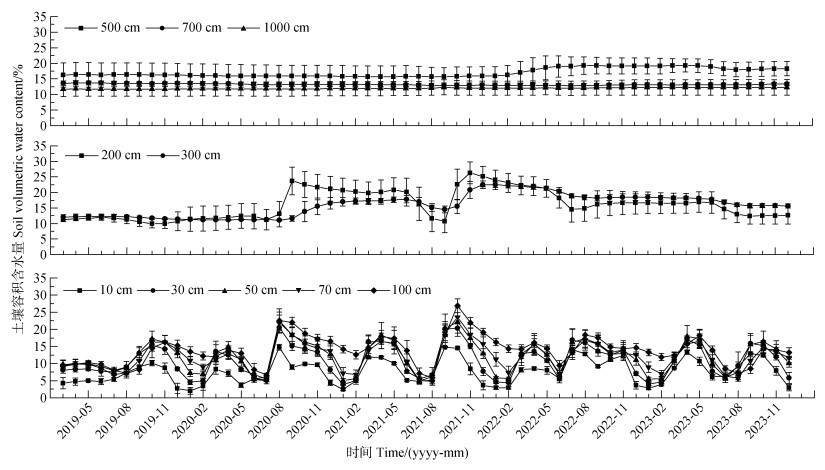
本试验采用时域反射仪(TDR),分辨率为0.1%vol(CS655 Campbell Scientific公司,美国),在样地对10个深度(10、20、30、50、70、100、200、300、500、1 000 cm)的土壤容积含水量进行长期定位监测,监测频率为每小时一次。本研究以坡上、坡中和坡下三个监测点作为重复,容积含水量标准差如图 1所示。
|
注:图中误差线为标准差。 Note:Error bars in the figure indicate standard deviation. 图 1 土壤容积含水量标准差图 Fig. 1 Standard deviation diagram of soil volume water content |
降水事件:将间隔超过2天的降水记录的时间定义为单个降水事件的起始时间,考虑到分类过程中极小降水的历时和雨强会影响分类结果的合理性,同时又为全面呈现研究区的降水情况,因此将雨量小于2 mm的降水剔除。
降水-土壤水分响应过程:当至少连续4天无降水记录后发生1 h降水量超过0.4 mm(高于仪器分辨率)的降水时,则认为是一次降水-土壤水分响应过程的开始;当连续4天的累计降水量小于0.2 mm时,则认为是一次降水-土壤水分响应过程的结束。因此,一个降水-土壤水分响应过程可能包含多个降水事件[19-20]。
土壤蓄水量和蓄水量变化量计算:
| $ \begin{aligned} & W=\mathrm{VWC} \times h \\ & \Delta W=W_2-W_1 \end{aligned} $ | (1) |
式中,W:土壤蓄水量(mm);VWC:土壤体积含水量(%);h:土层深度(mm);∆W:表示土壤蓄水量变化量(mm);W2:降水-土壤水分响应过程后的土壤蓄水量(mm);W1:降水前的土壤蓄水量(mm)。
降水-土壤水分响应过程的土壤水分补给量计算:
| $ \begin{aligned} & S_{\mathrm{p}}=\sum\nolimits_{i=1}^{10} \theta_i d_i \\ & \Delta S=S_P-S_0 \end{aligned} $ | (2) |
式中,SP为每次降水过程后的土壤蓄水量(mm);θi为第i个深度区间的平均容积含水量(%vol);di为第i个深度区间的厚度(mm);S0为降水前的土壤蓄水量(mm),计算方法与SP一致;∆S为每次降水-土壤水分响应过程后的土壤水分补给量(mm)。
次降水过程的水量平衡方程:
| $ {P_i} = \Delta {S_i} + E{T_i} + {R_i} $ | (3) |
式中,Pi为每次降水过程的雨量(mm),∆Si为每次降水-土壤水分响应过程后的土壤水分补给量(mm),Ri为每次降水过程样地内产生的径流量(mm),ETi为冠层和枯落物截留(mm)。
使用Origin2021进行绘图。
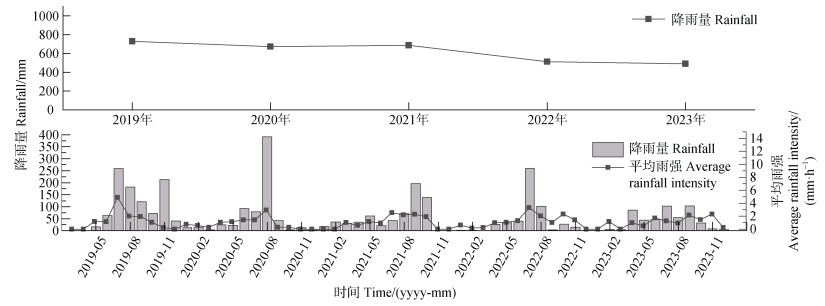
2 结果 2.1 降水特征如图 2所示,研究区降水量无论在年际还是年内均存在较大变化,表现出显著的干湿交替。年内降水量呈“单峰”趋势变化,集中于6—9月,2020年8月降水量最多为391.01mm。月均降水强度与降水量的变化趋势基本一致。
|
图 2 观测期月尺度降水特征 Fig. 2 Monthly rainfall characteristics during the experimental period |
研究期间降雨事件共计129次,参考中国气象局(标准来源为国家标准GB/T 28592-2012)将降雨划分等级,详情见表 1。(1)小雨,12 h平均降雨量0.1~4.9 mm,该类降水共10场占总场次的8%。(2)中雨,12 h平均降雨量5.0~14.9 mm,该类降水共59场占总场次的46%。(3)大雨,12 h平均降雨量15.0~29.9 mm,该类降水共34场占总场次的26%。(4)暴雨,12 h平均降雨量30.0~69.9 mm,该类降水共24场占总场次的19%。(5)大暴雨,12 h平均降雨量70.0~139.9 mm,该类降水共2场占总场次的1%。研究区大部分降水事件均属于中雨类型,尽管大雨和暴雨发生频率较低,但其在补给地下水等方面发挥着关键作用。

|
表 1 2019—2023年降水特征 Table 1 Rainfall characteristics during the year of 2019—2023 |
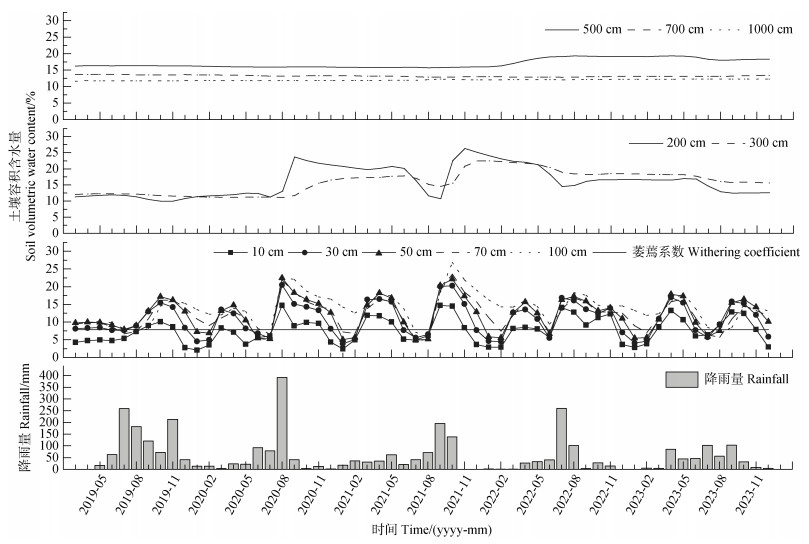
如图 3所示,土壤水分变化与降水时间分布密切相关。0~100 cm的土壤水分受到降雨影响较大,随时间变化在年内呈现“双峰”型变化趋势,200~500 cm土壤水分含量相对稳定,只在降水充沛时有所增加。700~1 000 cm土壤水分含量不受降水的影响,土壤水分含量无明显变化。此外,柠条的生长也显著影响了土壤水分的变化。具体表现如下:2020年6—7月份,柠条生长的蒸散耗水量的增加,土壤水分含量显著降低,0~100 cm平均土壤含水量为6.58%和5.92%,低于凋萎系数7.82%,形成了土壤干层,8月降水量最大,0~100 cm平均土壤含水量增加为20.95%,由于降水入渗土壤具有时滞性,200cm土壤含水量在9月达到峰值,为28.43%,300 cm深土壤含水量在12月达到峰值,为18.47%。
|
注:萎蔫系数:宁婷等[21]在黄土丘陵区撂荒坡地研究得出萎蔫系数的均值7.82%。 Note: withering coefficient: Ning Ting et al [21]. obtained the withering coefficient of abandoned slope land of 0~400cm in loess hilly region. 图 3 观测期土壤水分含量月变化 Fig. 3 Monthly variation of soil moisture content during the experimental period |
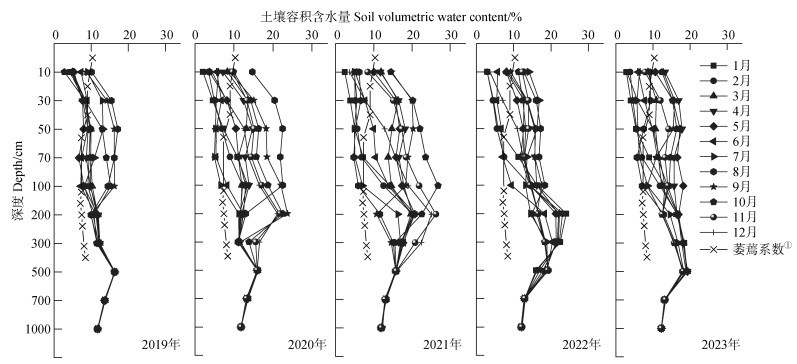
如图 4所示,柠条林年际土壤水分沿剖面变化趋势一致。在0~300 cm土壤深度范围内,柠条林土壤水分趋势呈现为0~30 cm增大,30~50 cm减小,50~200 cm增大,200~300 cm减小的趋势,但由于6—7月份柠条蒸散耗水量增加,土壤水分在0~50 cm深度呈现持续减小的趋势。由于300 cm以下土层柠条根系较少,水分消耗减少,降雨充沛的季节补给深度最深为500 cm,使得在300~1 000 cm深度范围内土壤水分变化趋势为先增加,再减少,500 cm处土壤水分为16.20%~21.71%。
|
注:①萎蔫系数为宁婷等[21]在黄土丘陵区研究得出0~400 cm的撂荒坡地的萎蔫系数。 Note: ①withering coefficient: Ning Ting et al [21]. obtained the withering coefficient of abandoned slope land of 0~400 cm in loess hilly region. 图 4 土壤水分沿土壤剖面垂直方向的变化 Fig. 4 Changes of soil moisture along the vertical direction of soil profiles |
为进一步探究降雨对柠条土壤水分的影响,选取2020年降水数据和土壤水分数据,分析土壤水分响应过程,划分13组降水-土壤水分响应过程并将降水划分等级,具体属性列于表 2。
|
|
表 2 降水-土壤水分响应过程特征 Table 2 Characteristics of rainfall-soil moisture response process |
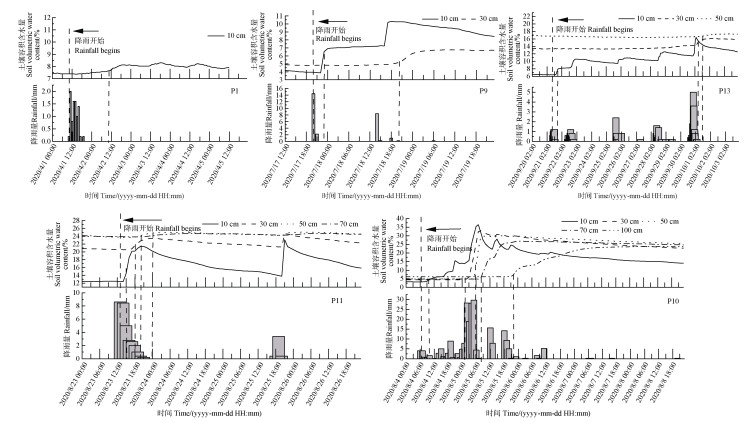
如图 5所示,不同类型的降雨导致的土壤水分响应过程也存在较大差异。降雨强度越大,土壤水分的响应越快,0~10 cm土壤对降水的响应最为敏感。暴雨(P10)和大雨(P9)的响应时间最短为3 h,其次是长历时中雨(P13)为6 h,而短历时中雨(P1)的响应过程则相对缓慢为23 h。随土层加深,响应时间也逐渐延长。土壤水分响应还受前期降水的影响,前期降水会使土壤保持在较高的含水饱和度,入渗速率加快,因此P11较P9的土壤水分响应更快。
|
注:P1、P13为中雨,P9、P11为大雨,P10为暴雨。 Note: P1 and P13 are moderate rain, P9 and P11 are Large rain, and P10 is heavy rain. 图 5 不同类型次降雨下土壤含水量的动态变化特征 Fig. 5 Dynamics of soil water content with time in different types of rainfall |
土壤水分含量在达到最高点后便开始消退,随着深度增加土壤水分所受的环境影响减小,消退速度减慢,表现出了更强的持水能力。24 h后,10 cm处土壤水分消退最快,消退45.34%,30 cm处消退14.39%,50 cm处消退5.21%,70 cm处消退1.99%,100 cm处消退0.59%。50 cm以下的土壤在降水补给后能维持较高的含水状态,为植被生长提供了有利的水分储备。
2.4 土壤水分补给量特征如表 3所示,降水类型与土壤水分入渗深度呈显著正相关性。暴雨的降雨量、历时和雨强最大,最深入渗深度为200 cm,其次是大雨和长历时中雨,为100 cm和70 cm,短历时中雨为10 cm,小雨的入渗深度均小于10 cm。P11和P9的降水量相似,而P11的雨强和历时均较小,但水分入渗深度明显增大主要是受到前期降水的影响。降水过程的连续性也会影响水分入渗深度,P8的降水事件个数有3个,而P7和P13的降水事件个数只有2个,因此P8的入渗深度小于P7和P13。
|
|
表 3 土壤水分响应深度与降雨属性的相关性 Table 3 The Relationship correlation analysis between response depth of soil moisture and rainfall attributes |
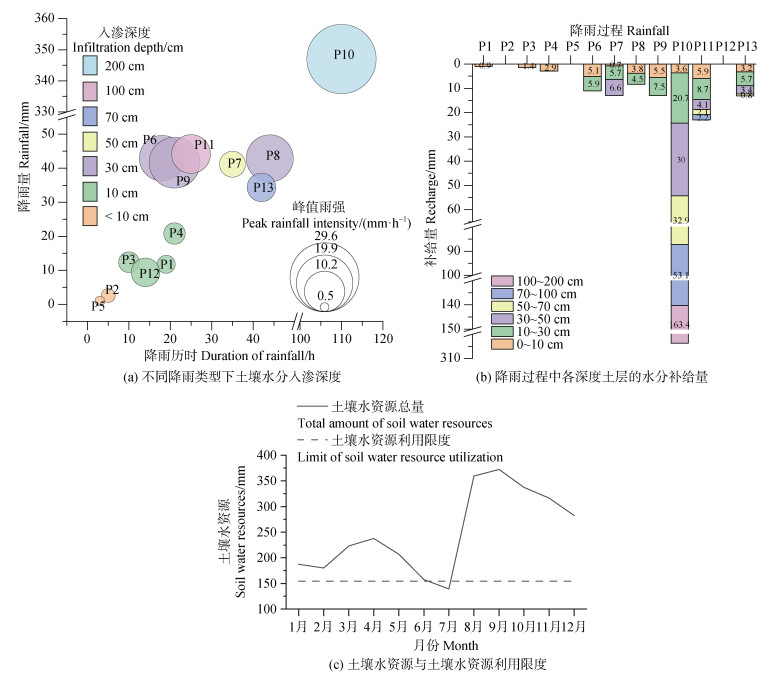
如图 6所示,不同降水类型的土壤水分补给量也存在显著差异。暴雨(P10)的土壤水分补给量最大,占降水量的87.5%,其中50 cm以下补给量为249.4 mm,占暴雨补给量的82.1%,其次是大雨,为36.2%,长历时中雨为29.7%,短历时中雨为12%,小雨未能使土壤水分得到补给。由此可见,暴雨作为最有效的补给来源,在该区域土壤水分补给中发挥着不可替代的作用。
|
注:P2、P5为小雨,P1、P3、P4、P7、P8、P12、P13为中雨,P6、P9、P11为大雨,P10为暴雨。 Note: P2、P5 are light rain, P1、P3、P4、P7、P8、P12、P13 are moderate rain, P6、P9、P11 are large rain, and P10 is heavy rain. 图 6 不同降水模式土壤水分入渗深度及各深度土层的水分补给量 Fig. 6 Infiltration depth of soil water in different rainfall patterns and water supply of soil layers at different depths |
根据不同土层的萎蔫系数和最大入渗深度值,计算得出该地土壤水资源利用限度为154.6 mm。6—7月,土壤水资源总量低于土壤水资源利用限度,土壤出现了季节性干层,柠条根系的吸水困难,土壤水分抑制柠条的生长。但在研究区降雨量较大的时期,降水的补给使土壤水资源的总量上升,满足了柠条生长所需的水分。因此,虽然在夏季出现了季节性干层,但年降雨量总体上可以满足柠条生长所需。
表 4列出了不同降水类型水量平衡分配情况。暴雨产流量最大,有利于当地河流健康,暴雨和长历时中雨的补给最多,有利于当地柠条生长,而小雨、短历时中雨和大雨则大部分以蒸散发的形式损失。因此,及时高效地利用暴雨资源补给深层土壤,是缓解区域干旱、恢复生态系统的关键举措。
|
|
表 4 次降水过程的水量平衡特征 Table 4 Characteristics of water balance in a rainfall process |
降水格局与土壤水分的分布状况有着密切关系,降水峰值往往会引起土壤水分峰值的出现,同时植被生长的节律和气温的季节变化进一步促进了土壤水分的动态变化[21-22]。目前有学者[23-25]的研究结果发现各月的土壤水分与降水量显著正相关,0~100 cm土壤水分存在显著季节性变化,年内变化基本经历由少至多2次交替,在每年4月和9月左右是土壤水分含量的高值中心。本研究的研究结果(图 3)与上述研究结果一致,柠条0~100 cm土壤水分在年内变化表现出明显的“双峰”趋势,主要原因为:(1)春季气温回升,冰雪融水对浅层土壤进行了补给;(2)秋季降水较为充沛,为土壤补给了较多水分,且秋季气温降低,柠条蒸腾速率下降,水分消耗减小,因此秋季是全年土壤水分恢复最充足的时期,含水量可达到全年最高点。200~500 cm土壤水分含量相对稳定,只在降水充沛时有所增加,但由于降水入渗土壤具有时滞性[26-27],深层土壤水分补给较慢,但水分含量稳定。700~1 000 cm土壤水分含量基本不受降水的影响,随深度的增加柠条土壤水分含量无明显变化。
土壤水分垂直空间分布受土壤蒸发、植被蒸腾、根系分布及土壤类型的影响会表现出一定的差异性,有研究发现随着深度的增加,土壤体积含水量表现出先增加—后减小—再增加的趋势[28-31]。本研究结果也显示类似的结论(图 4),年内土壤水分在0~300 cm深度范围内均呈现先增大后减小再增大再减小的趋势,其主要是受到大气降水和蒸散发的影响以及植被根系调节[32]。由于300 cm以下土层柠条根系较少,水分消耗减少,降雨充沛的季节补给深度最深为500 cm,使得在300~1 000 cm深度范围内土壤水分变化趋势为先增加,后持续减小的趋势。
在柠条生长旺盛期,由于降水的高度季节性集中和土壤水分滞后响应的双重影响,50~100 cm出现季节性干层(图 3、图 4)。但在雨季,降水补给会使这些缺水层次得到恢复,土壤水分含量达到柠条萎蔫系数之上,满足柠条用水需求,因此年降水量总体满足柠条生长所需。
3.2 土壤水分含量对降水响应的差异土壤水分对降水的响应受到多种因素的影响,但降水的雨量和强度对土壤水分的影响最为显著。降水量和降水强度越大,水分入渗的深度就越深,补给量也越多[33-35]。本研究结果(图 6)显示,暴雨入渗深度最深可达200 cm,而小雨的入渗深度仅限于0~10 cm。暴雨的土壤水分补给量最大,占降水量的87.5%,其次是大雨,为36.2%,长历时中雨为29.7%,短历时中雨为12%,小雨未能使土壤水分得到补给。除了当次降水的特征外,前期降水状况也会显著影响水分入渗深度,当表层初始含水量较高时,降水入渗会加快,持续时间短,补给作用大。如图 5和图 6所示,P11与P9相比,二者降水量、降水强度和降水历时相似,但P11入渗深度显著增大,入渗速度更快。这是由于土壤处于一个较为湿润的状态,不仅有利于湿润锋向下运移,还会通过增强土壤气体效应而加速这一过程[36]。
不同土层对降水的响应存在明显差异,降水响应的程度也将随土层深度的增加而逐渐减弱[37-38],本研究结果显示(图 4)0~100 cm深度的土壤水分波动幅度最大,其中以10 cm土壤水分最为敏锐地反映出降水量的变化,0~100 cm深度的土壤水分受到降水量和强度的影响最为显著。200~300 cm土壤水分的变化则介于两者之间,受植物根系的影响较大。由于远离地表,300 cm以下的土壤水分的波动十分有限,仅在极端降水事件下有所响应。随着深度的加大,土壤水分受蒸发损耗的影响越来越小,因此,对于深层土壤而言,一旦接受了降水补给,其含水量就能维持较长时间,为干旱时期提供一定的缓冲能力。从水量平衡的角度分析,降水量在入渗和蒸发之间的分配将决定着干旱黄土的恢复速度,研究结果表明,无论什么样的降水类型其主要份额仍以补给土壤水分为主。
4 结论研究区大部分降水事件均属于中雨类型,暴雨虽然发生频率较低,但在补给土壤水分等方面发挥着不可替代的作用。黄土丘陵区柠条林地土壤水分动态呈现明显的季节性变化特征,主要源于降水时空分布格局和植被蒸散发的影响。具体表现为:土壤水分在年内变化呈现“双峰”型变化,与当地的雨季和干季交替出现密切相关。从垂直分布上看,0~100 cm土壤水分波动最为剧烈,200~300 cm次之,500~1 000 cm则相对稳定。夏季柠条生长旺盛期,50~100 cm土层普遍会出现不同程度的季节性干旱,会对植被的正常生长造成不利影响,但年降水量总体上可以满足柠条生长所需。降水类型是影响土壤水分入渗深度和补给量的关键因素。暴雨事件的入渗深度最深,可达200 cm,而小雨仅局限于0~10 cm;中雨则介于两者之间,随降水历时的增加,入渗深度也逐步加大。暴雨的土壤水分补给量远高于小雨和中雨,占降水量的87.5%,而小雨基本无法实现有效补给。降水的主要份额以补给土壤水分为主,暴雨、大雨和历时长中雨能较好对土壤水分进行补给,小雨和短历时中雨补给效率较低,更多以蒸散发形式损失。
| [1] |
Zhang J, Zuo X A, Lü P. Effects of changes in rainfall patterns during the growing season on plant community structure, function and aboveground biomass in typical habitats of Keerqin sandy land (In Chinese)[J]. Journal of Desert Research, 2024, 44(4): 1-13. [张晶, 左小安, 吕朋. 生长季降水格局变化对科尔沁沙地典型生境植物群落结构、功能和地上生物量的影响[J]. 中国沙漠, 2024, 44(4): 1-13.]
(  0) 0) |
| [2] |
Yang L, Zhang Z H, Li Z S. Effects of large-scale re-vegetation on soil desiccation in the Loess Plateau: Problems and perspectives (In Chinese)[J]. Acta Ecologica Sinica, 2019, 39(20): 7382-7388. [杨磊, 张子豪, 李宗善. 黄土高原植被建设与土壤干燥化: 问题与展望[J]. 生态学报, 2019, 39(20): 7382-7388.]
( 0) |
| [3] |
Zhu X L, Si J H, He X H, et al. Effects of long-term afforestation on soil water and carbon in the Alxa Plateau[J]. Frontiers in Plant Science, 2024, 14: 1273108. DOI:10.3389/fpls.2023.1273108
( 0) |
| [4] |
Zhou D M, Si J H, He X H, et al. Simulation of the soil water-carrying capacity of Haloxylon ammodendron plantations in the Alxa Desert, China: Implications for afforestation[J]. Catena, 2024, 235: 107637. DOI:10.1016/j.catena.2023.107637
( 0) |
| [5] |
Wu Y Z, Jia X X, An J, et al. Afforestation vegetation uses water from very deep soil layers in the semi-arid Loess Plateau[J]. Hydrological Processes, 2023, 37(7): e14933. DOI:10.1002/hyp.14933
( 0) |
| [6] |
Ren J Y, Qiao Y N, Yan L Y, et al. Dynamic changes and influencing factors of soil moisture of main tree species in Loess Hilly Region (In Chinese)[J]. Research of Soil and Water Conservation, 2022, 29(6): 73—80, 89. [任婧宇, 乔雨宁, 闫璐瑶, 等. 黄土丘陵区主要树种土壤水分动态变化特征及影响因子[J]. 水土保持研究, 2022, 29(6): 73—80, 89.]
( 0) |
| [7] |
Zhang K M, Wang X, Wang Y K, et al. Water variation of deep desiccation soil in loess hilly area under typical mulching (In Chinese)[J]. Transactions of the Chinese Society for Agricultural Machinery, 2022, 53(2): 336-345. [张珂萌, 汪星, 汪有科, 等. 典型地面覆盖下黄土丘陵区干化土壤深层水分变化研究[J]. 农业机械学报, 2022, 53(2): 336-345.]
( 0) |
| [8] |
Zhao Y L, Wang Y Q, Zhou J X, et al. Spatiotemporal variation and controlling factors of dried soil layers in a semi-humid catchment and relevant land use management implications[J]. Catena, 2024, 240: 107973. DOI:10.1016/j.catena.2024.107973
( 0) |
| [9] |
Chen G J, Wu Q F, Wang Y B, et al. Deep soil water use of old-aged vegetation(17- to 36-year stand age)after the formation of dried soil layers based on in situ monitoring[J]. Journal of Hydrology: Regional Studies, 2023, 48: 101446. DOI:10.1016/j.ejrh.2023.101446
( 0) |
| [10] |
Zhang J G, Lan Z L, Li H W, et al. Coupling effects of soil organic carbon and moisture under different land use types, seasons and slope positions in the Loess Plateau[J]. Catena, 2023, 233: 107520. DOI:10.1016/j.catena.2023.107520
( 0) |
| [11] |
Wang Y Q. Characteristics of water, roots and nutrients in soil profile of Caragana korshinskii forest land in Loess Hilly Region[D]. Yinchuan: Ningxia University, 2022.[王永强. 黄土丘陵区带状柠条林地土壤剖面水分、根系及养分特征[D]. 银川: 宁夏大学, 2022.]
( 0) |
| [12] |
Wang S. Study on transpiration water consumption characteristics of typical arbor and shrub species in water-wind erosion ecotone[D]. Yangling, Shaanxi: Research Center for Eco-Environmental Sciences, Chinese Academy of Sciences, 2019.[王胜. 水蚀风蚀交错区典型乔灌树种蒸腾耗水特征研究[D]. 陕西杨凌: 中国科学院教育部水土保持与生态环境研究中心, 2019.]
( 0) |
| [13] |
Yuan E S, Zhou Q W, Yan W H, et al. Response of the winter soil moisture of different vegetation types to rainfall events in Karst slope land[J]. Hydrology Research, 2022, 53(10): 1271-1285. DOI:10.2166/nh.2022.033
( 0) |
| [14] |
Wu Y F, Xiao P Q, Hao S L, et al. Response of soil moisture of typical shrubland and waste grassland to precipitation in the loess hilly-gully region (In Chinese)[J]. Research of Soil and Water Conservation, 2022, 29(4): 121-126. [吴远菲, 肖培青, 郝仕龙, 等. 黄丘区典型灌木和荒草地土壤含水量变化对降雨的响应[J]. 水土保持研究, 2022, 29(4): 121-126.]
( 0) |
| [15] |
Zhai B C, Zhu Y, Shen X J, et al. Spatiotemporal variation of soil moisture and the responses to rainfall events in two typical mature forest stands in the Loess Hilly Region (In Chinese)[J]. Research of Soil and Water Conservation, 2024, 31(4): 170-178. [翟博超, 朱燕, 申小娟, 等. 黄土丘陵区两个典型成熟森林群落土壤水分时空变化特征及对降雨事件的响应[J]. 水土保持研究, 2024, 31(4): 170-178.]
( 0) |
| [16] |
Ding W B, Wang F, Jin K. Effects of rainfall and plant characteristics on the spatiotemporal variation of soil moisture in a black locust plantation(Robinia pseudoacacia)on the Chinese Loess Plateau[J]. Water, 2023, 15(10): 1870. DOI:10.3390/w15101870
( 0) |
| [17] |
Ge F C. Study on water conservation function of typical artificial vegetation in Loess Plateau[D]. Yangling, Shaanxi: Northwest A&F University, 2023.[葛俸池. 黄土高原典型人工植被水源涵养功能研究[D]. 陕西杨凌: 西北农林科技大学, 2023.]
( 0) |
| [18] |
Gao Y K, Li J, Wang X, et al. Soil desiccation and root and nutrient characteristics of Medicago sativa L. and Caragana korshinskii in loess hilly area (In Chinese)[J]. Research of Soil and Water Conservation, 2023, 30(6): 168-176. [高元亢, 李婧, 汪星, 等. 黄土丘陵苜蓿与柠条深层土壤干化状况及根系与养分特征[J]. 水土保持研究, 2023, 30(6): 168-176.]
( 0) |
| [19] |
Jin Z, Guo L, Lin H, et al. Soil moisture response to rainfall on the Chinese Loess Plateau after a long-term vegetation rehabilitation[J]. Hydrological Processes, 2018, 32(12): 1738-1754. DOI:10.1002/hyp.13143
( 0) |
| [20] |
Liu X L. Simulation study on the characteristics of soil water consumption and compensation on downhill slope under ecological construction conditions[D]. Xi'an: Xi'an University of Technology, 2019.[刘小璐. 生态建设条件下坡面土壤水分消耗与补偿特征模拟研究[D]. 西安: 西安理工大学, 2019.]
( 0) |
| [21] |
Ning T, Guo Z S, Li Y L. Soil water characteristic curves and soil water constants at different depths in the abandoned sloping field of Loess Hilly Region (In Chinese)[J]. Journal of Soil and Water Conservation, 2014, 28(3): 166-170. [宁婷, 郭忠升, 李耀林. 黄土丘陵区撂荒坡地土壤水分特征曲线及水分常数的垂直变异[J]. 水土保持学报, 2014, 28(3): 166-170.]
( 0) |
| [22] |
Zhao Y L. Multi-scale soil hydrological processes and driving factors in the Loess Plateau[D]. Yangling, Shanxi: Research Center for Eco-Environmental Sciences, Chinese Academy of Sciences, 2022.[赵亚丽. 黄土高原多尺度土壤水文过程与驱动因素[D]. 陕西杨凌: 中国科学院教育部水土保持与生态环境研究中心, 2022.]
( 0) |
| [23] |
Li L, Zhang Z H, Sang Y Q, et al. Soil moisture dynamics of Vitex negundo and its response to different rainfall events in hilly region of Taihang Mountains (In Chinese)[J]. Science Technology and Engineering, 2021, 21(14): 5752-5758. DOI:10.3969/j.issn.1671-1815.2021.14.016 [李龙, 张志华, 桑玉强, 等. 太行低山区荆条土壤水分动态及其对不同降雨量的响应[J]. 科学技术与工程, 2021, 21(14): 5752-5758.]
( 0) |
| [24] |
Wei L L. Study on response mechanism of shallow soil moisture to precipitation in Loess Plateau[D]. Lanzhou: Lanzhou University, 2022.[魏兰兰. 黄土高原浅层土壤水分对降水的响应机制研究[D]. 兰州: 兰州大学, 2022.]
( 0) |
| [25] |
Chen J, Song N P, Chen L, et al. Soil moisture dynamics and its response to precipitation in different cover types of desert steppe (In Chinese)[J]. Journal of Soil and Water Conservation, 2021, 35(6): 198-206. [陈娟, 宋乃平, 陈林, 等. 荒漠草原不同覆被类型土壤水分动态及其对降水的响应[J]. 水土保持学报, 2021, 35(6): 198-206.]
( 0) |
| [26] |
Zhang H Y, An J, Wu Y Z, et al. Seasonal variation of water and carbon distribution in soil profile of typical vegetation conditions on the Loess Plateau (In Chinese)[J]. Soil and Water Conservation in China, 2024(3): 39-45. [张恒宇, 安娟, 吴元芝, 等. 黄土高原典型植被条件下土壤剖面水、碳分布季节变化研究[J]. 中国水土保持, 2024(3): 39-45.]
( 0) |
| [27] |
Liang H B, Li Y N, An X X, et al. Soil moisture dynamics and its temporal stability under different-aged Caragana korshinskii shrubs in the Loess Hilly Region of China[J]. Water, 2023, 15(13): 2334. DOI:10.3390/w15132334
( 0) |
| [28] |
Wang C S, Yang X N, Sun W Y, et al. Soil water storage capacity and rainwater infiltration in hilly-gully loess region under severe rainstorm (In Chinese)[J]. Acta Pedologica Sinica, 2020, 57(2): 296-306. DOI:10.11766/trxb201902190602 [王承书, 杨晓楠, 孙文义, 等. 极端暴雨条件下黄土丘陵沟壑区土壤蓄水能力和入渗规律[J]. 土壤学报, 2020, 57(2): 296-306.]
( 0) |
| [29] |
Pei Y W, Huang L M, Li R L, et al. Root water source of Pinus sylvestris L. var. mongholica litv. and influencing factors in the southeastern part of Mu Us sandy land, China (In Chinese)[J]. Acta Pedologica Sinica, 2022, 59(5): 1336-1348. DOI:10.11766/trxb202011060608 [裴艳武, 黄来明, 李荣磊, 等. 毛乌素沙地东南缘人工林樟子松根系吸水来源与影响因素[J]. 土壤学报, 2022, 59(5): 1336-1348.]
( 0) |
| [30] |
Wang S W, Guo Z S. Effects of perennial Caragana korshinskii kom on soil moisture (In Chinese)[J]. Research of Soil and Water Conservation, 2020, 27(3): 70-75. [王松伟, 郭忠升. 多年生人工柠条林生长对土壤水分的影响[J]. 水土保持研究, 2020, 27(3): 70-75.]
( 0) |
| [31] |
Qiu D X, Gao P, Mu X M, et al. Vertical variations and transport mechanism of soil moisture in response to vegetation restoration on the Loess Plateau of China[J]. Hydrological Processes, 2021, 35(10): e14397. DOI:10.1002/hyp.14397
( 0) |
| [32] |
Liang H B, Xue Y Y, Shi J W, et al. Soil moisture dynamics under Caragana korshinskii shrubs of different ages in Wuzhai County on the Loess Plateau, China[J]. Earth and Environmental Science Transactions of the Royal Society of Edinburgh, 2018, 109(3/4): 387-396.
( 0) |
| [33] |
Luo Z B, Fan J, Shao M A, et al. Evaluating soil water dynamics and vegetation growth characteristics under different soil depths in semiarid loess areas[J]. Geoderma, 2024, 442: 116791. DOI:10.1016/j.geoderma.2024.116791
( 0) |
| [34] |
Dang Y, Wang W, Zhang Y E, et al. Dynamic response of soil moisture content to rainfall under different vegetation cover types on the Bashang Plateau, northwestern Hebei Province of Northern China (In Chinese)[J]. Journal of Beijing Forestry University, 2023, 45(5): 106-118. [党毅, 王维, 张永娥, 等. 坝上高原不同植被类型覆盖下土壤水分含量对降雨的动态响应[J]. 北京林业大学学报, 2023, 45(5): 106-118.]
( 0) |
| [35] |
[35]Cheng L, Wu B, Jia X H, et al. Dynamics of soil moisture during the growing season in the Mu Us Sandy Land and its response to rainfall based on continuous observation data (In Chinese)[J]. Arid Land Geography, 2024, 47(4): 648-661. [成龙, 吴波, 贾晓红, 等. 基于连续观测数据的毛乌素沙地生长季土壤水分动态及其对降水的响应[J]. 干旱区地理, 2024, 47(4): 648-661.]
( 0) |
| [36] |
Ge F C, Xu M X, Gong C, et al. Land cover changes the soil moisture response to rainfall on the Loess Plateau[J]. Hydrological Processes, 2022, 36(11): e14714. DOI:10.1002/hyp.14714
( 0) |
| [37] |
Bai X W, Bu R, Hong G Y, et al. Soil moisture characteristics and its response to precipitation of typical plantation in mu us sandy land (In Chinese)[J]. Forest Resources Management, 2023(6): 52-60. [白星雯, 布日古德, 洪光宇, 等. 毛乌素沙地典型人工林土壤水分特征及其对降水的响应[J]. 林草资源研究, 2023(6): 52-60.]
( 0) |
| [38] |
Sun Y R, Chen Y M, Wang Y J, et al. Dynamic variation characteristics of soil moisture in Caragana korshinskii plantation in loess hilly area and the influence of rainfall characteristics on it (In Chinese)[J]. Journal of Soil and Water Conservation, 2023, 37(1): 272-279. [孙亚荣, 陈云明, 王亚娟, 等. 黄土丘陵区柠条人工林土壤水分动态变化特征及降雨特征对其影响[J]. 水土保持学报, 2023, 37(1): 272-279.]
( 0) |