 2025, Vol. 62


阻燃剂是降低材料易燃性的一种化学品,其中溴代阻燃剂(Brominated flame retardants,BFRs)曾是使用最为广泛的一类有机阻燃剂[1]。传统的BFRs主要指多溴联苯醚(Polybrominated diphenyl ethers,PBDEs),从20世纪60年代开始在全世界范围内广泛使用[2],随后在水体、大气、土壤等环境介质中被普遍检测到[3],其危害也逐渐显现。2009年,商业五溴和八溴产品被列入持久性有机污染物清单。2013年,美国环保署(USEPA)提出全面禁止使用PBDEs。随着阻燃剂需求量的大幅度增加,加之部分BFRs的禁用,氯代阻燃剂(Chlorinated flame retardants,CFRs)逐渐成为BFRs的替代品。氯原子可使可燃气体失去H+和OH–自由基,从而减缓燃烧速率,阻止火势的扩散,因而常被用作聚氨酯泡沫中的阻燃剂。其中主要代表是氯代有机磷阻燃剂(Chlorinated organophosphate flame retardants,Cl-OPFRs)和得克隆(Dechlorane plus,DPs)。CFRs多为添加型阻燃剂,其随着生产、使用和废弃排放等很容易被释放至大气、水、土壤等环境中[4]。目前已有许多研究表明其具有多方面的毒性效应,主要包括生殖毒性、胚胎发育毒性、神经毒性、潜在致癌性和内分泌干扰效应等[5]。欧盟已将部分典型的Cl-OPFRs包括磷酸三(2-氯乙基)酯(Tris(2-chloroethyl)phosphate,TCEP)、磷酸三(2-氯丙基)酯(Tri(2-chloropropyl)phosphate,TCPP)和磷酸三(1,3-二氯异丙基)酯(Tris(1,3-Dichloro-2-Propyl)phosphate,TDCPP)分别列入第二批和第四批高度关注物质名录。DPs是一种人工合成的脂肪族CFRs[6],其具有环境持久性、生物累积性和长距离迁移特性,也已被证实可通过食物链在营养级水平上生物放大[7]。卤代阻燃剂的环境行为和风险等研究一直是国内外相关领域的热点前沿。
土壤环境作为疏水有机化合物的主要储存和交换场所之一,是卤代阻燃剂的重要汇集地。从21世纪初期开始,全球每年50%~80%的电子垃圾被合法或者非法出口至亚洲,其中90%被运往中国[8]。由于缺乏有效的回收和处理体系,大量含有卤代阻燃剂的废旧电子产品未经妥善处理而导致土壤环境中卤代阻燃剂污染严重。在广东省清远、贵屿及浙江台州等地的电子垃圾拆解和回收场区土壤中检测出大量的卤代阻燃剂,浓度高达25 479 ng·g–1 dw[9]。污染土壤中高浓度的卤代阻燃剂会通过向水体和植物中迁移,并通过生物积累和放大而带来严重的危害。一些非法的电子垃圾回收区附近植物体内的卤代阻燃剂浓度最高甚至可达15 600 ng·g–1 dw[10]。在针对中国东部十省农业土壤近十年的调查中发现,土壤中新型溴代阻燃剂(Novel brominated flame retardants,NBFRs)含量随时间呈显著上升趋势,∑26PBDEs(26种PBDEs)和∑5NBFRs(5种NBFRs)的浓度范围分别为0.144~215 ng·g–1 dw和0.186~144 ng·g–1 dw[11],在广东稻田中也检测出了CFRs的存在,其中TCEP的浓度高达47 ng·g–1[12]。因此,为了更好地防范治理这类污染物,当前国内外学者已针对土壤环境中卤代阻燃剂的迁移转化特征及其风险评估等内容展开了大量研究[13],但关于该领域相关研究的梳理和整合分析尚不多见。
因此,本文基于Web of Science核心合集数据库,并结合VOS viewer和Citespace等文献计量分析工具,对2008—2023年间发表的关于土壤中典型卤代阻燃剂方面文献信息进行科学知识图谱分析,针对发文数量、学科门类、主要国家和研究机构的合作关系、主要研究学者、关键词聚类及其变化趋势等内容进行了计量分析和讨论,重点梳理了卤代阻燃剂在土壤环境中的分布与污染累积特征、降解转化与生物积累及其在水土环境中的迁移行为和人体健康风险等方面的相关研究进展、热点和发展趋势,旨在为未来土壤环境中典型卤代阻燃剂相关研究提供一定的参考。
1 材料与方法 1.1 数据来源数据来源于美国汤森路透公司(Thomson Reuters)Web of Science(WOS)核心合集数据库,检索主题词为:TS=("soil" AND("halogenated flame retardants" OR "brominated flame retardants" OR "chlorinated flame retardants" OR "novel brominated flame retardants" OR "CFRs" OR "BFRs" OR "NBFRs" OR "polybrominated diphenyl ethers" OR "dechlorane plus "OR "tris(2-chloroethyl)phosphate" OR "tris(1-chloro-2-methylethyl)phosphate" OR "tris(1,3-dichloro-2-propyl)phosphate" OR "Tetrabromobisphenol A" OR "PBDE*" OR "DP" OR "TCEP" OR "TCPP" OR "TDCPP" OR "TBBPA"))。设置检索时间限定为2008—2023年,检索日期为2024年1月27日,最终检索得到相关文献2 259篇。
1.2 研究方法在WOS核心合集数据库中分次下载这2 259篇文献相应全纪录与引用的参考文献,每次下载500篇。利用VOS viewer软件的合作网络(Co-authorship)分析土壤环境中典型卤代阻燃剂研究领域相关国家/地区和研究学者之间的合作关系,阈值分别设置为30和5。结合VOS viewer的共现网络(Co-occurrence)和CiteSpace的关键词突现(Burstness)分析选定所有关键词(All Keywords),阈值分别设置为35和25,重点解析该领域的研究热点和趋势。采用Excel 2023与Origin 2023软件进行数据统计与图形绘制。
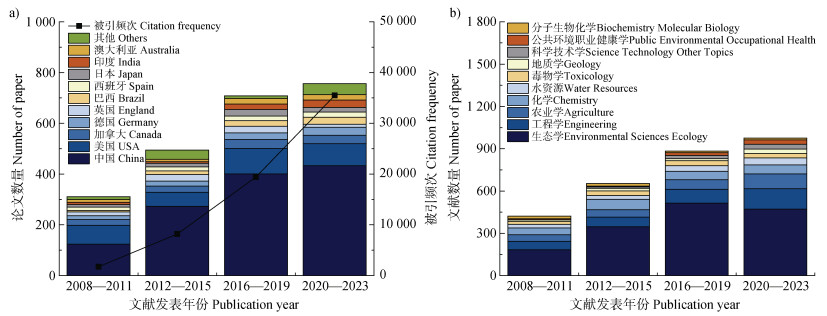
2 结果与讨论 2.1 时间发展脉络及发文学科分布2008—2023年土壤环境中典型卤代阻燃剂研究领域的论文数量总体呈现逐年上升的趋势(图 1a),这表明近年来该污染物在土壤环境中的相关研究持续受到关注。其中,中国一直是总发文量最高的国家,共发表了1 231篇论文,总被引频次达到了39 654次,这说明中国对该领域的研究高度关注。不同学科的分布体现了土壤环境中卤代阻燃剂相关研究领域的多样性。本文以每4年为一个跨度,研究了2008—2023年期间发文量排在前十的学科占比(图 1b)。其中,研究排名前三的学科占比总和超过73%,分别是环境生态学(1 514篇,占比51.6%)、工程学(372篇,占比12.7%)和农业学(272篇,占比9.3%),特别是工程学和农业学方向的发文量占比在近四年增幅最为明显,分别从11.1%和7.7%增至14.9%和10.8%,这表明土壤环境中卤代阻燃剂的相关污染问题是这些学科领域的研究热点。
|
图 1 2008—2023年土壤中卤代阻燃剂研究领域年度发文数量及被引频次(a)和发文前十学科组成(b) Fig. 1 Annual number of paper and citation frequency(a), and the composition of the top 10 disciplines(b)in the field of halogenated flame retardants in soil from 2008 to 2023 |
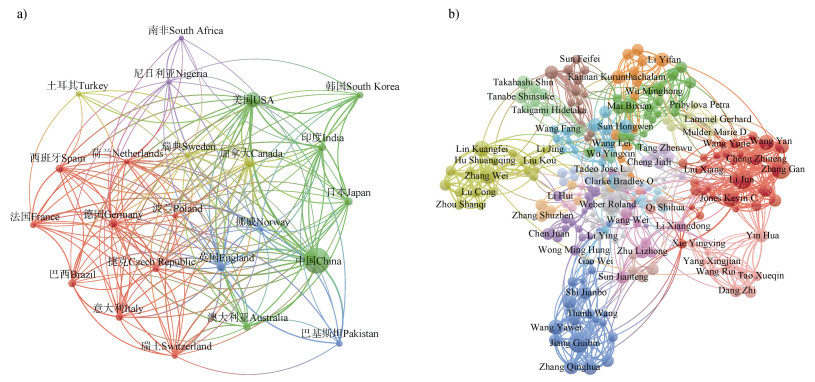
土壤环境中卤代阻燃剂相关领域的国家/地区间的合作关系如图 2a所示,图中圆圈的大小表示该国家/地区的文章发表数量多少[14],而距离则表示各个国家/地区间合作的密切程度,距离越近则表示科研合作越密切[15]。其中发文数量超过100篇且合作密切的国家包括中国(总联系强度(TLS)为400)、美国(TLS为332)、加拿大(TLS为130)等。中国作为总联系强度最高的国家,其在该领域与美国、加拿大、印度、日本等国家有密切联系,这说明中国在该领域研究中的研究成果和影响力显著。
|
注:节点代表发文国家或研究学者,节点大小表示其出现的频次,不同颜色代表不同聚类。 Note: Nodes represent the paper publishing countries or researchers, node sizes represent their frequency of occurrence, and different colors represent different clusters. 图 2 发文国家(a)和研究学者(b)之间的合作网络关系 Fig. 2 Collaborative network between the paper publishing countries(a)and researchers(b) |
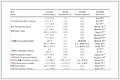
通过对作者的合作关系进行了聚类分析发现,共形成16个聚类组(图 2b),该研究领域发文量前五的作者均来自于中国科学院(表 1)。以李军(Li Jun)为核心的研究团队共发表了论文60篇,篇均被引频次为61.33,位居第一,这表明该团队在土壤卤代阻燃剂的研究领域具有较大的影响力。李军(Li Jun)、张干(Zhang Gan)及其团队主要对BFRs等持久性有机污染物在中国南方农田土壤、森林土壤、电子废弃场地土壤以及青藏高原土壤的浓度和分布进行了检测和分析[16]。而以江桂斌(Jiang Guibin)为核心的研究团队主要关注新型和传统阻燃剂在特殊环境如北极、南极、高原山区等环境中的分布[17]。以张卫(Zhang Wei)和林匡飞(Lin Kuangfei)为核心的研究团队则更加偏向于研究分析土壤环境中卤代阻燃剂的生物毒性和暴露风险,及其高效降解去除的方法[18]。以孙红文(Sun Hongwen)、于志强(Yu Zhiqiang)和季荣(Ji Rong)等团队为中心,也形成了多个合作网络,他们的研究方向涵盖了BFRs和CFRs的环境监测方法和污染控制技术研究及其在中国的空间地理分布、植物积累转化和人体暴露等[19]。
|
表 1 土壤环境中卤代阻燃剂研究领域发文量前五的作者 Table 1 The top 5 authors in the field of halogenated flame retardants in soil |
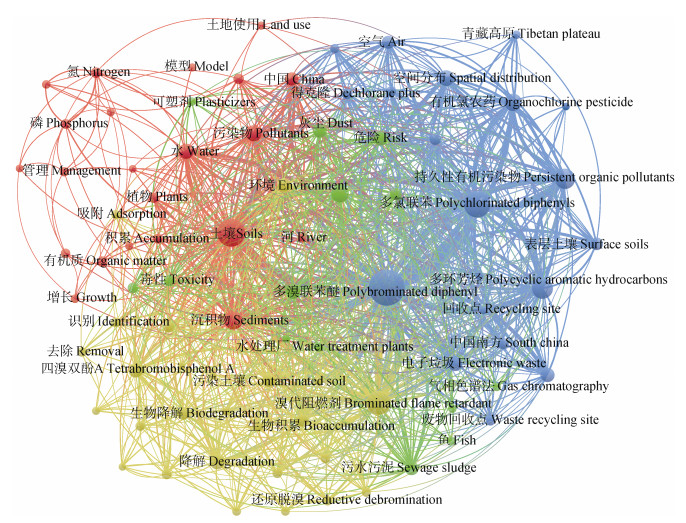
关键词是对文章主旨的高度概括,通过VOS viewer软件对该领域的高频关键词构建共现网络,进一步分析土壤环境中卤代阻燃剂的研究热点。出现频次较高的关键词有:polybrominated diphenyl ethers(多溴联苯醚,1 208次)、soils(土壤,679次)、polychlorinated biphenyls(多氯联苯,612次)、brominated flame retardants(溴代阻燃剂,477次)、polycyclic aromatic hydrocarbons(多环芳烃,347次)、persistent organic pollutants(持久性有机污染物,326)、sediments(沉积物,255次)、human exposure(人体暴露,246次)、organochlorine pesticides(有机氯农药,231次)等。根据关键词共现网络(图 3),该领域的研究热点主要划分为4个聚类:卤代阻燃剂在土壤环境中的分布与污染特征(蓝色聚类)、卤代阻燃剂的降解转化与生物积累(黄色聚类)、卤代阻燃剂在水土环境中的迁移行为(红色聚类)、卤代阻燃剂的人体健康风险评估(绿色聚类)。
|
注:节点代表关键词,节点大小表示其出现的频次,不同颜色代表不同聚类。 Note: Nodes represent keywords, node sizes represent their frequency of occurrence, and different colors represent different clusters. 图 3 关键词共现网络分析 Fig. 3 Keywords co-occurrence network analysis |
该聚类主要关键词有:polybrominated diphenyl ethers(多溴联苯醚,1 208次)、polychlorinated- biphenyls(多氯联苯,612次)、polycyclic aromatic hydrocarbons(多环芳烃,347次)、persistent organic pollutants(持久性有机污染物,326次)、organochlorine pesticides(有机氯农药,231次)、spatial distribution(空间分布,179次)、electronic waste(电子垃圾,147次)等。由于大量含有卤代阻燃剂的废旧电子产品缺乏有效的回收和处理体系,简易的电子垃圾拆解和回收区成为这些持久性污染物进入环境的重要来源,通常这些区域的土、水等介质的卤代阻燃剂浓度较高[8]。通过对中国121个地区土壤中卤代阻燃剂检测分析发现,经济更发达的城市地区卤代阻燃剂的浓度通常高于农村地区,主要集中在珠江三角洲(珠三角)、长江三角洲(长三角)和环渤海这三大经济圈区域[20]。珠三角地区如广东一些非法电子垃圾拆解区的土壤中PBDEs浓度范围为12.3~3 713.2 ng·g–1 dw,TBBPA浓度范围为21.19~144.09 ng·g–1 dw,NBFRs的浓度为0.44~134.7 ng·g–1 dw[21–24]。而长三角地区如浙江台州电子废弃污染区土壤中PBDEs检测浓度高达25 478.8 ng·g–1 dw[9]。此外,曾大量生产过PBDEs的地区如环渤海的山东寿光,其工业土壤中也检出大量PBDEs污染,浓度范围为39.9~8145 ng·g–1 dw[25-26]。
由于卤代阻燃剂在环境中的高毒性和持久性,从2008年开始BFRs在全球范围内被逐步限制使用和淘汰。在对广东清远间隔四年的两次卤代阻燃剂浓度检测发现,溴含量较低的多溴联苯醚同系物(BDE-28、BDE-47、BDE-99、BDE-100)的丰度降
低,但是溴含量较高的多溴联苯醚同系物(BDE- 183、BDE-209)变化升高[21]。而自从我国2011年发布《废弃电器电子产品回收处理管理条例》禁止不受管制的电子废物回收以来,溴化程度较低的PBDEs在土壤中的浓度一直下降。例如广东清远同一地点的土壤卤代阻燃剂浓度与管理政策颁布之前相比降低了一至两个数量级[27-28]。而值得注意的是,作为替代性卤代阻燃剂,NBFRs和CFRs在土壤环境样本中的浓度也并不低。如NBFRs的代表性阻燃剂十溴二苯乙烷(Decabromobibenzyl,DBDPE)和1,2-双(2,4,6-三溴苯氧基)乙烷(1,2-Bis(2,4,6-tribromophenoxy)ethane,BTBPE),其在环境中的浓度虽然不及BDE-209高,但其浓度普遍大于其他BDE同系物[12]。而对于CFRs而言,环渤海地区的总体浓度较其他两个地区更高。如Cl-OPFRs在环渤海天津静海以及辽宁本溪的土壤中浓度分别为138~829 ng·g–1 dw和98.5~364 ng·g–1 dw,较珠三角地区广东广州土壤(0.041~0.25 ng·g–1 dw)中的浓度高出1~2个数量级[12,29-30]。因此,新型卤代阻燃剂可能是继传统BFRs之后的潜在新威胁,相关研究迫切需要跟进。
2.3.2 卤代阻燃剂的降解转化与生物积累该聚类主要关键词有:brominated flame retardants(溴代阻燃剂,477次)、degradation(降解,168次)、tetrabromobisphenol-A(四溴双酚A,153次)、environment(环境,136次)、decabromodiphenyl ether(十溴联苯醚,123次)、bioaccumulation(生物积累,104次)、biodegradation(生物降解,95次)、debromination(脱溴,68次)等。还原脱卤是卤代阻燃剂降解转化的关键过程,BFRs在土壤中可通过非生物和生物过程转化成低溴化、羟基化和甲氧基化的BFRs[31]。非生物过程如光催化、零价铁还原或自由基氧化降解等可能会产生更多具有毒性和持久性的副产物,相比之下,微生物降解过程更为环境友好和经济高效,因此了解其降解机理对于开发有效的原位修复策略至关重要。有研究发现从中国山东PBDE污染场地中分离出的假单细胞菌(Pseudomonas stutzeri)能够在14 d内降解94.7%的BDE-47[32]。在PBDEs逐步还原脱溴过程中,其同系物显示出相似的脱溴顺序,一般是先脱间位和对位溴,然后是邻位[33]。近期研究发现TBBPA可通过微生物连续作用实现完全降解,其在脱卤菌Dehalobacter的作用下逐步厌氧还原脱溴为双酚A(BPA)[34],而BPA可进一步通过鞘氨醇单胞菌(Sphingomonas sp.)好氧氧化生成CO2[35],实现完全脱毒。普氏芽孢杆菌(Bacillus pumilus)、红球菌(Rhodococcus ruber)、脱亚硫酸菌(Desulfitobacterium)、脱卤拟球菌(Dehalococcoides)等也被发现是卤代阻燃剂降解过程中的优势细菌[36]。在实现BFRs生物降解的同时,其降解后的产物也不能忽视,仍需进一步加强BFRs的无害化降解和特征脱卤反应菌株的富集与鉴定等方面的研究。
卤代阻燃剂可从土壤转移至植物,并通过食物链传递而在更高营养级富集,从而增大其潜在的生态和健康风险。已有研究发现电子回收区附近植物体内的卤代阻燃剂浓度极高,最高甚至可达15 600 ng·g–1 dw[10]。据统计,BDE-209是植物中检出含量最高的BFRs,TCEP和TCPP是残留最多的CFRs[37]。CFRs在植物中的含量普遍高于BFRs,这是由于CFRs的疏水性低于BFRs,因而更易从土壤中转移至植物体内[10]。在针对谷物中卤代阻燃剂的研究发现,其在水稻中的浓度通常高于其他种类的谷物(如玉米)或者其他淀粉来源(如土豆)[38]。而对于叶菜类植物如卷心菜、白菜、韭菜等,其叶部卤代阻燃剂的浓度普遍高于根部[39-40]。这是由于除了从土壤和水中吸收卤代阻燃剂之外,大气沉积和气叶交换也是植物从环境中吸收有机化合物的重要途径。此外,对不同地区的红树林各部位卤代阻燃剂污染分布研究也发现,红树林叶片中的卤代阻燃剂水平显著高于红树林枝、根、果实[41]。而作为土壤常见生物,蚯蚓等土壤动物可通过摄食或皮肤接触卤代阻燃剂,且其体内卤代阻燃剂的生物积累量随着暴露浓度的增加而增加。不仅是土壤动物,鱼类和鸟类等动物体内也检测出卤代阻燃剂的存在,甚至在偏远的北极环境中的动物体内检测到卤代阻燃剂,其浓度高达44~480 ng·g–1 lw[42]。卤代阻燃剂会造成如生殖发育、神经发育甚至导致胚胎发育畸形等影响。与食物链中营养水平较低的动物相比,营养水平较高的动物体内卤代阻燃剂的检出浓度更高,这证实卤代阻燃剂的确会随着食物链生物放大[43]。总体而言,在环境中普遍存在的卤代阻燃剂已不可避免地存在生物积累与放大现象,并对生物体造成损伤[44]。因此,其生物毒理与环境危害等方面的研究也需进一步加强。
2.3.3 卤代阻燃剂在水土环境中的迁移行为该聚类主要关键词有:soils(土壤,679次)、sediments(沉积物,255次)、pollutants(污染物,1 944次)、water(水,173次)、China(中国,123次)、nitrogen(氮,74次)、organic matter(有机质,70次)、transport(转运,70次)等。本文统计发现该聚类相关论文的发表年限最新,这也说明该聚类相关研究是当前的热点趋势。卤代阻燃剂在土壤环境中的迁移行为主要受到土壤理化性质、污染物理化性质、自然条件如降水等因素的影响[45-46],其中,土壤有机质的影响最为显著。已有许多研究证实,有机质含量更高的土壤会提供更多的吸附位点,从而吸附更多卤代阻燃剂并降低其迁移性[13]。卤代阻燃剂在土壤中的吸附和解吸多为非线性的过程[47]。此外,卤代阻燃剂的理化性质如疏水性(KOW)对其在土壤中迁移行为的影响也十分显著。CFRs中TDCPP由于其更高的疏水性(KOW=3.80),更易被土壤吸附固定,而TCEP(KOW=2.21)则可能更易从土壤迁移至地下水[13]。对于PBDE同系物而言,占比最大的BDE-209的疏水性最高(KOW=9.97),具有低溶解度(4.17×10⁻⁹ mg·L–1),其向深层土壤的迁移主要依靠与细颗粒和胶体相关的优先流动机制[21]。
土壤中的卤代阻燃剂会通过分配和淋溶等过程迁移至地表水和地下水中,其向水体迁移的能力主要取决于其溶解度[48]。在针对黄河三角洲地区表层河流沉积物中阻燃剂的分布调查发现,OPFRs的平均浓度(37.60 ng·g–1)普遍高于PBDEs(18.33 ng·g–1)[49],这表明在土水环境中迁移性更高的CFRs可能具有更大的风险。降水和潮汐运动也是影响卤代阻燃剂在水体中迁移分布的重要因素,有研究发现PBDEs在水体样本中的浓度与降雨量呈正相关,而DP在水体样本中的浓度与降雨量呈负相关[50],而潮汐运动能影响DP在水中的垂直和水平分布[51]。此外,通过对比各个环境介质中代表性BFRs如TBBPA的浓度发现,其在水环境以及污泥中的浓度最低,其次是沉积物和土壤,而环境灰尘中的浓度最高[52]。但由于来源的复杂性,而卤代阻燃剂也可在不同的环境介质之间转移,源解析仍是环境中卤代阻燃剂污染研究的重难点。总体而言,蓄积在土壤中的卤代阻燃剂可能成为其他环境重要的二次污染源,进一步增加生态和健康风险。因此,厘清土壤环境中卤代阻燃剂的环境行为与机理对于明确其污染风险与影响十分关键。
2.3.4 卤代阻燃剂的人体健康风险该聚类主要关键词有:human exposure(人体暴露,246次)、flame retardants(阻燃剂,159次)、risk(风险,141次)、sewage sludge(污水污泥,135次)、dust(灰尘,132次)、toxicity(毒性,86次)等。目前,卤代阻燃剂已在人体样本包括血清、头发、母乳、尿液和其他人体基质中普遍检出。值得注意的是,本文统计发现卤代阻燃剂在中国三大经济发达地区人群的血液和母乳中的检出率最高,且长三角和珠三角地区的母乳样本中卤代阻燃剂的含量要高于环渤海地区。居住在污染区的人们体内卤代阻燃剂含量明显高于未污染区的人们,例如,浙江温岭市电子垃圾回收区居民的血清中NBFRs(4.2~128 ng·g–1 lw)的含量明显高于城市居民(nd~33.2 ng·g–1 lw)[53]。BFRs广泛存在于不同人群中,青少年和成人体内的卤代阻燃剂含量有所不同,如广东地区青少年体内∑13PBDE含量为86~1 270 ng·g–1,成年人体内含量为87~620 ng·g–1[54]。甚至在胎儿的血清中也被发现(∑PBDEs:1.5~12 ng·g–1 lw),其含量略低于母体血清内的含量(∑PBDEs:1.6~17 ng·g–1 lw)。此外,女性血液中卤代阻燃剂的含量略低于男性血液中的含量,而中国人体样本中PBDEs的含量较欧美人低[55]。在所收集的文献数据中,人体样品中BDE-47、BDE-153、BDE-209的含量明显高于其他BFRs[56]。
目前对卤代阻燃剂的人体健康风险评估集中在经口摄入、皮肤接触和吸入土壤颗粒等暴露途径。其中,膳食摄入和粉尘摄入是大多数BFRs的主要暴露途径。通过文献统计发现,成人每天通过膳食摄入的BFRs剂量为9.9~98 ng,鱼类和海产品以及乳制品的贡献相对较高[57]。但总体而言,由于不同地区和国家之间饮食习惯差异,饮食中接触BFRs所带来的人体健康风险可能有限。值得注意的是,人类大约90%的时间是在室内环境中度过的,与室内空气吸入和皮肤接触相比,摄入灰尘是儿童在室内环境中接触BFRs的主要途径,特别是婴幼儿的接触量高于年龄较大的儿童,该暴露途径的潜在风险不容忽视。而与粉尘摄入和吸入相比,膳食摄入也是TCEP、TCPP等CFRs最主要的暴露途径[58]。在非法电子垃圾拆解和回收区,吸入则被证实是人们接触CFRs的最主要途径[59]。在单一途径暴露的情况下,农田土壤和填埋场土壤中卤代阻燃剂对成人的致癌风险范围处于10–7~10–4,而对青少年和幼儿的致癌风险大于10–4,这表明土壤中卤代阻燃剂致癌风险已超出可接受范围,尤其是对青少年和幼儿的致癌风险不可接受[13,60]。随着越来越多替代化合物出现,新型阻燃剂如NBFRs和CFRs的风险评估工作也应该是未来研究关注的重点。因此对环境中卤代阻燃剂人体健康风险的评估仍值得关注,特别是不同的暴露途径以及一些新型卤代阻燃剂的潜在风险尚需进一步评估。
利用CiteSpace的关键词突现(Strength)分析土壤环境中卤代阻燃剂研究的关键词发现,溴代阻燃剂(Brominated flame retardants)、四溴双酚A(Tetrabromobisphenol A)、氯代阻燃剂(Chlorinated flame retardants)、有机磷酸酯(Organophosphate esters)等关键词依次出现(表 2),这表明随着时间的推移,卤代阻燃剂的研究对象逐渐从传统的BFRs转移至新型的CFRs,特别是Cl-OPFRs。最早期人们主要聚焦于沉积物(Sediment)环境中卤代阻燃剂的相关研究,随后逐渐关注污泥(Sewage sludge)、土壤(Soil)、空气(Air)、灰尘(Dust)以及废水(Waste water)等环境。而值得注意的是,关于其在土壤环境的研究从2014年开始持续至今,土壤一词的突现强度最高(13.73)(表 2)。人们对于卤代阻燃剂的研究也更加深入,逐渐从环境分布、污染特征等研究转移至其在动植物体内的分布和在食物链的传递,近几年更加注重卤代阻燃剂对人体的毒性及健康风险评估。
|
|
表 2 关键词突现信息 Table 2 Information of keyword with the citation bursts |
自2008年以来,土壤环境中卤代阻燃剂领域发文最多的学科为环境生态学,中国一直是发文量最多的国家,其在国际合作方面也表现突出,科研能力和国际影响力受到了领域内学者的认可。卤代阻燃剂在土壤环境中的污染分布以及迁移转化是以往研究的重点,特别是关于BFRs的降解转化相关研究,近几年更加注重卤代阻燃剂对人体的毒性及健康风险。我国经济发达地区如珠三角、长三角和环渤海地区土壤中卤代阻燃剂的含量明显高于其他地区,特别是在非法电子拆解和回收区,甚至在其周边土壤和植物中也检测出极高浓度的BFRs和CFRs等。卤代阻燃剂可从土壤转移至植物,并通过食物链传递而在更高营养级富集,从而增大其潜在的生态和健康风险。卤代阻燃剂在人体内也已经普遍检出,经口摄入是其最主要的暴露途径,尤其对青少年和幼儿的致癌风险不可接受。随着越来越多替代化合物出现,其长期影响仍值得关注,特别是不同的暴露途径以及一些新型卤代阻燃剂如NBFRs和CFRs的潜在风险也需进一步评估。
总而言之,当前研究对于土壤中卤代阻燃剂特别是新型卤代阻燃剂的环境行为和风险的认识尚不全面,且多数集中于BFRs在人工环境中的迁移转化过程研究,而在复杂自然环境中的转化机理有待进一步明晰,转化过程中中间产物的环境行为和生态健康风险也值得持续关注。卤代阻燃剂在土壤环境中的污染过程及生态效应与土壤组成及性质密切相关,同时还会受到共存污染物的影响,例如具有载体效应的新污染物微塑料与其相互作用和复合污染机制等,厘清上述问题对于准确评估其生态健康风险至关重要。卤代阻燃剂的毒理学数据仍然有限,尚需更多探究以完善对其风险评估。此外,自然环境中卤代阻燃剂具有难降解性,常规的修复方法难以去除,其在土壤环境中的防治及修复仍具有挑战,高效修复技术的研发十分必要。
| [1] |
Liu M G, Brandsma S H, Schreder E. From e-waste to living space: Flame retardants contaminating household items add to concern about plastic recycling[J]. Chemosphere, 2024, 365: 143319. DOI:10.1016/j.chemosphere.2024.143319
(  0) 0) |
| [2] |
Li Y N, Zhen X M, Liu L, et al. Halogenated flame retardants in the sediments of the Chinese Yellow Sea and East China Sea[J]. Chemosphere, 2019, 234: 365-372. DOI:10.1016/j.chemosphere.2019.06.115
( 0) |
| [3] |
Liu Z Y, Zhang Y Q, Li F F, et al. The effect of anthropogenic activities on the behavior of novel brominated flame retardants in surface soil of Northern China urbanized zone[J]. Science of the Total Environment, 2024, 952: 175836. DOI:10.1016/j.scitotenv.2024.175836
( 0) |
| [4] |
He Y, Su X, Li S Y, et al. Pollution risk and regulation of organochlorine in soil: from the perspective of multi-process coupling (In Chinese)[J]. Acta Pedologica Sinica, 2024, 61(5): 1179-1187. DOI:10.11766/trxb202312010504 [何艳, 苏心, 李淑瑶, 等. 土壤有机氯污染风险与调控: 基于多过程耦合的视角[J]. 土壤学报, 2024, 61(5): 1179-1187.]
( 0) |
| [5] |
Yuan S W, Zhang H, Wang S H, et al. Do the same chlorinated organophosphorus flame retardants that cause cytotoxicity and DNA damage share the same pathway?[J]. Ecotoxicology and Environmental Safety, 2024, 273: 116158. DOI:10.1016/j.ecoenv.2024.116158
( 0) |
| [6] |
Skogeng L P, Lunder Halvorsen H, Breivik K, et al. Spatial distribution of Dechlorane Plus and dechlorane related compounds in European background air[J/OL]. Frontiers in Environmental Science, 2023, 10: DOI: 10.3389/fenvs.2022.1083011. [2024-11-03].
( 0) |
| [7] |
Jiang Y, Jia H L, Yang W C, et al. Trophic transfer of dechloranes in marine food webs in Dalian Bay, China[J]. Chemosphere, 2024, 364: 143087. DOI:10.1016/j.chemosphere.2024.143087
( 0) |
| [8] |
McGrath T J, Ball A S, Clarke B O. Critical review of soil contamination by polybrominated diphenyl ethers(PBDEs)and novel brominated flame retardants(NBFRs); concentrations, sources and congener profiles[J]. Environmental Pollution, 2017, 230: 741-757. DOI:10.1016/j.envpol.2017.07.009
( 0) |
| [9] |
Yang Z Z, Zhao X R, Zhao Q, et al. Polybrominated diphenyl ethers in leaves and soil from typical electronic waste polluted area in South China[J]. Bulletin of Environmeantal Contamination and Toxicology, 2008, 80(4): 340-344. DOI:10.1007/s00128-008-9385-x
( 0) |
| [10] |
Li H R, Lao Z L, Liu Y S, et al. Uptake, accumulation, and translocation of organophosphate esters and brominated flame retardants in water hyacinth(Eichhornia crassipes): A field study[J]. Science of the Total Environment, 2023, 874: 162435. DOI:10.1016/j.scitotenv.2023.162435
( 0) |
| [11] |
An Q, Yang L N, Yang S C, et al. Legacy and novel brominated flame retardants in agricultural soils of Eastern China(2011–2021): Concentration level, temporal trend, and health risk assessment[J]. Journal of Hazardous Materials, 2023, 446: 130631. DOI:10.1016/j.jhazmat.2022.130631
( 0) |
| [12] |
Cui K Y, Wen J X, Zeng F, et al. Occurrence and distribution of organophosphate esters in urban soils of the subtropical city, Guangzhou, China[J]. Chemosphere, 2017, 175: 514-520. DOI:10.1016/j.chemosphere.2017.02.070hazmat.2022.130631
( 0) |
| [13] |
Xuan Y J, Shen D S, Long Y Y, et al. Enlarging effects of microplastics on adsorption, desorption and bioaccessibility of chlorinated organophosphorus flame retardants in landfill soil particle-size fractions[J]. Journal of Hazardous Materials, 2024, 479: 135717. DOI:10.1016/j.jhazmat.2024.135717
( 0) |
| [14] |
Long Y Y, Fan L J, Shen D S, et al. Bibliometric analysis of research status and developing trends on landfill pollutants (In Chinese)[J]. Environmental Pollution and Control, 2023, 45(1): 97-104. [龙於洋, 范丽娇, 沈东升, 等. 基于文献计量的垃圾填埋场污染物研究现状与趋势分析[J]. 环境污染与防治, 2023, 45(1): 97-104.]
( 0) |
| [15] |
Zang Y A, Wang T T, Hu X J, et al. Research progress and hotspots analysis of soil antibiotic resistance genes (In Chinese)[J]. Acta Pedologica Sinica, 2024, 61(3): 607-618. DOI:10.11766/trxb202210200578 [张友爱, 王婷婷, 胡小婕, 等. 土壤抗生素抗性基因研究进展及热点分析[J]. 土壤学报, 2024, 61(3): 607-618.]
( 0) |
| [16] |
Liu X, Bing H, Chen Y, et al. Brominated flame retardants and dechlorane plus on a remote high mountain of the eastern Tibetan Plateau: Implications for regional sources and environmental behaviors[J]. Environmental Geochemistry and Health, 2018, 40(5): 1887-1897. DOI:10.1007/s10653-017-9938-1
( 0) |
| [17] |
Xiong S Y, Hao Y F, Li Y M, et al. Accumulation and influencing factors of novel brominated flame retardants in soil and vegetation from Fildes Peninsula, Antarctica[J]. Science of the Total Environment, 2021, 756: 144088. DOI:10.1016/j.scitotenv.2020.144088
( 0) |
| [18] |
Ling S Y, Lu C, Fu M R, et al. Distribution characteristics and risks assessment of brominated flame retardants in surface soil from both a legacy and a new e-waste dismantling site[J]. Journal of Cleaner Production, 2022, 373: 133970. DOI:10.1016/j.jclepro.2022.133970
( 0) |
| [19] |
Zhang Q, Yao Y M, Wang Y, et al. Plant accumulation and transformation of brominated and organophosphate flame retardants: A review[J]. Environmental Pollution, 2021, 288: 117742. DOI:10.1016/j.envpol.2021.117742
( 0) |
| [20] |
Li W L, Ma W L, Jia H L, et al. Polybrominated diphenyl ethers(PBDEs)in surface soils across five Asian countries: Levels, spatial distribution, and source contribution[J]. Environmental Science & Technology, 2016, 50(23): 12779-12788.
( 0) |
| [21] |
Cheng Z N, Wang Y, Wang S R, et al. The influence of land use on the concentration and vertical distribution of PBDEs in soils of an e-waste recycling region of South China[J]. Environmental Pollution, 2014, 191: 126-131. DOI:10.1016/j.envpol.2014.04.025
( 0) |
| [22] |
Huang D Y, Zhao H Q, Liu C P, et al. Characteristics, sources, and transport of tetrabromobisphenol A and bisphenol A in soils from a typical e-waste recycling area in South China[J]. Environmental Science and Pollution Research, 2014, 21(9): 5818-5826. DOI:10.1007/s11356-014-2535-2
( 0) |
| [23] |
Wang J, Liu L, Wang J, et al. Distribution of metals and brominated flame retardants(BFRs)in sediments, soils and plants from an informal e-waste dismantling site, South China[J]. Environmental Science and Pollution Research, 2015, 22(2): 1020-1033. DOI:10.1007/s11356-014-3399-1
( 0) |
| [24] |
He J X. A preliminary study on the effects of plant rhizosphere on the distribution of pollutants and microbial diversity in e-waste contaminated soil[D]. Guangzhou: Guangdong University of Technology, 2017.[何洁鑫. 植物根际对电子垃圾污染土壤中污染物分布和微生物多样性影响的初步研究[D]. 广州: 广东工业大学, 2017.]
( 0) |
| [25] |
Li W L, Liu L Y, Zhang Z F, et al. Brominated flame retardants in the surrounding soil of two manufacturing plants in China: Occurrence, composition profiles and spatial distribution[J]. Environmental Pollution, 2016, 213: 1-7. DOI:10.1016/j.envpol.2016.01.092
( 0) |
| [26] |
Zhu Z C, Chen S J, Zheng J, et al. Occurrence of brominated flame retardants(BFRs), organochlorine pesticides(OCPs), and polychlorinated biphenyls(PCBs)in agricultural soils in a BFR-manufacturing region of North China[J]. Science of the Total Environment, 2014, 481: 47-54. DOI:10.1016/j.scitotenv.2014.02.023
( 0) |
| [27] |
Tian M, Chen S J, Wang J, et al. Plant uptake of atmospheric brominated flame retardants at an E-waste site in Southern China[J]. Environmental Science & Technology, 2012, 46(5): 2708-2714.
( 0) |
| [28] |
Chen S J, Tian M, Zheng J, et al. Elevated levels of polychlorinated biphenyls in plants, air, and soils at an E-waste site in Southern China and enantioselective biotransformation of chiral PCBs in plants[J]. Environmental Science & Technology, 2014, 48(7): 3847-3855.
( 0) |
| [29] |
Wang Y, Sun H W, Zhu H K, et al. Occurrence and distribution of organophosphate flame retardants(OPFRs)in soil and outdoor settled dust from a multi-waste recycling area in China[J]. Science of the Total Environment, 2018, 625: 1056-1064. DOI:10.1016/j.scitotenv.2018.01.013
( 0) |
| [30] |
Wang Y, Li J J, Xu Y, et al. Uptake, translocation, bioaccumulation, and bioavailability of organophosphate esters in rice paddy and maize fields[J]. Journal of Hazardous Materials, 2023, 446: 130640. DOI:10.1016/j.jhazmat.2022.130640
( 0) |
| [31] |
Gao Y J, Xie C J, Yu H, et al. Research progress of transfer and transformation of brominated flame retardants in soil (In Chinese)[J]. Research of Environmental Sciences, 2021, 34(2): 479-490. [高玉娟, 谢承劼, 余红, 等. 溴代阻燃剂在土壤中的迁移转化研究进展[J]. 环境科学研究, 2021, 34(2): 479-490.]
( 0) |
| [32] |
Zhang S W, Xia X H, Xia N, et al. Identification and biodegradation efficiency of a newly isolated 2, 2', 4, 4'-tetrabromodiphenyl ether(BDE-47)aerobic degrading bacterial strain[J]. International Biodeterioration & Biodegradation, 2013, 76: 24-31.
( 0) |
| [33] |
Robrock K R, Korytár P, Alvarez-Cohen L. Pathways for the anaerobic microbial debromination of polybrominated diphenyl ethers[J]. Environmental Science & Technology, 2008, 42(8): 2845-2852.
( 0) |
| [34] |
McAvoy D C, Pittinger C A, Willis A M. Biotransformation of tetrabromobisphenol A(TBBPA)in anaerobic digester sludge, soils, and freshwater sediments[J]. Ecotoxicology and Environmental Safety, 2016, 131: 143-150. DOI:10.1016/j.ecoenv.2015.07.009
( 0) |
| [35] |
Liu G P, Liu S M, Yang J, et al. Complete biodegradation of tetrabromobisphenol A through sequential anaerobic reductive dehalogenation and aerobic oxidation[J]. Journal of Hazardous Materials, 2024, 470: 134217. DOI:10.1016/j.jhazmat.2024.134217
( 0) |
| [36] |
Chang B V, Yuan S Y, Ren Y L. Aerobic degradation of tetrabromobisphenol-a by microbes in river sediment[J]. Chemosphere, 2012, 87(5): 535-541. DOI:10.1016/j.chemosphere.2011.12.057
( 0) |
| [37] |
Zhang X L, Zou W, Mu L, et al. Rice ingestion is a major pathway for human exposure to organophosphate flame retardants(OPFRs)in China[J]. Journal of Hazardous Materials, 2016, 318: 686-693. DOI:10.1016/j.jhazmat.2016.07.055
( 0) |
| [38] |
Zhang W, Giesy J P, Wang P L. Organophosphate esters in agro-foods: Occurrence, sources and emerging challenges[J]. Science of the Total Environment, 2022, 827: 154271. DOI:10.1016/j.scitotenv.2022.154271
( 0) |
| [39] |
Wang Y, Zhang Z H, Bao M J, et al. Characteristics and risk assessment of organophosphate esters and phthalates in soils and vegetation from Dalian, Northeast China[J]. Environmental Pollution, 2021, 284: 117532. DOI:10.1016/j.envpol.2021.117532
( 0) |
| [40] |
Luo Q, Wang S, Shan Y, et al. Matrix solid-phase dispersion coupled with gas chromatography-tandem mass spectrometry for simultaneous determination of 13 organophosphate esters in vegetables[J]. Analytical and Bioanalytical Chemistry, 2018, 410(27): 7077-7084. DOI:10.1007/s00216-018-1308-z
( 0) |
| [41] |
Qiu Y W, Qiu H L, Zhang G, et al. Bioaccumulation and cycling of polybrominated diphenyl ethers(PBDEs)and dechlorane plus(DP)in three natural mangrove ecosystems of South China[J]. Science of the Total Environment, 2019, 651: 1788-1795. DOI:10.1016/j.scitotenv.2018.10.055
( 0) |
| [42] |
Bekele T G, Zhao H, Yang J, et al. A review of environmental occurrence, analysis, bioaccumulation, and toxicity of organophosphate esters[J]. Environmental Science and Pollution Research, 2021, 28(36): 49507-49528. DOI:10.1007/s11356-021-15861-8
( 0) |
| [43] |
Hou R, Lin L, Li H X, et al. Occurrence, bioaccumulation, fate, and risk assessment of novel brominated flame retardants(NBFRs)in aquatic environments—A critical review[J]. Water Research, 2021, 198: 117168. DOI:10.1016/j.watres.2021.117168
( 0) |
| [44] |
Li M, Gong X Y, Tan Q W, et al. A review of occurrence, bioaccumulation, and fate of novel brominated flame retardants in aquatic environments: A comparison with legacy brominated flame retardants[J]. Science of the Total Environment, 2024, 939: 173224. DOI:10.1016/j.scitotenv.2024.173224
( 0) |
| [45] |
Ren X Y, Zeng G M, Tang L, et al. Sorption, transport and biodegradation–An insight into bioavailability of persistent organic pollutants in soil[J]. Science of the Total Environment, 2018, 610: 1154-1163.
( 0) |
| [46] |
Liu J, Zhang N M. A review on environmental behavior of thiamethoxam in farmland soils (In Chinese)[J]. Soil, 2020, 52(5): 883-890. [刘娟, 张乃明. 噻虫嗪在农田土壤中环境行为的研究进展[J]. 土壤, 2020, 52(5): 883-890.]
( 0) |
| [47] |
Gorgy T, Li L Y, Grace J R, et al. Migration of polybrominated diphenyl ethers in biosolids-amended soil[J]. Environmental Pollution, 2013, 172: 124-130.
( 0) |
| [48] |
Zhang Q Y, Wang Y, Zhang C, et al. A review of organophosphate esters in soil: Implications for the potential source, transfer, and transformation mechanism[J]. Environmental Research, 2022, 204: 112122.
( 0) |
| [49] |
Yang C. Environmental behavior and exposure risk of novel flame retardants in surface river sediments in the Yellow River Delta region[D]. Tianjin: Tianjin University of Technology, 2020.[杨晨. 黄河三角洲地区表层河流沉积物中新型阻燃剂的环境行为及暴露风险研究[D]. 天津: 天津理工大学, 2020.]
( 0) |
| [50] |
Wang Q, Kelly B C. Occurrence and distribution of halogenated flame retardants in an urban watershed: Comparison to polychlorinated biphenyls and organochlorine pesticides[J]. Environmental Pollution, 2017, 231: 252-261.
( 0) |
| [51] |
Zafar M I, Kali S, Ali M, et al. Dechlorane plus as an emerging environmental pollutant in Asia: A review[J]. Environmental Science and Pollution Research, 2020, 27(34): 42369-42389.
( 0) |
| [52] |
Liu K, Li J, Yan S J, et al. A review of status of tetrabromobisphenol A(TBBPA)in China[J]. Chemosphere, 2016, 148: 8-20.
( 0) |
| [53] |
Xu L, Huang Z, Zhang Q, et al. Methylsiloxanes and their brominated products in one e-waste recycling area in China: Emission, environmental distribution, and elimination[J]. Environmental Science & Technology, 2020, 54(7): 4267-4274.
( 0) |
| [54] |
Guo L C, Lv Z L, Zhu T T, et al. Associations between serum polychlorinated biphenyls, halogen flame retardants, and renal function indexes in residents of an e-waste recycling area[J]. Science of the Total Environment, 2023, 858: 159746.
( 0) |
| [55] |
Bi X H, Qu W Y, Sheng G Y, et al. Polybrominated diphenyl ethers in South China maternal and fetal blood and breast milk[J]. Environmental Pollution, 2006, 144(3): 1024-1030.
( 0) |
| [56] |
Chen Z J, Liu H Y, Cheng Z, et al. Polybrominated diphenyl ethers(PBDEs)in human samples of mother–newborn pairs in South China and their placental transfer characteristics[J]. Environment International, 2014, 73: 77-84.
( 0) |
| [57] |
Domingo J L. Polybrominated diphenyl ethers in food and human dietary exposure: A review of the recent scientific literature[J]. Food and Chemical Toxicology, 2012, 50(2): 238-249.
( 0) |
| [58] |
He C, Wang X, Tang S, et al. Concentrations of organophosphate esters and their specific metabolites in food in southeast Queensland, Australia: Is dietary exposure an important pathway of organophosphate esters and their metabolites?[J]. Environmental Science & Technology, 2018, 52(21): 12765-12773.
( 0) |
| [59] |
Ma Y L, Stubbings W A, Cline-Cole R, et al. Human exposure to halogenated and organophosphate flame retardants through informal e-waste handling activities - A critical review[J]. Environmental Pollution, 2021, 268: 115727.
( 0) |
| [60] |
An Q, Aamir M, Mao S D, et al. Current pollution status, spatial features, and health risks of legacy and emerging halogenated flame retardants in agricultural soils across China[J]. Science of the Total Environment, 2022, 803: 150043.
( 0) |