 2025, Vol. 62


水陆交错带作为最接近河岸带水体的区域[1-2],不仅具有非常重要的生态、经济、社会、旅游、景观价值,而且对截留地表径流污染物、有效阻止氮污染物进入水体,改善水体环境、维持河岸带生态系统平衡等起着非常重要的作用[3-4]。土壤硝化过程是氮循环中一个重要的生物转化过程[5],有机氮污染物进入到河岸带生态系统后,在河岸带微生物和酶的作用下进行矿化水解,将大分子有机质转变为铵态氮(NH4+-N);随后在氨氧化菌和亚硝酸盐氧化菌的作用下,将铵态氮NH4+-N转变为亚硝态氮(NO2– -N)和硝态氮(NO3–-N),为土壤反硝化和厌氧氨氧化脱氮过程提供反应底物,进而提高了河岸带土壤氮污染物拦截净化能力[5-6]。多种环境因素会对土壤的硝化作用产生影响,其中最主要的限制因子包括土壤中氮素含量及存在形态、土壤温度、水分等[5]。因此,研究河岸带水陆交错带土壤硝化速率及其影响因素对维持河水水质和河岸带生态系统稳定性十分重要。
汾河流域位于山西省中部和西南部,纵贯山西省境内,自北向南流经忻州、太原、晋中、临汾、运城和吕梁6个市的41个县(市、区),是黄河第二大支流,也是山西省内最大河流,被称为山西人民的母亲河,流域南北长约413 km,干流长约700 km,流域面积约40 000 km2,约占山西省国土总面积的1/4[7-8]。汾河自北向南穿过太原市,其河岸带是经过水利治理和绿化、美化后形成的两岸宽约百米的绿色生态长廊,汾河太原段河岸带是城市与水体间的重要组成部分,在涵养水源、净化水质、维护生物多样性和休闲娱乐等方面具有重要作用[9]。太原汾河公园水体总氮含量约为24.09 mg·L–1,远超地表水Ⅴ类标准(>2.0 mg·L–1),属于劣Ⅴ类水质[10]。汾河太原段河岸带在减少地表径流氮污染进入水体,进而保护水体质量起着至关重要的作用,然而目前对于汾河太原段河岸水陆交错带土壤拦截径流氮污染还不清晰。因此本研究选取太原市汾河河岸水陆交错带作为研究对象,开展土壤硝化速率及其理化性质分析,揭示汾河河岸带土壤硝化速率的时空分布特征,探究影响土壤硝化速率时空分布特征的影响因素,以期对河岸水陆交错带土壤硝化速率有更加清晰的认识,进而为汾河太原段水陆交错带建设优化工程提供理论依据。
1 材料与方法 1.1 研究区概况太原市(37°27′—38°25′N,111°30′—113°09′E)位于山西省中部、晋中盆地北部,整体地势北高南低,三面环山,属于北温带大陆性季风气候,昼夜温差大,夏季炎热多雨,冬季寒冷干燥,年均气温9.5 ℃,年均降水量468.4 mm,海拔约800 m,市内河流蓄水量基本稳定,仅汛期和枯水期有较大的变化[11-12]。
研究区域位于太原市汾河公园,采样地选择具有代表性的由沙袋构成的生态驳岸,河岸带整体宽度约为10 m,植物类型有白蜡(Fraxinus chinensis)、垂柳(Salix babylonica)、榆树(Ulmus pumila)、蒲公英(Taraxacum mongolicum)、芦苇(Phragmites australis),土壤类型主要为褐土和草甸土。
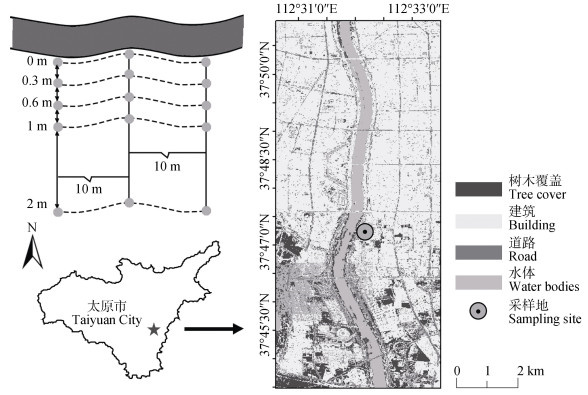
1.2 采样点布设根据汾河太原段河流整治和生态修复工程并结合现场踏勘结果,在汾河太原段生态驳岸布设3条垂直河流且植被类型、密度和长势基本一致的样带,理论上,生态河岸带足够宽即可控制大部分氮磷污染[13]。然而,城市河岸带的宽度相对有限,并且有相关研究[14]表明土壤硝化作用主要影响临时淹没区即1 m范围内,因此本研究在距离河岸边0、0.3、0.6、1 m布设采样点,选择2 m作为对照样点进行土壤样品采集,共设置15个采样点(图 1)。
|
图 1 研究区域图及采样点示意图 Fig. 1 The study area map and sampling point diagram |
经过一周无雨期,于夏季2023年7月19日和秋季2023年10月28日进行土壤样品的采集。采样时,用小铲除去除表层3 mm左右的草根浮土,然后用环刀取0~10 cm和10~20 cm土壤样品带回室内测定土壤容重;用土钻钻取表层0~10 cm和中层10~20 cm的土壤样品,各样点周边3点混合成不少于500 g的样品,部分土样于4 ℃冷藏用于硝化培养实验;部分土样去除石子、植物根系等杂质后风干研磨,过孔径2.00 mm筛,用于土壤理化指标的测定。
1.4 土壤硝化速率测定称取10 g新鲜于放入50 mL培养瓶中,加入30 mL去离子水并25 ℃预培养1 d,吸取培养瓶内液体并过滤取得上清液后测量NO3–-N浓度,然后依次加入1.5 mL的KH2PO4(0.2 mol·L–1)、3.5 mL的K2HPO4(0.2 mol·L–1)、15 mL的(NH4)2SO4(0.05 mol·L–1)溶液,随后用封口膜密封培养瓶并扎出孔洞通气,将培养瓶放入25 ℃摇床中震动24 h。培养完成后,从培养瓶中取出滤液,使用间断化学分析仪(SMARCHEM450)测量培养前后滤液中的NO3–-N浓度,以NO3–-N的产生量除以培养时间计算硝化速率[15]。
| $ N=\frac{1000\left(C_2-C_1\right) V_1}{T M} $ | (1) |
式中,N为硝化速率(mg·kg–1·d–1),C2和C1分别为培养24 h后的NO3–-N浓度和初始浓度(mg·kg–1),V1为培养液体积,T为培养时间,M为基质干重(g)。
1.5 土壤理化指标测定土壤理化指标的测定有土壤质量含水率(WC)、土壤容重(BD)、土壤pH、电导率(EC)、有机质(SOM)、全氮(TN)、NH4+-N、NO3–-N。WC用烘干法测定;BD用环刀法测定;pH用玻璃电极法测定;EC用电极法测定;SOM采用德国耶拿multiN/C仪进行测定;TN、NH4+-N和NO3–-N用全自动间断化学分析仪(SMARCHEM450)测定。具体方法参见《土壤农业化学分析方法》[16]。
1.6 数据处理与分析利用ArcMap 10.8和Adobe Photoshop 2020绘制研究区域图及采样点示意图;采用SPSS 27软件对土壤硝化速率及其土壤理化性质关系进行描述性统计;采用Origin 2022软件进行Spearman相关性分析;使用Canono 5.0软件进行冗余排序分析(Redundancy analysis,RDA)并制作排序图;使用IBM SPSS Amos 26 Graphics绘制结构方程模型图;其余直方图和折线图均用Origin 2022软件绘制。
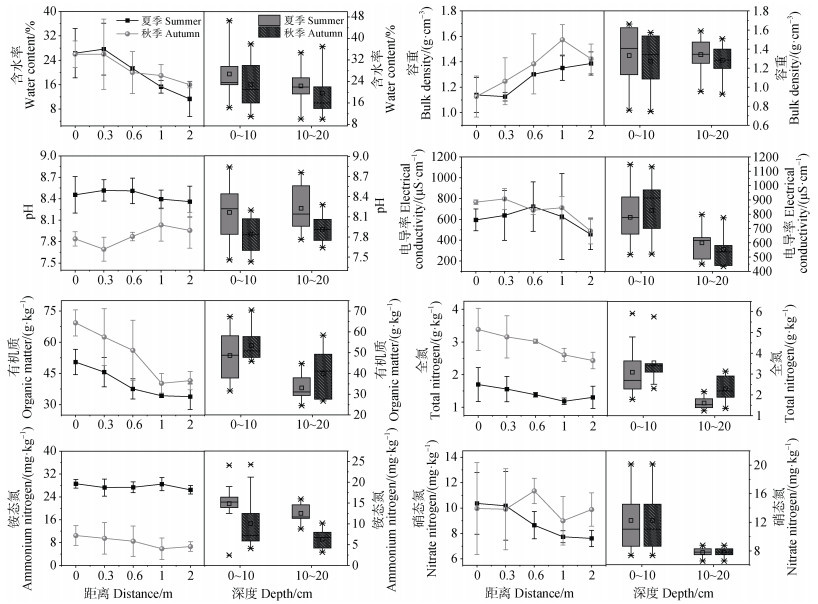
2 结果 2.1 土壤理化性质时空分布特征汾河太原段河岸带土壤时空变化特征如图 2所示:夏季土壤WC、BD平均值要低于秋季;土壤属于碱性土壤;EC的值表明土壤为中度盐化土壤(EC < 570 μS·cm–1为非盐化土,570~760 μS·cm–1为轻度盐化土,760~1240 μS·cm–1为中度盐化土,1240~1920 μS·cm–1为重度盐化土[17]);夏季土壤SOM(40.35 g·kg–1)、TN(1.43 g·kg–1)、NO3–-N(8.91 g·kg–1)平均值远低于秋季土壤SOM(53.94 g·kg–1)、TN(2.92 g·kg–1),NO3–-N(10.02 mg·kg–1);土壤NH4+-N平均值夏季高于秋季。
|
图 2 不同季节土壤理化性质随距岸边不同距离及土壤深度的空间变化 Fig. 2 Spatial variation of soil physicochemical properties with different distances from the shore and soil depth in different seasons |
土壤WC呈现近岸高于远岸,土壤BD呈现远岸高于近岸;土壤pH和EC在距离上变化趋势不一致;随着距离增加,土壤SOM和TN沿河心至边坡有减小的特征;土壤NH4+-N在距离水陆交错带1 m处发生突变;土壤NO3–-N在距离水陆交错带0.6 m处发生突变,但整体上土壤NH4+-N和NO3–-N含量近岸高于远岸。土壤BD随着土壤深度的增加而增大;土壤WC、EC、SOM、TN、NH4+-N、NO3–-N随土壤深度的增加而显著递减。
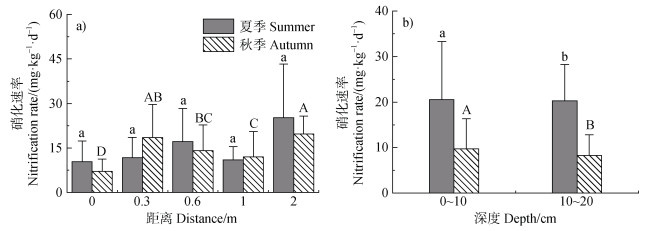
2.2 土壤硝化速率时空分布特征汾河太原段水陆交错带夏季土壤硝化速率在水平距离变化上不具有显著差异(图 3a),垂向深度对水陆交错带土壤具有显著差异(图 3b);秋季水平距离和垂向深度的变化均对土壤硝化速率具有显著差异(图 3)。土壤平均硝化速率夏季(15.12 mg·kg–1·d–1)高于秋季(14.28 mg·kg–1·d–1),土壤硝化速率在距离河岸0 m处最小,在2 m处最大,土壤硝化速率整体上变化规律为先升高后降低;0~10 cm土层硝化速率高于10~20 cm土层(图 3)。
|
注:小写字母表示夏季显著差异性,大写字母表示秋季显著差异性(P < 0.05)。 Note:Lowercase letters indicate significant differences in summer,and uppercase letters indicate significant differences in autumn(P < 0.05). 图 3 不同季节河岸带土壤硝化速率随距岸边不同距离(a)及土壤深度(b)的空间变化特征 Fig. 3 Spatial variation characteristics of soil nitrification rate in riparian zone with different distances from the shore(a)and soil depth(b)in different seasons |
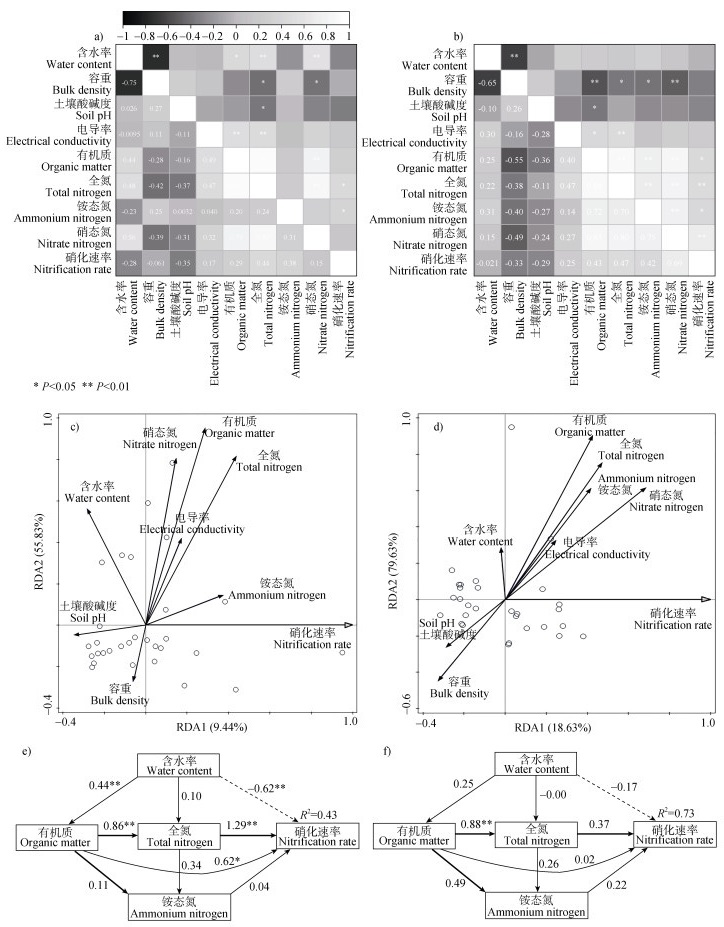
Spearman相关性分析结果表明(图 4a和图 4b):夏季土壤硝化速率与TN、NH4+-N呈显著正相关,土壤TN与土壤SOM、NO3–-N、WC、EC呈显著正相关,与土壤BD、pH呈显著负相关;秋季土壤硝化速率与TN、NH4+-N、NO3–-N、SOM含量呈显著正相关关系。夏秋两季土壤WC与土壤BD均呈显著负相关。
|
注:a):夏季Spearman相关分析;b):秋季Spearman相关分析;c):夏季RDA排序分析;d):秋季RDA排序分析;e):夏季结构方程模型分析;f):秋季结构方程模型分析。图e、f中箭头上的数据为标准化路径系数,实线表示正向影响,虚线表示负向影响。线条粗细表示相关大小。 Note:a):Spearman correlation analysis in summer;b):Autumn Spearman correlation analysis;c):Summer RDA ranking analysis;d):Autumn RDA ranking analysis;e):Summer structural equation model analysis;f):Autumn structural equation model analysis. The data on the arrows in Figures e and f are normalized path coefficients,with solid lines indicating positive influences and dashed lines indicating negative influences. The line thickness indicates the relevant size. 图 4 夏秋季节土壤硝化速率与土壤理化性质分析 Fig. 4 Analysis of soil nitrification rate and soil physicochemical properties in summer and autumn |
RDA排序分析结果表明夏季第1、2排序轴分别解释了9.44 %、55.83 %(图 4c):TN、SOM、NO3–-N、NH4+-N、EC是影响土壤硝化速率的正向因子,WC、BD、pH是影响土壤硝化速率的负向因子;秋季第1、2排序轴分别解释了18.62 %、79.63 %(图 4d),SOM是影响土壤硝化速率的主要因子。
结构方程模型(图 4e和图 4f)结果表明:夏季土壤TN与土壤硝化速率呈极显著正相关,标准化路径系数为1.29;土壤SOM与土壤硝化速率呈显著正相关,标准化系数为0.62;土壤WC与土壤硝化速率呈显著负相关,标准化路径系数为–0.62。秋季土壤各理化性质对土壤硝化速率无显著相关。综合以上三种分析方法可知,夏季汾河太原段水陆交错带土壤硝化速率主要受土壤TN影响。
3 讨论 3.1 土壤理化性质时空变化规律不同地区土壤的土地利用类型、气候、地形条件以及植物群落存在差异,因此土壤理化性质呈现空间差异[18]。有研究表明[19],土壤受到汾河横、纵向水分渗透的影响,秋季大气温度较低,土壤的蒸发量降低导致秋季土壤WC较高。夏季土壤BD低于秋季,这可能主要是因为夏季植物生长茂盛,植物根系的穿插作用导致土壤容重较低[20]。汾河太原段土壤整体呈现碱性,这可能与汾河太原段土壤属于褐土有关[21]。夏季降水较多,夏季植物根部土壤长时间处于水淹缺氧状态,故本研究中夏季土壤NO3–-N含量较低[22]。
土壤SOM随河岸距离的增加而减少,这与姜田亮等[23]在石羊河下游的研究结果不一致,本研究沿水流方向,采样点距离河岸仅2 m,土壤环境容易受河流入渗影响,距离河流较近的土壤碳浓度整体大于距河流较远处[24];土壤NH4+-N、NO3–-N随着离河岸距离的增加而减小,NH4+-N和NO3–-N在距离河岸1 m和0.6 m处发生突变是由于采样该区域树叶等凋落物累积较多,为土壤提供了更多的氮素。
土壤WC表层高于下层是由于表层具有较多枯落物,使得土壤蒸发散失水分时受到枯落物层的阻滞,从而使得表层蒸发较少[25]。土壤BD随深度的增加而增大主要是因为土壤表层有机质含量较高,同时表层土壤团聚体的形成使得土壤中大孔隙增加,质地疏松,土壤容重较小,而在受到荷载压力作用下,下层土壤质地较紧实,土壤容重较大[26]。SOM和TN随土层深度增加而逐渐减低,主要是因为土壤中有机物质主要来源为植物枯落物[27-28]。因此,地表枯落物腐化成为土壤有机质;土壤有机质是全氮的主要来源[29],表层土壤微生物固定和转化氮素能力较强,致使氮组分在表层土壤富集,伴随淋溶作用以及土壤微生物活性随土层降低,深土层氮素较表层土壤低[30];表层土壤NH4+-N、NO3–-N含量高于10~20 cm,大气氮沉降、植被掉落、施肥等人类活动是主要原因[31]。
3.2 土壤硝化速率时空变化规律水陆交错带土壤硝化速率夏季高于秋季,一方面可能是因为在夏季气温高于秋季气温,土壤微生物在适宜温度下能够促进土壤硝化速率的发生,导致夏季土壤硝化速率要高于秋季土壤硝化速率[32-33]。另一方面主要是因为夏季于7月份采取土壤样品温度升高,pH与土壤中理化性质间的交互作用增强,从而进一步影响土壤硝化速率。土壤硝化过程是在微生物作用下进行的,微生物种群的大小和活性影响着土壤硝化作用的强度,而微生物的活动受土壤温度和湿度等环境因素的影响较大,这就形成了土壤硝化速率明显的季节性变化[34]。
从距离变化上看土壤硝化速率的最小值出现在距离河岸0 m处,最大值出现在距离河岸2 m处,土壤硝化速率水平分布特征主要与土壤含水率、有机质、氮素水平密切相关。土壤中的碳是影响土壤硝化速率的重要因素,碳源增加会显著提升土壤的硝化作用,碳源缺乏可能是限制土壤硝化速率的主要因素[35];铵态氮、硝态氮含量是影响硝化速率的主要因素,主要是因为它们作为充足的底物提高了参与土壤氮矿化的微生物生物量,底物浓度越高,土壤硝化速率越大;土壤水分含量不同影响土壤的通气环境,从而影响土壤的厌氧以及好氧环境,土壤硝化作用发生在有氧条件下,因此土壤水分含量是影响土壤硝化的重要因素之一[36]。所测理化指标表明距离水体较近土壤WC、SOM、氮素水平较高,导致0 m处土壤硝化速率低于2 m处。
从土壤剖面垂直分布上看,两个季节均表层土壤硝化速率显著高于深层土壤,这与相关研究得出的土壤硝化作用主要发生在土壤表层结果一致。大量研究表明氧气水平是限制硝化作用的主要因素[37-38]。为了使硝化反应顺利进行,必须有足够的氧气供应,土壤氧含量在充分暴露于空气中的表层土壤中达到最大值,随着土壤深度的增加,土壤湿度和压实度高,O2含量逐渐减少,不利于硝化细菌的生长活性,使得硝化速率减弱[39]。
该研究区域土壤硝化速率显著高于红壤[40]、喀斯特地区[41]的土壤硝化速率,主要由于碱性土壤更有利于硝化作用的发生,在pH较低的环境下,氨气根会衍生出铵根离子,使得土壤环境中氨浓度急速下降,这样会导致微生物氨氧化细菌无法利用养分进行硝化作用,在pH高于6.0时硝化速率就会显著提高[42]。另一方面是由于该区域的有效氮与有机质高于其他研究区域,而土壤氮素与含碳量作为硝化作用的底物导致该区域硝化速率较高。
4 结论太原段汾河水陆交错带在水平距离,土壤含水率呈现近岸高于远岸,土壤容重呈现远岸高于近岸,土壤有机质和全氮沿河心至边坡有减小的特征,整体上土壤铵态氮和硝态氮含量均是近岸要高于远岸。在垂向深度,土壤含水率、电导率、有机质、全氮、铵态氮和硝态氮均随土层深度的增加而减小。夏季土壤含水率、容重、有机质、全氮、硝态氮平均值低于秋季,铵态氮平均值夏季高于秋季。太原段汾河水陆交错带在水平距离上土壤硝化速率在1 m处降低;在垂向上土壤硝化速率随着土层深度的增加而逐渐降低;夏季土壤硝化速率高于秋季。在河流氮污染严重的情况下,充分保护1 m以内的水陆交错带,这将有助于增强河岸带土壤拦截径流氮污染的能力。土壤全氮是夏季汾河太原段水陆交错带土壤硝化速率的主要影响因素。
| [1] |
Jiang Y F, Wu Y Z, Ding D L. Assessment and promotion strategy on landscape holistic adaptation of land-water ecotone in southern Chongming, Shanghai (In Chinese)[J]. Resources and Environment in the Yangtze Basin, 2020, 29(2): 449-458. [姜允芳, 武雅芝, 丁冬琳. 崇南水陆交错带景观整体适应性评价与提升[J]. 长江流域资源与环境, 2020, 29(2): 449-458.]
(  0) 0) |
| [2] |
Yao F, Chen L Q, Wang B Y, et al. Analysis on gradient characteristic of landscape pattern of land use in Chaohu Lake-land ecotone (In Chinese)[J]. Research of Soil and Water Conservation, 2016, 23(3): 214-219. [姚飞, 陈龙乾, 王秉义, 等. 巢湖水陆交错带土地利用景观格局梯度分析[J]. 水土保持研究, 2016, 23(3): 214-219.]
( 0) |
| [3] |
Xiu C, Ouyang Z Y, Zheng H. Flora analysis of riparian vegetation in Yongding-Haihe river system, China (In Chinese)[J]. Acta Ecologica Sinica, 2014, 34(6): 1535-1547. [修晨, 欧阳志云, 郑华. 北京永定河-海河干流河岸带植物的区系分析[J]. 生态学报, 2014, 34(6): 1535-1547.]
( 0) |
| [4] |
Wang C, Yin W, Jia H Y, et al. Review on the influence mechanism of riparian zone to the river ecosystem (In Chinese)[J]. Ecological Science, 2018, 37(3): 222-232. [王超, 尹炜, 贾海燕, 等. 滨岸带对河流生态系统的影响机制研究进展[J]. 生态科学, 2018, 37(3): 222-232.]
( 0) |
| [5] |
Yan L B, Xie C K, Xu X, et al. The influence of revetment types on soil denitrification in the adjacent tidal urban riparian zones[J]. Journal of Hydrology, 2019, 574: 398-407. DOI:10.1016/j.jhydrol.2019.04.071
( 0) |
| [6] |
Li J B, Wang X M, Xie R R, et al. Effects of Spartina alterniflora invasion on sediment nitrification-denitrification processes in the Cyperus malaccensis marsh of the Ming River Estuary (In Chinese)[J]. Acta Scientiae Circumstantiae, 2017, 37(3): 1065-1073. [李家兵, 汪旭明, 谢蓉蓉, 等. 闽江口互花米草入侵过程对短叶茳芏沼泽沉积物硝化-反硝化作用的影响[J]. 环境科学学报, 2017, 37(3): 1065-1073.]
( 0) |
| [7] |
Zhang Y L, Liu Z X, Liu K X, et al. Macro-barcoding using eDNA of benthic animal in Fen River Basin and evaluation of water ecological health (In Chinese)[J]. Wetland Science & Management, 2024, 20(4): 55-60. [张玉蕾, 刘占鑫, 刘凯鑫, 等. 汾河流域底栖动物eDNA宏条形码研究及水生态健康评价[J]. 湿地科学与管理, 2024, 20(4): 55-60.]
( 0) |
| [8] |
Dang J J, Li Y X. Distribution change and influencing factors of pCO2 in Taiyuan section of Fenhe River in winter (In Chinese)[J]. Environmental Protection Science, 2025, 51(1): 89-95. [党佳佳, 李云霄. 冬季汾河太原段水体pCO2的分布变化及影响因素[J]. 环境保护科学, 2025, 51(1): 89-95.]
( 0) |
| [9] |
Zhai B J. Evaluation and optimization of urban river landscape—Taking Taiyuan section of Fenhe River as an example[D]. Taigu, Shanxi: Shanxi Agricultural University, 2021.[翟毕娇. 城市河道景观评价与优化——以汾河太原段河道为例[D]. 山西太谷: 山西农业大学, 2021.]
( 0) |
| [10] |
Liu G M, Yang X Y, Zhen Z L, et al. Evaluation of water quality in Taiyuan Fenhe Park (In Chinese)[J]. Forest Inventory and Planning, 2020, 45(4): 109-113. DOI:10.3969/j.issn.1671-3168.2020.04.021 [刘广敏, 杨秀云, 甄志磊, 等. 太原汾河公园水质现状评价[J]. 林业调查规划, 2020, 45(4): 109-113.]
( 0) |
| [11] |
Yan C Y, Yuan L S, Zhang X P, et al. Study on bird feeding tree species in the green space of Fenhe Park in Taiyuan City (In Chinese)[J]. Shanxi Forestry Science and Technology, 2023, 52(3): 16-19. [闫彩云, 原林山, 张先平, 等. 太原市汾河公园绿地中鸟类食源树种研究[J]. 山西林业科技, 2023, 52(3): 16-19.]
( 0) |
| [12] |
Pei T T, He J Y, Wu X G, et al. Research on street tree composition, growth structure characteristics and correlation with socioeconomic conditions in Taiyuan, China (In Chinese)[J]. Chinese Landscape Architecture, 2023, 39(8): 115-120. [裴婷婷, 贺金钰, 武小钢, 等. 太原市行道树结构特征及其与社会经济因素相关性研究[J]. 中国园林, 2023, 39(8): 115-120.]
( 0) |
| [13] |
Aguiar T R Jr, Rasera K, Parron L M, et al. Nutrient removal effectiveness by riparian buffer zones in rural temperate watersheds: The impact of no-till crops practices[J]. Agricultural Water Management, 2015, 149: 74-80. DOI:10.1016/j.agwat.2014.10.031
( 0) |
| [14] |
Yan L B, Xie C K, Xu X, et al. Effects of revetment type on the spatial distribution of soil nitrification and denitrification in adjacent tidal urban riparian zones[J]. Ecological Engineering, 2019, 132: 65-74. DOI:10.1016/j.ecoleng.2019.04.005
( 0) |
| [15] |
Xu D F, Li Y X, Howard A, et al. Effect of earthworm Eisenia fetida and wetland plants on nitrification and denitrification potentials in vertical flow constructed wetland[J]. Chemosphere, 2013, 92(2): 201-206. DOI:10.1016/j.chemosphere.2013.03.016
( 0) |
| [16] |
Lu R K
. Analytical methods for soil and agro-chemistry (In Chinese). Beijing: China Agricultural Science and Technology Press, 2000. [鲁如坤
. 土壤农业化学分析方法[M]. 北京: 中国农业科技出版社, 2000.]
( 0) |
| [17] |
Han J X, Gu X W, Cheng C X, et al. Research on the spatial variability and synergism of soil salt and physical properties in different soil irrigation areas (In Chinese)[J]. China Rural Water and Hydropower, 2020(10): 148—152, 158. [韩金旭, 谷晓伟, 程春晓, 等. 不同土质灌区土壤盐分与物理特性空间变异规律及协同关系研究[J]. 中国农村水利水电, 2020(10): 148—152, 158.]
( 0) |
| [18] |
Li E Y, He G Y. Tibetan Plateau alpine meadow soil properties and enzyme activity in response to fertilization gradients in different seasons (In Chinese)[J]. Guihaia, 2014, 34(4): 467—472, 449. [李恩宇, 何贵永. 青藏高原高寒草甸不同季节土壤理化性质及酶活性对施肥处理的响应[J]. 广西植物, 2014, 34(4): 467—472, 449.]
( 0) |
| [19] |
Zheng W X. Study on spatial variability and influencing factors of soil organic carbon in Karst Area[D]. Guiyang: Guizhou Normal University, 2021.[郑维熙. 岩溶地区土壤有机碳的空间变异特征及其影响因素研究[D]. 贵阳: 贵州师范大学, 2021.]
( 0) |
| [20] |
Yang W H, Wang M H, Li W P, et al. Effects of land use types on soil organic carbon in the South China Sea wetland (In Chinese)[J]. Ecology and Environmental Sciences, 2018, 27(6): 1034-1043. [杨文焕, 王铭浩, 李卫平, 等. 黄河湿地包头段不同地被类型对土壤有机碳的影响[J]. 生态环境学报, 2018, 27(6): 1034-1043.]
( 0) |
| [21] |
Shi Y Q, Wang N L. Temporal and spatial dynamics of soil erosion sensitivity in Taiyuan (In Chinese)[J]. Journal of Gansu Agricultural University, 2023, 58(5): 199-210. [石玉琼, 王宁练. 太原市土壤侵蚀敏感性的时空动态[J]. 甘肃农业大学学报, 2023, 58(5): 199-210.]
( 0) |
| [22] |
Tan X, Dong Z, Zhang L M, et al. Seasonal dynamics of soil physicochemical properties, enzyme activity and bacterial diversity of three re-vegetation species in the riparian zone of the Three Gorges Reservoir area (In Chinese)[J]. Journal of Chongqing Normal University: Natural Science, 2023, 40(4): 59-69. [谭雪, 董智, 张丽苗, 等. 三峡库区消落带3种人工种植植物土壤理化性质、酶活性及细菌多样性季节变化特征[J]. 重庆师范大学学报: 自然科学版, 2023, 40(4): 59-69.]
( 0) |
| [23] |
Jiang T L, Zhang H J, Ji Y F, et al. The relationship between spatial variation of vegetation cover and soil factors in desert riparian zone (In Chinese)[J]. Journal of Gansu Agricultural University, 2019, 54(4): 131-141. [姜田亮, 张恒嘉, 纪永福, 等. 荒漠河岸带植被盖度的空间变化与土壤因子关系的探究[J]. 甘肃农业大学学报, 2019, 54(4): 131-141.]
( 0) |
| [24] |
Zhao M F. Study on soil microorganisms and denitrification rate in the riparian zone of the lower Fenhe River[D]. Xi'an: Xi'an University of Technology, 2022.[赵梦凡. 汾河下游河岸带土壤微生物及反硝化速率研究[D]. 西安: 西安理工大学, 2022.]
( 0) |
| [25] |
Shang J X, Zuo L P, Xi Z C, et al. Trends in soil moisture and litter changes in different afforestation sites (In Chinese)[J]. Contemporary Horticulture, 2023, 46(11): 58-61. [尚金霞, 左利萍, 席忠诚, 等. 不同造林地土壤水分及枯落物变化趋势[J]. 现代园艺, 2023, 46(11): 58-61.]
( 0) |
| [26] |
Wang S M, Zhang H L, Zhang H S, et al. Distribution characteristics and influencing factors of soil bulk density at different soil layers in typical small watershed in loess region of western Shanxi Province (In Chinese)[J]. Chinese Journal of Ecology, 2024, 43(3): 609-615. [王思敏, 张红丽, 张恒硕, 等. 晋西黄土区典型小流域不同土层土壤容重分布特征及其影响因素[J]. 生态学杂志, 2024, 43(3): 609-615.]
( 0) |
| [27] |
Zhang T J, Chen Y J, Liu J Z. Spatial distribution of soil salinity and nutrients under different vegetation communities in Yellow River Estuary wetland (In Chinese)[J]. Soils, 2020, 52(1): 180-187. [张天举, 陈永金, 刘加珍. 黄河口湿地不同植物群落土壤盐分与养分分布特征[J]. 土壤, 2020, 52(1): 180-187.]
( 0) |
| [28] |
Cong J, Wang X L, Liu X, et al. The distribution variation and key influencing factors of soil organic carbon of natural deciduous broadleaf forests along the latitudinal gradient[J]. Acta Ecologica Sinica, 2016, 36(5): 333-339.
( 0) |
| [29] |
Li Z W, Liu C, Dong Y T, et al. Response of soil organic carbon and nitrogen stocks to soil erosion and land use types in the Loess hilly–gully region of China[J]. Soil & Tillage Research, 2017, 166: 1-9.
( 0) |
| [30] |
Tan H, Tuo Y F, Feng Y Y, et al. Vertical characteristics and seasonal dynamics of soil nitrogen components at different elevations in Liziping nature reserve, Sichuan (In Chinese)[J]. Journal of Soil and Water Conservation, 2024, 38(2): 234-245. [谭豪, 脱云飞, 冯永钰, 等. 四川栗子坪自然保护区不同海拔土壤氮组分垂直特征及季节动态[J]. 水土保持学报, 2024, 38(2): 234-245.]
( 0) |
| [31] |
Li B L, Yang L H, Song X F, et al. The influence of soil physics and chemical properties on groundwater nitrogen pollution in the riparian zone of Shaying River (In Chinese)[J]. China Environmental Science, 2024, 44(7): 3955-3965. [李宝玲, 杨丽虎, 宋献方, 等. 沙颍河典型河段河岸带土壤理化性质对地下水氮污染的影响[J]. 中国环境科学, 2024, 44(7): 3955-3965.]
( 0) |
| [32] |
Jahangir M R, Fenton O, Carolan R, et al. Application of 15N tracing for estimating nitrogen cycle processes in soils of a constructed wetland[J]. Water Research, 2020, 183: 116062.
( 0) |
| [33] |
Qiu Z C, Wang M, Lai W L, et al. Plant growth and nutrient removal in constructed monoculture and mixed wetlands related to stubble attributes[J]. Hydrobiologia, 2011, 661(1): 251-260.
( 0) |
| [34] |
Bai R J, Yang Z P, Zhang Q, et al. Soil nitrogen mineralization and nitrification under Caragana microphylla shrubs of different ages in the northwestern Shanxi Loess Plateau (In Chinese)[J]. Acta Ecologica Sinica, 2016, 36(24): 8008-8014. [白日军, 杨治平, 张强, 等. 晋西北不同年限小叶锦鸡儿灌丛土壤氮矿化和硝化作用[J]. 生态学报, 2016, 36(24): 8008-8014.]
( 0) |
| [35] |
Wang D P, Zheng L, Luo X H, et al. Nitrification and denitrification under different temperature, moisture, carbon and nitrogen sources in latosols (In Chinese)[J]. Chinese Journal of Soil Science, 2018, 49(3): 616-622. [王大鹏, 郑亮, 罗雪华, 等. 砖红壤不同温度、水分及碳氮源条件下硝化和反硝化特征[J]. 土壤通报, 2018, 49(3): 616-622.]
( 0) |
| [36] |
Cong J J, Ma J L, Li S H, et al. Changes in the community structure of nitrification and denitrification microorganisms in black soil under different water contents (In Chinese)[J]. Journal of Plant Nutrition and Fertilizer Science, 2023, 29(8): 1400-1410. [丛兢兢, 马君玲, 李顺和, 等. 不同水分含量下黑土硝化反硝化微生物群落结构的变化[J]. 植物营养与肥料学报, 2023, 29(8): 1400-1410.]
( 0) |
| [37] |
Rivas A, Singh R, Horne D, et al. Denitrification potential in the subsurface environment in the Manawatu River catchment, New Zealand: Indications from oxidation-reduction conditions, hydrogeological factors, and implications for nutrient management[J]. Journal of Environmental Management, 2017, 197: 476-489.
( 0) |
| [38] |
Li Y Y, Chapman S J, Nicol G W, et al. Nitrification and nitrifiers in acidic soils[J]. Soil Biology & Biochemistry, 2018, 116: 290-301.
( 0) |
| [39] |
Yang Y J, Zhang H P, Shan Y H, et al. Response of denitrification in paddy soils with different nitrification rates to soil moisture and glucose addition[J]. Science of the Total Environment, 2019, 651: 2097-2104.
( 0) |
| [40] |
Zhu T B, Zeng S M, Qin H L, et al. Low nitrate retention capacity in calcareous soil under woodland in the Karst region of southwestern China[J]. Soil Biology & Biochemistry, 2016, 97: 99-101.
( 0) |
| [41] |
Sun M M. Microbial mechanisms of soil nitrification and denitrification affected by karst vegetation restoration[D]. Wuhan: Huazhong Agricultural University, 2023.[孙明明. 喀斯特植被恢复影响土壤硝化和反硝化作用的微生物机制[D]. 武汉: 华中农业大学, 2023.]
( 0) |
| [42] |
Subbarao G V, Yoshihashi T, Worthington M, et al. Suppression of soil nitrification by plants[J]. Plant Science, 2015, 233: 155-164.
( 0) |