 2025, Vol. 62


2. 北京师范大学环境学院, 北京 100875
2. School of Environment, Beijing Normal University, Beijing 100875, China
工业化和城镇化的快速发展显著增加了污染物的排放,对土壤生态系统健康和可持续性构成了直接威胁[1]。《全国土壤污染状况调查公报》显示全国土壤的点位超标率为16.1%,其中,多环芳烃(PAHs)污染点位超标率达到1.4%[2],PAHs因其致癌、致畸、致突变等特征,不仅对生态环境带来严重影响,也对人体健康构成潜在威胁,已成为全球关注的焦点之一。包含PAHs在内的多种污染物具有较强的扩散性,可通过迁徙物种、空气、地表径流或地下水流动等途径远距离扩散,在远离污染源的地区沉积并积累[3-4]。近年来,多项研究在自然生态系统中检测到PAHs污染,包括多个自然保护区:黄河三角洲自然保护区的土壤PAHs致癌风险值已超过健康管控值,有潜在致癌风险[5];大湾区淇澳自然保护区、福田自然保护区土壤PAHs污染水平分别达到轻度、严重污染程度[6]。
森林和草原是典型的自然生态系统,为人类提供各种生态系统服务,包括调节生态平衡、保护环境和孕育生物多样性等[7-8]。全球范围草原面积约为5 254万km2,占土地面积的40.5%(不包括格陵兰岛和南极)[9],我国草原面积265万km2,约占国土面积的27.5%,类型涵盖典型草原、草甸草原、荒漠草原和高寒草甸等[10]。我国的森林面积为231万km2,森林覆盖率为24%[11],森林类型和资源分布受地形、气候等自然条件的影响,各地区存在显著差异。研究表明,草原和森林土壤逐渐受到多种污染物的影响[12],然而,目前针对我国森林、草原等自然生态系统土壤PAHs污染状况及其来源解析的研究仍较为有限。
PAHs的主要来源包括天然源和人为源两类:天然源包括燃烧(如火山活动、森林和草原野火等)及生物合成(如沉积物成岩、生物转化过程、微生物、原生动物、藻类和高等植物的合成等)[13]。人为源主要包括石油产品泄漏、化石燃料和生物质燃烧、机动车尾气、家用炊具排放等[14]。明确土壤污染来源对于确定污染责任主体、制定适宜的管控措施至关重要。因此,本研究采集了典型森林和草原生态系统的土壤样品,分析土壤中PAHs的污染特征,定量识别各生态系统土壤PAHs的主要来源,以期为自然生态系统保护及污染防控提供科学依据和数据支撑。
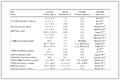
1 材料与方法 1.1 土壤样品采集根据气候和植被类型,选取了5个森林生态系统和3个草原生态系统作为研究对象,分别为帽儿山森林(MEF)、西山森林(XSF)、神农架森林(SNF)、鼎湖山森林(DHF)、西双版纳森林(BNF)、呼伦贝尔草原(HLG)、张北草原(ZBG)和鄂尔多斯草原(ORG)。各采样点地理坐标、海拔、生态系统类型、土壤类型、气候特征如表 1所示。2021年,在各生态系统中采集表层土壤样品(0~20 cm)。每个地点设置6个样方(5 m×5 m)。去除凋落物层后,使用无菌土壤取样器(内径5 cm)于每个样方的四个角落及中心共采集5个土壤样品,充分混合后形成1个混合土壤样品。每个生态系统共获得6个混合土壤样品。采集的土壤样品置于无菌密封袋中,保存在冰盒中带回实验室。取出土壤样品中的植物根系、残体和石块等杂质,储存于4 ℃,用于理化性质和污染物含量测试。
|
表 1 典型森林和草原生态系统采样点的地理坐标、生态系统类型、土壤类型和气候特征 Table 1 Geographic coordinates, ecosystem type, soil type, and climatic characteristics of the sampling sites in typical forest and grassland ecosystems |
土壤pH的测定使用电极法(水︰土质量比为2.5︰1),用校正后的pH计(PHS-2F,雷磁,上海)测定。土壤含水率采用重量法测定。风干土壤样品过120目筛后,使用元素分析仪(EA3000,Eurovector,意大利)测定全碳和全氮含量。使用元素分析仪(EA3000,Eurovector,意大利)测定土壤有机碳含量。用电感耦合等离子发射光谱仪(ICP-OES,iCAP-7600,Thermo Fisher Scientific,美国)测定土壤中的全磷含量[15]。土壤粒径采用激光粒度分析仪(LS13320,Beckman Coulter,美国)测定,按照砂粒2.00~0.05 mm、粉粒0.05~0.002 mm、黏粒小于0.002 mm分级[16]。
1.3 土壤PAHs含量测试方法本研究主要测定16种优先控制PAHs,包括萘(Nap)、苊烯(Acy)、苊(Ace)、芴(Flu)、菲(Phe)、蒽(Ant)、荧蒽(Flt)、芘(Pyr)、苯并[a]蒽(BaA)、䓛(Chr)、苯并[b]荧蒽(BbF)、苯并[k]荧蒽(BkF)、苯并[a]芘(BaP)、二苯并[a,h]蒽(DahA)、茚并[1,2,3-cd]芘(IcdP)、苯并[g,h,i]芘(BghiP)。测定方法采用内标法,利用气相色谱-质谱联用仪(GC-MS,Varian 4000,美国)测定,色谱柱为DB-5MS(30 m×0.25 mm×0.25 μm),具体分析方法参照文献[17]。测得样品PAHs加标回收率范围是75%~108%,达到样品测试要求。测试使用的正己烷、二氯甲烷等溶剂均为色谱级,购自于上海阿拉丁生化科技股份有限公司,PAHs标准品、氘代PAHs内标混合液、二氟联苯等购自坛墨质检科技股份有限公司。
1.4 土壤PAHs源解析方法本研究采用特征比值法与正定矩阵因子分解模型(PMF)对土壤中多环芳烃的污染源进行识别与解析。特征比值法可通过已知污染源的典型比值对污染类型进行初步判断,而PMF模型则基于观测数据分解污染源的组成与贡献率,适用于复杂环境样品的定量溯源分析[18]。
1.4.1 特征化合物比值法特征比值法通过对相对稳定的各类多环芳烃含量比值来解析土壤PAHs来源,Flt/(Flt+Pyr)、BaA/(BaA+Chr)、Ant/(Ant+Phe)和IcdP/(IcdP+BghiP)具有较好的稳定性,可作为PAHs潜在污染源的特征比值,已被广泛用于评估PAHs的来源[19]。各比值的取值和对应来源如表 2所示。
|
|
表 2 特征化合物比值代表的多环芳烃(PAHs)来源[19-20] Table 2 Sources of polycyclic aromatic hydrocarbons(PAHs)represented by ratios of characteristic compounds[19-20] |
 ;Ant,蒽;Phe,菲;Flt,荧蒽;Pyr,芘。下同。Note:IcdP:Indeno[1,2,3-cd]perylene;BghiP,Benzo[g,h,i]pyrene;BaA,Benz[a]anthracene;Chr,Chrysene;Ant,Anthracene;Phe,Phenanthrene;Flt,Fluoranthene;Pyr,Pyrene. The same below.
PMF是一种受体模型,可在源未知的情况下使用,应用非负因子分析方法有效避免分解过程中产生负值,是定量源解析的有效工具[18],已广泛应用在大气环境、水体、沉积物等介质,在土壤污染源解析中也有有效应用[14,21]。模型依据式(1)进行源分配,并使用式(2)计算累积残差Q作为模型误差的度量:
| $\begin{equation*} X_{i j}=\sum\limits_{k=1}^{p} \boldsymbol{g}_{i k} \boldsymbol{f}_{k j}+\boldsymbol{e}_{i j} \end{equation*}$ | (1) |
| $\begin{equation*} Q=\sum\limits_{i=1}^{n} \sum\limits_{j=1}^{m}\left(\frac{\boldsymbol{e}_{i j}}{\mu_{i j}}\right)^{2} \end{equation*} $ | (2) |
式中,i为样本数;j为污染物种类;p为影响样本的总因子数;Xij为第i个样本中第j种污染物浓度,mg·L–1;gik为第i个样本中第k个源的贡献矩阵;fkj为每个源的成分矩阵;eij为残差矩阵;Q为累积残差;µij为第i个样本中第j种污染物的不确定度,µij的计算公式为:
| $\mu_{i j}= \begin{cases}\frac{5}{6} \times \mathrm{MDL} & (c \leqslant \mathrm{MDL}) \\ \sqrt{(\mathrm{EF} \times c)^{2}+(0.5 \times \mathrm{MDL})^{2}} & (c>\mathrm{MDL})\end{cases} $ | (3) |
式中,MDL为方法检出限,mg·L–1;EF为不确定百分数,%;c为每个样本的污染物浓度,mg·L–1。
2 结果与讨论 2.1 典型森林和草原生态系统土壤理化性质差异典型森林和草原生态系统土壤理化性质如表 3所示。森林土壤的含水率普遍高于草原土壤,这可能与其较密集的林冠覆盖和较高的土壤有机质含量有关,从而增强土壤的保水能力[22]。不同生态系统之间的土壤养分含量存在差异,其中全磷含量在各生态系统土壤中差异较小;森林土壤的全碳、全氮和有机碳含量普遍高于草原土壤,这可能与森林生态系统中较为丰富的凋落物输入和有机质积累密切相关[23]。就土壤酸碱性而言,森林土壤普遍呈酸性,这可能与凋落物分解过程中产生的有机酸有关;而草原土壤则呈中性至碱性。各生态系统土壤的质地存在显著差异,这与成土母质和气候条件有着密切的联系[24]。
|
|
表 3 典型森林和草原生态系统土壤理化性质 Table 3 Soil physicochemical properties of typical forest and grassland ecosystems |
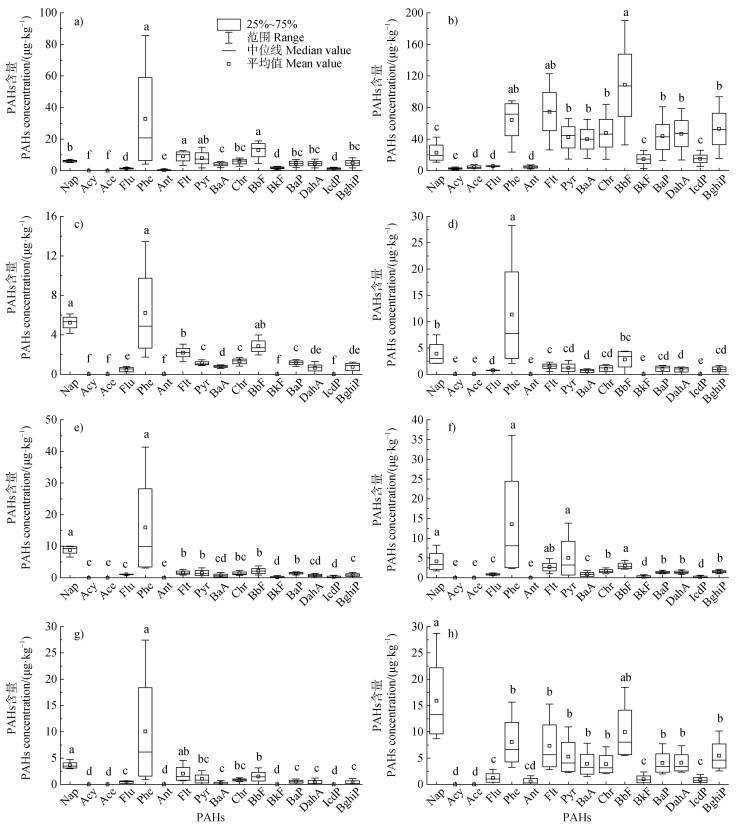
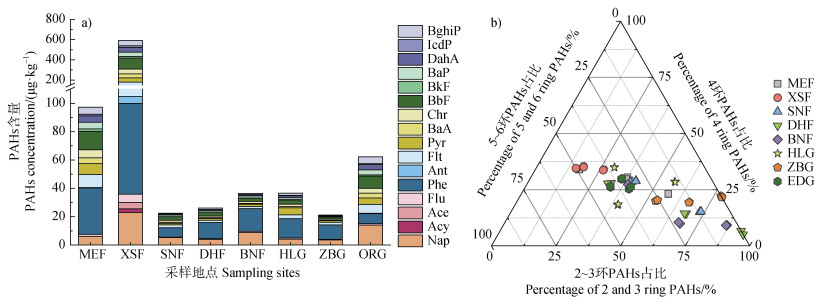
各生态系统表层土中PAHs的含量和低、中、高环PAHs分布如图 1和图 2所示。草原生态系统土壤总PAHs(∑PAHs)范围为HLG14.66~90.21 μg·kg–1、ZBG7.11~46.86 μg·kg–1、ORG38.46~137.42 μg·kg–1。森林生态系统土壤∑PAHs范围为MEF31.81~164.40 μg·kg–1、XSF208.82~976.47 μg·kg–1、SNF18.86~24.80 μg·kg–1、DHF10.87~46.05 μg·kg–1、BNF19.92~60.49 μg·kg–1。MEF、SNF、DHF、BNF土壤中Phe是含量最高的PAHs;XSF土壤中∑PAHs含量显著高于其他森林生态系统,并且4环以上的PAHs含量占比较高,这与Qu等[25]对北京城市公园土壤中PAHs含量(66~6867 μg·kg–1)的研究结果一致。这可能是由于XSF位于北京,而在超大城市环境中,交通源是PAHs的重要来源之一。赵冰帅等[26]分析了我国路域农田土壤的PAHs含量,范围为86.4~3568 μg·kg–1,高于本研究中自然生态系统森林和草原土壤;马妍等[27]汇总了我国近年来表层土壤PAHs污染水平,范围为313.1~1 070.45 μg·kg–1,并呈现显著的区域性特征:东北、西北地区的土壤PAHs含量较高,而南方地区的污染则呈现西高东低的趋势。该现象与本研究中各森林、草原土壤中PAHs含量的趋势一致。然而,本研究中,除XSF外,其他自然生态系统的土壤PAHs含量均处于较低的污染水平。
|
注:Nap,萘;Acy,苊烯;Ace,苊;Flu,芴;BbF,苯并[b]荧蒽;BkF,苯并[k]荧蒽;BaP,苯并[a]芘;DahA,二苯并[a,h]蒽。图中不同字母表示PAHs组分含量差异显著(P < 0.05)。下同。 Note: Nap: Naphthalene; Acy: Acenaphthylene; Ace: Acenaphthene; Flu: Fluorene; BbF: Benzo[b]fluoranthene; BkF: Benzo[k]fluoranthene; BaP: Benzo[a]pyrene; DahA: Dibenz[a, h]anthracene. Different letters indicate significant differences between PAH component concentrations at the level of 0.05. The same below. 图 1 典型森林和草原生态系统土壤中PAHs组分含量分布(a. MEF,b. XSF,c. SNF,d. DHF,e. BNF,f. HLG,g. ZBG,h. ORG) Fig. 1 Distribution of PAH component concentrations in soils of typical forest and grassland ecosystems(a. MEF, b. XSF, c. SNF, d. DHF, e. BNF, f. HLG, g. ZBG, h. ORG) |
|
注:a)不同生态系统土壤16种PAHs浓度组成;b)不同环数PAHs百分比。 Note: a)Concentrations of 16 PAHs in different ecosystems, b)Percentage of PAHs in different ring numbers. 图 2 不同生态系统采样点土壤中PAHs的浓度组成与环数分布特征 Fig. 2 Concentration composition and ring-based distribution of PAHs in soils from typical forest and grassland ecosystems |
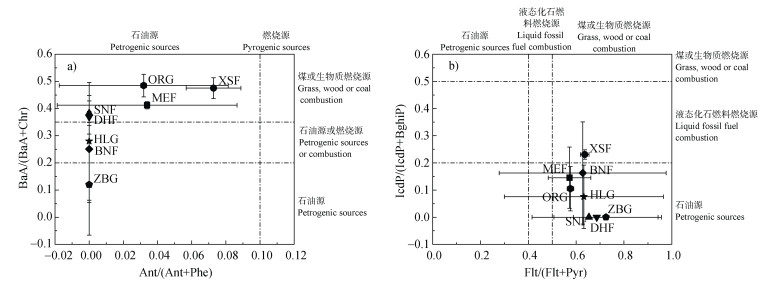
典型森林和草原生态系统土壤PAHs特征比值如图 3所示,总体而言,Ant/(Ant+Phe)小于0.10,73.3%的BaA/(BaA+Chr)大于0.35,83.3%的Flt/(Flt+Pyr)大于0.5,62.2%的IcdP/(IcdP+BghiP)小于0.2。典型森林和草原生态系统土壤PAHs主要受石油源和煤或生物质燃烧源的影响,XSF土壤还受液态化石燃料燃烧的影响,主要来源于过路车辆的污染物排放(包括油品泄漏、交通尾气等)[28]。此外,石油源对自然生态系统的影响较大,而在以工业为主的城市土壤中,燃烧源通常是主要的污染来源[19]。
|
注:a)Ant/(Ant+Phe)和BaA/(BaA+Chr);b)Flt/(Flt+Pyr)和IcdP/(IcdP+BghiP);图中各生态系统PAHs特征比值数据表示为平均值与标准差。 Note: a)Ant/(Ant+Phe)and BaA/(BaA+Chr); b)Flt/(Flt+Pyr)and IcdP/(IcdP+BghiP). The diagnostic ratios of PAHs in each ecosystem are presented as mean values(points with different shapes)and standard deviation(error bars). 图 3 典型森林和草原生态系统土壤PAHs特征比值 Fig. 3 Diagnostic ratios of PAHs in soils of typical forest and grassland ecosystems |
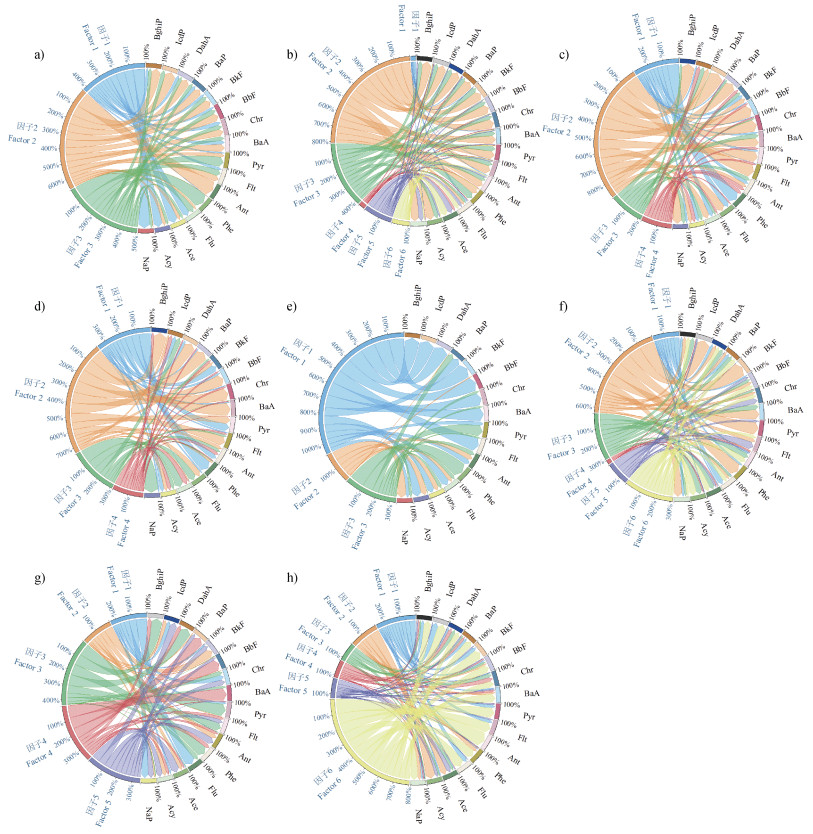
特征比值法可有效推测PAHs形成的可能过程,但是由于形成过程具有较大的不确定性,仅凭特征比值法无法得出明确结论,需进一步开展来源的定量分析。为此,采用PMF法进一步定量确定各自然生态系统土壤中PAHs的来源。在PMF模拟过程中,为选择最佳因子数,测试了各生态系统土壤PAHs分别选用3至6个因子时的解析结果,根据PMF运行结果中的Q值、残差以及测量值与模拟值之间相关性,选择了最佳因子数进行分析。其中,MEF和BNF均识别出3个因子;SNF和DHF均识别出4个因子;ZBG识别出5个因子;XSF、HLG和ORG均识别出6个因子。根据PMF运算结果中各因子载荷的PAHs比例以及各PAHs对应的指纹图谱,综合确定了PMF各因子所代表的PAHs来源。图 4展示了各生态系统土壤中PAHs通过PMF源解析后的指纹图谱,以及各PAHs在源中的负荷大小。
|
图 4 基于PMF模型的典型森林和草原生态系统土壤PAHs源贡献率(a. MEF,b. XSF,c. SNF,d. DHF,e. BNF,f. HLG,g. ZBG,h. ORG) Fig. 4 Source contribution of PAHs in soils of typical forest and grassland ecosystems based on the PMF models(a. MEF, b. XSF, c. SNF, d. DHF, e. BNF, f. HLG, g. ZBG, h. ORG) |
MEF土壤中3个因子对PAHs含量的贡献率分别为26.6%、41.6%和31.8%。因子1中Nap、Acy、Ace、Flu等低环PAHs载荷较高,这些PAHs与石油挥发泄漏相关,推测因子1为石油挥发泄漏源[29];因子2中载荷较高的是Ant和高环PAHs,DahA和IcdP等高环PAHs是车辆排放的指示物,推测因子2为交通排放源[30];因子3中载荷较高的为Phe、Flt和Pyr,是燃煤源的典型标志,推测因子3为燃煤源[31]。类似地,BNF的3个因子贡献率分别为66.6%、12.4%和21.0%,推测因子1至因子3分别为交通排放源、石油挥发泄漏源和燃煤源。
SNJ土壤中4个因子对PAHs含量的贡献率分别为18.3%、55.9%、13.6%和12.2%。其中,因子1中Phe载荷较高,推测因子1为燃煤源;因子2的中高环PAHs载荷较高,柴油车尾气中的PAHs主要以四环为主,而汽油车尾气中以5~6环为主[4],推测因子2为交通排放源;因子3中Nap、BaA和IcdP载荷较高,一些工业活动,包括焦炭生产以及煤焦油蒸馏等,释放热解PAHs(即BaA、Chr、IcdP和BghiP)和低分子量PAHs(如Nap和Acy等),BaA为焦炭炉排放的特征指标,推测因子3为焦化源[30]。因子4中,Acy、Ant和IcdP载荷较高,Acy和Ant通常被视为生物质燃烧的标志组分[32],推测因子4为生物质燃烧源。类似地,DHF土壤中因子1推测为燃煤源,贡献率为22.3%,因子2为交通排放源,贡献率为45.9%,因子3为石油挥发泄漏源,贡献率为19.5%,因子4为生物质燃烧源,贡献率为12.4%。
ZBG土壤中5个因子对PAHs的贡献率分别为14.7%、12.3%、27.1%、23.8%和22.1%。因子1中NaP和Flu载荷最高,推测为石油挥发泄漏源;因子2中Ant和BkF载荷最高,Acy和Ace在因子2有中等载荷,推测为燃煤源[31];因子3中Pyr、DahA、BghiP载荷较高,推测为交通排放源[30];因子4中BaA、BbF、BaP载荷较高,推测为焦化源;因子5中Acy、Ant和IcdP载荷较高,推测为生物质燃烧源。
XSF土壤的因子1贡献率为2.0%,Flu、Ant和BaP载荷较高,推测为生物质燃烧源;因子2贡献率为50.5%,高环PAHs载荷高,推测为交通排放源;因子3贡献率为26.5%,Phe载荷较高,推测为燃煤源;因子4贡献率为2.5%,Ace载荷最高,符合商业杂酚油的特征,代表商业杂酚油源[33];因子5贡献率为11.5%,Nap、Acy、Ace和Flu等低环PAHs载荷较高,是石油挥发泄漏源的典型特征[29];因子6贡献率为7.0%,Ace和Flu载荷较高,推测为焦化源[30]。类似地,HLG土壤的PMF解析的6因子识别及贡献率分别为:因子1(石油源挥发泄漏源)10.6%,因子2(燃煤源)39.6%,因子3(汽油源)18.9%,因子4(商业杂酚油源)1.7%,因子5(柴油源)9.4%,因子6(生物质燃烧源)19.8%。其中,交通排放中的汽油源主要释放BbF、Flu、IcdP、Chr、Pyr和BaP等,柴油源则以BaA、Chr、IcdP、BkF为主[30]。ORG土壤中PMF解析的6因子及贡献率分别为因子1(生物质燃烧源)16.1%、因子2(石油挥发泄漏源)11.4%、因子3(柴油源)7.4%、因子4(汽油源)7.1%、因子5(焦化源)7.9%、因子6(燃煤源)50.2%。
综上所述,8个典型自然生态系统均受到较多人为源影响,尤其是森林生态系统土壤,主要受到交通排放的强烈影响,贡献率41.6%~55.9%;其次是燃煤源,贡献率18.3%~31.8%;MEF地区石油挥发泄漏源贡献率在研究的生态系统中最高,这可能与黑龙江省较高的石油储量以及石油开采和利用活动有关[26]。HLG和ORG土壤PAHs,燃煤源贡献率最高,分别为39.6%和50.2%;而交通排放源对ZBG土壤PAHs的贡献率最高,为27.1%。该现象可能与HLG地区较低的平均温度和较高的煤炭采暖需求密切相关,这与Sun等[34]研究发现的呼伦湖沉积物中燃煤源占比最高的结果一致。ORG位于鄂尔多斯,是重要的能源战略基地和工业城市,鄂尔多斯的煤炭产量约占全国的六分之一,煤炭的开采、加工和利用导致燃煤源PAHs占比较高;而ZBG位于京津冀经济带,交通密集且旅游业发达,因此交通排放源贡献较高。此外,草原生态系统土壤中生物质燃烧源对PAHs贡献率较高,为16.1%~22.1%,高于森林生态系统。森林火灾和草原火灾均为PAHs的生物质燃烧源,而草原相对距离耕地更近,秸秆焚烧等活动对草原土壤PAHs的影响较大[35]。
通过特征比值法与PMF模型,识别并定量解析了典型自然生态系统土壤PAHs的主要污染来源。结果表明,森林和草原生态系统已受到人为活动的显著影响。污染源解析结果有助于厘清污染物的输入路径与主导成因,进一步指导区域生态保护策略的制定,提高污染治理的精准性与生态保护的有效性。未来可结合稳定同位素和生物标志物等技术,进一步深化污染来源识别,增强源解析的机制解释。
3 结论不同生态系统土壤PAHs总含量差异显著,草原生态系统土壤的16种PAHs含量范围为7.11~137.42 μg·kg–1;森林土壤PAHs污染水平为10.87~976.47 μg·kg–1。西山森林因位于超大城市受交通排放影响,土壤PAHs含量高于其他生态系统。森林生态系统土壤PAHs的主要来源为交通排放源和燃煤源,贡献率分别为41.6%~55.9%和18.3%~31.8%;草原生态系统中,张北草原土壤PAHs主要来源于交通排放源,而其他草原土壤则以燃煤源为主,贡献率为39.6%~50.2%。此外,草原生态系统的生物质燃烧源贡献率高于森林。研究揭示了不同类型自然生态系统土壤中PAHs的分布特征及其污染来源差异,为厘清污染物主导成因提供了科学依据,有助于指导区域生态保护策略的制定与污染治理的精准化实施。
| [1] |
O'Riordan R, Davies J, Stevens C, et al. The ecosystem services of urban soils: A review[J]. Geoderma, 2021, 395: 115076.
(  0) 0) |
| [2] |
Ministry of Environmental Protection of the People's Republic of China, Ministry of Land and Resources of the People's Republic of China. Report on the national general survey of soil contamination [EB/OL]. [2025-06-03]. https://www.gov.cn/foot/site1/20140417/782bcb88840814ba158d01.pdf.[中华人民共和国环境保护部, 中华人民共和国国土资源部. 全国土壤污染状况调查公报[EB/OL]. [2025-06-03]. https://www.gov.cn/foot/site1/20140417/782bcb88840814ba158d01.pdf.]
( 0) |
| [3] |
Gong P, Xu H, Wang C F, et al. Persistent organic pollutant cycling in forests[J]. Nature Reviews Earth & Environment, 2021, 2(3): 182-197.
( 0) |
| [4] |
Wei L J, Lv J Y, Zuo P J, et al. The occurrence and sources of PAHs, oxygenated PAHs(OPAHs), and nitrated PAHs(NPAHs)in soil and vegetation from the Antarctic, Arctic, and Tibetan Plateau[J]. Science of the Total Environment, 2024, 912: 169394.
( 0) |
| [5] |
Zhang K Y, Liu Z H, Wang Y H, et al. Risk assessment and spatial characteristics of PAHs in soils in the Yellow River Delta nature reserve (In Chinese)[J]. Ecology and Environmental Sciences, 2022, 31(11): 2198-2205. [张楷悦, 刘增辉, 王颜昊, 等. 黄河三角洲自然保护区土壤PAHs的风险评估和空间特征[J]. 生态环境学报, 2022, 31(11): 2198-2205.]
( 0) |
| [6] |
Wu Y N, Jiang B W, Zou Y, et al. Influence of bacterial community diversity, functionality, and soil factors on polycyclic aromatic hydrocarbons under various vegetation types in mangrove wetlands[J]. Environmental Pollution, 2022, 308: 119622.
( 0) |
| [7] |
Barreiro A, Fox A, Jongen M, et al. Soil bacteria respond to regional edapho-climatic conditions while soil fungi respond to management intensity in grasslands along a European transect[J]. Applied Soil Ecology, 2022, 170: 104264.
( 0) |
| [8] |
Wang J, Lu H F, Lin Y B, et al. Dynamics of community structure and bio-thermodynamic health of soil organisms following subtropical forest succession[J]. Journal of Environmental Management, 2021, 280: 111647.
( 0) |
| [9] |
Zhao Y Y, Liu Z F, Wu J G. Grassland ecosystem services: A systematic review of research advances and future directions[J]. Landscape Ecology, 2020, 35(4): 793-814.
( 0) |
| [10] |
Chen T, Bademu Q Q G, Dong X, et al. Effects of heavy grazing on soil microbial diversity and its drivers in different types of grasslands (In Chinese)[J]. Chinese Science Bulletin, 2025, 70(11): 1601-1611. [陈焘, 巴德木其其格, 董鑫, 等. 不同类型草原重度放牧对土壤微生物多样性的影响及其驱动因素[J]. 科学通报, 2025, 70(11): 1601-1611.]
( 0) |
| [11] |
Office of the National Greening Committee. Bulletin on the State of China's Land Greening in 2022[EB/OL]. [2025-06-03]. https://www.gov.cn/xinwen/2023-03/20/content_5747510.htm.[全国绿化委员会办公室. 2022年中国国土绿化状况公报[EB/OL]. [2025-06-03]. https://www.gov.cn/xinwen/2023-03/20/content_5747510.htm.]
( 0) |
| [12] |
Dai S, Zhou Q, Yang Y D, et al. Increasing contamination of polycyclic aromatic hydrocarbons in Chinese soils[J]. Journal of Environmental Management, 2024, 368: 122268.
( 0) |
| [13] |
Haritash A K, Kaushik C P. Biodegradation aspects of polycyclic aromatic hydrocarbons(PAHs): A review[J]. Journal of Hazardous Materials, 2009, 169(1/2/3): 1-15.
( 0) |
| [14] |
Jiang C L, Zhao D S, Chen X, et al. Distribution, source and ecological risk assessment of polycyclic aromatic hydrocarbons in groundwater in a coal mining area, China[J]. Ecological Indicators, 2022, 136: 108683.
( 0) |
| [15] |
Li Y Q, Ma J W, Li Y J, et al. Microbial community and enzyme activity respond differently to seasonal and edaphic factors in forest and grassland ecosystems[J]. Applied Soil Ecology, 2024, 194: 105167.
( 0) |
| [16] |
Wu K N, Zhao R. Soil texture classification and its application in China (In Chinese)[J]. Acta Pedologica Sinica, 2019, 56(1): 227-241. DOI:10.11766/trxb201803120129 [吴克宁, 赵瑞. 土壤质地分类及其在我国应用探讨[J]. 土壤学报, 2019, 56(1): 227-241.]
( 0) |
| [17] |
Li Y J, Ma J W, Li Y Q, et al. Nitrogen addition facilitates phytoremediation of PAH-Cd cocontaminated dumpsite soil by altering alfalfa growth and rhizosphere communities[J]. Science of the Total Environment, 2022, 806: 150610.
( 0) |
| [18] |
Liu H B, Qu M K, Zhang J L, et al. Research progress in source apportionment of soil pollutants (In Chinese)[J]. Environmental Monitoring and Forewarning, 2021, 13(1): 1-6. [刘宏波, 瞿明凯, 张健琳, 等. 土壤污染物源解析技术研究进展[J]. 环境监控与预警, 2021, 13(1): 1-6.]
( 0) |
| [19] |
Xie T, Wang M E, Jiang R, et al. Comparative study on anthropogenic impacts on soil PAHs: Accumulation and source apportionment in tourist and industrial cities in Hebei Province, China[J]. Science of the Total Environment, 2024, 912: 168435.
( 0) |
| [20] |
Liu Z J, Teng Y, Huang B, et al. Distribution and sources analysis of PAHs in farmland soils in areas typical of the Yangtze River Delta, China (In Chinese)[J]. Acta Pedologica Sinica, 2010, 47(6): 1110-1117. DOI:10.11766/trxb200903190110 [刘增俊, 滕应, 黄标, 等. 长江三角洲典型地区农田土壤多环芳烃分布特征与源解析[J]. 土壤学报, 2010, 47(6): 1110-1117.]
( 0) |
| [21] |
Zhou S Z, Wang X Y, Yang Y, et al. Distribution and source identification of polycyclic aromatic hydrocarbons(PAHs)with PCA-MLR and PMF methods in the topsoil of Chengdu at SW, China[J]. Science of the Total Environment, 2024, 908: 168263.
( 0) |
| [22] |
Greiser C, Hederová L, Vico G, et al. Higher soil moisture increases microclimate temperature buffering in temperate broadleaf forests[J]. Agricultural and Forest Meteorology, 2024, 345: 109828.
( 0) |
| [23] |
Li Y J, Ma J W, Li Y Q, et al. Spatiotemporal variations in the soil quality of agricultural land and its drivers in China from 1980 to 2018[J]. Science of the Total Environment, 2023, 892: 164649.
( 0) |
| [24] |
Liu F, Zhang G L, Song X D, et al. High-resolution and three-dimensional mapping of soil texture of China[J]. Geoderma, 2020, 361: 114061.
( 0) |
| [25] |
Qu Y J, Gong Y W, Ma J, et al. Potential sources, influencing factors, and health risks of polycyclic aromatic hydrocarbons(PAHs)in the surface soil of urban parks in Beijing, China[J]. Environmental Pollution, 2020, 260: 114016.
( 0) |
| [26] |
Zhao B S, Wu Y F, Li S X, et al. Characteristics and risk assessment of polycyclic aromatic hydrocarbons(PAHs)contamination in roadside farmland soils of China (In Chinese)[J]. Environmental Science, 2025, 46(2): 1076-1088. [赵冰帅, 吴怡霏, 李素鑫, 等. 中国路域农田土壤多环芳污染特征和风险评价[J]. 环境科学, 2025, 46(2): 1076-1088.]
( 0) |
| [27] |
Ma Y, Cheng L, Ruan Z Y, et al. Polycyclic aromatic hydrocarbons in surface soil of China(2000-2020): Temporal and spatial distribution, influencing factors (In Chinese)[J]. Environmental Science, 2021, 42(3): 1065-1072. [马妍, 程芦, 阮子渊, 等. 近20年中国表层土壤中多环芳烃时空分布特征及源解析[J]. 环境科学, 2021, 42(3): 1065-1072.]
( 0) |
| [28] |
Pang L, Zhang S W, Wang L J, et al. Pollution characteristics and risk assessment of polycyclic aromatic hydrocarbons in the sediment of Wei River[J]. Environmental Earth Sciences, 2021, 80(5): 203.
( 0) |
| [29] |
Liu Y G, Gao P, Su J, et al. PAHs in urban soils of two Florida cities: Background concentrations, distribution, and sources[J]. Chemosphere, 2019, 214: 220-227.
( 0) |
| [30] |
Wang C H, Wu S H, Zhou S L, et al. Polycyclic aromatic hydrocarbons in soils from urban to rural areas in Nanjing: Concentration, source, spatial distribution, and potential human health risk[J]. Science of the Total Environment, 2015, 527: 375-383.
( 0) |
| [31] |
Liu Z L, Zheng T, Chen Q Y, et al. Identification and health risk evaluation of soil contaminated by polycyclic aromatic hydrocarbons at shale gas extraction sites based on positive matrix factorization[J]. Chemosphere, 2024, 356: 141962.
( 0) |
| [32] |
Dong Y, He X L, Zhang Y N, et al. Pollution characteristics and quantitative analysis of health risk sources of polycyclic aromatic hydrocarbons in Kuye River of energy and chemical industry base (In Chinese)[J]. Environmental Science, 2025, 46(7): 4285-4295. [董颖, 何新林, 张亚宁, 等. 能源化工基地窟野河多环芳烃污染特征及健康风险源定量解析[J]. 环境科学, 2025, 46(7): 4285-4295.]
( 0) |
| [33] |
Chen P. Source identification and analysis of polycyclic aromatic hydrocarbons in road green belts soil of urban districts in Shanghai (In Chinese)[J]. Journal of Zhejiang Agricultural Sciences, 2020, 61(7): 1380-1383. [陈平. 上海市城区道路绿化带土壤多环芳烃来源识别与解析[J]. 浙江农业科学, 2020, 61(7): 1380-1383.]
( 0) |
| [34] |
Sun H J, Sun L, Zang S Y. Pollution history, source and transport path for PAHs in dated sediment cores from four lakes in Northern China[J]. Journal of Cleaner Production, 2022, 374: 133994.
( 0) |
| [35] |
Yang H Y, Yue B, Yan Z Y, et al. Emission characteristics of polycyclic aromatic hydrocarbons(PAHs)during rural solid waste(RSW)and straw mixed burning (In Chinese)[J]. Acta Scientiae Circumstantiae, 2019, 39(5): 1626-1632. [杨惠媛, 岳波, 晏卓逸, 等. 村镇生活垃圾与秸秆混合焚烧过程中多环芳烃(PAHs)释放特征[J]. 环境科学学报, 2019, 39(5): 1626-1632.]
( 0) |