 2026, Vol. 63


2. 武汉理工大学关键非金属矿产资源绿色利用教育部重点实验室, 武汉 430070;
3. 中国科学院水利部水土保持研究所水土保持与荒漠化整治全国重点实验室, 陕西杨凌 712100
2. Key Laboratory of Green Utilization of Critical Non‐metallic Mineral Resources, Ministry of Education, Wuhan University of Technology, Wuhan 430070, China;
3. State Key Laboratory of Soil and and Water Conservation and Desertification Control, Institute of Soil and Water Conservation, Chinese Academy of Sciences, Yangling, Shaanxi 712100, China
磷是陆地生态系统中不可或缺的关键养分元素,参与生物体的多种生命代谢过程。大量研究表明,磷是限制陆地生态系统初级生产力的主要养分元素[1-2]。土壤中磷主要来自母岩风化,在植物和微生物作用下原生矿物磷不断损失,而有机磷不断累积,在生态系统演替后期,土壤磷的有效供给成为制约生态系统生产力和土壤碳汇能力提升的关键[3]。目前多数研究认为,土壤中仅有水溶性磷、部分吸附态和有机态磷可供生物体吸收利用[2,4]。因此,探究环境变化下土壤磷生物有效性的响应特征及机制是当前全球变化研究的热点之一。
山地作为陆地生态系统的关键组成部分,覆盖了全球约20%的陆地面积,在中国该比例更是高达陆地面积的2/3[5]。由于山地地形起伏大、水土流失严重、局地小气候复杂以及植被类型多样,土壤中不同磷库间的转化极易造成土壤磷的损失[6]。而且,山地生态系统,尤其是高山生态系统,对全球变化十分敏感。根据世界气象组织(WMO)《2023年全球气候状况》报告,2023年全年平均气温较工业化前(1850—1900年)水平高出1.45 ℃,预计未来的增幅更大[7]。此外,自21世纪初以来,我国大气氮沉降的增长趋势逐渐放缓,部分地区甚至出现稳定化或下降趋势[8],但是在许多山区大气氮沉降量依然呈现增加趋势[9]。气候变暖和大气氮沉降增加能够直接或间接改变山地生态系统的氮磷平衡关系,最终可能加剧生态系统的磷限制[10-11]。
近年来,许多学者利用原位模拟实验探讨了气候变暖与大气氮沉降增加对山地土壤磷生物有效性的影响[12-14]。一般认为,增温能够促进土壤金属氧化物对无机磷的吸附作用,提高土壤微生物活性、加快根系周转和磷酸酶分泌,促进有机磷的矿化过程[13-14],从而提高土壤磷的生物有效性。但是,增温也会造成土壤水分下降,这不仅会降低磷在土壤中的迁移性和生物有效性,而且会限制植物生长和微生物活性[2,15],影响生物对土壤磷的形态转化。氮输入能够降低土壤pH,改变养分平衡,造成微生物活性下降以及植物养分获取策略的改变,进而影响土壤磷的生物有效性[16-18]。然而,目前针对增温或氮添加对山地土壤磷生物有效性的影响仍缺乏系统认知,研究结果也存在很大争议,这可能与生态系统类型、增温或氮添加速率和时间、不同海拔的微气候和初始环境条件的差异有关[12,19-20]。此外,气候变暖和大气氮沉降通常同步发生,山地土壤磷生物有效性如何响应增温和氮添加的交互作用(如协同、加和和抵消效应),目前尚缺乏深入研究。因此,系统分析增温、氮添加及其交互作用对山地土壤磷生物有效性的影响,不仅能够加深对全球气候变化背景下山地磷生物地球化学循环过程及机理的认识,而且对于提高生物地球化学模型的预测能力具有重要意义。
本研究结合Meta分析,归纳了国内山地生态系统原位模拟增温和氮添加实验结果,旨在综述山地土壤磷生物有效性对增温、氮添加及其交互作用的响应与机制,在此基础上提出未来亟需关注的热点前沿问题,为科学认识气候变化下山地磷的生物地球化学循环过程及机理提供理论依据。为此,本研究在中国知网(CNKI)和Web of Science数据库中筛选了2000—2024年发表的论文(关键词:增温(warming)、氮添加(nitrogen addition/deposition)、土壤生物有效磷(soil bioavailable phosphorus)、土壤磷形态(soil phosphorus fractions)),并制定了两个筛选标准:(1)研究必须是在野外进行原位模拟增温或氮添加实验;(2)研究数据信息必须完整,包括对照组和处理组中所选变量的平均值和样本量。通过筛选后发现,符合要求的国外原位增温实验研究仅有4个,为了避免数据在空间上的不均匀性,本研究重点关注我国相关研究的结果,具体包括增温方面的30篇文献,共98条数据;氮添加方面82篇文献,共422条数据。提取数据包括:(1)样点经纬度、气候因子和海拔;(2)实验组与对照组生物有效磷数据、重复数、标准差;(3)土壤理化性质、生态系统类型等变量;(4)增温幅度和氮添加量(种类)、增温和氮添加时间与方式。采用R语言4.3.2的“meta”包进行Meta分析[2]。
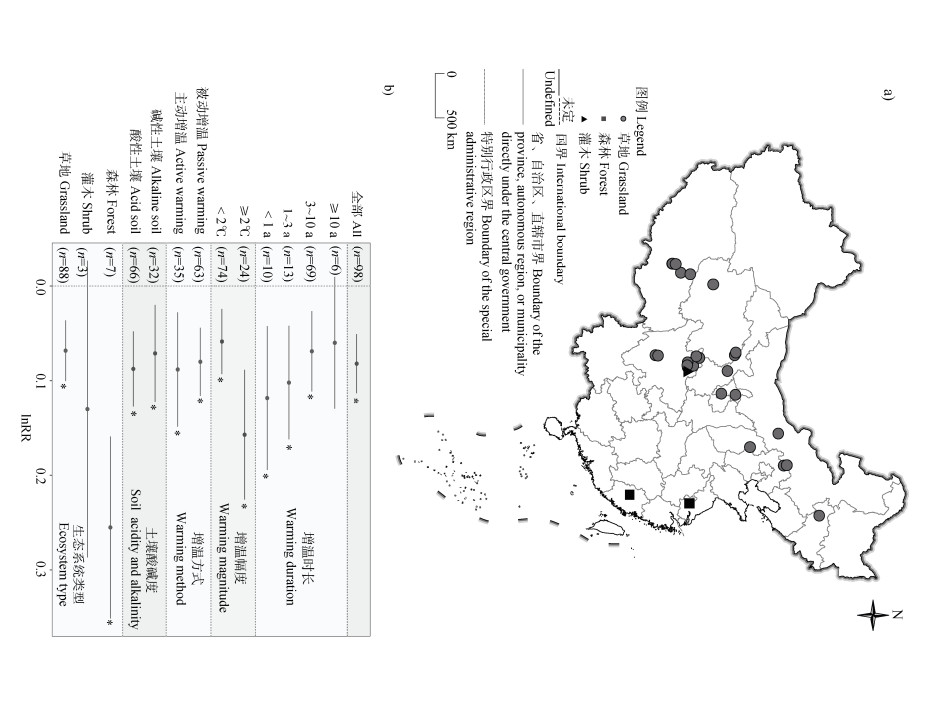
1 山地土壤磷生物有效性对增温的响应 1.1 增温下山地土壤磷生物有效性的变化特征Meta分析结果显示,增温整体上提高了山地土壤磷的生物有效性,在增温时间和生态系统类型间存在差异(图 1)。短期增温(≤10 a)下生物有效磷浓度提高主要与微生物活性增加进而促进凋落物和有机质分解有关[20]。目前对长期增温的研究较少,现有结果发现,增温超过10 a对土壤磷生物有效性的影响整体不明显(图 1)。一项14 a的模拟增温研究发现,增温导致铁氧化物含量增加,促进对无机磷的固定,抑制了磷的生物有效性[14]。增温通常造成土壤水分下降,抑制磷酸酶的产生和活性,降低有机质的分解速率[2,21],造成土壤磷的迁移性和生物有效性下降。但是,有研究表明,在热带森林地区,增温促进了有机磷矿化和无机磷溶解,生物有效磷含量显著增加[22]。在高海拔地区的研究发现,增温促进了植物羧酸盐的分泌,造成土壤难利用磷的活化,但是因为植物对磷的需求增加,最终土壤生物有效磷浓度无显著变化[19]。可见,增温对山地土壤磷生物有效性的影响尚存在较大争议。此外,由于山地生态系统,尤其是高山生态系统,环境条件复杂,现有研究多采用被动增温方式(温室、开顶箱等)模拟气候变暖(图 1),该方法简单易行,但更适用于草地、灌木等植物较矮的生态系统。土壤生物有效磷的响应特征可能因增温设施的形状、大小及增温效果而异[23]。同时,不同山地区域的初始环境背景(如植被类型、土壤环境)也可能造成增温后土壤磷生物有效性响应的差异。因此,需综合考虑生态系统类型、气候、海拔、增温幅度和时长等多种因素,分析增温下山地土壤磷生物有效性的变化特征和机制。
|
注:图a基于国家测绘地理信息局标准地图服务网站下载的审图号为GS(2023)2763号的标准地图制作,底图无修改。图b中*代表变量对增温的响应具有显著性(95%的置信区间不与零相交),括号内的数字表示样本量。lnRR为响应比。下同。 Note: Fig. a, the map is based on the standard map with the approval number GS(2023)2763 downloaded from the standard map service website of the National Administration of Surveying, Mapping and Geoinformation, and the base map has not been modified. Fig. b, * represents the significant effects of the size under warming(95% confidence interval did not overlap with zero). The number in parentheses represents the sample size. lnRR is response ratio. The same below. 图 1 原位增温实验的样点分布(a)和土壤生物有效磷对增温的响应特征(b) Fig. 1 Locations of in situ warming experiment sites(a)and the response characteristics of soil bioavailable phosphorus to warming(b) |
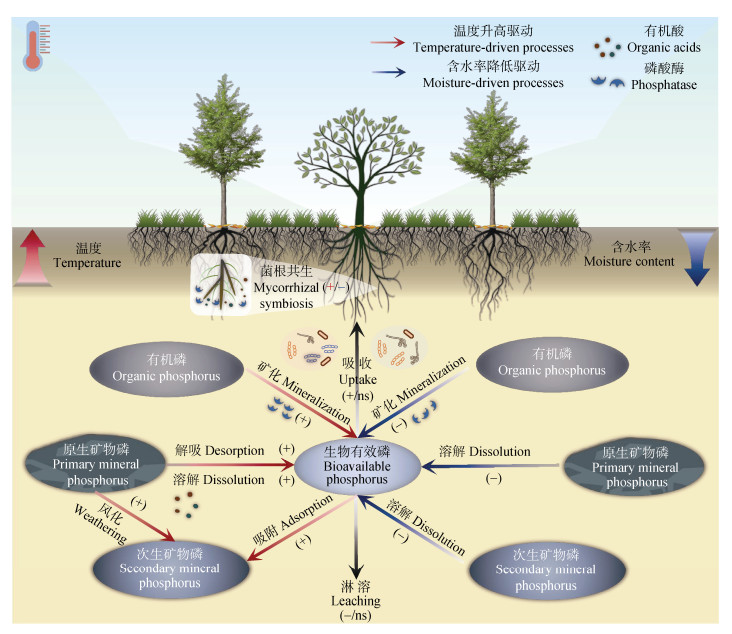
温度升高能够直接加速原生矿物磷的风化,或者通过影响多种非生物和生物因素改变土壤磷的形态组成[24-25],进而调控磷的生物有效性(图 2)。非生物因素主要包括温度、含水量、金属氧化物含量等。大部分研究表明,增温能降低含水率并且促进金属氧化物对磷的固定[14,26]。生物因素主要包括土壤微生物和植物作用。增温能直接促使植物和微生物分泌磷酸酶,加速有机磷的矿化,也会促进植物释放羧酸盐,活化土壤钙结合态磷[27],提高磷的生物有效性。此外,由于植物和微生物对温度的敏感性不同,增温能够通过改变植物和微生物群落结构、养分利用策略以及菌根共生关系等,间接影响土壤磷的生物有效性[13,28]。
|
注:(+):促进,(-):抑制,ns:无影响。下同。 Note: (+): Facilitation, (-): Inhibition, ns: No effect. The same below. 图 2 气候变暖下山地土壤磷生物有效性变化的影响机制[4,12] Fig. 2 Influential mechanisms of climate warming on soils phosphorus bioavailability in mountain soils[4, 12] |
增温会改变土壤水分、金属阳离子等非生物因素,调控土壤磷的生物有效性(图 2)。增温通常增加土壤水分蒸发,降低土壤含水率[28]。一方面,土壤含水率的下降直接导致土壤磷的溶解性下降,增加次生矿物磷含量[29]。另一方面,增温造成的水分下降能够抑制土壤生物活性,造成磷酸酶的生产效率下降和分泌量减少[24],最终影响有机磷矿化。然而,增温对土壤生物有效磷的影响取决于不同气候区或生态系统的初始土壤含水量大小。当土壤水分充足、不限制生物生长时,土壤温度升高能够促进不稳定态磷的活化,增加土壤磷的生物有效性[30];反之,当土壤水分含量低、限制生物生长时,增温会进一步加剧土壤水分的限制作用,抑制磷的生物地球化学循环过程,最终降低或者不改变土壤磷的生物有效性[31-32]。
此外,增温也会影响土壤金属氧化物的形态和含量,改变其对磷的吸附能力。一方面,土壤中游离的磷酸根离子容易吸附至带正电的金属矿物表面,造成生物有效磷含量下降。金属氧化物的静电吸附属于吸热反应[33],温度升高可促进金属氧化物对无机磷的吸附。最近的研究发现,增温增加了非结晶态和结晶态铁氧化物含量,促进了非生物过程对磷的固定,降低了土壤磷的生物有效性[14]。另一方面,增温下金属氧化物对土壤生物有效磷的影响与土壤酸碱度密切相关。在酸性土壤中,磷主要以铝或铁结合态的形式存在,增温能够增加铁氧化物的溶解度,从而提供更多磷的吸附位点[34]。在碱性土壤中,钙结合态磷占主导,增温下根系羧酸盐的分泌会促进钙结合态磷的活化[19]。因此,增温对土壤磷生物有效性影响的过程和程度取决于局地初始环境条件(土壤含水量、酸碱度等)。
1.2.2 增温下生物因素对磷生物有效性的影响增温能够改变土壤微生物活性、群落结构以及群落之间的交互作用,调节微生物分泌磷酸酶[35-36],影响有机磷矿化及磷的生物有效性(图 2)。在山地生态系统中土壤微生物受低温胁迫,有机磷矿化能力受到限制[4],而增温会提高微生物活性,加快有机磷的矿化过程[37]。微生物增殖首先增加自身生物量的积累,促进微生物对磷的固持[38-39],从而降低土壤生物有效磷含量。微生物生物量磷是生物有效磷的重要来源[5],长期增温可能通过微生物生物量磷的周转促进或维持土壤磷的生物有效性。但是,当增温导致植物对磷的竞争加剧和水分降低时,微生物生物量磷减少[24]。其次,由于不同微生物群落对温度的敏感性存在差异[40],增温可改变微生物群落结构和群落间的相互作用,影响土壤磷的生物有效性[41-42]。例如,土壤细菌和真菌对温度变化的敏感性具有明显差异,这不仅改变了微生物群落的多样性及其磷酸酶的分泌,而且改变微生物群落之间的相互作用[36,41],最终影响微生物对磷的周转。最近在贡嘎山的研究表明,土壤细菌和真菌多样性对增温的响应在海拔上呈现相反的趋势[25]。增温时间和幅度也会造成土壤微生物产生不同响应。有研究发现,短期较高的增温幅度加剧土壤水分蒸发,造成细菌生物量减少[43],而长期增温下真菌展现出较细菌更强的适应性[44]。此外,Yuan等[42]发现,增温增强了土壤微生物网络的复杂性和稳定性,这对微生物乃至生态系统的功能具有重要影响。但是,增温下微生物多样性和网络复杂性的变化如何影响土壤磷的循环过程目前仍缺乏系统认知。
增温下土壤微生物磷循环相关功能的改变对生物有效磷具有重要影响。一方面,增温会促进微生物分泌磷酸酶,酶促反应的加快有助于增加有机磷矿化[45]。例如,祁连山[13]和鼎湖山[27]的研究均发现,温度升高增加了土壤微生物对磷的需求,促进了酸性磷酸酶的分泌,加速了有机磷矿化。但是,增温导致的水分限制也会抑制微生物活性,造成磷酸酶的分泌减少[15]。另一方面,增温通过改变微生物群落组成影响磷循环功能基因的丰度,进而改变特异性微生物矿化和吸收磷的潜力。最近,Wang等[38]在高寒草甸的研究发现,增温增加了磷转运基因(如pst和pit)的丰度,促进了磷酸盐特异性转运蛋白的形成,增加了微生物对磷的吸收潜力;同时,增温增加了微生物负责编码磷酸酯水解酶基因(phoD和phoX)的表达,增强了微生物矿化有机磷的潜力。增温下微生物驱动磷的循环是一个复杂的双向调控过程,增温既能通过增强微生物活性、改变微生物群落结构、促进磷酸酶分泌及磷循环功能基因表达加速有机磷矿化,也会通过水分限制和加剧竞争抑制微生物对磷的转化。
除了土壤微生物,增温下植物生产力、生物量分配和群落结构的改变也能够显著影响土壤磷的生物有效性。一般地,增温下植物生产力的提升会加剧其对磷的需求,导致土壤生物有效磷降低[27]。其次,增温后地上与地下生物量的再分配调控了土壤磷的生物有效性[46],该影响与土壤水分密切相关。在干旱地区,增温加剧了水分蒸发,抑制根系生长,从而减少植物对生物有效磷的吸收;但是在水分充足的地区,增温可促进根系生长,促进磷的吸收利用[36]。此外,由于植物固有的热敏感性,不同植物群落对增温的响应不同[47]。一方面,由于不同植物的磷养分利用策略和分配存在差异[48],增温造成植物多样性的变化势必影响土壤磷的生物有效性。另一方面,增温能够影响植物的生理活动,并改变植物磷养分利用策略,进而调控土壤磷的生物有效性。有研究发现,增温提高了植物磷的重吸收效率,以适应土壤磷的限制[49]。Zhou等[19]的研究显示,增温造成莎草释放羧酸盐以活化钙结合态磷,维持土壤生物有效磷的供给。菌根共生是植物吸收磷的重要策略,外生菌根真菌主要通过释放水解酶和氧化酶矿化有机磷,而丛枝菌根真菌可直接吸收无机磷,并将磷转移至根系[50]。大多数研究表明,增温可增加菌根定殖[51-52],促进植物对土壤磷的利用。Mei等[51]在温带草甸的研究发现,增温能够促进菌根真菌中溶磷菌活性,加快凋落物分解,提高土壤生物有效磷浓度。但是,当增温造成土壤水分下降、植物蒸腾作用增加时,植物会抑制菌根真菌的生长[53],减少菌根真菌对磷的利用。此外,增温会改变菌根真菌群落组成,进一步影响生物有效磷的含量[54]。例如,增温增加了长距离探索型外生菌根真菌的相对丰度,促进了有机磷的矿化,增加植物对磷的吸收[55]。增温还可通过提高磷吸收效率更高的丛枝菌根真菌丰度(如大孢子科丛枝菌根真菌等),以满足植物对磷的需求[52]。因此,增温通过改变植物生长和菌根共生策略调控了土壤磷的生物有效性,但是该过程受水分条件和菌根功能适应性的共同影响。
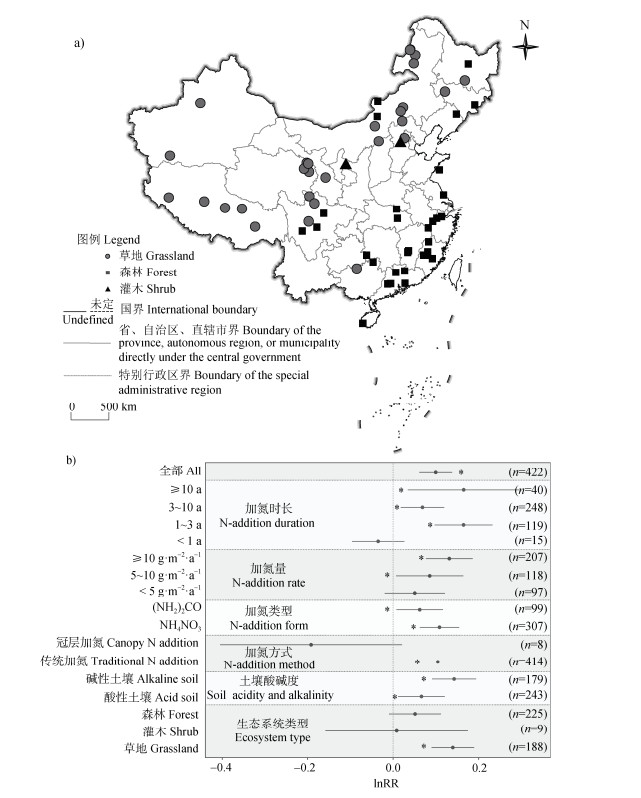
2 山地土壤磷生物有效性对氮添加的响应 2.1 氮添加下山地土壤磷生物有效性的变化特征氮添加整体上增加了山地土壤磷的生物有效性,但是响应的程度与氮添加量、持续时间、施加方式及生态系统类型等有关(图 3)。Meta分析结果显示,较短时间的氮添加(< 1 a)对生物有效磷的影响不明显,但是随着添加时间的增加,土壤磷的生物有效性显著增加。但是,Ma等[56]的研究发现,较短时间(< 3 a)氮添加增加土壤酸性磷酸酶活性,促进了有机磷矿化并提高了磷的生物有效性,而长期氮添加对该过程影响较弱。此外,土壤生物有效磷对氮添加的响应随氮添加量的增加而增加(图 3)。低氮添加主要满足植物和微生物的生长需求,而高氮添加能够降低土壤pH,促进无机磷的活化并增加微生物对有机磷的矿化作用[17,57]。但是,在松嫩平原草甸的研究表明,随着施氮量增加,微生物和植物对磷的需求增加,生物吸收造成土壤磷的生物有效性显著下降[58]。氮添加对土壤磷生物有效性的影响可能与模拟大气氮沉降的方式有关,传统的氮添加主要采用地表喷撒施肥的方式,而林冠喷施的结果更加接近实际的大气氮沉降对土壤生物有效磷的影响[59-60]。Meta分析结果也显示,冠层施氮倾向于降低土壤磷的生物有效性,而地表喷施的方式显著提高了土壤磷的生物有效性(图 3)。上述结果表明,氮添加对山地土壤磷生物有效性的影响仍存在较大争议,需要综合考虑多种因素的复杂作用。
|
注:图b中N代表氮。 Note: In Figure b, N represents nitrogen. 图 3 氮添加实验样点的分布(a)和土壤生物有效磷对氮添加的响应特征(b) Fig. 3 Locations of in situ nitrogen addition experiment sites(a)and the response characteristics of soil bioavailable phosphorus to nitrogen addition(b) |
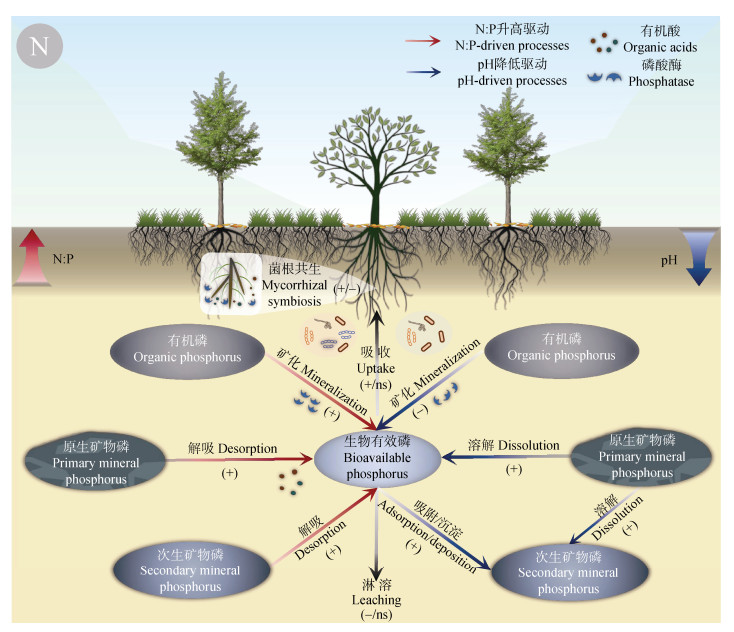
氮添加能够改变多种非生物因素(土壤pH、金属氧化物、养分计量比)与生物因素(植物、微生物),间接影响土壤磷的形态转化,最终调节磷的生物有效性(图 4)。大部分研究表明,氮添加会降低土壤pH,改变金属氧化物的含量[59-60]。氮添加下土壤酸化能够促进矿物结合态磷的溶解和释放[60]。但是,氮添加下土壤酸化还可能增加铁和铝氧化物对磷的吸附位点,降低生物有效磷含量[61]。此外,氮添加打破了土壤氮磷平衡,刺激植物和微生物对磷的需求[62]。在氮添加下微生物直接增加磷酸酶的分泌,并通过改变群落结构或磷循环功能基因,提高有机磷的矿化潜力[63-64]。此外,氮添加可以刺激植物根际有机酸、磷酸酶的分泌,或者通过改变养分利用策略、菌根共生关系提高土壤磷的生物有效性[61,65]。
|
图 4 大气氮沉降对山地土壤磷生物有效性的影响机制[4,12] Fig. 4 Influential mechanisms of atmospheric nitrogen deposition on soils phosphorus bioavailability in mountain soils[4, 12] |
氮添加能够改变土壤pH、金属氧化物和养分计量比等关键理化性质,间接调控土壤磷的生物有效性(图 4)。在碱性或中性土壤中,氮添加导致的土壤酸化显著促进矿物磷的溶解(例如,钙结合态磷向中等可利用无机磷和生物有效磷转化),增加磷的生物有效性[60,63]。然而,在酸性土壤中,铁和铝氧化物或氢氧化物的增加可能抵消土壤酸化造成的生物有效磷的增加。例如,氮添加使土壤氢离子含量增加,能够促进富含铝或铁的次生矿物与磷酸根离子结合并形成沉淀,导致磷的生物有效性降低[66]。但是也有研究表明,土壤酸化造成游离态和有机结合态铝或铁减少,进而削弱矿物介导的磷吸附,从而增强磷的生物有效性[59]。
此外,氮和磷作为植物生产力的两大关键限制养分,外源氮输入势必打破土壤氮磷平衡,造成生态系统磷限制[10,12]。磷限制增加会促进生物采取必要的磷养分利用策略,加快土壤磷的形态转化,最终调控磷的生物有效性[65]。盛基峰等[67]的研究发现,氮添加造成的无机氮含量增加促进了磷酸酶的分泌,加速了有机磷矿化,但是由于受磷限制,矿化释放的无机磷迅速被微生物固持,导致生物有效磷无明显变化。但是,Guan等[63]在青藏高原高寒草地为期8年的氮添加实验发现,氮诱导的磷限制促进了土壤磷的生物有效性。综上,氮添加通过土壤酸化、矿物磷酸盐溶解以及氮磷平衡的改变对磷生物有效性产生复杂影响,这取决于土壤性质、生态系统类型及生物作用的程度。
2.2.2 氮添加下生物因素对磷生物有效性的影响氮添加会改变微生物活性,影响微生物对磷的固定和矿化,进而影响土壤生物有效磷(图 4)。氮添加对微生物活性的影响与土壤初始氮含量和氮添加量有关。当微生物受到氮限制时,氮添加可缓解微生物的氮限制并提高其活性[45]。但是,长期氮添加造成的土壤酸化会抑制微生物活性(尤其是溶磷细菌)[38]。一般地,氮添加会促进微生物对磷的需求,刺激磷酸酶的分泌并加快有机磷的矿化,进而提高磷的生物有效性[68]。还有研究表明,氮添加使微生物对磷的固定速率高于矿化速率,造成微生物生物量磷增加,而土壤生物有效磷的含量无显著变化[69]。其次,氮添加导致的养分失衡和土壤酸化会改变微生物群落组成,进而调控微生物对磷的周转[70-71]。氮添加会降低微生物多样性,且真菌和细菌有不同的响应[38,70]。随着氮添加量的增加,pH降低和化学计量失衡导致细菌丰度降低,细菌群落由富营养型(变形菌属优势)向贫营养型(放线菌属优势)转变[71]。真菌对养分的需求及其代谢活性较细菌低,在缺氮环境里施氮会增加土壤真菌多样性,在富氮环境里则相反[72]。
氮添加对微生物磷循环功能的影响会调节土壤磷的生物有效性。一方面,氮添加影响微生物磷酸酶的分泌。氮添加能促使微生物从环境中获取更多的氮用于磷酸酶生产,加速有机磷的矿化[68]。但是,当土壤缺氮时,添加的氮首先被植物和微生物利用,而非用于磷酸酶的生产[73]。另一方面,氮添加影响微生物磷循环功能基因的表达[42,74]。在磷生物有效性低的热带或亚热带森林,氮添加刺激了微生物对磷的需求,为满足自身需求,参与磷饥饿反应调节(phoU和phoR)和有机磷矿化(phoN、phoD和appA)的基因上调,进而提升了微生物获取、转运磷酸盐以及矿化有机磷的潜力[75]。但是也有研究表明,氮添加导致的土壤酸化降低了无机磷溶解基因的丰度,且有机磷矿化基因丰度与氮添加种类有关,铵态氮添加提高了与有机磷矿化相关功能基因的丰度,而硝态氮添加则相反[42]。因此,氮添加下土壤微生物活性和群落结构的变化以及微生物磷循环功能基因表达的程度共同决定了土壤磷的生物有效性。
氮添加不仅影响微生物群落与功能,而且影响植物对磷的利用过程,这取决于土壤初始养分以及氮添加量。在缺氮环境里氮添加促进了植物生长,增加了植物对磷的需求,导致土壤生物有效磷减少[62]。但也有研究表明,氮添加会增加凋落物积累,并促进微生物活性,提高有机质的分解,从而增加土壤生物有效磷的含量[76-77]。氮添加可以改变植物群落结构和植物的生产力水平,进而调控土壤磷的生物有效性[12]。Zhang等[78]在高寒草甸的研究发现,较高氮添加导致物种多样性降低,但该过程如何影响土壤生物有效磷仍需探究。此外,植物通过改变磷养分利用策略以适应氮添加导致的氮磷失衡[18,77]。Lin等[79]的研究表明,在缺磷生态系统中,氮添加提高了叶片磷的重吸收效率,以保持氮磷的化学计量平衡。平衡生长假说认为,植物优先分配地下生物量以获取限制其生长的资源。基于此,随着氮添加量增加,生态系统可能由氮限制转向磷限制,植物会增加地下生物量的分配,提高细根产量和根际微生物活性[77],增强对土壤磷的利用。此外,氮添加通过改变菌根共生关系调节土壤磷的形态转化和利用[80]。氮添加对菌根共生关系的影响与土壤初始养分和氮添加量有关。当土壤磷生物有效性较低时,氮添加促使根系菌根定殖和外部菌丝发育,促进有机磷矿化以及次生矿物磷的溶解,以满足植物对磷的需求[81]。当生态系统处于氮限制时,随着氮添加量增加,植物氮限制的缓解会减少对菌根真菌的碳分配,菌根真菌对植物的养分贡献下降[82]。此外,氮添加导致的土壤酸化和养分限制的转变会影响菌根真菌群落结构[80]。随着氮添加的进行,外生菌根真菌以接触—短—中距离探测外生菌根真菌向中—长距离探测外生菌根真菌转变,从而更为有效地获取生物有效磷[83]。根据生态系统初始氮磷平衡状态和氮输入强度,氮添加通过调控植物生长、养分分配策略以及菌根共生等途径影响土壤磷的生物有效性。
3 增温和氮添加交互作用对山地土壤磷生物有效性的响应研究大气氮沉降增加和温度升高通常同时发生,但是增温和氮添加对山地土壤磷循环,特别是对磷生物有效性的影响机制尚不明确[10,41]。现有研究表明,温带草原土壤生物有效磷对氮添加和增温的响应较高寒草原更为敏感,这可能与土壤微生物和酶活性有关[84]。此外,增温和氮添加对土壤磷生物有效性的影响与降水状况密切相关,在降水丰富地区增温和氮添加显著提高了生物有效磷浓度[85]。增温和氮添加对土壤磷生物有效性的影响涉及复杂的非生物和生物因素及其交互作用。例如,在受氮限制的亚热带森林中,尽管氮添加增加了植物氮磷吸收,但是增温促进了矿物磷的溶解和其他阴离子(如碳酸氢盐、硫酸盐和有机酸)的解吸,最终造成土壤中易利用无机磷和中等可利用无机磷增加[23]。增温和氮添加对土壤磷生物有效性的影响与植物和微生物参与的磷形态转化过程密不可分[86]。一方面,增温和氮添加能够影响微生物群落结构和功能,间接调节了磷的生物有效性。增温和氮添加交互处理对土壤磷循环的影响可能是协同的,即通过刺激微生物分泌磷酸酶加速有机磷的矿化[24,84]。Jiang等[87]在碱性草甸的研究发现,由于增温和氮添加分别促进了氨化作用和硝化作用,土壤真菌物种多样性显著增加。但是也有研究发现,增温与氮添加对土壤微生物群落的影响不明显[88-89]。目前,增温和氮添加对微生物的影响如何改变土壤磷生物有效性仍不清楚。另一方面,增温和氮添加改变植物根系的碳分配,影响菌根共生关系,进而改变根系对土壤磷的吸收。例如,短期增温和氮添加减少了草甸细根生物量,加速了细根死亡,进而增加植物菌根定殖以获取磷[90]。在缺磷生态系统中,增温和氮添加下植物菌根共生系统采用“最优”策略,将更多的碳分配给菌根真菌以获取磷,从而改变土壤磷的生物有效性[51]。总之,增温和氮添加对土壤磷生物有效性的影响可能涉及土壤理化性质、微生物以及植物-微生物的相互作用,未来需要深入探究增温和氮添加交互作用对土壤磷生物有效性的作用机制。
4 总结与展望山地生态系统对全球变化十分敏感,持续的增温和大气氮沉降可能导致生态系统出现磷限制,威胁山地生态系统的稳定性。近年来,原位模拟气候变暖或大气氮沉降增加对土壤磷循环的影响研究取得了较大进展。Meta分析表明,单一增温和氮添加处理整体上不会降低山地土壤磷的生物有效性(图 1,图 3),但是也有研究存在相反的结果。增温主要通过改变土壤水分(如抑制磷的溶解和迁移)、金属阳离子吸附能力(如增加铁氧化物对磷的固定),以及微生物和植物活动(如促进磷酸酶分泌和菌根共生)调控土壤磷的生物有效性。氮添加通过降低土壤pH促进矿物磷溶解,并通过改变氮磷平衡、调控微生物活性和群落结构(如磷酸酶分泌和磷循环功能基因表达)以及植物磷利用策略(如菌根共生和养分分配)影响土壤磷的生物有效性。上述增温和氮添加对土壤磷生物有效性的影响与不同生态系统初始的环境条件密切相关。此外,关于增温和氮添加的交互作用对土壤磷生物有效性的影响研究十分欠缺,极大限制了对气候变暖和大气氮沉降增加下土壤磷生物有效性影响机制的认识。未来亟需针对以下方面开展深入研究,以深刻理解未来气候变化下山地磷生物地球化学循环的过程及机理,为山地生态系统的健康与可持续发展提供理论支撑。
4.1 开展长期、多海拔原位模拟增温和氮添加实验,揭示山地土壤磷生物有效性的响应规律山地生态系统海拔高差和环境异质性大,可能导致生物和非生物因素对增温和氮添加的响应存在较大差异。此外,气候变暖和大气氮沉降增加是长期且相对缓慢的过程,短期模拟实验难以掌握土壤磷生物有效性的响应规律。因此,未来研究应重点关注以下方向:在典型山地生态系统(如青藏高原)建立长期定位观测站点,开展十年以上的原位模拟增温(特别是主动增温)和氮添加实验,以捕捉土壤磷生物有效性的长期变化趋势;其次,选择不同海拔梯度的试验样地,系统研究海拔差异对土壤磷形态转化和生物有效性的影响,揭示海拔梯度与气候变化的交互作用。综合研究增温和氮添加的交互效应,阐释二者交互对生态系统磷循环的调控作用;最后,研发和应用高频采样和实时监测技术,动态追踪土壤磷形态的季节性和年际变化,充分认识增温和氮添加及其交互作用下山地磷的循环过程和机制,以及土壤磷生物有效性的变化规律。
4.2 结合先进技术手段,深入剖析增温和氮添加对山地土壤磷生物有效性的影响机制结合传统化学连续提取法、核磁共振和同步辐射光源的X射线吸收近边结构、薄膜扩散梯度等先进技术手段,精确刻画增温和氮添加下土壤中不同磷形态的转化过程,定量评估土壤中活性磷的动态变化及其生物有效性[91-92]。利用磷酸根氧同位素和33P同位素稀释技术[92],追踪土壤磷的来源和转化途径,揭示增温和氮添加下生物作用对磷循环关键过程的影响。采用高通量测序以及多组学技术(宏基因组、宏转录组、蛋白组等),从分子水平揭示增温和氮添加下土壤微生物群落结构、功能基因表达及其对磷形态转化的影响,重点关注土壤微生物-植物之间的交互作用,阐明增温和氮添加下影响土壤磷循环过程及其生物有效性的关键机制。
4.3 优化磷生物地球化学循环模型参数,预测气候变化对山地土壤磷循环的影响针对不同山地生态系统的特点,获取土壤磷形态组成、生物有效性及相关生物地球化学参数,优化现有模型(如Community Land Model-CNP、Carnegie-Ames-Stanford Approach-CNP[93-94])的参数设置。在模型中纳入增温、氮沉降等多因子的耦合效应,模拟复杂气候变化情景下土壤磷循环的动态响应。开发土壤磷生物有效性的模块,量化不同磷形态的转化速率及其对植物和微生物的有效性。此外,利用长期定位观测数据和实验数据对模型进行验证,评估模型预测的不确定性,并提出改进策略。结合模型预测结果,评估未来气候变化下土壤磷生物有效性变化对山地生态系统多功能性的影响,为生态系统管理和政策制定提供科学依据。
| [1] |
Du E Z, Terrer C, Pellegrini A F A, et al. Global patterns of terrestrial nitrogen and phosphorus limitation[J]. Nature Geoscience, 2020, 13(3): 221-226. DOI:10.1038/s41561-019-0530-4
(  0) 0) |
| [2] |
Hou E Q, Luo Y Q, Kuang Y W, et al. Global meta-analysis shows pervasive phosphorus limitation of aboveground plant production in natural terrestrial ecosystems[J]. Nature Communications, 2020, 11(1): 637. DOI:10.1038/s41467-020-14492-w
( 0) |
| [3] |
Wang Y H, Bing H J, Moorhead D L, et al. Bacterial community structure modulates soil phosphorus turnover at early stages of primary succession[J]. Global Biogeochemical Cycles, 2024, 38(10): e2024GB008174. DOI:10.1029/2024GB008174
( 0) |
| [4] |
Zhao M Y, Mills B J W, Poulton S W, et al. Drivers of the global phosphorus cycle over geological time[J]. Nature Reviews Earth & Environment, 2024, 5: 873-889.
( 0) |
| [5] |
Wen A B, Tang Q, Ouyang C J, et al. Mountain protection and mountain development in China: Review and prospect (In Chinese)[J]. Bulletin of Chinese Academy of Sciences, 2023, 38(3): 376-384. [文安邦, 汤青, 欧阳朝军, 等. 中国山地保护与山区发展: 回顾与展望[J]. 中国科学院院刊, 2023, 38(3): 376-384.]
( 0) |
| [6] |
Wang J P, Wu Y H. Phosphorus bioavailability in mountain ecosystems: Characteristics and ecological roles (In Chinese)[J]. Acta Ecologica Sinica, 2016, 36(5): 1204-1214. [王吉鹏, 吴艳宏. 磷的生物有效性对山地生态系统的影响[J]. 生态学报, 2016, 36(5): 1204-1214.]
( 0) |
| [7] |
Dai T L, Hong J L, Li Y, et al. Global significant weather and climate events in 2023 (In Chinese)[J]. Meteorological Monthly, 2024, 50(3): 370-376. [代潭龙, 洪洁莉, 李莹, 等. 2023年全球重大天气气候事件[J]. 气象, 2024, 50(3): 370-376.]
( 0) |
| [8] |
Yu G R, Jia Y L, He N P, et al. Stabilization of atmospheric nitrogen deposition in China over the past decade[J]. Nature Geoscience, 2019, 12(6): 424-429. DOI:10.1038/s41561-019-0352-4
( 0) |
| [9] |
Peng Y R, Wang T, Chang R Y. An increasing trend of inorganic nitrogen deposition across montane regions of China[J]. Atmospheric Environment, 2023, 304: 119780. DOI:10.1016/j.atmosenv.2023.119780
( 0) |
| [10] |
Du E Z, de Vries W, Collalti A, et al. Climate warming alters nutrient cycling and its constraint on CO2 fertilization in global forests[J]. Current Climate Change Reports, 2025, 11: 3. DOI:10.1007/s40641-025-00201-6
( 0) |
| [11] |
Yu J L, Bing H J, Chang R Y, et al. Microbial metabolic limitation response to experimental warming along an altitudinal gradient in alpine grasslands, eastern Tibetan Plateau[J]. Catena, 2022, 214: 106243. DOI:10.1016/j.catena.2022.106243
( 0) |
| [12] |
Chen M L, Chen H, Mao Q G, et al. Effect of nitrogen deposition on the soil phosphorus cycle in forest ecosystems: A review (In Chinese)[J]. Acta Ecologica Sinica, 2016, 36(16): 4965-4976. [陈美领, 陈浩, 毛庆功, 等. 氮沉降对森林土壤磷循环的影响[J]. 生态学报, 2016, 36(16): 4965-4976.]
( 0) |
| [13] |
Rui Y C, Wang Y F, Chen C R, et al. Warming and grazing increase mineralization of organic P in an alpine meadow ecosystem of Qinghai-Tibet Plateau, China[J]. Plant and Soil, 2012, 357(1/2): 73-87.
( 0) |
| [14] |
Tian Y, Shi C P, Malo C U, et al. Long-term soil warming decreases microbial phosphorus utilization by increasing abiotic phosphorus sorption and phosphorus losses[J]. Nature Communications, 2023, 14(1): 864. DOI:10.1038/s41467-023-36527-8
( 0) |
| [15] |
Li W J, Wang J L, Jiang L M, et al. Rhizosphere effect and water constraint jointly determined the roles of microorganism in soil phosphorus cycling in arid desert regions[J]. Catena, 2023, 222: 106809. DOI:10.1016/j.catena.2022.106809
( 0) |
| [16] |
Yu Q S, Ni X F, Hagedorn F, et al. Field experiments and a meta-analysis reveal a minor influence of nitrogen addition on phosphorus fractions in forests[J]. Global Change Biology, 2025, 31(4): e70156. DOI:10.1111/gcb.70156
( 0) |
| [17] |
Liu Y, Bing H J, Wu Y H, et al. Nitrogen addition promotes soil phosphorus availability in the subalpine forest of eastern Tibetan Plateau[J]. Journal of Soils and Sediments, 2022, 22(1): 1-11. DOI:10.1007/s11368-021-03064-0
( 0) |
| [18] |
Fan Y X, Lin F, Yang L M, et al. Decreased soil organic P fraction associated with ectomycorrhizal fungal activity to meet increased P demand under N application in a subtropical forest ecosystem[J]. Biology and Fertility of Soils, 2018, 54(1): 149-161. DOI:10.1007/s00374-017-1251-8
( 0) |
| [19] |
Zhou J, Li X L, Peng F, et al. Mobilization of soil phosphate after 8 years of warming is linked to plant phosphorus-acquisition strategies in an alpine meadow on the Qinghai-Tibetan Plateau[J]. Global Change Biology, 2021, 27(24): 6578-6591. DOI:10.1111/gcb.15914
( 0) |
| [20] |
Gong S W, Guo R, Zhang T, et al. Warming and nitrogen addition increase litter decomposition in a temperate meadow ecosystem[J]. PLoS One, 2015, 10(3): e0116013. DOI:10.1371/journal.pone.0116013
( 0) |
| [21] |
Zuccarini P, Sardans J, Asensio L, et al. Altered activities of extracellular soil enzymes by the interacting global environmental changes[J]. Global Change Biology, 2023, 29(8): 2067-2091. DOI:10.1111/gcb.16604
( 0) |
| [22] |
Yang L M, Yang Z J, Peng Y Z, et al. Evaluating P availability influenced by warming and N deposition in a subtropical forest soil: A bioassay mesocosm experiment[J]. Plant and Soil, 2019, 444(1/2): 87-99.
( 0) |
| [23] |
Zhu B, Chen Y. Techniques and methods for field warming manipulation experiments in terrestrial ecosystems (In Chinese)[J]. Chinese Journal of Plant Ecology, 2020, 44(4): 330-339. [朱彪, 陈迎. 陆地生态系统野外增温控制实验的技术与方法[J]. 植物生态学报, 2020, 44(4): 330-339.]
( 0) |
| [24] |
Gong S W, Zhang T, Guo J X. Warming and nitrogen deposition accelerate soil phosphorus cycling in a temperate meadow ecosystem[J]. Soil Research, 2020, 58(1): 109-115. DOI:10.1071/SR19114
( 0) |
| [25] |
Liu Y, Delgado-Baquerizo M, Bing H J, et al. Warming-induced shifts in alpine soil microbiome: An ecosystem-scale study with environmental context-dependent insights[J]. Environmental Research, 2024, 255: 119206. DOI:10.1016/j.envres.2024.119206
( 0) |
| [26] |
Jiang F, Huang J, Chu G W, et al. Effects of warming on soil phosphorus fractions and their contributions to available phosphorus in south subtropical forests (In Chinese)[J]. Chinese Journal of Plant Ecology, 2021, 45(2): 197-206. [蒋芬, 黄娟, 褚国伟, 等. 增温对南亚热带森林土壤磷形态的影响及其对有效磷的贡献[J]. 植物生态学报, 2021, 45(2): 197-206.]
( 0) |
| [27] |
Lie Z Y, Zhou G Y, Huang W J, et al. Warming drives sustained plant phosphorus demand in a humid tropical forest[J]. Global Change Biology, 2022, 28(13): 4085-4096. DOI:10.1111/gcb.16194
( 0) |
| [28] |
Li J S, Wu B Y, Zhang D D, et al. Elevational variation in soil phosphorus pools and controlling factors in alpine areas of Southwest China[J]. Geoderma, 2023, 431: 116361. DOI:10.1016/j.geoderma.2023.116361
( 0) |
| [29] |
Zhang H Z, Shi L L, Lu H B, et al. Drought promotes soil phosphorus transformation and reduces phosphorus bioavailability in a temperate forest[J]. Science of the Total Environment, 2020, 732: 139295. DOI:10.1016/j.scitotenv.2020.139295
( 0) |
| [30] |
Wood T E, Matthews D, Vandecar K, et al. Short-term variability in labile soil phosphorus is positively related to soil moisture in a humid tropical forest in Puerto Rico[J]. Biogeochemistry, 2016, 127(1): 35-43. DOI:10.1007/s10533-015-0150-z
( 0) |
| [31] |
Fan Y X, Lu S X, He M, et al. Long-term throughfall exclusion decreases soil organic phosphorus associated with reduced plant roots and soil microbial biomass in a subtropical forest[J]. Geoderma, 2021, 404: 115309. DOI:10.1016/j.geoderma.2021.115309
( 0) |
| [32] |
Wankmüller F J P, Delval L, Lehmann P, et al. Global influence of soil texture on ecosystem water limitation[J]. Nature, 2024, 635(8039): 631-638. DOI:10.1038/s41586-024-08089-2
( 0) |
| [33] |
Yan Y P, Wang X M, Hu Z, et al. Research progresses on sorption and desorption characteristics of phosphate on minerals (In Chinese)[J]. Soils, 2021, 53(3): 439-448. [严玉鹏, 王小明, 胡震, 等. 磷酸根在矿物表面的吸附-解吸特性研究进展[J]. 土壤, 2021, 53(3): 439-448.]
( 0) |
| [34] |
Aguiar D, Melo V F, Nogueira M A, et al. The role of microbial mechanisms on the availability of soil phosphorus from fixed and structural mineral fractions[J]. Journal of Soil Science and Plant Nutrition, 2024, 24(4): 8192-8207. DOI:10.1007/s42729-024-02106-z
( 0) |
| [35] |
Ma Z L, Chen Y M, Xu W J, et al. Effects of warming on the stoichiometry of soil microbial biomass and extracellular enzymes in an alpine shrubland[J]. Geoderma, 2023, 430: 116329. DOI:10.1016/j.geoderma.2023.116329
( 0) |
| [36] |
Yu Y, Zhou Y, Janssens I A, et al. Divergent rhizosphere and non-rhizosphere soil microbial structure and function in long-term warmed steppe due to altered root exudation[J]. Global Change Biology, 2024, 30(1): e17111. DOI:10.1111/gcb.17111
( 0) |
| [37] |
Luo C Y, Wu Y H, He Q Q, et al. Increase of temperature exacerbates the conversion of P fractions in organic horizon[J]. Soil Biology & Biochemistry, 2024, 192: 109368.
( 0) |
| [38] |
Wang X W, Guo H, Wang J N, et al. Microbial phosphorus-cycling genes in soil under global change[J]. Global Change Biology, 2024, 30(4): e17281. DOI:10.1111/gcb.17281
( 0) |
| [39] |
Bing H J, Wu Y H, Zhou J, et al. Stoichiometric variation of carbon, nitrogen, and phosphorus in soils and its implication for nutrient limitation in alpine ecosystem of Eastern Tibetan Plateau[J]. Journal of Soils and Sediments, 2016, 16(2): 405-416. DOI:10.1007/s11368-015-1200-9
( 0) |
| [40] |
Zhang S, Wang M M, Xiao L J, et al. Reconciling carbon quality with availability predicts temperature sensitivity of global soil carbon mineralization[J]. Proceedings of the National Academy of Sciences of the United States of America, 2024, 121(11): e2313842121.
( 0) |
| [41] |
Xiong Q L, Pan K W, Zhang L, et al. Warming and nitrogen deposition are interactive in shaping surface soil microbial communities near the alpine timberline zone on the eastern Qinghai-Tibet Plateau, southwestern China[J]. Applied Soil Ecology, 2016, 101: 72-83. DOI:10.1016/j.apsoil.2016.01.011
( 0) |
| [42] |
Yuan M M, Guo X, Wu L W, et al. Climate warming enhances microbial network complexity and stability[J]. Nature Climate Change, 2021, 11(4): 343-348. DOI:10.1038/s41558-021-00989-9
( 0) |
| [43] |
Zhang K, Shi Y, Jing X, et al. Effects of short-term warming and altered precipitation on soil microbial communities in alpine grassland of the Tibetan Plateau[J]. Frontiers in Microbiology, 2016, 7: 1032.
( 0) |
| [44] |
Wang S Q, Song M H, Wang C M, et al. Mechanisms underlying soil microbial regulation of available phosphorus in a temperate forest exposed to long-term nitrogen addition[J]. Science of the Total Environment, 2023, 904: 166403. DOI:10.1016/j.scitotenv.2023.166403
( 0) |
| [45] |
Zhang W N, Yang Z, Yan Y P, et al. Research progress on soil organic phosphorus mineralization and its regulation (In Chinese)[J]. Acta Pedologica Sinica, 2025, 62(2): 334-347. DOI:10.11766/trxb202404140154 [张万年, 杨子, 严玉鹏, 等. 土壤有机磷的矿化及其调控研究进展[J]. 土壤学报, 2025, 62(2): 334-347.]
( 0) |
| [46] |
Quan Q, He N P, Zhang R Y, et al. Plant height as an indicator for alpine carbon sequestration and ecosystem response to warming[J]. Nature Plants, 2024, 10(6): 890-900. DOI:10.1038/s41477-024-01705-z
( 0) |
| [47] |
Wei B, Zhang D Y, Wang G Q, et al. Experimental warming altered plant functional traits and their coordination in a permafrost ecosystem[J]. New Phytologist, 2023, 240(5): 1802-1816. DOI:10.1111/nph.19115
( 0) |
| [48] |
Gao X L, Li X G, Zhao L, et al. Regulation of soil phosphorus cycling in grasslands by shrubs[J]. Soil Biology & Biochemistry, 2019, 133: 1-11.
( 0) |
| [49] |
Zheng L, Cao X, Yang Z Y, et al. Effects of warming conditions on plant nitrogen-phosphorus stoichiometry and resorption of three plant species in alpine meadows on the Tibetan Plateau[J]. Journal of Plant Ecology, 2024, 17(3): rtae032. DOI:10.1093/jpe/rtae032
( 0) |
| [50] |
Rosling A, Midgley M G, Cheeke T, et al. Phosphorus cycling in deciduous forest soil differs between stands dominated by ecto- and arbuscular mycorrhizal trees[J]. New Phytologist, 2016, 209(3): 1184-1195. DOI:10.1111/nph.13720
( 0) |
| [51] |
Mei L L, Yang X, Zhang S Q, et al. Arbuscular mycorrhizal fungi alleviate phosphorus limitation by reducing plant N: P ratios under warming and nitrogen addition in a temperate meadow ecosystem[J]. Science of the Total Environment, 2019, 686: 1129-1139. DOI:10.1016/j.scitotenv.2019.06.035
( 0) |
| [52] |
Cao J L, Lin T C, Yang Z J, et al. Warming exerts a stronger effect than nitrogen addition on the soil arbuscular mycorrhizal fungal community in a young subtropical Cunninghamia lanceolata plantation[J]. Geoderma, 2020, 367: 114273. DOI:10.1016/j.geoderma.2020.114273
( 0) |
| [53] |
Qiu Y P, Guo L J, Xu X Y, et al. Warming and elevated ozone induce trade-offs between fine roots and mycorrhizal fungi and stimulate organic carbon decomposition[J]. Science Advances, 2021, 7(28): eabe9256. DOI:10.1126/sciadv.abe9256
( 0) |
| [54] |
Xu X Y, Qiu Y P, Zhang K C, et al. Climate warming promotes deterministic assembly of arbuscular mycorrhizal fungal communities[J]. Global Change Biology, 2022, 28(3): 1147-1161. DOI:10.1111/gcb.15945
( 0) |
| [55] |
Kengdo S K, Peršoh D, Schindlbacher A, et al. Long-term soil warming alters fine root dynamics and morphology, and their ectomycorrhizal fungal community in a temperate forest soil[J]. Global Change Biology, 2022, 28(10): 3441-3458. DOI:10.1111/gcb.16155
( 0) |
| [56] |
Ma X M, Zhu B, Nie Y X, et al. Root and mycorrhizal strategies for nutrient acquisition in forests under nitrogen deposition: A meta-analysis[J]. Soil Biology & Biochemistry, 2021, 163: 108418.
( 0) |
| [57] |
Li X R, Lin H, Cao P L, et al. Long-term nitrogen application exacerbates soil phosphorus limitation at different depths in subtropical natural Castanopsis carlesii forest: Based on soil extracellular enzymes and their stoichiometric ratios (In Chinese)[J]. Soils, 2024, 56(5): 963-974. [李欣冉, 林浩, 曹平丽, 等. 长期施氮加剧亚热带米槠天然林不同深度土壤磷限制: 基于土壤胞外酶活性及其化学计量比角度[J]. 土壤, 2024, 56(5): 963-974.]
( 0) |
| [58] |
Cui H Y, Sun W, Delgado-Baquerizo M, et al. Cascading effects of N fertilization activate biologically driven mechanisms promoting P availability in a semi-arid grassland ecosystem[J]. Functional Ecology, 2021, 35(4): 1001-1011. DOI:10.1111/1365-2435.13773
( 0) |
| [59] |
Fan Y X, Zhong X J, Lin F, et al. Responses of soil phosphorus fractions after nitrogen addition in a subtropical forest ecosystem: Insights from decreased Fe and Al oxides and increased plant roots[J]. Geoderma, 2019, 337: 246-255. DOI:10.1016/j.geoderma.2018.09.028
( 0) |
| [60] |
Wang R Z, Yang J J, Liu H Y, et al. Nitrogen enrichment buffers phosphorus limitation by mobilizing mineral-bound soil phosphorus in grasslands[J]. Ecology, 2022, 103(3): e3616. DOI:10.1002/ecy.3616
( 0) |
| [61] |
Zhang H Z, Shi L L, Fu S L. Effects of nitrogen deposition and increased precipitation on soil phosphorus dynamics in a temperate forest[J]. Geoderma, 2020, 380: 114650. DOI:10.1016/j.geoderma.2020.114650
( 0) |
| [62] |
Gao X L, Gao Y M, Li X W, et al. Eleven-year canopy nitrogen addition enhances the uptake of phosphorus by plants and accelerates its depletion in soil[J]. Forests, 2024, 15(3): 416. DOI:10.3390/f15030416
( 0) |
| [63] |
Guan Z H, Cao Z N, Li X G, et al. Effects of winter grazing and N addition on soil phosphorus fractions in an alpine grassland on the Qinghai-Tibet Plateau[J]. Agriculture, Ecosystems & Environment, 2023, 357: 108700.
( 0) |
| [64] |
Han B, Li J J, Liu K S, et al. Variations in soil properties rather than functional gene abundances dominate soil phosphorus dynamics under short-term nitrogen input[J]. Plant and Soil, 2021, 469(1/2): 227-241.
( 0) |
| [65] |
Deng M F, Liu L L, Sun Z Z, et al. Increased phosphate uptake but not resorption alleviates phosphorus deficiency induced by nitrogen deposition in temperate Larix principis-rupprechtii plantations[J]. New Phytologist, 2016, 212(4): 1019-1029. DOI:10.1111/nph.14083
( 0) |
| [66] |
Jin J Y, Roland B, Bing H J, et al. Nitrogen addition reduces soil phosphorus leaching in a subtropical forest of eastern Tibetan Plateau[J]. Applied Soil Ecology, 2024, 202: 105616. DOI:10.1016/j.apsoil.2024.105616
( 0) |
| [67] |
Sheng J F, Li Y, Yu M J, et al. Effects of nitrogen and phosphorus addition on soil nutrients and activity of related enzymes in alpine grassland (In Chinese)[J]. Ecology and Environmental Sciences, 2022, 31(12): 2302-2309. [盛基峰, 李垚, 于美佳, 等. 氮磷添加对高寒草地土壤养分和相关酶活性的影响[J]. 生态环境学报, 2022, 31(12): 2302-2309.]
( 0) |
| [68] |
Wei K, Sun T, Tian J H, et al. Soil microbial biomass, phosphatase and their relationships with phosphorus turnover under mixed inorganic and organic nitrogen addition in a Larix gmelinii plantation[J]. Forest Ecology and Management, 2018, 422: 313-322. DOI:10.1016/j.foreco.2018.04.035
( 0) |
| [69] |
Yuan X C, Xie H, Bai X Y, et al. Effects of short-term nitrogen addition on bioavailable phosphorus in rhizosphere and bulk soils of a Castanopsis fabri forest (In Chinese)[J]. Acta Ecologica Sinica, 2024, 44(17): 7817-7829. [元晓春, 谢欢, 柏欣宇, 等. 短期氮添加对罗浮栲林根际和非根际土壤生物有效磷的影响[J]. 生态学报, 2024, 44(17): 7817-7829.]
( 0) |
| [70] |
Cao Z C, Cheng S L, Fang H J, et al. Responses of soil organic carbon dynamics and microbial community structure to organic nitrogen fertilization in the temperate needle-broadleaved mixed forest (In Chinese)[J]. Acta Pedologica Sinica, 2020, 57(4): 963-974. DOI:10.11766/trxb201908130350 [曹子铖, 程淑兰, 方华军, 等. 温带针阔叶林土壤有机碳动态和微生物群落结构对有机氮添加的响应特征[J]. 土壤学报, 2020, 57(4): 963-974.]
( 0) |
| [71] |
Qiu L J, Li Y J, Zhong Q, et al. Adaptation mechanisms of the soil microbial community under stoichiometric imbalances and nutrient-limiting conditions in a subtropical nitrogen-saturated forest[J]. Plant and Soil, 2023, 489(1/2): 239-258.
( 0) |
| [72] |
Zhou Z H, Wang C K, Zheng M H, et al. Patterns and mechanisms of responses by soil microbial communities to nitrogen addition[J]. Soil Biology & Biochemistry, 2017, 115: 433-441.
( 0) |
| [73] |
Pii Y, Mimmo T, Tomasi N, et al. Microbial interactions in the rhizosphere: Beneficial influences of plant growth-promoting rhizobacteria on nutrient acquisition process. A review[J]. Biology and Fertility of Soils, 2015, 51(4): 403-415. DOI:10.1007/s00374-015-0996-1
( 0) |
| [74] |
Dai Z M, Liu G F, Chen H H, et al. Long-term nutrient inputs shift soil microbial functional profiles of phosphorus cycling in diverse agroecosystems[J]. The ISME Journal, 2020, 14(3): 757-770. DOI:10.1038/s41396-019-0567-9
( 0) |
| [75] |
Zeng Q X, Peñuelas J, Sardans J, et al. Keystone bacterial functional module activates P-mineralizing genes to enhance enzymatic hydrolysis of organic P in a subtropical forest soil with 5-year N addition[J]. Soil Biology & Biochemistry, 2024, 192: 109383.
( 0) |
| [76] |
Wu J J, Zhang H, Cheng X L, et al. Nitrogen addition stimulates litter decomposition rate: From the perspective of the combined effect of soil environment and litter quality[J]. Soil Biology & Biochemistry, 2023, 179: 108992.
( 0) |
| [77] |
Geng P F, Jin G Z. Fine root morphology and chemical responses to N addition depend on root function and soil depth in a Korean pine plantation in Northeast China[J]. Forest Ecology and Management, 2022, 520: 120407. DOI:10.1016/j.foreco.2022.120407
( 0) |
| [78] |
Zhang R, Shen H, Dong S K, et al. Effects of 5-year nitrogen addition on species composition and diversity of an alpine steppe plant community on Qinghai-Tibetan Plateau[J]. Plants, 2022, 11(7): 966. DOI:10.3390/plants11070966
( 0) |
| [79] |
Lin G G, Gao M X, Zeng D H, et al. Aboveground conservation acts in synergy with belowground uptake to alleviate phosphorus deficiency caused by nitrogen addition in a larch plantation[J]. Forest Ecology and Management, 2020, 473: 118309. DOI:10.1016/j.foreco.2020.118309
( 0) |
| [80] |
Xie H, Zhang Q F, Chen T T, et al. Interaction of soil arbuscular mycorrhizal fungi and plant roots acts on maintaining soil phosphorus availability under nitrogen addition (In Chinese)[J]. Chinese Journal of Plant Ecology, 2022, 46(7): 811-822. [谢欢, 张秋芳, 陈廷廷, 等. 氮添加促进丛枝菌根真菌和根系协作维持土壤磷有效性[J]. 植物生态学报, 2022, 46(7): 811-822.]
( 0) |
| [81] |
Zhang Z L, Guo W J, Wang J P, et al. Extraradical hyphae alleviate nitrogen deposition-induced phosphorus deficiency in ectomycorrhiza-dominated forests[J]. New Phytologist, 2023, 239(5): 1651-1664. DOI:10.1111/nph.19078
( 0) |
| [82] |
Wu H, Yang J J, Fu W, et al. Identifying thresholds of nitrogen enrichment for substantial shifts in arbuscular mycorrhizal fungal community metrics in a temperate grassland of northern China[J]. New Phytologist, 2023, 237(1): 279-294. DOI:10.1111/nph.18516
( 0) |
| [83] |
Zhu X M, Lambers H, Guo W J, et al. Extraradical hyphae exhibit more plastic nutrient-acquisition strategies than roots under nitrogen enrichment in ectomycorrhiza-dominated forests[J]. Global Change Biology, 2023, 29(16): 4605-4619. DOI:10.1111/gcb.16768
( 0) |
| [84] |
Hu W J, Tan J R, Shi X R, et al. Nutrient addition and warming alter the soil phosphorus cycle in grasslands: A global meta-analysis[J]. Journal of Soils and Sediments, 2022, 22(10): 2608-2619. DOI:10.1007/s11368-022-03276-y
( 0) |
| [85] |
Ren H Y, Kang J, Yuan Z Y, et al. Responses of nutrient resorption to warming and nitrogen fertilization in contrasting wet and dry years in a desert grassland[J]. Plant and Soil, 2018, 432(1/2): 65-73.
( 0) |
| [86] |
Wang X Y, Yan X B, Huang K L, et al. Nitrogen enrichment and warming shift community functional composition via distinct mechanisms: The role of intraspecific trait variability and species turnover[J]. Functional Ecology, 2022, 36(5): 1230-1242. DOI:10.1111/1365-2435.14012
( 0) |
| [87] |
Jiang M, Tian Y B, Guo R, et al. Effects of warming and nitrogen addition on soil fungal and bacterial community structures in a temperate meadow[J]. Frontiers in Microbiology, 2023, 14: 1231442. DOI:10.3389/fmicb.2023.1231442
( 0) |
| [88] |
Li Y, Wang S M, Wang Y, et al. Climate warming and nitrogen deposition had no significant interaction effect on litter decomposition of subtropical mountain forest in Southwest China[J]. Plant and Soil, 2024, 504(1): 911-922.
( 0) |
| [89] |
Shen R C, Xu M, Chi Y G, et al. Soil microbial responses to experimental warming and nitrogen addition in a temperate steppe of northern China[J]. Pedosphere, 2014, 24(4): 427-436. DOI:10.1016/S1002-0160(14)60029-1
( 0) |
| [90] |
Xiong D C, Yang Z J, Chen G S, et al. Interactive effects of warming and nitrogen addition on fine root dynamics of a young subtropical plantation[J]. Soil Biology & Biochemistry, 2018, 123: 180-189.
( 0) |
| [91] |
Hedley M J, Stewart J W B, Chauhan B S. Changes in inorganic and organic soil phosphorus fractions induced by cultivation practices and by laboratory incubations[J]. Soil Science Society of America Journal, 1982, 46(5): 970-976. DOI:10.2136/sssaj1982.03615995004600050017x
( 0) |
| [92] |
Helfenstein J, Tamburini F, von Sperber C, et al. Combining spectroscopic and isotopic techniques gives a dynamic view of phosphorus cycling in soil[J]. Nature Communications, 2018, 9(1): 3226. DOI:10.1038/s41467-018-05731-2
( 0) |
| [93] |
Wang Y P, Huang Y Y, Augusto L, et al. Toward a global model for soil inorganic phosphorus dynamics: Dependence of exchange kinetics and soil bioavailability on soil physicochemical properties[J]. Global Biogeochemical Cycles, 2022, 36(3): e2021GB007061. DOI:10.1029/2021GB007061
( 0) |
| [94] |
Huang M, Wang N, Wang Z S, et al. Modeling phosphorus effects on the carbon cycle in terrestrial ecosystems (In Chinese)[J]. Chinese Journal of Plant Ecology, 2019, 43(6): 471-479. [黄玫, 王娜, 王昭生, 等. 磷影响陆地生态系统碳循环过程及模型表达方法[J]. 植物生态学报, 2019, 43(6): 471-479.]
( 0) |