 2026, Vol. 63


2. 农产品产地环境监测北京市重点实验室, 北京市农林科学院质量标准与检测技术研究所, 北京 100097;
3. 农业农村部农膜污染防控重点实验室, 中国农业科学院农业环境与可持续发展研究所, 北京 100081;
4. 南疆特色农林产物利用与装备兵团重点实验室, 塔里木大学机械电气化工程学院, 新疆阿拉尔 843300
2. Beijing Municipal Key Laboratory of Agriculture Environment Monitoring, Institute of Quality Standard and Testing Technology, Beijing Academy of Agriculture and Forestry Sciences, Beijing 100097, China;
3. Key Laboratory of Prevention and Control of Residual Pollution in Agricultural Film, Ministry of Agriculture and Rural Affairs, Institute of Environment and Sustainable Development in Agriculture, Chinese Academy of Agricultural Sciences, Beijing 100081, China;
4. Xinjiang Production and Construction Corps (XPCC) Key Laboratory of Utilization and Equipment of Special Agricultural and Forestry Products in Southern Xinjiang, College of Mechanical and Electrical Engineering, Tarim University, Alar, Xinjiang 843300, China
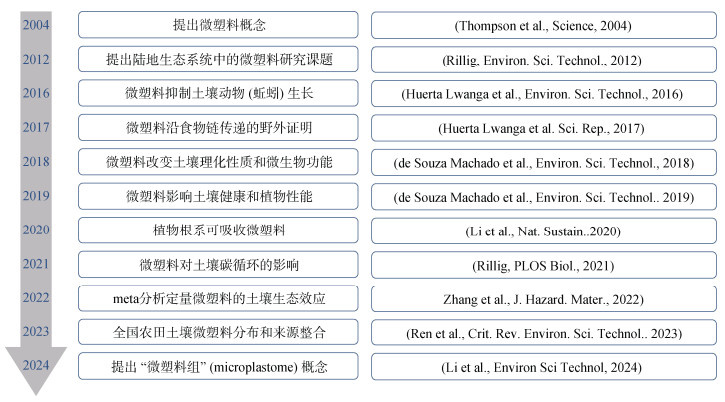
2004年英国科学家Thompson在Science杂志上首次提出“微塑料”的概念,发现在英国17处海滩样本中均存在微塑料,并已在远洋和沉积环境中积累[1](图 1)。所谓微塑料是塑料破裂降解产生的粒径小于5 mm的塑料碎片[1-2],而小于1 μm的微塑料也被称为纳米塑料[3]。2004—2019年期间,有关微塑料污染研究主要集中在海洋、淡水湖、河流等水生生态系统,仅有7.01%是关于陆地生态系统的[4-5]。而2020—2024年间,微塑料研究重点从海洋环境转向淡水环境,但陆地生态系统的微塑料研究依然相对较少[6]。2012年,德国科学家Rillig在Environmental Science & Technology上提出土壤和陆地环境中微塑料污染问题后,学界才逐渐开始关注微塑料对土壤环境的影响[7]。
截至目前,土壤微塑料研究主要包括分析方法、生态环境效应、迁移过程、食物链传递及健康风险以及土壤微塑料污染的预防和治理等方面。关于土壤微塑料的分析方法,当前研究大多采用浮选、消解、染色、观测计数、组分鉴定等测定流程,但各研究中对于各环节的具体操作及参数设置差异较大[8]。土壤微塑料污染广泛存在,尤其在覆盖地膜的农田中。土壤微塑料的生态环境效应主要体现在对土壤理化性质、动植物生长以及微生物丰度和多样性的影响上。2022年Zhang等基于整合分析方法,量化了大/微塑料对于全球土壤生态系统的影响,发现所有有效数据中36%的实验添加大塑料的含量大于411.1 kg·hm−2,同时22%的微塑料添加量都高于67.5 g·kg−1 [9],从而远远高于实际情况[10]。有关土壤微塑料环境效应研究多基于微宇宙培养环境,目前急需模拟真实环境下微塑料的含量,从而进行深入讨论。土壤中微塑料的运移主要受农业耕作、地表径流和土壤动物行为的影响[5]。而土壤微塑料沿食物链传递并威胁人体健康的可能性体现在植物对微纳米塑料的吸收[11]以及动物对微塑料的富集上[12]。
2 农田土壤微塑料特征及来源近年来,国内不少科学家开展了微塑料污染方面的研究工作,尤其是在全国第二次污染源普查项目带动下,积累了一手数据并取得了一定的研究结果[21]。相关研究主要集中在土壤微塑料的形态特征、化学组分、丰度分布及来源的探究上。
2.1 农田土壤微塑料形态特征农田土壤微塑料形态特征主要包括形状、尺寸以及颜色等。微塑料形状主要包括碎片、纤维、颗粒、薄膜和发泡等类型[22]。其中农田土壤中微塑料大多呈薄膜状、碎片状和和纤维状[23]。全国各地土壤中微塑料的尺寸分布基本都呈现出随着尺寸的减小而占比增加的规律[24]。此外,还有研究表明不同环境的农田土壤中微塑料粒径多集中在200~500 μm之间,不同区域和不同农田土壤类型中微塑料尺寸特征也存在差异[25]。土壤中微塑料颜色主要包括透明、白色、黑色、蓝色和红色等,一般以透明和白色为主,这与农用塑料薄膜的主要颜色相对应[25]。
2.2 农田土壤微塑料的化学组分特征农田土壤中微塑料的化学组分以聚乙烯(Polyethelene,PE)、聚丙烯(Polypropylene,PP)、聚苯乙烯(Polystyrene,PS)和聚氯乙烯(Polyvinyl chloride,PVC)等为主,还包括聚酰胺(Polyamide,PA)、脲-甲醛树脂(Urea-formaldehyde,UF)、聚甲醛树脂(Polyoxymethylene,POM)等[26-27]。各种材质塑料在农业领域的用途因性能而异,PE是农膜的主要成份,主要应用于制造地膜、管道等;PP是包装物的主要成份,可用于制作温室棚膜、农具、渔网等;PS主要用于制作温室大棚的保温板、育苗容器和灌溉管道等;PVC可用于制造棚膜、灌溉管道和防虫网等PA和UF用于缓释肥料的包膜材料;POM可用于制造农机零件。
2.3 农田土壤微塑料丰度及分布微塑料在农田土壤中普遍存在,具有明显的空间异质性,且不同研究间土壤微塑料丰度结果差异也较大。当前土壤中检测到的微塑料最高重量丰度为澳大利亚塑料工厂用地中的6.7%[10]。根据我国28个省、自治区、直辖市的875个采样点数据分析表明,目前土壤微塑料丰度范围为1.6×10⁵ ~6.2× 10⁵ items·kg−1,平均值为4 537 items·kg−1,从高到低依次为南方(4 818 items·kg−1)、北方(4 156 items·kg−1)、西北(3 603 items·kg−1)和青藏高原(82 items·kg−1)[13]。土壤微塑料残留主要集中在表层土中,不同地区0~10 cm土壤微塑料丰度显著高于更深土层[28],同时微塑料可以迁移进入80~100 cm深层土体,通常黏土和孔隙度小的土壤中微塑料丰度较高[29]。
2.4 农田土壤微塑料的来源土壤微塑料的来源十分复杂,与区域社会经济发展状况、生产特点等密切相关,主要包括农业塑料、地表径流与灌溉、大气沉降、有机肥等。农业塑料包括农膜、各类包装物(化肥、农药、种子、农产品等)、各类塑料管道等,会产生微塑料泄露到土壤中[30-31]。不同的灌溉水源对土壤中微塑料的贡献不同,使用地表水、地下水和处理过的废水灌溉的农田土壤微塑料丰度分别为326~2 406、274~2 053和114~800 items·kg−1[32]。据估算雨水径流中微塑料的年排放量达8×10⁵~3×10⁶ items·hm−2,其中纤维占比68%~87%[33]。大气沉降中的微塑料主要有PE、PP和PS等组分,形态包括纤维、泡沫、碎片和薄膜等,以纤维为主[34]。空气中的微塑料会随着大气沉降进入地面,法国巴黎空气中微塑料的沉降通量为29~280 items·m−2 d−1[35];上海地区空气中微塑料含量为0~4.2 items·m−3,全年的大气传输量为120.7 kg[36]。有机肥中含有丰富的微塑料,据估算,我国每年通过施用有机肥而进入到土壤中的微塑料将高达52~26 400 t[37]。此外,轮胎磨损颗粒、污泥农用以及垃圾填埋也是农田土壤微塑料的重要来源[38-39]。
3 农田土壤微塑料生态环境效应 3.1 土壤微塑料对植物的影响很多研究表明,微米级和纳米级塑料可以进入植物体。亚微米级微塑料可以通过质外体运输穿过细胞间隙聚集在小麦根的木质部和皮层组织的细胞壁上,再随着蒸腾作用向植物的上部移动,通过维管组织运输到地上部的茎部维管束和叶片的脉管组织中[40]。此外,空心菜等蔬菜吸收微塑料主要是一种应激反应,空心菜受损后新长根时的空隙可进入大于1 μm的微塑料,更大粒径微塑料主要是通过作物根系受损后被动吸收至维管束,再经维管束传输至根茎叶[11]。而纳米级微塑料更易于植物的主动吸收,有研究表明:植物也可以通过叶片吸收纳米塑料,主要是通过气孔和毛状体途径[41]。一般而言,植物暴露于微塑料会导致其生长发育受阻。Meta分析表明,微塑料暴露使植物株高、生物量分别下降了13%和12%[14]。此外,添加微塑料会降低植物的蒸腾速率和光合作用,还会诱导植物产生氧化应激反应,使过氧化物酶(Peroxidase,POD)、过氧化氢酶(Catalase,CAT)活性和丙二醛(Malondialdehyde,MDA)含量分别升高61.03%、8.30%和52.43%[42]。
3.2 土壤微塑料对土壤动物的影响微塑料很容易被土壤动物摄取,然后聚集在其体内或者组织内。微塑料添加培养实验发现蚯蚓、鼠妇、跳虫、线虫、线蚓及原生动物等的肠道、体内或者粪便中均有微塑料[43-47]。微塑料的大小与许多动物的食物相近,很容易被动物误食,粒径较大的微塑料不能被吸收,会随着代谢物排出体外,这期间会通过物理刮擦等方式对动物肠道造成损伤,引发炎症反应[48]。而粒径较小的微塑料颗粒就会通过吞噬细胞的吞噬作用进入动物的系统和组织中,在低营养级生物体内积累富集[49]。低营养级生物被次级消费者捕食后,可通过食物链进入更高级消费者体内,直接作用于相关食物链中其他生物[50]。有研究者进行了微塑料对土壤中蚯蚓生长发育影响的模拟研究,结果显示,土壤中微塑料丰度的影响高于微塑料的类别,当土壤微塑料含量达40 g·kg−1时,蚯蚓会产生对高微塑料含量区域的回避行为;当含量达53和97 g·kg−1时,蚯蚓卵和幼虫数量显著减少[51]。然而英国科学家的研究结果显示,在土壤微塑料含量达10 g·kg−1时,小麦的生长和产量均不受影响[52]。根据目前的土壤微塑料的含量(北京、山东和新疆土壤中微塑料含量分别为3.12、5.63和7.99 mg·kg−1),实际土壤中微塑料对作物和土壤动物的影响并不明显[53]。土壤微塑料在实际土壤中的间接反应,如吸附/释放重金属或有机污染物,虽有研究,但尚未有明确性的结论。
4 土壤微塑料研究面临的挑战 4.1 研究和表示方法一致性问题目前农田土壤中微塑料的检测方法有限,微塑料定量和鉴定方法以及丰度计量单位没有统一规范,不同的测定方法得到的结果难以比较,必须尽快建立规范准确的检测方法及计量单位体系[54]。同一区域,甚至同一样品,不同测定者的结果可能差异巨大,土壤微塑料丰度从几个到几百万items·kg−1(干土)不等,主要原因是采用了不同的微塑料分离方法和测定设备等。土壤微塑料分离技术主要包括手动分离、密度分离、静电分离、油提取和泡沫浮选等,其中最常用的是使用不同盐溶液(NaCl、ZnCl2和NaI)的密度分离方法[55]。微塑料提取后,需要通过一定量的H2O2或酸碱溶液的消解来去除土壤样品中的有机杂质,以避免对微塑料的荧光染色和识别产生干扰。不同浮选溶液浓度和浮选次数,结合不同消解温度和时间,其微塑料提取效率在53%~96%之间变化[56]。此外,不同检测仪器的应用(如荧光显微镜,拉曼光谱或傅里叶变换显微红外光谱(μ-FTIR)和热萃取热脱附气相色谱-质谱(TED-GC-MS))会因其不同的检测限而导致土壤微塑料丰度的变化。例如,拉曼光谱300 nm的检出限要明显低于μ-FTIR的20 µm。最后,检测方法的差异必然导致了计量单位形式的不同,主要包括数量浓度(单位重量土壤含有的微塑料个数)和质量浓度(单位质量土壤含有的微塑料质量)两种表示方法[10,57],这也更加增大了不同研究结果间的比较难度。总体而言,由于提取和检测方法的限制,土壤微塑料丰度存在较大的不确定性。因此,有必要建立土壤微塑料分析方法的标准验证过程。
4.2 土壤微塑料问题的巨大不确定性当前研究对土壤微塑料来源的了解非常有限。在一些研究中,土壤中微塑料残留量同地膜覆盖时间成正比[58-59]。例如,新疆覆膜5年和24年的棉田中微塑料平均丰度分别为80.3和308 items·kg−1[31],因此地膜一直被认为是土壤中微塑料的主要贡献者。土壤微塑料来源的定量研究大多基于模型模拟,Ren等[60]利用经验公式估算,农膜对中国土壤总微塑料的贡献率为10%~30%,确定性为60%~95%。然而,我们最近的研究表明,中国使用农膜最多的西北地区并没有伴随着最高的土壤微塑料丰度[13]。因此,农膜对土壤微塑料的贡献可能被高估了。
大塑料和微塑料对作物生产和土壤健康的影响同样尚不明确,尽管许多研究结果显示微塑料对土壤生态系统的影响是很明显的。最近,我们使用全球整合分析系统地量化了大塑料和微塑料对土壤生态系统功能的影响,结果表明不同研究结果间存在巨大差异[9],同时不同尺寸、形态、组分和浓度的微塑料对同一土壤指标的影响也存在差异。比如,在67个观测结果中,PE微塑料使土壤pH平均降低了2%,而在另外16个观测结果中,生物可降解微塑料则使pH平均升高了3%。对于植物生长,薄膜状微塑料使株高平均降低了11%,而基于21个观测结果的颗粒状微塑料对株高的影响则不显著。土壤动物指标中,PS和PVC微塑料均降低了动物体重,但程度差异较大,分别为3%和11%。同样,微塑料对土壤微生物丰度和多样性的影响在不同的研究中也有所不同。一个更重要的事实是,大多数塑料残留物对土壤生态系统的定量影响是基于实验室内的培养实验,其在实验处理中,塑料添加量往往远高于实际农田中的残留浓度,比如大塑料添加浓度甚至高达800 kg·hm−2,微塑料添加量则高达140 g·kg−1,远高于已有研究中实地检测出的最高值67.5 g·kg−1[10]。微塑料的土壤生态效应因其浓度、尺寸、形状和材质的不同而差异较大,因此,需要更多的基于实际田间微塑料赋存特征的土壤培养和田间试验来积累更多的基础数据,为微塑料的土壤健康效应的探索提供科学支撑。
4.3 农田土壤微塑料污染的防控策略土壤微塑料的污染防控要采用源头控制—过程管理—末端治理的全链条模式。在源头控制方面:划定地膜适宜覆盖区域,根据不同地区的种植情况、气候条件和土壤特性,划分必覆区(如西北干旱区)、可覆区(如华北部分地区)和不覆区(如华南和西南部分地区)。通过品种选育、种植制度优化等方式,因地制宜推广保水剂施用、无膜浅埋滴灌、秸秆覆盖替代等技术,减少地膜使用;通过增加厚度提升地膜的耐用性和可回收性;使用可降解地膜替代传统地膜以加快塑料降解;提高回收利用率、鼓励废旧塑料的循环利用;明确减塑指标并出台相应的制度和法规;通过限制生产、产品替代、税收调节和回收补贴等政策调节。过程管理方面:加强残膜的回收、清除、堆放和回收管理;加强废物管理基础设施和处置方法、提高机械回收效率、研发残膜回收再利用技术手段;加强宣传,提高公众认知。在末端治理方面,理论上,土壤中微塑料的修复可以采用相关的塑料降解微生物和酶,以及活性炭来实现。如芽孢杆菌能降解PE,并释放能降解高密度聚乙烯(High-density polyethylene,HDPE)的酯酶和漆酶[61],而表面活性剂的存在会增强枯草芽孢杆菌对微塑料的降解能力[62];胞外酶能作用于土壤塑料表面的大分子,通过表面功能化促进塑料分解[63-64]。生物炭可以作为土壤微塑料污染的潜在修复剂主要归因于其对微塑料的吸附作用,及其对微塑料影响土壤健康和植物生长胁迫的缓解。然而,上述修复方法在实地环境中实践难度极大,也尚未见到实施的样板和范例。因此,当前的土壤微塑料污染防范策略重点应在源头控制和过程管理上;同时,应加强对已有微塑料污染末端治理的研究。
| [1] |
Thompson R C, Olsen Y, Mitchell R P, et al. Lost at sea: Where is all the plastic?[J]. Science, 2004, 304(5672): 838. DOI:10.1126/science.1094559
(  0) 0) |
| [2] |
Thompson R C, Courtene-Jones W, Boucher J, et al. Twenty years of microplastic pollution research—What have we learned?[J]. Science, 2024, 386(6720): eadl2746. DOI:10.1126/science.adl2746
( 0) |
| [3] |
Zou Z, Li S, Wu J, et al. Effects of nanopolystyrene addition on nitrogen fertilizer fate, gaseous loss of N from the soil, and soil microbial community composition[J]. Journal of Hazardous Materials, 2022, 438: 129509. DOI:10.1016/j.jhazmat.2022.129509
( 0) |
| [4] |
Qin F, Du J, Gao J, et al. Bibliometric profile of global microplastics research from 2004 to 2019[J]. International Journal of Environmental Research and Public Health, 2020, 17(16): 5639. DOI:10.3390/ijerph17165639
( 0) |
| [5] |
Yang L, Zhang Y, Kang S, et al. Microplastics in soil: A review on methods, occurrence, sources, and potential risk[J]. Science of the Total Environment, 2021, 780: 146546. DOI:10.1016/j.scitotenv.2021.146546
( 0) |
| [6] |
Xing Z, Fu W, Li L, et al. Bibliometric analysis of microplastics research: Advances and future directions(2020–2024)[J]. Continental Shelf Research, 2025, 285: 105371. DOI:10.1016/j.csr.2024.105371
( 0) |
| [7] |
Rillig M C. Microplastic in terrestrial ecosystems and the soil?[J]. Environmental Science & Technology, 2012, 46(12): 6453-6454.
( 0) |
| [8] |
Fok L, Lam T W L, Li H, et al. A meta-analysis of methodologies adopted by microplastic studies in China[J]. Science of the Total Environment, 2020, 718: 135371. DOI:10.1016/j.scitotenv.2019.135371
( 0) |
| [9] |
Zhang J, Ren S, Xu W, et al. Effects of plastic residues and microplastics on soil ecosystems: A global meta-analysis[J]. Journal of Hazardous Materials, 2022, 435: 129065. DOI:10.1016/j.jhazmat.2022.129065
( 0) |
| [10] |
Fuller S, Gautam A. A procedure for measuring microplastics using pressurized fluid extraction[J]. Environmental Science & Technology, 2016, 50(11): 5774-5780.
( 0) |
| [11] |
Li L, Luo Y, Li R, et al. Effective uptake of submicrometre plastics by crop plants via a crack-entry mode[J]. Nature Sustainability, 2020, 3(11): 929-937. DOI:10.1038/s41893-020-0567-9
( 0) |
| [12] |
Huerta Lwanga E, Mendoza Vega J, Ku Quej V, et al. Field evidence for transfer of plastic debris along a terrestrial food chain[J]. Scientific Reports, 2017, 7(1): 14071. DOI:10.1038/s41598-017-14588-2
( 0) |
| [13] |
Ren S, Wang K, Zhang J, et al. Potential sources and occurrence of macro-plastics and microplastics pollution in farmland soils: A typical case of China[J]. Critical Reviews in Environmental Science and Technology, 2023, 54(7): 533-556.
( 0) |
| [14] |
Zhang J, Ren S, Xu W, et al. Effects of plastic residues and microplastics on soil ecosystems: A global meta-analysis[J]. Journal of Hazardous Materials, 2022, 435: 129065. DOI:10.1016/j.jhazmat.2022.129065
( 0) |
| [15] |
Rillig M C, Leifheit E, Lehmann J. Microplastic effects on carbon cycling processes in soils[J]. PLOS Biology, 2021, 19(3): e3001130. DOI:10.1371/journal.pbio.3001130
( 0) |
| [16] |
de Souza Machado A A, Lau C W, Kloas W, et al. Microplastics can change soil properties and affect plant performance[J]. Environmental Science & Technology, 2019, 53(10): 6044-6052.
( 0) |
| [17] |
de Souza Machado A A, Lau C W, Till J, et al. Impacts of microplastics on the soil biophysical environment[J]. Environmental Science & Technology, 2018, 52(17): 9656-9665.
( 0) |
| [18] |
Huerta Lwanga E, Mendoza Vega J, Ku Quej V, et al. Field evidence for transfer of plastic debris along a terrestrial food chain[J]. Scientific Reports, 2017, 7(1): 14071. DOI:10.1038/s41598-017-14588-2
( 0) |
| [19] |
Huerta Lwanga E, Gertsen H, Gooren H, et al. Microplastics in the terrestrial ecosystem: implications for Lumbricus terrestris(Oligochaeta, Lumbricidae)[J]. Environmental Science & Technology, 2016, 50(5): 2685-2691.
( 0) |
| [20] |
Li C, Li X, Bank M S, et al. The "microplastome" – A holistic perspective to capture the real-world ecology of microplastics[J]. Environmental Science & Technology, 2024, 58(9): 4060-4069.
( 0) |
| [21] |
Ministry of Ecology and Environment of the People's Republic of China. A guide to the emission coeddicient of the second national census on pollution sources (In Chinese). Beijing: China Environment Publishing Group, 2022. [中华人民共和国生态环境部. 第二次全国污染源普查产排污系数书册[M]. 北京: 中国环境出版集团, 2022.]
( 0) |
| [22] |
Lozano Y M, Lehnert T, Linck L T, et al. Microplastic shape, polymer type, and concentration affect soil properties and plant biomass[J]. Frontiers in Plant Science, 2021, 12: 616645. DOI:10.3389/fpls.2021.616645
( 0) |
| [23] |
Bai R, Liu H, Cui J, et al. The characteristics and influencing factors of farmland soil microplastic in Hetao Irrigation District, China[J]. Journal of Hazardous Materials, 2024, 465: 133472. DOI:10.1016/j.jhazmat.2024.133472
( 0) |
| [24] |
Yang J, Li L Z, Zhou Q, et al. Microplastics contamination of soil environment: Sources, processes and risks (In Chinese)[J]. Acta Pedologica Sinica, 2021, 58(2): 281-298. DOI:10.11766/trxb202006090286 [杨杰, 李连祯, 周倩, 等. 土壤环境中微塑料污染: 来源、过程及风险[J]. 土壤学报, 2021, 58(2): 281-298.]
( 0) |
| [25] |
Chen L, Yu L, Li Y, et al. Spatial distributions, compositional profiles, potential sources, and intfluencing factors of microplastics in soils from different agricultural farmlands in China: A national perspective[J]. Environmental Science & Technology, 2022, 56(23): 16964-16974.
( 0) |
| [26] |
Kou S Q, Guan Z, Lu X Y, et al. Migration of microplastics in soil and its effect on organic pollutants: A Review (In Chinese)[J]. Soils, 2024, 56(3): 457-470. [寇诗棋, 关卓, 鲁旭阳, 等. 土壤中微塑料迁移及其对有机污染物的影响研究进展[J]. 土壤, 2024, 56(3): 457-470.]
( 0) |
| [27] |
Chen Y L, Sun K, Han L F, et al. Separation, identification, and quantification methods in soil microplastics analysis: A review (In Chinese)[J]. Acta Pedologica Sinica, 2022, 59(2): 364-380. DOI:10.11766/trxb202012070566 [陈雅兰, 孙可, 韩兰芳, 等. 土壤中微塑料的分离及检测方法研究进展[J]. 土壤学报, 2022, 59(2): 364-380.]
( 0) |
| [28] |
Zhang J, Wang K, Hao T, et al. Long-term plastic film mulching promotes microplastic accumulation and alters gross nitrogen transformation in soil[J]. Applied Soil Ecology, 2025, 208: 106007. DOI:10.1016/j.apsoil.2025.106007
( 0) |
| [29] |
Li S, Ding F, Flury M, et al. Macro- and microplastic accumulation in soil after 32 years of plastic film mulching[J]. Environmental Pollution, 2022, 300: 118945. DOI:10.1016/j.envpol.2022.118945
( 0) |
| [30] |
Gündoğdu R, Önder D, Gündoğdu S, et al. Plastics derived from disposable greenhouse plastic films and irrigation pipes in agricultural soils: A case study from Turkey[J]. Environmental Science and Pollution Research, 2022, 29(58): 87706-87716. DOI:10.1007/s11356-022-21911-6
( 0) |
| [31] |
Huang Y, Liu Q, Jia W, et al. Agricultural plastic mulching as a source of microplastics in the terrestrial environment[J]. Environmental Pollution, 2020, 260: 114096. DOI:10.1016/j.envpol.2020.114096
( 0) |
| [32] |
Salehi Z, Hashemi S H, Flury M. Micro- and mesoplastics in farmlands with different irrigation water sources[J]. Water, Air, & Soil Pollution, 2023, 234(4): 267.
( 0) |
| [33] |
Piñon-Colin T d J, Rodriguez-Jimenez R, Rogel- Hernandez E, et al. Microplastics in stormwater runoff in a semiarid region, Tijuana, Mexico[J]. Science of the Total Environment, 2020, 704: 135411. DOI:10.1016/j.scitotenv.2019.135411
( 0) |
| [34] |
Li J, Zhang J, Ren S, et al. Atmospheric deposition of microplastics in a rural region of North China Plain[J]. Science of the Total Environment, 2023, 877: 162947. DOI:10.1016/j.scitotenv.2023.162947
( 0) |
| [35] |
Dris R, Gasperi J, Rocher V, et al. Microplastic contamination in an urban area: A case study in Greater Paris[J]. Environmental Chemistry, 2015, 12(5): 592-599. DOI:10.1071/EN14167
( 0) |
| [36] |
Liu K, Wang X, Fang T, et al. Source and potential risk assessment of suspended atmospheric microplastics in Shanghai[J]. Science of the Total Environment, 2019, 675: 462-471. DOI:10.1016/j.scitotenv.2019.04.110
( 0) |
| [37] |
Luo Y M, Zhou Q, Zhang H B, et al. Pay attention to research on microplastic pollution in soil for prevention of ecological and food chain risks (In Chinese)[J]. Bulletin of Chinese Academy of Sciences, 2018, 33(10): 1021-1030. [骆永明, 周倩, 章海波, 等. 重视土壤中微塑料污染研究防范生态与食物链风险[J]. 中国科学院院刊, 2018, 33(10): 1021-1030.]
( 0) |
| [38] |
Weithmann N, Möller J N, Löder M G J, et al. Organic fertilizer as a vehicle for the entry of microplastic into the environment[J]. Science Advances, 2018, 4(4): eaap8060. DOI:10.1126/sciadv.aap8060
( 0) |
| [39] |
Evangeliou N, Grythe H, Klimont Z, et al. Atmospheric transport is a major pathway of microplastics to remote regions[J]. Nature Communications, 2020, 11(1): 3381. DOI:10.1038/s41467-020-17201-9
( 0) |
| [40] |
Li R J, Li L Z, Zhang Y C, et al. Uptake and accumulation of microplastics in a cereal plant wheat (In Chinese)[J]. Chinese Science Bulletin, 2020, 65(20): 2120-2127. [李瑞杰, 李连祯, 张云超, 等. 禾本科作物小麦能吸收和积累聚苯乙烯塑料微球[J]. 科学通报, 2020, 65(20): 2120-2127.]
( 0) |
| [41] |
Zhou J, Xia R. Leafy vegetable assimilation of atmospheric microplastics/nanoplastics: an overlooked source in human food?[J]. Environmental Science & Technology Letters, 2024, 11(2): 51-53.
( 0) |
| [42] |
Zhou L, Chu J, Zhang Y, et al. Potential impacts of microplastic particle size and type on soil properties and buckwheat performance[J]. Agronomy, 2025, 15(5): 1064. DOI:10.3390/agronomy15051064
( 0) |
| [43] |
Chen Y, Liu X, Leng Y, et al. Defense responses in earthworms(Eisenia fetida)exposed to low-density polyethylene microplastics in soils[J]. Ecotoxicology and Environmental Safety, 2020, 187: 109788. DOI:10.1016/j.ecoenv.2019.109788
( 0) |
| [44] |
Zhu D, Chen Q, An X, et al. Exposure of soil collembolans to microplastics perturbs their gut microbiota and alters their isotopic composition[J]. Soil Biology & Biochemistry, 2018, 116: 302-310.
( 0) |
| [45] |
Liu X B, Dong X S, Xie Z H, et al. Ecological effects and biodegradation of microplastics in soils (In Chinese)[J]. Acta Pedologica Sinica, 2022, 59(2): 349-363. DOI:10.11766/trxb202102240040 [刘鑫蓓, 董旭晟, 解志红, 等. 土壤中微塑料的生态效应与生物降解[J]. 土壤学报, 2022, 59(2): 349-363.]
( 0) |
| [46] |
Zhang L, Sun D, Zhang J Q, et al. Research progress on the migration of agricultural film microplastics and phthalates in soil (In Chinese)[J]. Soils, 2024, 56(5): 938-947. [张蕾, 孙东, 张建强, 等. 农膜微塑料与酞酸酯在土壤中迁移的研究进展[J]. 土壤, 2024, 56(5): 938-947.]
( 0) |
| [47] |
da Costa Araújo A P, Malafaia G. Microplastic ingestion induces behavioral disorders in mice: A preliminary study on the trophic transfer effects via tadpoles and fish[J]. Journal of Hazardous Materials, 2021, 401: 123263. DOI:10.1016/j.jhazmat.2020.123263
( 0) |
| [48] |
Rawle D J, Dumenil T, Tang B, et al. Microplastic consumption induces inflammatory signatures in the colon and prolongs a viral arthritis[J]. Science of the Total Environment, 2022, 809: 152212. DOI:10.1016/j.scitotenv.2021.152212
( 0) |
| [49] |
Ikuta T, Tame A, Takahashi T, et al. Microplastic particles are phagocytosed in gill cells of deep-sea and coastal mussels[J]. Frontiers in Marine Science, 2022, 9: 1034950. DOI:10.3389/fmars.2022.1034950
( 0) |
| [50] |
Okeke E S, Okoye C O, Atakpa E O, et al. Microplastics in agroecosystems-impacts on ecosystem functions and food chain[J]. Resources, Conservation and Recycling, 2022, 177: 105961. DOI:10.1016/j.resconrec.2021.105961
( 0) |
| [51] |
Ding W, Li Z, Qi R, et al. Effect thresholds for the earthworm Eisenia fetida: Toxicity comparison between conventional and biodegradable microplastics[J]. Science of the Total Environment, 2021, 781: 146884. DOI:10.1016/j.scitotenv.2021.146884
( 0) |
| [52] |
Brown R W, Chadwick D R, Thornton H, et al. Field application of pure polyethylene microplastic has no significant short-term effect on soil biological quality and function[J]. Soil Biology & Biochemistry, 2022, 165: 108496.
( 0) |
| [53] |
Qi R, Tang Y, Jones D L, et al. Occurrence and characteristics of microplastics in soils from greenhouse and open-field cultivation using plastic mulch film[J]. Science of the Total Environment, 2023, 905: 166935. DOI:10.1016/j.scitotenv.2023.166935
( 0) |
| [54] |
Wang K, Liu X, Chadwick D R, et al. The agricultural plastic paradox: Feeding more, harming more?[J]. Environment International, 2025, 198: 109416. DOI:10.1016/j.envint.2025.109416
( 0) |
| [55] |
Möller J N, Löder M G J, Laforsch C. Finding microplastics in soils: A review of analytical methods[J]. Environmental Science & Technology, 2020, 54(4): 2078-2090.
( 0) |
| [56] |
Qi R M. Characteristics and ecological effects of soilmicroplastic in typical agricultural region with plastic film mulching in China[D]. Beijing: Chinese Academy of Agricultural Sciences, 2021.[戚瑞敏. 中国典型覆膜农区土壤微塑料特征及生态效应[D]. 北京: 中国农业科学院, 2021.]
( 0) |
| [57] |
Jia Z, Wei W, Wang Y, et al. Occurrence characteristics and risk assessment of microplastics in agricultural soils in the loess hilly gully area of Yan' an, China[J]. Science of the Total Environment, 2024, 912: 169627. DOI:10.1016/j.scitotenv.2023.169627
( 0) |
| [58] |
Zhu Y E, Wen H X, Li T H X, et al. Distribution and sources of microplastics in farmland soil along the Fenhe River (In Chinese)[J]. Environmental Science, 2021, 42(8): 3894-3903. [朱宇恩, 文瀚萱, 李唐慧娴, 等. 汾河沿岸农田土壤微塑料分布特征及成因解析[J]. 环境科学, 2021, 42(8): 3894-3903.]
( 0) |
| [59] |
Zhou B, Wang J, Zhang H, et al. Microplastics in agricultural soils on the coastal plain of Hangzhou Bay, east China: Multiple sources other than plastic mulching film[J]. Journal of Hazardous Materials, 2020, 388: 121814. DOI:10.1016/j.jhazmat.2019.121814
( 0) |
| [60] |
Ren S, Kong S, Ni H. Contribution of mulch film to microplastics in agricultural soil and surface water in China[J]. Environmental Pollution, 2021, 291: 118227. DOI:10.1016/j.envpol.2021.118227
( 0) |
| [61] |
Ndahebwa Muhonja C, Magoma G, Imbuga M, et al. Molecular characterization of low-density polyethene(LDPE)degrading bacteria and fungi from Dandora dumpsite, Nairobi, Kenya[J]. International Journal of Microbiology, 2018, 2018(1): 4167845.
( 0) |
| [62] |
Vimala P P, Mathew L. Biodegradation of polyethylene using Bacillus subtilis[J]. Procedia Technology, 2016, 24: 232-239. DOI:10.1016/j.protcy.2016.05.031
( 0) |
| [63] |
Corradini F, Meza P, Eguiluz R, et al. Evidence of microplastic accumulation in agricultural soils from sewage sludge disposal[J]. Science of the Total Environment, 2019, 671: 411-420. DOI:10.1016/j.scitotenv.2019.03.368
( 0) |
| [64] |
Han X, Liu W, Huang J W, et al. Structural insight into catalytic mechanism of PET hydrolase[J]. Nature Communications, 2017, 8(1): 2106. DOI:10.1038/s41467-017-02255-z
( 0) |