 2026, Vol. 63


微塑料作为全球关注的四种新污染物之一,其环境行为与生态风险已成为环境科学领域的研究热点。微塑料的生态风险不仅限于其自身的直接毒性效应,更体现在通过改变水体浊度、土壤理化性质及遮蔽光线等间接影响陆地生态系统功能[1-2];同时其高比表面积赋予的污染物载体功能,可能引发复合污染风险[3]。此外,微塑料在环境老化过程中产生的表面特性演变(如表面形貌、电荷、含氧官能团和疏水性改变等)会显著影响其环境界面行为[4],这为微塑料污染研究提出了新的科学问题。
土壤环境中微塑料的老化机制主要涉及光解、机械破碎和生物降解[4]。在紫外辐射作用下,聚合物中的不饱和键被激发,在有氧条件下生成表面自由基,从而引发氧化、脱氢、键断裂和交联反应[5-6]。机械破碎作用主要通过水流剪切力与砂石摩擦加速微塑料的老化破碎[7-8]。生物降解途径包括微生物酶解[9]和土壤动物摄食转化(如微塑料在蚯蚓体内破碎)[10]。然而,不同环境介质中微塑料的老化机制存在显著差异。例如,深埋在土壤中的微塑料因光屏蔽效应难以发生光老化,而表层土壤中的微塑料在光-生物协同作用下可能呈现加速老化特征。但是,植物和土壤附着引发的遮光效应可能会干扰土壤表层微塑料的光老化。因此,亟需加强对表层和深层土壤微塑料老化行为的研究。
当前研究多采用紫外辐射、芬顿(Fenton)氧化等人工加速老化方法模拟微塑料的老化行为[11-12]。但是,室内模拟条件与真实环境存在显著差异。实验室紫外线强度可达自然光照的10倍~50倍,而化学氧化剂的使用可能改变表面官能团的自然形成路径[13]。特别是针对长期(约12个月)的自然老化过程,现有研究在环境介质特异性、自然老化行为等方面仍存在不足,严重制约了微塑料环境风险的准确评估。因此,本研究选取聚氯乙烯(PVC)和聚酰胺(PA)两种典型微塑料,通过设置空气、土壤表层(0 cm)和土壤内部(10 cm)三种环境场景,开展为期12个月的自然老化实验。通过多重技术手段表征两种微塑料的自然老化特征,同时基于化学降解和热降解实验评估两种老化微塑料的稳定性。研究成果将深化对自然土壤环境中微塑料老化行为的理解,为准确评估其环境风险和开展模拟老化实验提供科学依据。
1 材料与方法 1.1 供试材料供试微塑料购自广东广源塑料原料有限公司。PVC和PA微塑料均为白色颗粒状,平均粒径分别为1 909 ± 241 μm和1 958 ± 321 μm。供试土壤为扬州大学试验田表层土壤(0~20 cm),经自然风干后去除植物残体,过20目标准筛备用。利用激光粒度仪(Mastersizer 2000,Malvern,英国)分析土壤颗粒组成:砂粒、粉粒和黏粒分别为81.2%、15.7%和3.1%。根据《国际制土壤质地分类》[14],供试土壤为砂质壤土,其主要理化性质如下:pH7.10,容重1.38 g·cm−3,有机质22.5 g·kg−1。
1.2 微塑料自然老化实验为探究微塑料在土壤环境中的自然老化行为,本研究设计了土壤表层(0 cm,有阳光辐射)和土壤内部(10 cm,无阳光辐射)两种老化场景,同时设置仅有阳光辐射的空气暴露作为对照。土壤表层暴露:在陶瓷花盆中装入2.0 kg风干土壤,加水使土壤全部润湿后,平衡7 d。随后,将1.0 g原始微塑料样品分散于土壤表层。为防止微塑料样品被风吹走,在微塑料上方加盖长方形石英盖。石英盖倾斜放置,其一端搭在花盆边缘,从而保证表层土壤进行正常的水气交换。土壤深层暴露:在花盆中装入1.0 kg风干土壤(土深约10 cm),加水使土壤全部润湿后,将1.0 g原始微塑料样品分散于土壤表层,然后在微塑料上方再填装1.0 kg风干土壤。空气暴露:将1.0 g原始微塑料样品分散于500目(25 μm)不锈钢筛网上,在其上方放置石英盖。所有老化实验均在扬州大学环境科学与工程学院楼顶(32°20′25.73″N,119°24′8.28″E)进行,实验周期为2022年10月22日至2023年10月21日。
1.3 样品前处理老化实验结束后,按以下流程收集并清洗微塑料样品:用不锈钢镊子将土壤中的老化微塑料样品转移至80目不锈钢筛网上,用蒸馏水冲洗后,将微塑料样品转移至50 mL玻璃烧杯,加入30 mL蒸馏水超声清洗20 min(重复2次),再用30 mL乙醇按相同步骤清洗1次,总计清洗3次;随后,用蒸馏水冲洗后,置于烘箱中烘干(30 ℃)。
1.4 微塑料表征方法采用场发射扫描电镜(GeminiSEM 300,Zeiss,德国)观察老化前后微塑料的表面形貌特征;利用X射线光电子能谱(ESCALAB 250XI,Thermo,美国)测定原始和老化微塑料的元素组成;采用单色化Al Kα光源,氩气压力为1×10⁻⁸ Pa,在150.0 eV的通带能量和1.00 eV的能量步长下获取C1s精细光谱;使用配备锗晶体衰减全反射附件的傅里叶变换红外光谱仪(610-IR,Varian,美国)分析原始和老化微塑料的表面官能团,测试条件为:扫描范围为4 000~500 cm−1,分辨率为4 cm−1,扫描次数为32次。同时,基于式(1)计算两种微塑料的羰基指数(CI):
| $ {\text{CI}} = \frac{{{I_{{\text{C}} = {\text{O}}}}}}{{{I_{{\text{C}} - H}}}} $ | (1) |
式中,
微塑料的稳定性越强表示其抗氧化能力越突出。因此,本文分别采用化学氧化和热解方法测定原始和老化微塑料的稳定性。热解:使用热重分析仪(TGA 8000,PerkinElmer,美国)对微塑料的热稳定性进行分析。测试条件如下:称取约3.0 mg老化微塑料样品,将样品均匀平铺在氧化铝坩埚中,在20 mL·min–1氮气氛围下,以10 ℃·min–1的速率从30 ℃加热至600 ℃,获取样品的热重曲线。化学氧化:准确称取50.0 mg老化微塑料样品,将其置于玻璃管中,加入7 mL30%的过氧化氢(H2O2),将玻璃管置于80 ℃水浴锅中反应72 h。采用式(2)计算微塑料样品的质量损失。每个样品设置三组平行。
| $ \Delta m = {m_1} - {m_0} $ | (2) |
式中,
利用Excel 2016和SPSS 22.0对实验数据进行统计分析。基于单因素方差分析中的邓肯(Duncan)多重比较检验不同处理组之间数据的差异显著性(P < 0.05);利用Origin 2021和PowerPoint 2016绘制图片。
1.7 质量控制在自然老化实验期间,定期检查实验装置及标签完整性,防止样品损失或混淆。取样时,用镊子轻轻夹取微塑料样品,避免人为损坏样品。实验中用到的器皿均经过彻底清洗,以避免样品污染。涉及定量分析的指标(如粒径和化学氧化质量损失),均进行了重复测试,并用平均值±标准差的形式表示;同时以原始微塑料的表征结果作为对照。
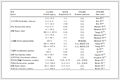
2 结果与讨论 2.1 自然老化微塑料的化学特征 2.1.1 元素变化微塑料的自然老化过程可能伴随氧化和降解反应发生,导致微塑料中的碳(C)、氧(O)等元素组成发生变化。因此,元素组成和O/C比常被用于评估微塑料的老化程度[11,15]。如表 1所示,原始PVC微塑料中除了C和氯(Cl)元素外,还含有O元素。这是因为PVC塑料中通常添加大量含氧的塑化剂[16],以降低其刚性。在三种不同环境中老化12个月后,PVC微塑料中O元素的比例较原始PVC微塑料有所增加,且筛网上老化的PVC微塑料中的O元素比例最大;此外,老化PVC微塑料的O/C比均大于原始PA微塑料,且表现出O/C比由高到低依次为筛网、土内、土表。这表明PVC微塑料在太阳辐射下发生了光氧化反应。研究指出,光照可激发PVC分子中的C–Cl键,导致C–Cl键断裂并生成氯自由基和烷基自由基,这些自由基随后与氧气反应生成过氧化自由基,引发链式氧化反应,形成含氧官能团,导致O元素含量增加[17]。原始PA微塑料中具有酰胺基(O=C–NH),因此本身就含有O元素。与原始PA微塑料相比,老化PA微塑料的O元素比例有所增加,具体表现为:土内和筛网相当,但小于土表。尽管老化环境相同,但两种微塑料的O元素变化则完全相反,这表明微塑料的自身属性也是控制其老化行为的关键因素。
|
表 1 原始和老化微塑料的元素组成 Table 1 The elemental composition of pristine and aged microplastics |
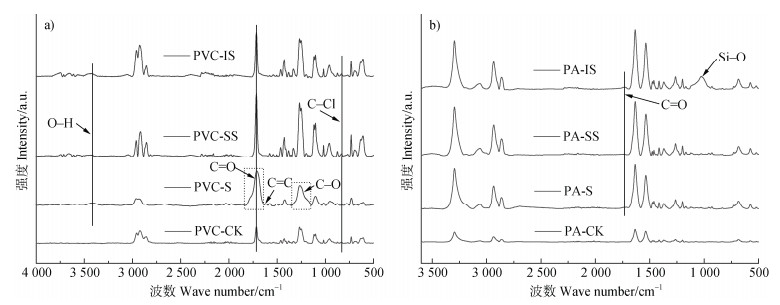
元素组成的变化与官能团的改变直接相关。如图 1a所示,除了与原始PVC微塑料共有的特征峰(如2 800~3 000 cm–1(C–H伸缩振动)、1 428 cm–1(–CH–变形振动)、1 246 cm–1(–CH–摇摆振动)、840 cm–1(C–Cl伸缩振动)和682 cm–1(C–Cl伸缩振动))之外[18],老化PVC微塑料在3 350~3 500 cm–1出现新的特征峰,对应O–H,表明PVC微塑料在三种环境中均发生了氧化[17]。与土壤中老化的PVC微塑料相比,筛网上老化的PVC微塑料在1 612 cm–1处新增共轭双键(C=C),且840 cm–1处的C–Cl键消失;此外,筛网上老化的PVC微塑料在1 712 cm–1处的C=O键和土壤中老化的PVC微塑料明显不同[19]。该现象是由于PVC微塑料在长期紫外线辐射下发生了剧烈的光氧化反应,释放氯化氢并生成共轭双键[20],从而导致C–Cl和C=C发生明显变化。经过12个月老化的PA微塑料的典型特征峰(如690 cm–1(C–C)、1 263 cm–1(C–O)、1 539 cm–1(酰胺Ⅱ键)、1 639 cm–1(酰胺Ⅰ键)、2 865 cm–1(C–H)、2 935 cm–1(C–H)和3 296 cm–1(N–H))未发生明显变化,但在1 720 cm–1附近出现新的羰基(C=O)吸收峰[21],表明PA微塑料在三种环境中均发生了氧化反应。此外,土内老化的PA微塑料在1 030 cm–1处新增了Si–O,表明PA微塑料表面附着了土壤矿物[22];但是,在另外两种老化PA微塑料上未发现土壤矿物吸收峰。这是因为被埋在土壤中的PA微塑料与土壤矿物充分接触,从而导致二者发生稳定结合。同样是被埋在土内的PVC微塑料表面并未检测到矿物吸收峰,与Wang等[22]的研究结果一致,表明不同类型微塑料与土壤矿物的结合存在差异。
|
图 1 原始和老化微塑料的傅里叶变换红外光谱(FTIR)(a. PVC,b. PA) Fig. 1 Fourier transform infrared spectroscopy (FTIR) spectra of pristine and aged microplastics (a. PVC, b. PA) |
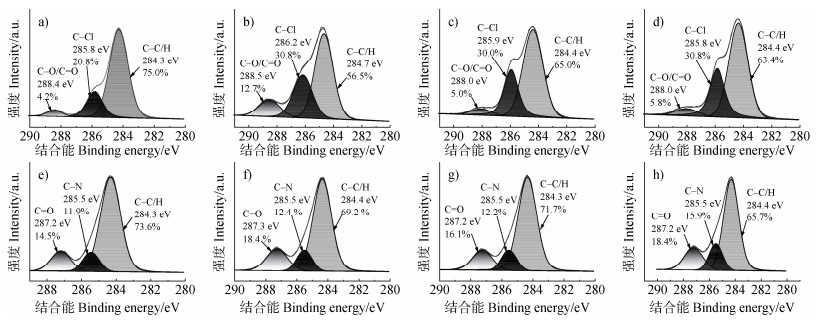
两种微塑料的精细C1s谱图如图 2所示。原始PVC微塑料的C1s谱图可被解卷积为三个峰:C–C/H(284.3 eV)、C–Cl(285.8 eV)和C–O/C=O(288.4 eV)。相比于原始PVC微塑料,老化PVC微塑料的C1s谱图并未出现新的特征峰,但三个峰的占比发生了变化。在筛网上经过12个月老化后,老化PVC微塑料中C–O/C=O峰的比例由4.2%增加为12.7%;在土表和土内老化的PVC微塑料的C–O/C=O峰的比例较原始PVC微塑料均有所增加,但增幅明显小于筛网上老化的PVC微塑料,进一步表明PVC微塑料在长期太阳光辐射下发生了剧烈的光氧化[17],导致其含氧官能团增加。原始PA微塑料的C1s谱图同样被解卷积为三个峰:C–C/H(284.4 eV)、C–N(285.5 eV)和C=O(287.3 eV)。与原始PA微塑料相比,三种老化PA微塑料的C=O峰的比例均有所增加,这与红外光谱检测到的新增羰基官能团(图 1b)一致。
|
注:图中的百分数表示各官能团的峰面积百分比。 Note: The percentages in the figure represent the peak area percentages of each functional group. 图 2 原始和老化微塑料的C1s精细谱图(a. PVC-CK,b. PVC-S,c. PVC-SS,d. PVC-IS,e. PA-CK,f. PA-S,g. PA-SS,h. PA-IS) Fig. 2 Deconvoluted XPS spectra of the pristine and aged microplastics in the C1s regions (a. PVC-CK, b. PVC-S, c. PVC-SS, d. PVC-IS, e. PA-CK, f. PA-S, g. PA-SS, h. PA-IS) |
如图 3所示,暴露在不同环境中的PVC微塑料呈现出明显的颜色差异。与原始白色透明的PVC微塑料相比,在土壤内部老化12个月的PVC微塑料的颜色几乎无变化;相比之下,在土壤表层老化12个月的PVC微塑料的颜色变黄,而在筛网上老化12个月的PVC微塑料的颜色由透明变为琥珀色。不难发现,只有在太阳光辐射下(筛网和土表)的PVC微塑料发生了明显的颜色变化。如图 1a所示,筛网上老化的PVC微塑料在紫外线辐射下发生了光氧化反应,生成了显色基团(即共轭双键),从而导致其颜色由透明逐渐变为琥珀色[20,23-24]。此外,筛网上老化的PVC微塑料的颜色变化程度明显大于土表老化的PVC微塑料,这是由植物和微塑料表面附着的土壤引发的遮光效应导致的[17]。相应地,在土表老化PVC微塑料上也未检测到发色基团吸收峰。此外,被埋在土壤中的PVC微塑料未发生光氧化反应,因此其颜色与原始PVC微塑料极为接近。

|
图 3 原始和老化微塑料的光学图像 Fig. 3 Optical images of pristine and aged microplastics |
在筛网上经过12个月的太阳辐射后,白色不透明的PA微塑料的颜色并未发生明显变化;而在土壤环境中(土表和土内)老化的PA微塑料的颜色略微加深,这是由于土壤附着在PA微塑料表面引起的。此外,土内老化的PA微塑料的颜色较土表的深,这可能是由于被埋在土壤中的PA微塑料与土壤充分接触,从而导致其表面附着的土壤多于土表。如图 1b所示,仅在土内老化的PA微塑料上检测到土壤矿物吸收峰(Si–O),这充分证明被埋在土壤中的PA微塑料表面附着了较多的土壤矿物。
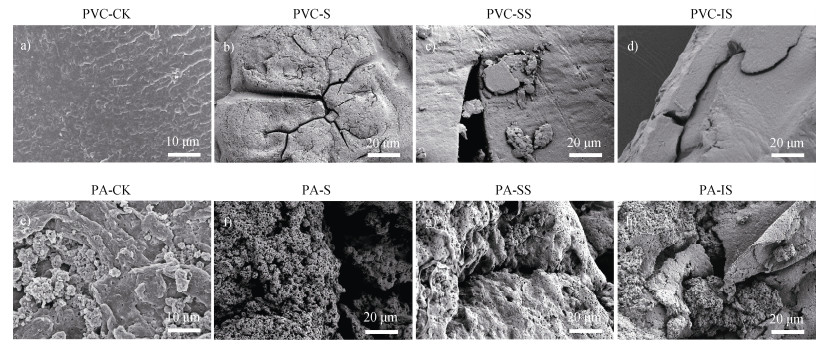
2.2.2 微观形貌变化如图 4a所示,原始PVC微塑料表面呈波纹状,表面完整且不存在裂纹;在三种环境中经过12个月老化后,PVC微塑料表面出现不同程度的裂纹(图 4b~图 4d),尤以筛网上老化的PVC微塑料表面的裂纹最多(图 4b),且其表面出现明显的光侵蚀现象。如图 4e所示,原始PA微塑料表面存在大量细小孔洞,但仍存在较大面积的完整表面。在三种环境中经过12个月老化后,PA微塑料表面的孔洞显著增多。相比之下,筛网上老化的PA微塑料表面的孔隙最发达,其表面已接近网状结构,表明PA微塑料发生了剧烈的光降解[25]。尽管被埋在土内的PA微塑料的表面也存在大量孔洞,但其表面仍存在较大面积的完整结构。
|
图 4 原始和老化微塑料的扫描电镜图像(a. PVC-CK,b. PVC-S,c. PVC-SS,d. PVC-IS,e. PA-CK,f. PA-S,g. PA-SS,h. PA-IS) Fig. 4 Scanning electron microscope (SEM) images of pristine and aged microplastics (a. PVC-CK, b. PVC-S, c. PVC-SS, d. PVC-IS, e. PA-CK, f. PA-S, g. PA-SS, h. PA-IS) |
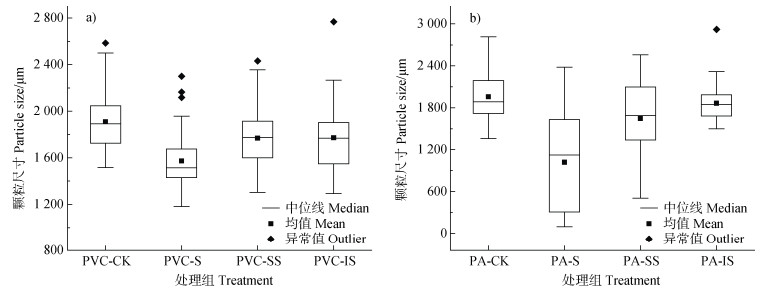
微塑料的老化途径主要包括光解、生物降解和外力侵蚀(如水力侵蚀、风力侵蚀和机械磨损等)[4]。因此,在微塑料的老化过程中,其粒径通常会发生动态变化。与原始PVC微塑料相比,在三种环境中老化后的PVC微塑料的粒径均呈现降低趋势(图 5a),表明PVC微塑料在三种环境中均发生了降解反应[26]。然而,三种环境中老化的PVC微塑料的粒径存在差异。具体而言,在土表和土内老化的PVC微塑料的粒径接近(P > 0.05),但其显著大于筛网上老化的PVC微塑料(P < 0.05)。此外,筛网上老化的PVC微塑料的粒径(1 573 ± 234 μm)较原始PVC微塑料(1 909 ± 241 μm)显著降低(P < 0.05)。这是由于筛网上的PVC微塑料发生了更高程度的光降解,导致其表面出现大量裂纹(图 4b),并逐渐破碎成粒径更小的PVC微塑料。如图 5b所示,在三种环境中老化后的PA微塑料的粒径也呈现降低趋势,但只有筛网上老化的PA微塑料的粒径(1 020 ± 699 μm)较原始PA微塑料(1 958 ± 321 μm)显著降低(P < 0.05)。这与PVC微塑料的情况一致,表明阳光辐射引发的光降解是控制两种微塑料粒径变化的关键因素。
|
图 5 原始和老化微塑料的粒径(a. PVC,b. PA) Fig. 5 Particle size of the pristine and aged microplastics (a. PVC, b. PA) |
CI常被用于定量评估微塑料的老化程度[27]。如表 2所示,原始PVC微塑料的CI(2.51)大于老化PVC微塑料(1.71~2.02),这与Fan等[28]报道的PVC微塑料的CI随紫外辐射时间延长而增加的结果相反。这是因为本研究选用的原始PVC微塑料中含有羰基官能团。如图 1a所示,筛网上老化的PVC微塑料的羰基官能团的红外吸收峰的形状发生明显变化,这表明在PVC微塑料老化过程中,其原有的羰基官能团会发生动态变化。因此,对于本身含有羰基官能团的微塑料,无法采用CI来评估其老化程度。与PVC微塑料不同,在原始PA微塑料中并未检测到明显的羰基吸收峰(图 1b)。如表 2所示,在三种不同环境中老化的PA微塑料的CI值较为接近(0.12~0.16),且明显大于原始PA微塑料(0.05)。这是由于PA微塑料在老化过程中发生氧化,导致其羰基官能团增加,从而提高了CI值。
|
|
表 2 原始和老化微塑料的羰基指数(CI) Table 2 The carbonyl index (CI) values of the pristine and aged microplastics |
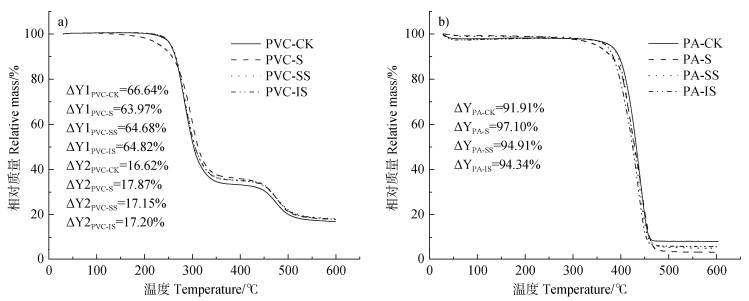
在老化过程中,微塑料的稳定性逐渐下降,从而导致其裂化形成纳米塑料,进一步加剧环境污染。为了探究不同环境中老化微塑料的稳定性,本文分别采用热重分析仪和化学降解法对不同老化微塑料进行分析。如图 6a所示,PVC微塑料的热解过程分为三个阶段:第一失重阶段、稳定阶段和第二失重阶段。第一失重阶段主要包括脱HCl过程[29]。在此阶段,土表和土内老化的PVC微塑料的热重(TGA)曲线与原始PVC微塑料的TGA曲线几乎完全重叠,大约在220 ℃时开始失重;而筛网上老化的PVC微塑料在130 ℃左右开始失重。较低的失重温度意味着微塑料的稳定性降低[30]。这表明筛网上的PVC微塑料发生了剧烈的老化,导致其热稳定性明显降低。但是,在第一失重阶段,原始PVC微塑料的失重率(66.64%)高于老化PVC微塑料(63.97%~64.82%)。这可能与PVC塑料的老化机理——脱HCl有关。筛网上的PVC微塑料在光氧化过程中生成并释放较多的HCl,因此其在第一阶段(即脱HCl过程)的失重率最低。第二失重阶段主要是PVC主链的降解过程[29]。在此阶段,三种环境中的老化PVC微塑料的失重率(17.15%~17.89%)均高于原始PVC微塑料的失重率(16.62%),且筛网上老化的PVC微塑料在第二阶段的失重率相对最高,进一步说明筛网上老化的PVC微塑料的热稳定性最差。如图 6b所示,原始PA微塑料的初始失重温度与土表和土内老化的PA微塑料较为接近,约为350 ℃,但土内老化的PA微塑料的失重速率快于原始PA和土表老化的PA。相比之下,筛网上老化的PA微塑料的初始失重温度较其余三种PA微塑料降低了约50 ℃。此外,筛网上老化的PA微塑料的失重率相对最高。上述结果表明筛网上老化的PA微塑料的热稳定性相对最差。
|
注:ΔY表示相对质量损失;数字“1”和“2”分别表示热解的第一阶段和第二阶段。 Note: ΔY denotes relative mass loss; the numbers "1" and "2" indicate the first and second stages of thermal decomposition, respectively. 图 6 原始和老化微塑料的热重(TGA)曲线(a. PVC,b. PA) Fig. 6 Thermogravimetric analysis (TGA) curves of the pristine and aged microplastics (a. PVC, b. PA) |
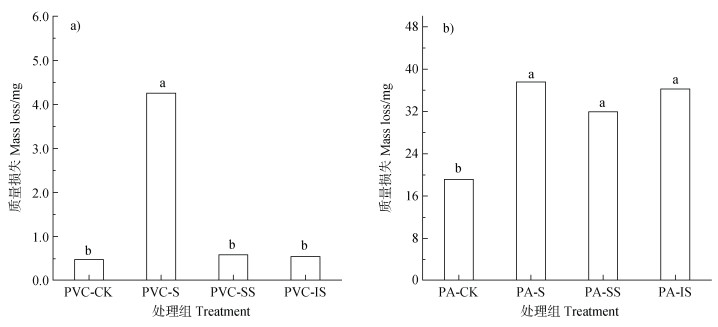
H2O2热氧化法常被用于评估生物质炭和微塑料等有机物的稳定性[31]。经过H2O2热氧化处理后,微塑料的质量损失越多表示其稳定性越差。如图 7a所示,土表和土内老化的PVC微塑料的质量损失与原始PVC微塑料间不具有显著性差异(P > 0.05)。相比之下,筛网上老化的PVC微塑料的质量损失显著高于原始PVC微塑料和两种在土壤中老化的PVC微塑料(P < 0.05),表明紫外辐射暴露下的PVC微塑料的稳定性最差。结合前文可知,在筛网上老化的PVC的形貌特征和官能团发生剧烈变化,光氧化严重破坏PVC微塑料的结构稳定性,从而导致其抗氧化性大幅降低。如图 7b所示,在三种环境中老化的PA微塑料的质量损失均显著大于原始PA微塑料(P < 0.05),但三种老化PA微塑料的质量损失不存在显著性差异(P > 0.05)。总体而言,暴露在阳光下的老化微塑料的稳定性最差,但具体取决于微塑料的自身属性。
|
注:图上不同小写字母表示不同处理组存在显著性差异(P < 0.05)。 Note: The significance of differences between the treatment groups is demonstrated by the lowercase letters at the 0.05 level. 图 7 化学降解条件下原始和老化微塑料的质量损失(a. PVC,b. PA) Fig. 7 Mass loss of the pristine and aged microplastics under chemical degradation conditions (a. PVC, b. PA) |
通过对两种微塑料理化性质的系统分析发现,PVC和PA微塑料的自然老化行为存在明显差异,且具有环境相关性。具体而言,太阳光诱导的光解是PVC微塑料的主要自然老化途径。在此过程中,伴随着HCl的释放和共轭双键、含氧官能团的生成,导致其颜色蜕变、粒径显著减小。土壤表层和土壤内部的PVC微塑料的自然老化程度较为接近,但均明显低于筛网上老化的PVC微塑料。筛网上老化的PVC微塑料的起始热解温度较原始和土壤中老化的PVC微塑料明显降低,且其在化学氧化过程中的质量损失明显高于原始和土壤中老化的PVC微塑料,表明光老化导致PVC微塑料的稳定性大幅降低。相对而言,暴露于筛网上的PA微塑料的老化程度略高于土表和土内的PA微塑料,但不如PVC微塑料明显。筛网上老化的PA微塑料的起始热解温度较原始和土壤中老化的PA微塑料降低了约50℃,且其热解失重率也略高,但三种老化PA微塑料在化学氧化过程中的质量损失无显著性差异。本研究揭示了不同土壤环境中PVC和PA两种典型微塑料的自然老化特征,研究结果对于了解两种微塑料的环境行为具有重要意义,同时为室内模拟老化试验设计(如设定模拟老化时间)提供了理论依据。
| [1] |
Bostan N, Ilyas N, Akhtar N, et al. Toxicity assessment of microplastic (MPs); a threat to the ecosystem[J]. Environmental Research, 2023, 234: 116523. DOI:10.1016/j.envres.2023.116523
(  0) 0) |
| [2] |
de Souza Machado A A, Lau C W, Kloas W, et al. Microplastics can change soil properties and affect plant performance[J]. Environmental Science & Technology, 2019, 53(10): 6044-6052.
( 0) |
| [3] |
Kou S Q, Guan Z, Lu X Y, et al. Migration of microplastics in soil and its effect on organic pollutants: A review (In Chinese)[J]. Soils, 2024, 56(3): 457-470. [寇诗棋, 关卓, 鲁旭阳, 等. 土壤中微塑料迁移及其对有机污染物的影响研究进展[J]. 土壤, 2024, 56(3): 457-470.]
( 0) |
| [4] |
Lu Q W, Zhou Y, Sui Q, et al. Mechanism and characterization of microplastic aging process: A review[J]. Frontiers of Environmental Science & Engineering, 2023, 17(8): 100.
( 0) |
| [5] |
Liu J F, Zheng L. Microplastic migration and transformation pathways and exposure health risks[J]. Environmental Pollution, 2025, 368: 125700. DOI:10.1016/j.envpol.2025.125700
( 0) |
| [6] |
Bai L H, Liang S J, Dong R C, et al. Natural photo-aging of biodegradable microplastics (In Chinese)[J]. Environmental Chemistry, 2022, 41(12): 3831-3839. [白利华, 梁思嘉, 董若辰, 等. 可生物降解微塑料的自然光解老化[J]. 环境化学, 2022, 41(12): 3831-3839.]
( 0) |
| [7] |
Hao Y L, Hu Y X, Guo S L. Effects of sediment abrasion on microplastic fragmentation (In Chinese)[J]. Acta Pedologica Sinica, 2024, 61(3): 737-745. DOI:10.11766/trxb202208250469 [郝永丽, 胡亚鲜, 郭胜利. 泥沙磨蚀作用对微塑料老化破碎的影响[J]. 土壤学报, 2024, 61(3): 737-745.]
( 0) |
| [8] |
Gao Y, Gao W, Liu Y Z, et al. A comprehensive review of microplastic aging: Laboratory simulations, physicochemical properties, adsorption mechanisms, and environmental impacts[J]. Science of the Total Environment, 2024, 957: 177427. DOI:10.1016/j.scitotenv.2024.177427
( 0) |
| [9] |
Rummel C D, Jahnke A, Gorokhova E, et al. Impacts of biofilm formation on the fate and potential effects of microplastic in the aquatic environment[J]. Environmental Science & Technology Letters, 2017, 4(7): 258-267.
( 0) |
| [10] |
Kwak J I, An Y J. Microplastic digestion generates fragmented nanoplastics in soils and damages earthworm spermatogenesis and coelomocyte viability[J]. Journal of Hazardous Materials, 2021, 402: 124034. DOI:10.1016/j.jhazmat.2020.124034
( 0) |
| [11] |
Liu P, Qian L, Wang H Y, et al. New insights into the aging behavior of microplastics accelerated by advanced oxidation processes[J]. Environmental Science & Technology, 2019, 53(7): 3579-3588.
( 0) |
| [12] |
Yu F, Wu Z J, Wang J Y, et al. Effect of landfill age on the physical and chemical characteristics of waste plastics/microplastics in a waste landfill sites[J]. Environmental Pollution, 2022, 306: 119366. DOI:10.1016/j.envpol.2022.119366
( 0) |
| [13] |
Brandon J, Goldstein M, Ohman M D. Long-term aging and degradation of microplastic particles: Comparing in situ oceanic and experimental weathering patterns[J]. Marine Pollution Bulletin, 2016, 110(1): 299-308. DOI:10.1016/j.marpolbul.2016.06.048
( 0) |
| [14] |
Wu K N, Zhao R. Soil texture classification and its application in China (In Chinese)[J]. Acta Pedologica Sinica, 2019, 56(1): 227-241. DOI:10.11766/trxb201803120129 [吴克宁, 赵瑞. 土壤质地分类及其在我国应用探讨[J]. 土壤学报, 2019, 56(1): 227-241.]
( 0) |
| [15] |
Liu P, Lu K, Li J L, et al. Effect of aging on adsorption behavior of polystyrene microplastics for pharmaceuticals: Adsorption mechanism and role of aging intermediates[J]. Journal of Hazardous Materials, 2020, 384: 121193. DOI:10.1016/j.jhazmat.2019.121193
( 0) |
| [16] |
Yan Y Y, Zhu F X, Zhu C Y, et al. Dibutyl phthalate release from polyvinyl chloride microplastics: Influence of plastic properties and environmental factors[J]. Water Research, 2021, 204: 117597. DOI:10.1016/j.watres.2021.117597
( 0) |
| [17] |
Ren Z F, Xu X Y, Liang J, et al. Aging dynamics of polyvinyl chloride microplastics in three soils with different properties[J]. Environmental Science & Technology, 2024, 58(50): 22332-22342.
( 0) |
| [18] |
Gu X Y, Xu X Y, Xian Z Y, et al. Joint toxicity of aged polyvinyl chloride microplastics and cadmium to the wheat plant (In Chinese)[J]. Environmental Chemistry, 2021, 40(9): 2633-2639. [顾馨悦, 徐修媛, 咸泽禹, 等. 老化聚氯乙烯微塑料与镉对小麦的联合毒性[J]. 环境化学, 2021, 40(9): 2633-2639.]
( 0) |
| [19] |
Martinho S D, Fernandes V C, Figueiredo S A, et al. Laboratory studies about microplastic aging and its effects on the adsorption of chlorpyrifos[J]. Polymers, 2023, 15(16): 3468. DOI:10.3390/polym15163468
( 0) |
| [20] |
Xu W W, Xiong Y, Guo S Y, et al. Color and molecular structure changes of natural aged rigid PVC (In Chinese)[J]. Acta Polymerica Sinica, 2017(8): 1374-1381. [徐文文, 熊英, 郭少云. 硬质聚氯乙烯自然老化的变色行为与分子结构变化[J]. 高分子学报, 2017(8): 1374-1381.]
( 0) |
| [21] |
Li J, Yu S G, Chen X H, et al. Highly enhanced adsorption of antibiotics on aged polyamide microplastics[J]. Colloids and Surfaces A: Physicochemical and Engineering Aspects, 2023, 658: 130690. DOI:10.1016/j.colsurfa.2022.130690
( 0) |
| [22] |
Wang K, Han T, Chen X D, et al. Insights into behavior and mechanism of tetracycline adsorption on virgin and soil-exposed microplastics[J]. Journal of Hazardous Materials, 2022, 440: 129770. DOI:10.1016/j.jhazmat.2022.129770
( 0) |
| [23] |
Bonifazi G, Fiore L, Pelosi C, et al. Evaluation of plastic packaging waste degradation in seawater and simulated solar radiation by spectroscopic techniques[J]. Polymer Degradation and Stability, 2023, 207: 110215. DOI:10.1016/j.polymdegradstab.2022.110215
( 0) |
| [24] |
Zhao X L, Wang J Y, Leung K M Y, et al. Color: An important but overlooked factor for plastic photoaging and microplastic formation[J]. Environmental Science & Technology, 2022, 56(13): 9161-9163.
( 0) |
| [25] |
Feng W H, Huang C J, Tan X L, et al. Release of the additive metals from 3 commonly used plastics during the degradation under the treatment of UV irradiation[J]. Ecotoxicology, 2022, 31(1): 75-84. DOI:10.1007/s10646-021-02467-6
( 0) |
| [26] |
Zhang C J, Tu C, Zhou Q, et al. Weathering characteristics of microplastics of low density polyethylene film in the coastal environment of the Yellow River Estuary (In Chinese)[J]. Acta Pedologica Sinica, 2021, 58(2): 456-463. DOI:10.11766/trxb201912250697 [张晨捷, 涂晨, 周倩, 等. 低密度聚乙烯薄膜微塑料在黄河口海岸带环境中的风化特征[J]. 土壤学报, 2021, 58(2): 456-463.]
( 0) |
| [27] |
Zhu K C, Sun Y J, Jiang W J, et al. Inorganic anions influenced the photoaging kinetics and mechanism of polystyrene microplastic under the simulated sunlight: Role of reactive radical species[J]. Water Research, 2022, 216: 118294. DOI:10.1016/j.watres.2022.118294
( 0) |
| [28] |
Fan X L, Gan R, Liu J Q, et al. Adsorption and desorption behaviors of antibiotics by tire wear particles and polyethylene microplastics with or without aging processes[J]. Science of the Total Environment, 2021, 771: 145451. DOI:10.1016/j.scitotenv.2021.145451
( 0) |
| [29] |
He W, Zeng J, Yan H, et al. Study on quality and performance of polyvinyl chloride blended resin (In Chinese)[J]. China Chlor-Alkali, 2025(3): 26-32. [何伟, 曾杰, 颜欢, 等. 聚氯乙烯掺混树脂质量及性能研究[J]. 中国氯碱, 2025(3): 26-32.]
( 0) |
| [30] |
Luo H W, Zhao Y Y, Li Y, et al. Aging of microplastics affects their surface properties, thermal decomposition, additives leaching and interactions in simulated fluids[J]. Science of the Total Environment, 2020, 714: 136862. DOI:10.1016/j.scitotenv.2020.136862
( 0) |
| [31] |
Yang F, Zhao L, Gao B, et al. The interfacial behavior between biochar and soil minerals and its effect on biochar stability[J]. Environmental Science & Technology, 2016, 50(5): 2264-2271.
( 0) |