 2026, Vol. 63


农业塑料地膜自20世纪60年代大规模应用以来,显著提高了作物产量与资源利用效率。以聚乙烯(PE)为代表的传统地膜因其抑草、调节土壤温湿度等作用,已成为不可或缺的农技产品[1-2]。然而,传统地膜的自然降解周期长,使用后难以彻底回收,导致塑料大量残留,在农田中形成“白色污染”,不仅破坏土壤结构、降低肥力,其缓慢降解过程还会释放微塑料,对土壤生态系统和水体环境构成长期威胁[3]。为应对这一环境问题,生物可降解地膜(Biodegradable mulches,BDMs)作为环境友好型替代产品近年来受到广泛关注。
BDMs通过材料创新来实现土壤中的自然降解,理论上可缓解传统地膜的环境负担。研究表明,BDMs能够维持作物产量并改善土壤微生物活性,在农业可持续发展中具有很强的应用潜力[4]。然而,在实际应用中,目前主流的BDMs材料降解速率受环境条件影响显著,田间性能表现不稳定[5]。此外,部分BDMs在降解过程中仍可能释放微塑料碎片以及添加剂[6],在土壤中的长期生态效应尚未完全明晰。同时生产成本高昂和机械强度不足[7-8]等问题也制约BDMs的大规模推广。
近几年针对生物可降解塑料研究迅速增长,也有综述论文指出了其使用关联的环境生态风险[9-10],但缺乏专门针对BDMs在土壤中环境行为的系统性分析。更重要的是,当前对BDMs降解过程中的“降解-释放-响应”的关系认知不足,影响其在田间使用过程中涉及的微污染物多界面迁移和生态风险评估。因此,本文聚焦BDMs在土壤中的环境行为,从降解机制、微塑料和添加剂释放等维度综述相关研究进展,旨在为完善其生态风险评估框架提供理论依据,为BDMs材料设计和应用的优化提供参考,以推动设施农业的绿色转型发展。
1 BDMs的主要类型及特征不同类型BDMs使用性能和特征迥异。原料来源与降解性能作为BDMs的两个核心评价指标,分别从材料生命周期起点和终点揭示可降解地膜的技术特征及潜在生态效应。因此,本文从原料来源和降解性两方面对BDMs进行分类。基于原料来源的分类侧重剖析材料的环境友好性与资源可再生性,而基于降解性能分类则聚焦产品服役周期终止后的环境归宿。
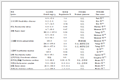
1.1 基于原料来源分类从原料来源看,BDMs可分为生物基与石油基两大类。生物基地膜以可再生资源为主要原料,这主要包括天然多糖基聚合物[11]、蛋白质及其衍生物[12]、木质素[13]等天然高分子材料,以及微生物发酵产生的聚羟基脂肪酸酯(PHA)和聚乳酸(PLA)[14]等微生物合成材料。生物基BDMs在生产时往往需要共混或者化学改性来提升其机械性能,增加了生产成本[15]。不同类型BDMs特性各异(表 1),PLA基地膜因本身脆性较高,常与聚己二酸-对苯二甲酸丁二醇酯(PBAT)共混形成PLA/PBAT复合材料,该策略不仅赋予材料更高的断裂伸长率,还可通过调控共混比例实现降解周期的精准设计,目前已成功应用于大规模农业生产[16]。石油基地膜则来源于化石燃料衍生物,例如PBAT和聚丁二酸丁二醇酯(PBS)[17]。PBAT基地膜是目前BDMs市场主流,既可单独成膜,也可与淀粉、纤维素等复合,具备 > 500%断裂伸长率以适应机械化铺设,但在长期紫外辐照下易降解[18]。尽管石油基地膜可通过微生物作用分解,其生产依赖不可再生资源,在可持续性方面仍然存在一定局限性。
|
表 1 常见生物可降解地膜材料的综合特性 Table 1 The comprehensive characteristics of common biodegradable mulches |


根据降解性能,BDMs可分为完全降解型与不完全降解型。完全降解型BDMs在土壤微生物作用下可彻底矿化为水、二氧化碳以及无害生物质,但降解速率受土壤温度、湿度及微生物群落结构影响显著[19]。如PLA在工业堆肥条件下(65~72℃,高湿有氧)可在1个月内基本降解[20],而在低温土壤中11个月后仍有大量残留[21]。不完全降解型BDMs主要是在传统塑料基材中添加淀粉、纤维素、小麦粉等天然物质制成的材料。微生物可在这类塑料母体上通过水解、酶解等生物化学作用进行分解,促使塑料大分子链断裂,生成低聚物片段[22]。不完全降解型BDMs可能在覆膜期后残留微塑料或寡聚物碎片,Griffin-LaHue等[23]在美国华盛顿州进行的田间填埋试验发现,五种BDMs在连续四年覆膜并翻埋后,即便在土壤中掩埋两年仍可检测到约4%~16%的可见残留物。总体而言,不同类型BDMs各具特色,实际应用中需根据作物需求、农田环境条件及经济成本综合权衡选择。
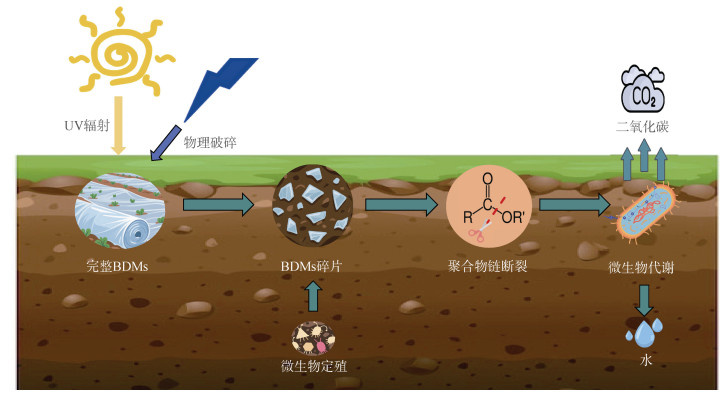
2 BDMs降解过程和机制 2.1 BDMs在土壤中的降解过程BDMs的降解呈现阶段性特征(图 1)。初期以物理破碎与化学降解为主,尤其是在覆膜情况下,地膜在光照、风力及耕作机械作用下碎裂为毫米级碎片,同时化学断裂使分子量降低[34]。随后,微生物群落逐渐成为主导力量,多种细菌在塑料表面定殖,通过酶解作用将碎片分解为单体(如乳酸、己二酸),最终经微生物代谢矿化为二氧化碳、水[35]。这一过程中,化学降解为生物降解提供底物,而微生物活动又通过产酸、产酶反馈调节土壤微环境,从而形成降解循环。
|
图 1 BDMs的降解路径示意图 Fig. 1 Schematic diagram of the degradation path of BDMs |
BDMs在初期(作物生长前中期)能保持高完整性,提供与常规地膜相当的保温保湿功能[36],但随环境暴露时间延长,逐步进入开裂(如玉米种植38 d后[37])和破碎阶段(如马铃薯种植150 d后[38])。不同材质地膜降解特性差异显著。PBAT地膜降解较快,力学性能(拉伸强度、断裂伸长率)随降解显著下降[37];PLA地膜主要通过水解作用缓慢降解,纯PLA重量损失率低于共混体系[39]。因此,需根据作物生长期匹配降解速率以实现农艺性能与环保性的平衡。
2.2 BDMs在土壤中的降解机制BDMs在土壤中的最终矿化依赖于化学、物理以及生物过程的协同作用,其核心在于聚合物链的断裂及微生物对降解产物的代谢,降解过程受材料化学结构和环境条件共同调控。对于主链含酯键的聚酯类BDMs(如PBAT和PLA),水解通常是关键的初始降解途径。土壤水分中的水分子可攻击酯键,使主链断裂并生成低分子量的低聚物和单体(如乳酸、己二酸、对苯二甲酸和丁二醇等)[40],这些小分子为后续生物降解提供了可被微生物利用的基质。在地膜铺设初期暴露于地表时,紫外线辐射会引发光氧化和诺里什反应(Norrish reactions),自由基链式裂解导致聚合物发生氧化和断裂,同时伴随表面性质改变,如产生裂纹和提高亲水性,从而显著降低分子量[41-43]。紫外老化过程不仅加速了材料的物理破碎,还为微生物酶的作用创造更多可攻击的位点。最终的生物降解过程由土壤微生物驱动,细菌(如Pseudomonas putida、Sphingomonas spp.[44])和真菌(如菌株B47-9[45])分泌的酯酶和脂肪酶可切割弱化的聚合物链及低聚物,将其转化为单体或二聚体。经微生物的代谢途径(如β-氧化),这些小分子最终被矿化为CO2和H2O,在厌氧环境下还可能生成CH4。生物降解效率与土壤中相应功能微生物群落的丰度和活性密切相关[46]。
环境条件是影响各降解过程速率的关键因素。紫外线和热量可直接提供断键能量,加快化学降解并增强微生物代谢活性[40],适中的土壤湿度和中性pH有利于维持酶的最佳活性,促进生物降解[46]。月均温度也是影响BDMs降解性能的关键变量[47],Moore-Kucera等[48]通过在美国三个典型农田开展田间埋设试验发现,BDMs的降解速率在不同地点差异显著,低温环境下微生物活性不足导致其降解受限,从而增加了残留风险。这种环境依赖性使BDMs的降解行为难以预测,亟需建立更精准的模型以适应多样化的田间条件。除聚酯类外,其他类型BDMs(如淀粉基、PHA)因化学结构不同其降解机制存在差异,淀粉基材料常通过糖苷键酶解,聚乙烯醇依赖氧化酶断链,而聚碳酸酯则易受碱性水解影响[49]。
2.3 BDMs降解性能的认定标准各类BDMs降解机制及其影响因素存在差异,导致降解标准与生态影响的不确定性。目前国际通行的生物降解认证标准(如ISO 17556)主要基于受控实验室条件下的测试,标准测试通常忽略土壤微生物群落多样性以及季节性温湿度波动等实际因素,实验室结果与田间表现存在偏差,难以反映自然土壤中BDMs的实际降解过程[48,50]。因此,未来需要更多基于实际农田土壤环境条件下的研究和标准认定工作,更精确地评价和认定BDMs的实际降解性能。
3 土壤中BDMs微塑料的释放与吸附行为 3.1 土壤中BDMs微塑料的释放在BDMs的降解过程中,塑料薄膜变质和破碎化,常常形成微塑料[34]。由于BDMs的降解速度较传统的塑料农膜更快,导致同一时间范围内BDMs会产生更多微塑料[51]。不同类型BDMs在田间实际环境与实验室模拟条件下的微塑料释放特征存在显著差异,如表 2所示,BDMs释放的微塑料丰度往往呈现“先增后减”的阶段性变化[52]。黑色地膜因炭黑延缓光降解,微塑料释放更平缓,较透明地膜释放量降低20%~45%[53-54]。薄型BIO地膜因物理脆弱性(易裂纹)和化学不稳定性(酯键水解快),在相同环境条件下比厚型膜降解更快,从而释放更多微塑料[55]。材质降解速率与微塑料尺寸、环境应力共同影响土壤微塑料污染程度,需关注长期田间生态效应。BDMs微塑料释放机制主要包括UV照射、机械磨损和微生物活动等环境风化过程导致的地膜碎片化[56],且机械磨损被证实会使可降解地膜释放比高密度聚乙烯(HDPE)、低密度聚乙烯(LDPE)地膜更多的微塑料[57]。
|
|
表 2 生物可降解地膜释放的微塑料 Table 2 Microplastic release of biodegradable mulches |
土壤中BDMs微塑料释放过程呈现阶段性特征,PBAT微塑料释放分为初始释放阶段(0~30 d)、关键释放阶段(60~120 d)和关键降解阶段(150~180 d)[52]。土壤中微塑料可发生垂直与水平迁移,受孔隙度、有机质等因素影响,其随老化变化的表面性质还可吸附污染物并促进共迁移[58]。环境相互作用上,BDMs微塑料会改变土壤微生物群落,富集可降解塑料聚合物的细菌类群,影响土壤功能和养分[59]。尽管可降解地膜设计为土壤中降解,但其释放的微塑料可迁移至水生、大气等环境介质。因BDMs微塑料的降解缓慢,其在土壤中的积累则会影响土壤性质、微生物群落及其他污染物行为,产生长期的环境影响[41]。
3.2 微塑料载体的吸附-解吸行为BDMs微塑料常作为污染物的迁移载体,其老化作用(如紫外辐射、机械磨损)会增加表面粗糙度和孔隙度,并生成羟基、羧基等官能团,显著增强对重金属和有机污染物的吸附能力[60-61]。例如,Wang等[62]对可降解与不可降解微塑料的对比研究发现,老化后的BDMs对罗丹明B(RhB)的吸附量可较原始样品高出10倍以上。解吸过程则表现出显著滞后效应,RhB与老化微塑料界面结合紧密,可能促进RhB在环境中的长距离迁移。值得注意的是,即使在模拟胃肠液环境中,BDMs微塑料仍可释放30%以上的RhB,这表明携载了污染物的BDMs微塑料被生物摄入后,可能引发更强的毒性效应。总体而言,BDMs微塑料在土壤中表现出阶段性释放,老化后对某些污染物表现出更强的吸附、迁移能力,可能对土壤性质和生态功能造成影响。未来研究中需系统评估BDMs微塑料在土壤中的释放速率、累积效应及与其他污染物的相互作用机制。
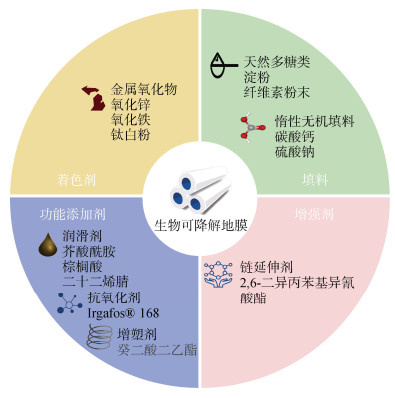
4 土壤中BDMs添加剂的释放 4.1 BDMs添加剂类型在工业生产过程中,为提升BDMs的机械强度、光稳定性以及可控降解性能,通常会引入多种辅助化合物,主要包括功能添加剂、着色剂、填料和增强剂等(图 2)。添加剂成分常以有机化合物(如邻苯二甲酸酯)及金属/类金属物质(如TiO2)为主[64],通过物理混合或化学键合等方式嵌入聚合物基质中,以优化地膜性能[65-66]。一般而言,添加剂的投加量在0.5%~2%之间,但会因抗水解、光稳定等功能需求及配方差异而有所调整,且不同厂家之间差异显著[67]。相较于传统LDPE地膜,BDMs减少了抗氧化剂和UV稳定剂的使用,并引入扩链剂以提升聚合物的降解性能。然而,Reay等[65]研究发现,BMDs整体的添加剂组成更为复杂,浸出量也更高,其中大量未知化合物可能带来潜在环境风险。因此,未来应建立基于暴露潜力和毒性不确定性的添加剂优先评估清单,推动这些高风险未知化合物纳入现有化学品毒性数据库(如ECETOC),为BDMs的环境安全评估提供科学依据。
|
图 2 生物可降解地膜添加剂的主要类型 Fig. 2 The main types of additive composition in biodegradable mulches |
BDMs中所含的添加剂未通过化学键与聚合物结合,很容易被浸出从而释放到周围土壤中[68]。近年来已有研究通过有机溶剂提取、水溶液浸出及田间模拟实验,检出多种BDMs添加剂(表 3)。与传统地膜相比,BDMs添加剂的释放速率普遍高于传统PE地膜,Xu等[66]通过土壤培养试验发现,双酚A(BPA)在特定BDMs中的释放速率常数(k1)高达5.89 d–1,显著高于传统PE/PP膜,且部分添加剂的释放量显著高于传统地膜。相比较而言,BDMs的主要类型有机添加剂及金属填料(如钙、锌)的浸出量相对更高,有机添加剂浸出量可达LDPE的数十倍[65]。增塑剂中邻苯二甲酸酯类(PAEs)检出频次最高,其总和浓度可达47 190 μg·kg–1,显示其作为主要增塑剂的广泛使用[69]。此外,BDMs添加剂释放也呈现显著异质性,从存在形式看,物理分散状态下,具有高疏水相互作用的添加剂因与聚合物基质形成强界面作用而浸出率低[70]。而通过氢键、静电作用等化学键合的添加剂则需经历基质降解或官能团断裂才能释放,例如含氧官能团丰富的可降解微塑料通过增强界面吸附延缓解吸过程[61,71]。
|
|
表 3 生物可降解地膜释放的添加剂 Table 3 Additives released from biodegradable mulches |
BMDs添加剂从地膜中释放后,会在土壤多介质环境中扩散,并进一步引发生态风险。部分添加剂(如吩嗪-(2,3 -二基)二氧二丁酸)可抑制土壤微生物活性或干扰代谢功能,显著干扰土壤生态功能[72]。土壤中塑料添加剂的存在会对植物的生长发育以及土壤-植物生态系统产生显著的负面影响,如高浓度(≥10.0 mg·L–1)的双酚A会抑制光合作用(损伤反应中心并增加热能散失),且效应强度因植物种类和暴露时间而异[73]。添加剂还会对土壤动物产生深远的影响,BDMs释放的添加剂可能通过浸出作用对蚯蚓产生显著毒性,导致其氧化应激反应增强和组织损伤(如肠道纤维化、体腔空洞形成),且其毒性效应与传统塑料相当甚至更严重[74]。目前,多数毒性研究基于实验室条件(如高浓度暴露),田间长期效应数据不足。综上,BDMs中普遍含有大量功能性添加剂,其种类繁多、理化性质差异显著,决定了其在聚合物降解过程中的释放行为高度异质。因此,在评估BDMs环境行为时,需将添加剂的释放纳入其环境风险的考量,相关添加剂的生态安全性仍需长期田间研究来验证。
5 总结与展望BDMs作为传统地膜替代方案,在缓解农业“白色污染”方面具潜力,但其环境行为复杂。BDMs在土壤中的降解性能受物理、化学、生物多重调控,降解性能具环境差异性。BDMs降解周期短,导致微塑料呈现集中释放的特征,其释放的微塑料通过吸附其他污染物进一步加剧环境风险。此外,BDMs添加剂的淋溶量较传统地膜普遍提高,渗漏的添加剂对土壤生物具有广泛的影响。尽管目前对土壤中BDMs的环境行为研究有所进展,但关于BDMs的降解机制、污染物释放和环境风险等方面仍有知识缺口,未来研究需聚焦以下方向:
1)当前BDMs受环境因素影响显著,田间实际降解性能并不稳定,需深入研究不同地理条件下土壤微生物与降解的互作机制,建立机器学习预测模型以匹配作物周期。还应积极进行材料创新,开发具有光热转化功能的新型地膜,通过光敏基团和热改性提升可控降解性,优化聚合物结构与添加剂配比等方法,平衡机械强度和功能持久性,提高BDMs实际降解效率和环境适应性。
2)BDMs降解产生的微纳塑料及添加剂可能通过土壤-水-生物迁移扩散,今后需重点研究微塑料表面特性变化对污染物吸附行为的影响,构建多介质迁移模型评估农田扩散风险。开发高分辨质谱筛查技术识别有毒添加剂,推动生物基增塑剂等无毒材料设计,从源头降低有害添加剂的释放。
3)目前BDMs环境影响评估尚不全面,后续有必要将生命周期评价与生态毒理研究结合起来,从碳足迹和土壤效应等方面定量比较不同地膜的差异,为制定合理的降解性能和添加剂标准提供科学依据。
4)需统一BDMs认证标准,明确田间条件下降解率检测方法与风险评估流程。建议制定包含降解速率、污染物释放和环境风险在内的BDMs综合评价框架,并结合田间长期检测数据结果进行验证。
| [1] |
Kader M A, Senge M, Mojid M A, et al. Recent advances in mulching materials and methods for modifying soil environment[J]. Soil and Tillage Research, 2017, 168: 155-166. DOI:10.1016/j.still.2017.01.001
(  0) 0) |
| [2] |
Hayes D G, Anunciado M B, DeBruyn J M, et al. Biodegradable plastic mulch films for sustainable specialty crop production[M]//Polymers for agri-food applications. Cham: Springer International Publishing, 2019: 183—213.
( 0) |
| [3] |
Calero M, Muñoz M J, Solís R R, et al. Agricultural plastic mulching as a source of microplastics in the terrestrial conditions[M]//Microplastic sources, fate and solution. Singapore: Springer Nature Singapore, 2023: 37—70.
( 0) |
| [4] |
Kusuma Dewi S, Ahmad Bhat S, Wei Y F, et al. Impacts of biodegradable mulch: Benefits, degradation, and residue effects on soil properties and plant growth[J]. Reviews in Agricultural Science, 2024, 12: 262-280. DOI:10.7831/ras.12.0_262
( 0) |
| [5] |
Akhir M A M, Mustapha M. Formulation of biodegradable plastic mulch film for agriculture crop protection: A review[J]. Polymer Reviews, 2022, 62(4): 890-918. DOI:10.1080/15583724.2022.2041031
( 0) |
| [6] |
Ju Z C, Du X F, Feng K, et al. The succession of bacterial community attached on biodegradable plastic mulches during the degradation in soil[J]. Frontiers in Microbiology, 2021, 12: 785737. DOI:10.3389/fmicb.2021.785737
( 0) |
| [7] |
Zhang W W, Wang L H, Zhou J Q, et al. Degradability of biodegradable plastic films and its mulching effects on soil temperature and maize yield in northeastern China[J]. International Journal of Agricultural and Biological Engineering, 2020, 13(2): 146-153. DOI:10.25165/j.ijabe.20201302.5360
( 0) |
| [8] |
Haapala T, Palonen P, Korpela A, et al. Feasibility of paper mulches in crop production—A review[J]. Agricultural and Food Science, 2014, 23(1): 60-79. DOI:10.23986/afsci.8542
( 0) |
| [9] |
Han Y J, Teng Y. Research progress on ecological effects and microbial degradation of biodegradable plastics in soils (In Chinese)[J]. Acta Pedologica Sinica, 2025, 62(6): 1585-1597. DOI:10.11766/trxb202405270210 [韩玉娟, 滕应. 土壤中生物可降解塑料的生态效应及微生物降解研究进展[J]. 土壤学报, 2025, 62(6): 1585-1597.]
( 0) |
| [10] |
Cao X M, Liang Y Q, Jiang J, et al. Organic additives in agricultural plastics and their impacts on soil ecosystems: Compared with conventional and biodegradable plastics[J]. Trends in Analytical Chemistry, 2023, 166: 117212. DOI:10.1016/j.trac.2023.117212
( 0) |
| [11] |
Rosseto M, Krein D D, Balbé N P, et al. Starch–gelatin film as an alternative to the use of plastics in agriculture: A review[J]. Journal of the Science of Food and Agriculture, 2019, 99(15): 6671-6679. DOI:10.1002/jsfa.9944
( 0) |
| [12] |
Wei B L, Zhao Y, Wei Y X, et al. Morphology and properties of a new biodegradable material prepared from zein and poly(butylene adipate-terephthalate)by reactive blending[J]. ACS Omega, 2019, 4(3): 5609-5616. DOI:10.1021/acsomega.9b00210
( 0) |
| [13] |
Gross R A, Kalra B. Biodegradable polymers for the environment[J]. Science, 2002, 297(5582): 803-807. DOI:10.1126/science.297.5582.803
( 0) |
| [14] |
Nizamuddin S, Chen C R. Biobased, biodegradable and compostable plastics: Chemical nature, biodegradation pathways and environmental strategy[J]. Environmental Science and Pollution Research, 2024, 31(6): 8387-8399. DOI:10.1007/s11356-023-31689-w
( 0) |
| [15] |
Vox G, Santagata G, Malinconico M, et al. Biodegradable films and spray coatings as eco-friendly alternative to petro-chemical derived mulching films[J]. Journal of Agricultural Engineering, 2013, 44: 221-225.
( 0) |
| [16] |
Lyu J S, Han J. Scale-up fabrication of a biodegradable PBAT/PLA composite film compatibilized with a chain extender for industrial agricultural mulch film application[J]. Composites Part C: Open Access, 2023, 12: 100397. DOI:10.1016/j.jcomc.2023.100397
( 0) |
| [17] |
Ryu Y, Bouharras F E, Cha M, et al. Recent advancements in the evolution, production, and degradation of biodegradable mulch films: A review[J]. Environmental Research, 2025, 277: 121629. DOI:10.1016/j.envres.2025.121629
( 0) |
| [18] |
Lin J, Li X X, Chai X C, et al. Comparison of aging properties of starch/PBAT degradable mulching film in different environments (In Chinese)[J]. Acta Materiae Compositae Sinica, 2024, 41(10): 5575-5583. [林军, 李晓萱, 柴喜存, 等. 淀粉/PBAT可降解地膜在不同环境下老化性能对比[J]. 复合材料学报, 2024, 41(10): 5575-5583.]
( 0) |
| [19] |
Francioni M, Kishimoto-Mo A W, Tsuboi S, et al. Evaluation of the mulch films biodegradation in soil: A methodological review[J]. Italian Journal of Agronomy, 2022, 17(3): 1936. DOI:10.4081/ija.2021.1936
( 0) |
| [20] |
Afshar S V, Boldrin A, Christensen T H, et al. Disintegration of commercial biodegradable plastic products under simulated industrial composting conditions[J]. Scientific Reports, 2025, 15: 8569. DOI:10.1038/s41598-025-91647-z
( 0) |
| [21] |
Rudnik E, Briassoulis D. Degradation behaviour of poly(lactic acid)films and fibres in soil under Mediterranean field conditions and laboratory simulations testing[J]. Industrial Crops and Products, 2011, 33(3): 648-658. DOI:10.1016/j.indcrop.2010.12.031
( 0) |
| [22] |
Yu S L. Research on the classification and production application of degradable plastics (In Chinese)[J]. Shandong Chemical Industry, 2022, 51(24): 138—140, 143. [于淑兰. 可降解塑料分类及生产应用研究[J]. 山东化工, 2022, 51(24): 138—140, 143.]
( 0) |
| [23] |
Griffin-LaHue D, Ghimire S, Yu Y X, et al. In-field degradation of soil-biodegradable plastic mulch films in a Mediterranean climate[J]. Science of the Total Environment, 2022, 806: 150238. DOI:10.1016/j.scitotenv.2021.150238
( 0) |
| [24] |
Ramadhani A M, Nassary E K, Rwehumbiza F B, et al. Potentials of synthetic biodegradable mulch for improved livelihoods on smallholder farmers: A systematic review[J]. Frontiers in Agronomy, 2024, 6: 1454060. DOI:10.3389/fagro.2024.1454060
( 0) |
| [25] |
Niu Z Y, Chen F P, Zhang H, et al. High content of thermoplastic starch, Poly(butylenes adipate-co-terephthalate)and Poly(butylene succinate)ternary blends with a good balance in strength and toughness[J]. Polymers, 2023, 15(9): 2040. DOI:10.3390/polym15092040
( 0) |
| [26] |
Thompson A A, Samuelson M B, Kadoma I, et al. Degradation rate of bio-based agricultural mulch is influenced by mulch composition and biostimulant application[J]. Journal of Polymers and the Environment, 2019, 27(3): 498-509. DOI:10.1007/s10924-019-01371-9
( 0) |
| [27] |
Mohan S, Panneerselvam K. A short review on mechanical and barrier properties of polylactic acid-based films[J]. Materials Today: Proceedings, 2022, 56: 3241-3246. DOI:10.1016/j.matpr.2021.09.375
( 0) |
| [28] |
Pandey A, Adama N, Adjallé K, et al. Sustainable applications of polyhydroxyalkanoates in various fields: A critical review[J]. International Journal of Biological Macromolecules, 2022, 221: 1184-1201. DOI:10.1016/j.ijbiomac.2022.09.098
( 0) |
| [29] |
Ran L B, Hong W, Yu G Y, et al. Preparation and improving mechanism of PBAT/PPC-based micro-layer biodegradable mulch film with excellent water resistance and mechanical properties[J]. Polymer, 2024, 291: 126614. DOI:10.1016/j.polymer.2023.126614
( 0) |
| [30] |
Othman N A F, Selambakkannu S, Seko N. Biodegradable dual-layer Polyhydroxyalkanoate(pha)/ Polycaprolactone(pcl)mulch film for agriculture: Preparation and characterization[J]. Energy Nexus, 2022, 8: 100137. DOI:10.1016/j.nexus.2022.100137
( 0) |
| [31] |
Ma J, Li B, Wang J, et al. Straw-based powder mulch film with PVA gradient distribution improving its wind and water resistance and consecutive planting[J]. Industrial Crops and Products, 2024, 222: 119591. DOI:10.1016/j.indcrop.2024.119591
( 0) |
| [32] |
Bi S W, Pan H, Barinelli V, et al. Biodegradable polyester coated mulch paper for controlled release of fertilizer[J]. Journal of Cleaner Production, 2021, 294: 126348. DOI:10.1016/j.jclepro.2021.126348
( 0) |
| [33] |
Chen Z T, Zhou Y, Luo C K, et al. Environmental impacts and mitigation potentials of CO2-based biodegradable plastic based on life cycle assessment–A case study of poly(propylene carbonate)[J]. Journal of Cleaner Production, 2024, 471: 143387. DOI:10.1016/j.jclepro.2024.143387
( 0) |
| [34] |
Sintim H Y, Bary A I, Hayes D G, et al. In situ degradation of biodegradable plastic mulch films in compost and agricultural soils[J]. Science of the Total Environment, 2020, 727: 138668. DOI:10.1016/j.scitotenv.2020.138668
( 0) |
| [35] |
Tosin M, Barbale M, Chinaglia S, et al. Disintegration and mineralization of mulch films and leaf litter in soil[J]. Polymer Degradation and Stability, 2020, 179: 109309. DOI:10.1016/j.polymdegradstab.2020.109309
( 0) |
| [36] |
Shen L X, Zhang Y M, Lan Y C, et al. Effects of degradable films with different degradation cycles on soil temperature, moisture and maize yield[J]. International Journal of Agricultural and Biological Engineering, 2019, 12(3): 36-44. DOI:10.25165/j.ijabe.20191203.4065
( 0) |
| [37] |
Feng C, Feng L S, Liu Q, et al. The degradation characteristics of different plastic films and their effects on maize yield in semi-arid area in western Liaoning (In Chinese)[J]. Scientia Agricultura Sinica, 2021, 54(9): 1869-1880. [冯晨, 冯良山, 刘琪, 等. 辽西半干旱区不同类型地膜降解特性及其对玉米产量的影响[J]. 中国农业科学, 2021, 54(9): 1869-1880.]
( 0) |
| [38] |
Yu J, Lei J, Li D, et al. Degradation characteristics of different films and their effects on potato growth and soil microenvironment in arid region (In Chinese)[J]. Journal of Nuclear Agricultural Sciences, 2025, 39(1): 170-181. [于婕, 雷佳, 李丹, 等. 不同地膜的降解特征及其对旱区马铃薯生长和土壤微环境的影响[J]. 核农学报, 2025, 39(1): 170-181.]
( 0) |
| [39] |
Podzorova M V, Tertyshnaya Y V, Selezneva L D, et al. Study of the biodegradability of polymer materials for use in agriculture[J]. Polymer Science, Series D, 2024, 17(2): 455-460. DOI:10.1134/S1995421224700771
( 0) |
| [40] |
Wang J H, Tian Y C, Zhou B. Degradation and stabilization of poly(butylene adipate-co-terephthalate)/polyhydroxyalkanoate biodegradable mulch films under different aging tests[J]. Journal of Polymers and the Environment, 2022, 30(4): 1366-1379. DOI:10.1007/s10924-021-02279-z
( 0) |
| [41] |
Ramanayaka S, Zhang H, Semple K T. Plastic mulch‐derived microplastics in agricultural soil systems[M]//Vithanage M, Prasad M N V. Microplastics in the Ecosphere: Air, water, soil, and food. New York: John Wiley & Sons Ltd, 2023: 233—247.
( 0) |
| [42] |
Qi R M, Jones D L, Liu Q Y, et al. Field test on the biodegradation of poly(butylene adipate-co- terephthalate)based mulch films in soil[J]. Polymer Testing, 2021, 93: 107009. DOI:10.1016/j.polymertesting.2020.107009
( 0) |
| [43] |
Qu P, Guo B H, Wang H B, et al. Degaradation characteristics of PBAT mulch in maize field (In Chinese)[J]. Transactions of the Chinese Society of Agricultural Engineering, 2017, 33(17): 194-199. [曲萍, 郭宝华, 王海波, 等. PBAT全生物降解地膜在玉米田中的降解特性[J]. 农业工程学报, 2017, 33(17): 194-199.]
( 0) |
| [44] |
Fontanazza S, Restuccia A, Mauromicale G, et al. Pseudomonas putida isolation and quantification by real-time PCR in agricultural soil biodegradable mulching[J]. Agriculture, 2021, 11(8): 782. DOI:10.3390/agriculture11080782
( 0) |
| [45] |
Koitabashi M, Noguchi M T, Sameshima-Yamashita Y, et al. Degradation of biodegradable plastic mulch films in soil environment by phylloplane fungi isolated from gramineous plants[J]. AMB Express, 2012, 2(1): 40. DOI:10.1186/2191-0855-2-40
( 0) |
| [46] |
Zhang Y L, Gao W, Mo A Y, et al. Degradation of polylactic acid/polybutylene adipate films in different ratios and the response of bacterial community in soil environments[J]. Environmental Pollution, 2022, 313: 120167. DOI:10.1016/j.envpol.2022.120167
( 0) |
| [47] |
Madin M, Goodin D, Moley L, et al. Environmental factors related to biophysical suitability and agronomic effects of biodegradable mulch applications: Benchmarking key variables using machine learning[J]. Environmental Challenges, 2025, 18: 101105. DOI:10.1016/j.envc.2025.101105
( 0) |
| [48] |
Moore-Kucera J, Cox S B, Peyron M, et al. Native soil fungi associated with compostable plastics in three contrasting agricultural settings[J]. Applied Microbiology and Biotechnology, 2014, 98(14): 6467-6485. DOI:10.1007/s00253-014-5711-x
( 0) |
| [49] |
Jin Y, Cai F F, Wang L G, et al. Advance in the degradation of biodegradable plastics in different environments (In Chinese)[J]. Chinese Journal of Biotechnology, 2022, 38(5): 1784-1808. [金琰, 蔡凡凡, 王立功, 等. 生物可降解塑料在不同环境条件下的降解研究进展[J]. 生物工程学报, 2022, 38(5): 1784-1808.]
( 0) |
| [50] |
Yu Y, Velandia M, Hayes D G, et al. Biodegradable plastics as alternatives for polyethylene mulch films[M]//Advances in Agronomy. Amsterdam: Elsevier, 2024: 121—192.
( 0) |
| [51] |
Liao J, Chen Q Q. Biodegradable plastics in the air and soil environment: Low degradation rate and high microplastics formation[J]. Journal of Hazardous Materials, 2021, 418: 126329. DOI:10.1016/j.jhazmat.2021.126329
( 0) |
| [52] |
Wang Y, Bai R H, Liu Q, et al. Degradation of biodegradable plastic films in soil: Microplastics formation and soil microbial community dynamics[J]. Journal of Hazardous Materials, 2025, 492: 138250. DOI:10.1016/j.jhazmat.2025.138250
( 0) |
| [53] |
Li S T, Ding F, Flury M, et al. Dynamics of macroplastics and microplastics formed by biodegradable mulch film in an agricultural field[J]. Science of the Total Environment, 2023, 894: 164674. DOI:10.1016/j.scitotenv.2023.164674
( 0) |
| [54] |
Wang K, Flury M, Sun S Y, et al. In-field degradation of polybutylene adipate-co-terephthalate(PBAT)films, microplastic formation, and impacts on soil health[J]. Environmental Research, 2025, 272: 121086. DOI:10.1016/j.envres.2025.121086
( 0) |
| [55] |
Uzamurera A G, Wang P Y, Zhao Z Y, et al. Thickness-dependent release of microplastics and phthalic acid esters from polythene and biodegradable residual films in agricultural soils and its related productivity effects[J]. Journal of Hazardous Materials, 2023, 448: 130897. DOI:10.1016/j.jhazmat.2023.130897
( 0) |
| [56] |
Yu Y X, Griffin-LaHue D E, Miles C A, et al. Are micro- and nanoplastics from soil-biodegradable plastic mulches an environmental concern?[J]. Journal of Hazardous Materials Advances, 2021, 4: 100024. DOI:10.1016/j.hazadv.2021.100024
( 0) |
| [57] |
Ouyang D, Peng Y F, Li B C, et al. Microplastic formation and simultaneous release of phthalic acid esters from residual mulch film in soil through mechanical abrasion[J]. Science of the Total Environment, 2023, 893: 164821. DOI:10.1016/j.scitotenv.2023.164821
( 0) |
| [58] |
Hu T T, Chen J W. A review on adsorption and transport of microplastics in soil and the effect of ageing on environmental behavior of pollutants (In Chinese)[J]. Rock and Mineral Analysis, 2022, 41(3): 353-363. [胡婷婷, 陈家玮. 土壤中微塑料的吸附迁移及老化作用对污染物环境行为的影响研究进展[J]. 岩矿测试, 2022, 41(3): 353-363.]
( 0) |
| [59] |
Li K, Jia W Q, Xu L B, et al. The plastisphere of biodegradable and conventional microplastics from residues exhibit distinct microbial structure, network and function in plastic-mulching farmland[J]. Journal of Hazardous Materials, 2023, 442: 130011. DOI:10.1016/j.jhazmat.2022.130011
( 0) |
| [60] |
Yang H, Yang J, Sun L W, et al. The alteration in adsorption mechanism and associated bioaccessibility of mesotrione on virgin and aged biodegradable mulch film-derived microplastics[J]. Chemical Engineering Journal, 2025, 515: 163821. DOI:10.1016/j.cej.2025.163821
( 0) |
| [61] |
Chen L, Mao C K, Yuan S N, et al. Comparison of aging behavior and adsorption processes of biodegradable and conventional microplastics[J]. Chemical Engineering Journal, 2024, 502: 157915. DOI:10.1016/j.cej.2024.157915
( 0) |
| [62] |
Wang K K, Kou Y L, Guo C Y, et al. Comparison of rhodamine B adsorption and desorption on the aged non-degradable and degradable microplastics: Effects of charge-assisted hydrogen bond and underline mechanism[J]. Environmental Technology & Innovation, 2024, 35: 103739.
( 0) |
| [63] |
Yang Y, Li Z, Yan C R, et al. Kinetics of microplastic generation from different types of mulch films in agricultural soil[J]. Science of the Total Environment, 2022, 814: 152572. DOI:10.1016/j.scitotenv.2021.152572
( 0) |
| [64] |
Hahladakis J N, Velis C A, Weber R, et al. An overview of chemical additives present in plastics: Migration, release, fate and environmental impact during their use, disposal and recycling[J]. Journal of Hazardous Materials, 2018, 344: 179-199. DOI:10.1016/j.jhazmat.2017.10.014
( 0) |
| [65] |
Reay M K, Graf M, Murphy M, et al. Higher potential leaching of inorganic and organic additives from biodegradable compared to conventional agricultural plastic mulch film[J]. Journal of Hazardous Materials, 2025, 488: 137147. DOI:10.1016/j.jhazmat.2025.137147
( 0) |
| [66] |
Xu Y W, Xiong B Y, Huang Y M, et al. Exploring additives beyond phthalates: Release from plastic mulching films, biodegradation and occurrence in agricultural soils[J]. Science of the Total Environment, 2024, 918: 170763. DOI:10.1016/j.scitotenv.2024.170763
( 0) |
| [67] |
Akhir M A M, Ramakrishnan S, Mariatti M. Anti-hydrolysis, UV absorber, and photostabilizer additives effect on degradation of poly(butylene adipate-co-terephthalate)biocomposite film for mulching application[J]. Polymers for Advanced Technologies, 2025, 36(7): e70266. DOI:10.1002/pat.70266
( 0) |
| [68] |
Hofmann T, Ghoshal S, Tufenkji N, et al. Plastics can be used more sustainably in agriculture[J]. Communications Earth & Environment, 2023, 4: 332.
( 0) |
| [69] |
Scopetani C, Bellabarba A, Selvolini G, et al. Evaluating additive release from conventional and biodegradable mulch films[J]. Science of the Total Environment, 2025, 975: 179294. DOI:10.1016/j.scitotenv.2025.179294
( 0) |
| [70] |
Ramanayaka S, Zhang H, Semple K T. Environmental fate of microplastics and common polymer additives in non-biodegradable plastic mulch applied agricultural soils[J]. Environmental Pollution, 2024, 363: 125249. DOI:10.1016/j.envpol.2024.125249
( 0) |
| [71] |
Bai H C, Liu B Y, Jiang Y X, et al. Adsorption-desorption behavior of malachite green on aged microplastics in seawater environment[J]. Separation and Purification Technology, 2025, 354: 128991. DOI:10.1016/j.seppur.2024.128991
( 0) |
| [72] |
Yang Y H, Han Y N, Zhao X, et al. Risks of biodegradable films: The time-lagged release of phthalic acid esters and organophosphates esters under realistic agricultural environments[J]. Environmental Pollution, 2025, 377: 126467. DOI:10.1016/j.envpol.2025.126467
( 0) |
| [73] |
Zhang J Z, Wang L H, Li M, et al. Effects of bisphenol A on chlorophyll fluorescence in five plants[J]. Environmental Science and Pollution Research, 2015, 22(22): 17724-17732. DOI:10.1007/s11356-015-5003-8
( 0) |
| [74] |
Zhao Y Y, Jia H T, Deng H, et al. Response of earthworms to microplastics in soil under biogas slurry irrigation: Toxicity comparison of conventional and biodegradable microplastics[J]. Science of the Total Environment, 2023, 858: 160092. DOI:10.1016/j.scitotenv.2022.160092
( 0) |
| [75] |
Scopetani C, Pellinen J, Selonen S. Phthalates and other organic chemicals in agricultural soils after use of different types of conventional and biodegradable plastics[J]. Environmental Research, 2024, 255: 119177. DOI:10.1016/j.envres.2024.119177
( 0) |
| [76] |
Fan R Q, Li B R, Liu Q, et al. Comparative evaluation of soil accumulation of light stabilizers from biodegradable mulching films versus conventional polyethylene ones[J]. Journal of Hazardous Materials, 2024, 465: 133302. DOI:10.1016/j.jhazmat.2023.133302
( 0) |