 2026, Vol. 63


2. 中国环境监测总站, 北京 100012
2. China National Environmental Monitoring Centre, Beijing 100012, China
塑料制品因具有价廉、耐用和可塑性高等优点,已在全球范围内大量使用。全球塑料制品年产量已从1950年的150万吨急剧增加到2020年的3.67亿吨[1],预计2050年产量将高达26亿吨[2]。同时我国塑料制品产量位居世界首位,约占全球产量的30%[3]。尽管塑料制品的循环使用率在增加,仍有超过50%的塑料进入环境中[4]。塑料产品常含邻苯二甲酸酯、双酚、溴化阻燃剂及全氟和多氟烷基物质等有毒添加剂,且其原料主要来源于原油,超过1/2的塑料聚合物原料被确定为危险聚合物,这些有毒化学物质会随着塑料的老化而溶出[5-6]。因此,塑料污染被认为是一个日益增长的环境问题。
环境中的塑料垃圾在紫外辐射、风化和微生物等作用下,会分解成危害更大的小尺寸碎片[7],其中,尺寸 < 5 mm的塑料被称为微塑料[8]。微塑料的环境行为和毒性效应与塑料垃圾显著不同,其可通过吸入和摄入等途径进入人体[1]。此外,微塑料具有粒径小、比表面积大、疏水性强等特性,对环境中的重金属、农药和抗生素等多种污染物具有较强的吸附能力,极易造成复合污染[9]。第二届联合国环境大会上,微塑料污染被列入环境与生态科学研究领域的第二大科学问题,成为与全球气候变化和臭氧耗竭等并列的重大环境问题。为避免微塑料对人类健康产生不良影响,近年来美国、英国、荷兰、法国、意大利、爱尔兰、瑞典、阿根廷、新西兰、韩国等发达国家已禁止制造、进口、出口或销售含有塑料微珠的化妆品和个人护理产品[10]。我国也于2022年5月印发《新污染物治理行动方案》,明确将微塑料列为重点新污染物之一进行管控与治理[9]。
土壤是微塑料的重要汇聚区,关于土壤微塑料的分布和生态效应已开展了一系列研究。现有结果表明,农田、海滩、林地等人类活动密集区土壤中存在大量微塑料,偏远山区和自然保护区等人迹罕至地区也有微塑料被检出[11-13]。微塑料一旦进入土壤,不仅破坏土壤结构、降低土壤肥力,且会对土壤动植物微生物产生危害,影响土壤生产力[14-15]。此外,微塑料可通过多种可食性植物进入人体,威胁人类健康[16-18]。然而,土壤微塑料的赋存规律、污染溯源方法和环境风险评价方法尚未得到充分探索。鉴于此,本文梳理了国内外土壤微塑料最新研究成果,从丰度、聚合物类型、尺寸、形状等多维度系统总结土壤微塑料的赋存规律。在污染溯源技术方面,重点归纳了污染特征分析法、排放清单法、多元统计模型法和共生污染物辅助判断法等适用于土壤微塑料的污染溯源方法,全面分析对比了现有环境风险评价方法的优缺点。同时,提出未来研究方向,以期为掌握当前土壤微塑料污染分布特征、开展污染风险评估和污染溯源研判提供科学依据。
1 土壤微塑料赋存特征 1.1 丰度赋存特征我国土壤微塑料的丰度差异较大,质量丰度从0.4 g·t–1到2 585 g·t–1不等,数量丰度从4.9 items·kg–1到6.9×10⁵ items·kg–1不等,整体呈南高北低的特征[19-22]。局地尺度研究表明,微塑料丰度空间分布呈现显著的人类活动强度依赖性,其中人口稠密区[12]、工业设施邻近区域[20]及交通道路周边[23]的污染程度较高。农业土壤中,覆膜农田微塑料污染程度一般高于非覆膜农田[7]。Ren等[21]在综合大量检测数据的基础上,利用蒙特卡洛模型分析发现66%~93%置信度条件下,我国农业薄膜对土壤微塑料的贡献率为10%~30%。表层土壤是微塑料的主要集聚区,随着深度增加,微塑料丰度一般呈递减规律[24]。根据大量数据推算,露天土壤0~10 cm土层微塑料丰度约占0~25 cm土层总丰度的77%[25]。旱地土壤微塑料丰度通常随农业种植时间增加[26],水田则可能会出现相反的规律[27],推测水田微塑料丰度降低的原因与稻田灌溉时的水流冲刷有关。
1.2 聚合物种类赋存特征目前土壤中已普遍检测出聚乙烯(PE)、聚丙烯(PP)、聚酰胺(PA)、聚苯乙烯(PS)、聚氯乙烯(PVC)、聚对苯二甲酸乙二醇酯(PET)、聚酯纤维(PES)、聚碳酸酯(PC)、丁苯橡胶(SBR)、人造丝(RY)等30余种微塑料聚合物[28]。一项全国范围的农用地土壤微塑料调查发现PP和PE是主要聚合物类型[25]。山东最大的蔬菜生产基地[29]、青藏高原东部的谷物和蔬菜地[30]、上海稻田养鱼系统[31]以及德国北部的典型农业土壤[32]也检测到类似的结果。在部分区域,PA[23]、PET[28]和PS[33]等微塑料也有较高的丰度。Scheurer和Bigalke[12]发现PVC、SBR和乳胶只存在于粒径为1~5 mm的微塑料中;PS则相反,只出现在粒径 < 1 mm的微塑料中。这些差异意味着不同类型聚合物进入土壤环境的时间可能不同,或者破碎化能力存在较大区别。
1.3 粒径赋存特征土壤微塑料的粒径分布很不均匀,但通常随着粒径减小数量会逐渐增多,且主要集中在1 mm以下粒径范围。吴亚梅等[34]发现北京市蔬菜大棚基地土壤中粒径 < 1 mm、1~2 mm、2~3 mm、3~4 mm和4~5 mm的微塑料分别占比47.52%、35.12%、3.39%和2.39%。周倩等[35]在河北省曹妃甸围填海区潮滩土壤中发现类似情况。Zhang和Liu[16]在我国西南滇池的农业种植区和河岸林缓冲区发现土壤中 < 1 mm微塑料的占比异常高,达95%。这主要与微塑料在土壤中缓慢破碎有关,随着污染时间增加,小粒径占比逐渐升高[36]。此外,小粒径微塑料更易沿土壤不规则裂缝向深层迁移,以致粒径比例会随土层深度变化。
1.4 颜色和形状赋存特征土壤微塑料颜色多样,以白色和透明色为主,还存在灰色、绿色、蓝色、黑色、红色、黄色和粉色等[34,36]。颜色的多样表明了土壤微塑料来源的复杂性。微塑料形状常分为纤维、碎片、颗粒、薄膜、泡沫和微珠等,其中薄膜、碎片和纤维最常见[19,37]。据大量文献分析,农田土壤中薄膜和碎片多为白色、透明色和黄色,主要成分是PP和PE;纤维多为白色和黑色,主要成分为PET和RY;泡沫多为白色,主要成分是PS[27,38-39]。如上海果园、菜田和稻田土壤中,56.87%的碎片为PE,30.34%的碎片为PP,72.87%的纤维为PET[27];北京的蔬菜大棚土壤微塑料中,85.17%的薄膜和74.85%的碎片为PE和PP,46.42%的纤维为RY,100%的泡沫为PS[34];汾河沿岸农田土壤微塑料中的薄膜和碎片以白色、黄色和透明色为主,其聚合物种类主要为PP[39]。
2 土壤微塑料污染溯源微塑料的溯源方法主要有污染特征分析法、排放清单法、多元统计模型法和共生污染物辅助判断法等。污染特征分析法是目前应用最多的方法,主要通过微塑料的聚合物种类、形状和颜色等信息推断微塑料的来源。PE是农田土壤中常见的微塑料,其可分为低密度聚乙烯(LDPE)和高密度聚乙烯(HDPE)。农业薄膜包括地表覆盖薄膜和温室棚膜,主要由LDPE组成[40]。Chen等[25]用去除蓝色、绿色、红色、粉红色等颜色和纤维状的LDPE占比作为农业薄膜的贡献率,发现农业薄膜贡献了17.1%的微塑料。PP是塑料编织产品的主要材料,在我国超过75%的塑料编织产品由PP制成[41]。农业生产活动中常见的塑料编织袋、塑料筐、肥料农药包装袋、黑色塑料育苗容器以及滴灌黑色水管、彩色塑料绳等主要成分均为PP[41-44]。PS主要源于白色泡沫箱在农业生产活动中的使用,部分薄膜和包装材料也会贡献少量薄膜和碎片[25]。PET与水果袋、反光膜、饮料瓶和化纤纺织品等有关,而PVC的来源通常与管道有关[28,45]。从形状看,薄膜状微塑料主要来源于农业生产活动中使用的大量塑料薄膜。我国是主要的农膜使用国家,但过去使用的地膜厚度普遍低于发达国家要求的0.02 mm,部分甚至低于0.005 mm,导致大量地膜破碎后残留在土壤中[38]。纤维状微塑料主要来源于污泥、人类衣物洗涤所产生的污水以及农业中使用的编织袋、塑料绳结破损等[46-48]。大气沉降[13]、农用塑料薄膜的卷曲[49]也是其来源之一。碎片状微塑料主要来源于研究区域农业生产中使用的塑料包装材料,如农药罐、塑料桶和肥料袋等[40]。此外,碎片状微塑料也可能与有机肥大量施用有关。有机肥中普遍含有微塑料,且以碎片状微塑料为主[50]。轮胎胎面磨损也被认为是颗粒状微塑料的环境来源之一,由于轮胎和路面的摩擦,胎面塑料颗粒会分散到环境中[51]。泡沫状微塑料主要来源于泡沫制品的使用等[39]。从颜色看,不同颜色的微塑料是由相应颜色大塑料裂解产生。一般而言,透明色和白色微塑料来自农业薄膜、包装袋、编织袋等,而有色微塑料主要来自有色塑料消费品[23,52]。
排放清单法主要是通过对污染源的污染物种类及排放量进行调查统计,建立污染源清单数据库,从而对不同源类的排放量进行评估。Chen等[25]对全国农田土壤微塑料污染溯源时,根据先前文献报道的粪便微塑料丰度(6 277 items·kg–1)、微塑料大气沉降通量(26 items·m–2·d–1)、土壤点位附近河流微塑料丰度(摘取相关论文数据)、地下水微塑料丰度(按附近河流微塑料丰度的0.47倍计算),结合地区的粪便施用量、土壤裸露时长、灌溉水量等指标分别计算了粪便施用、大气沉降、河水灌溉和地下水灌溉的贡献率,发现其对我国农田土壤整体的贡献率分别为(4.0±3.0)%、(5.9±5.0)%、(9.8±5.9)%和(5.8±4.5)%。Xiong等[53]对青海湖中微塑料溯源时,发现四条主要入湖河流及其河口的微塑料丰度远低于湖体,因此推断青海湖体中的微塑料并非主要来源于上游汇入而是陆地,岸边微塑料通过强降雨的方式进入了湖体。
多元统计模型法不需要对各个疑似污染源进行检测,而是通过降维的方法,对不同监测点位的多个变量间的关系进行分析,以较少有代表性的因子来说明众多变量所提取的主要信息。Ma等[54]对松花江微塑料的潜在来源进行研究时,通过多元统计分析评价水体类型、微塑料形态、颜色及粒径差异,识别出四个微塑料组群,发现潜在的微塑料来源包括日常用品(衣物、包装、个人护理品等)、渔业产品(渔网、绳索、浮标、漂浮球等)、农业生产(农业薄膜等)以及工业生产(合成纺织品等)。Peng等[55]对我国东南部罗源湾微塑料来源进行识别时,通过主成分分析对PES、PET、PP等指标进行了解析,发现工业活动和围填海工程是微塑料污染的主要来源。
共生污染物辅助判断法主要利用塑料生产制造过程中的重金属添加剂、排放场所吸附的特征有机污染物和微塑料表面生物膜群落结构等信息进行污染溯源分析。在塑料制造过程中,金属常被作为催化剂、颜料和稳定剂添加,因此在适当条件下可将特征金属与污染来源联系起来[56]。PE、PP和PVC等微塑料对环境中的有机物具有较强的亲和力,因此研究微塑料表面吸附的特征有机物有助于识别污染来源[57]。Di和Wang[58]分析三峡水库附近地表水和沉积物中的微塑料颗粒时,通过拉曼光谱检出了医药中间体,推测微塑料的来源与医院有关。特定环境中的微塑料表面会形成特定的生物膜群落,这些群落主要与所处环境有关而非微塑料本身[59]。当微塑料所处环境发生较大改变时,其表面的生物膜群落会缓慢更替,为短期内通过微塑料表面生物膜群落结构判断污染来源提供可能。尽管共生污染物辅助判断法存在较多挑战,但若能建立共生污染物与来源之间的特定联系,则在一定条件下具有潜在应用价值。
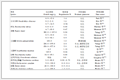
3 土壤微塑料环境风险评价环境风险评价是开展微塑料污染管控和治理的重要依据。目前土壤微塑料环境风险评价方法主要参考重金属的评价方法,包括污染负荷指数法(PLI)、地累积指数法(Igeo)和潜在生态风险指数法(PERI)等(表 1)[37,60]。
|
表 1 土壤微塑料风险评价方法 Table 1 Risk assessment methods for microplastic pollution in soil |
PLI最初由Tomlinson在从事重金属污染水平的分级研究中提出,常以背景值为评价标准[61]。该方法不仅能反应某点位的污染程度,还可使用求积统计法对区域污染程度进行评价。在微塑料领域,较多学者将PLI分为4个等级,即PLI<10为低风险,10<PLI<20为中风险,20<PLI<30为高风险,PLI>30为极高风险[40]。也有部分学者沿用原来重金属的方法将其用于微塑料污染程度评价,PLI < 1为轻度污染,1 < PLI < 2为中等污染,PLI > 2为重度污染[37]。Igeo为德国海德堡大学沉积物研究所的科学家Müller提出,利用重金属地球化学背景值,定量评价沉积物中的污染程度[62]。经吸收借鉴,学者们将其应用于微塑料污染状况评估。Igeo可将微塑料污染程度分为6个等级,Igeo<1为轻度污染,1<Igeo<2为轻度至中度污染,2<Igeo<3为中度至重度污染,3<Igeo<4为较重污染,4<Igeo<5为较重至重度污染,Igeo>5为极重污染[37]。PERI是瑞典学者Hakanson建立的一套应用沉积学原理评价重金属生态危害的方法[63]。该方法结合污染物实测浓度、危害评分和评价参考值等指标,评价污染物潜在危害的程度。Lithner等[64]建立的塑料危害评分模型为该方法在微塑料风险评价领域的应用提供了关键数据。该模型识别并汇编了55种塑料的危害评分,分值1~13 844不等。多数学者将微塑料PERI分为5个等级,PERI<150为低风险,150<PERI<300为中风险,300<PERI<600为高风险,600<PERI<1 200为危险,PERI>1 200为非常危险[65]。部分学者将其分为4个等级,PERI < 10为Ⅰ级风险,10<PERI < 100为Ⅱ级风险,100<PERI < 1 000为Ⅲ级风险,PERI > 1 000为Ⅳ级风险[37]。
上述环境风险评价方法大多与参考值的选择有较强关系,由于目前缺乏统一的标准,不同研究选用参考值的差异将影响研究结果之间的可比性。黄茜等[40]和Li等[65]分别使用设置的背景点丰度和监测区域微塑料丰度的最低值作为参考值,对武汉大棚蔬菜种植区和我国南方红树林土壤微塑料进行PLI和PERI风险评价。张雅珊等[1]综合大量文献后选择1 680 items·kg–1作为参考值对从不同论文中提取的土壤微塑料数据进行PLI和PERI风险评价。孙霞等[36]和李巧云等[37]选择Everaert利用数学模型估算出的安全浓度540 items·kg–1作为参考值分别评价了新疆棉区土壤微塑料的PLI环境风险和汉江上游农田土壤微塑料的PLI、Igeo和PERI环境风险。值得注意的是,塑料聚合物的危害系数对风险评价结果有较大影响。目前仅汇编了55种塑料聚合物的风险评分数据,当检出的微塑料聚合物风险评分数据缺乏时,PERI可能会低估微塑料的污染程度[64]。此外,风险评价结果等级的划分尚未形成统一标准,且现有塑料聚合物的危害系数间差异达四个数量级,导致风险评价结果的可信度存在争议,未来需建立标准化的模型来评估微塑料的生态风险。
当前微塑料风险评价方法还存在评价指标不完善的问题。现有风险评价方法主要是通过借鉴重金属的评价方法对微塑料进行风险评价,忽视了微塑料的独特性状,如:粒径、形状、颜色和老化程度等。研究表明,微塑料粒径越小越容易被植物、动物吸收积累[66]。细小的微塑料(μm级或nm级)会通过迁移行为和食物链传递放大其毒性效应。Lahive等[67]在研究微塑料对土壤隐囊虫的繁殖影响时,发现隐囊虫对13~18 μm和90~150 μm两组微塑料均会摄入,且13~18 μm微塑料的摄入量最大,EC50为(108±8.5)g·kg–1。因此,粒径应成为风险评价的重要指标,且小粒径的微塑料在风险评价时应予以重点突出。微塑料形状差异将带来对土壤理化性质和生物损伤等方面的不同影响。由于纤维是线性结构,与构成土壤主体的非线性团聚体结构截然不同,与颗粒和碎片相比,其改变土壤理化性质的潜力更高[68]。微塑料进入生物体后会对食道等器官造成机械性损伤,引起肠道阻塞、繁殖能力下降以及免疫反应降低、代谢紊乱等生化反应,而机械性损伤又与微塑料形状息息相关[69]。在一项大型蚤的亚致死效应研究中,球形PS较碎片和纤维状危害更大[70]。此外,微塑料颜色效应在生物进食环节需倍加关注。颜色较艳的以及与其食物颜色相近的微塑料更易被生物吞食[71]。微塑料老化会增加表面的粗糙度,从而为重金属、抗生素等污染物提供更多的吸附位点,导致复合污染加剧[72]。此外,老化对微塑料衍生的溶解有机物(DOM)也具有较大影响,随着老化时间的增加,会产生更多的DOM浸出液[73]。微塑料衍生的DOM具有多种危害,如降低微生物活性[74],抑制种子发芽[75],引发斑马鱼心血管系统紊乱和形态畸形[76],影响全球碳循环的调节[77],产生消毒副产物等[78]。
4 结论与展望微塑料因对土壤理化性质、生态系统以及人类健康产生重要影响,近年来已经成为研究热点。土壤微塑料污染受人类活动强度、土地利用类型、深度、污染年限等多因素叠加影响,在丰度、聚合物种类、颜色、粒径、形状等方面呈现不同的赋存特征。污染特征分析法、排放清单法、多元统计模型法和共生污染物辅助判断法是微塑料污染溯源的重要方法,但污染特征法依赖高精度监测数据,排放清单法数据获取与更新效率低、排放系数本土化不足、无组织排放核算易缺失,多元统计模型法主观性强、不同参数组合结果差异大、需依赖专家经验二次解读,共生污染物辅助判定法依赖特征谱库,且存在化学转化干扰因而特异性不足。现有土壤微塑料环境风险评价方法虽然得到一定应用,但参考值选择不统一、不全面,且忽视了微塑料的粒径、形状、颜色和老化程度等方面的环境影响,仅可粗略判断污染状况,还不足以精准支撑土壤微塑料污染防治。
鉴于土壤微塑料污染防治面临的挑战,提出如下研究方向:
1)建立健全土壤环境微塑料监测标准体系。准确、多维度的监测数据是开展环境赋存特征、迁移转化规律、环境风险评估,以及后续污染溯源和污染防治等研究的基础,当前环境微塑料研究领域普遍存在数据可比性差,难以进行横向比较的问题。应加快构建统一的监测标准体系,建立从监测技术规范、分析方法标准到标准物质等的土壤环境微塑料方法标准体系,研制自动化前处理平台,准确、快速获取土壤微塑料丰度、聚合物种类、颜色、粒径、形状等定性定量信息,通过多维度特征信息为土壤微塑料的污染溯源和风险评估奠定坚实的技术基础。
2)建立信息全面、数据精准的土壤微塑料溯源信息库。与水、气等其他环境介质相比,当前关于土壤环境中微塑料的来源和归趋的研究还很缺乏,基础数据不够丰富、全面,数据分析方法不统一。未来,在积累更多研究数据的基础上,通过标准的归一化处理,建立以聚合物种类、形状、颜色和尺寸分布为主要内容的溯源信息库,以及常见塑料共生污染物的特征谱库,可提高污染溯源的准确度和效率,为制定有效的防治策略提供科学依据。
3)加强土壤微塑料风险评价方法研究。构建毒理数据库,通过高通量实验量化不同聚合物对土壤微生物及植物根尖细胞凋亡率的剂量-效应曲线。量化复合污染协同效应,微塑料作为重金属/抗生素载体,其吸附-解吸行为显著放大毒性,但现有评价未纳入协同机制;加强微塑料在粒径、形状、颜色和老化程度等方面的环境影响基础研究,建立全面、系统、规范的环境风险评价体系,以便精准评估土壤微塑料的环境风险。
| [1] |
Zhang Y S, Chen Z Y, Ma W F. Research progress on the migration and transformation of microplastics and environmental risks (In Chinese)[J]. Chemical Industry and Engineering Progress, 2022, 41(11): 6080-6098. [张雅珊, 陈宗耀, 马伟芳. 微塑料的迁移转化及其生态风险研究进展[J]. 化工进展, 2022, 41(11): 6080-6098.]
(  0) 0) |
| [2] |
Jambeck J R, Geyer R, Wilcox C, et al. Marine pollution. Plastic waste inputs from land into the ocean[J]. Science, 2015, 347(6223): 768-771. DOI:10.1126/science.1260352
( 0) |
| [3] |
Zhang Z X, Yu H W, Meng L Y. Visualization analysis of the status and emerging trends of soil microplastics pollution (In Chinese)[J]. Journal China Agricultural University, 2023, 28(6): 36-49. [张孜璇, 于洪文, 孟龙月. 土壤中微塑料污染现状及其热点趋势可视化分析[J]. 中国农业大学学报, 2023, 28(6): 36-49.]
( 0) |
| [4] |
Eriksen M K, Damgaard A, Boldrin A, et al. Quality assessment and circularity potential of recovery systems for household plastic waste[J]. Journal of Industrial Ecology, 2019, 23(1): 156-168. DOI:10.1111/jiec.12822
( 0) |
| [5] |
He D F, Luo Y M, Lu S B, et al. Microplastics in soils: Analytical methods, pollution characteristics and ecological risks[J]. Trends in Analytical Chemistry, 2018, 109: 163-172. DOI:10.1016/j.trac.2018.10.006
( 0) |
| [6] |
Guo J J, Huang X P, Xiang L, et al. Source, migration and toxicology of microplastics in soil[J]. Environment International, 2020, 137: 105263. DOI:10.1016/j.envint.2019.105263
( 0) |
| [7] |
Fei Y F, Huang S Y, Wang J Q, et al. Microplastics contamination in the protected agricultural soils and its effects on bacterial community diversity (In Chinese)[J]. Chinese Science Bulletin, 2021, 66(13): 1592-1601. [费禹凡, 黄顺寅, 王佳青, 等. 设施农业土壤微塑料污染及其对细菌群落多样性的影响[J]. 科学通报, 2021, 66(13): 1592-1601.]
( 0) |
| [8] |
Rocha-Santos T, Duarte A C. A critical overview of the analytical approaches to the occurrence, the fate and the behavior of microplastics in the environment[J]. Trends in Analytical Chemistry, 2015, 65: 47-53. DOI:10.1016/j.trac.2014.10.011
( 0) |
| [9] |
Jiang X X, Feng X, Zhou X B, et al. Research progress on pollution status and analysis method for microplastics in soil (In Chinese)[J]. Environmental Chemistry, 2023, 42(1): 163-175. [姜晓旭, 封雪, 周笑白, 等. 土壤中微塑料污染现状与检测技术研究进展[J]. 环境化学, 2023, 42(1): 163-175.]
( 0) |
| [10] |
Zhang W, Cao F F, Qiu Y H, et al. Brief reviews of the control of plastic microbeads in cosmetics (In Chinese)[J]. China Food & Drug Administration Magazine, 2024(4): 108-115. [章为, 曹菲斐, 邱颖姮, 等. 浅议化妆品中塑料微珠治理[J]. 中国食品药品监管, 2024(4): 108-115.]
( 0) |
| [11] |
Feng S S, Lu H W, Tian P P, et al. Analysis of microplastics in a remote region of the Tibetan Plateau: Implications for natural environmental response to human activities[J]. Science of the Total Environment, 2020, 739: 140087. DOI:10.1016/j.scitotenv.2020.140087
( 0) |
| [12] |
Scheurer M, Bigalke M. Microplastics in Swiss floodplain soils[J]. Environmental Science & Technology, 2018, 52(6): 3591-3598.
( 0) |
| [13] |
Bläsing M, Amelung W. Plastics in soil: Analytical methods and possible sources[J]. Science of the Total Environment, 2018, 612: 422-435. DOI:10.1016/j.scitotenv.2017.08.086
( 0) |
| [14] |
Han Y J, Teng Y. Research progress on ecological effects and microbial degradation of biodegradable plastics in soils (In Chinese)[J]. Acta Pedologica Sinica, 2025, 62(6): 1585-1597. DOI:10.11766/trxb202405270210 [韩玉娟, 滕应. 土壤中生物可降解塑料的生态效应及微生物降解研究进展[J]. 土壤学报, 2025, 62(6): 1585-1597.]
( 0) |
| [15] |
Dissanayake P D, Kim S, Sarkar B, et al. Effects of microplastics on the terrestrial environment: A critical review[J]. Environmental Research, 2022, 209: 112734. DOI:10.1016/j.envres.2022.112734
( 0) |
| [16] |
Zhang G S, Liu Y F. The distribution of microplastics in soil aggregate fractions in southwestern China[J]. Science of the Total Environment, 2018, 642: 12-20. DOI:10.1016/j.scitotenv.2018.06.004
( 0) |
| [17] |
Qi Y L, Yang X M, Pelaez A M, et al. Macro- and micro- plastics in soil-plant system: Effects of plastic mulch film residues on wheat(Triticum aestivum)growth[J]. Science of the Total Environment, 2018, 645: 1048-1056. DOI:10.1016/j.scitotenv.2018.07.229
( 0) |
| [18] |
Kwak J I, An Y J. Microplastic digestion generates fragmented nanoplastics in soils and damages earthworm spermatogenesis and coelomocyte viability[J]. Journal of Hazardous Materials, 2021, 402: 124034. DOI:10.1016/j.jhazmat.2020.124034
( 0) |
| [19] |
Cao L, Wu D, Liu P, et al. Occurrence, distribution and affecting factors of microplastics in agricultural soils along the lower reaches of Yangtze River, China[J]. Science of the Total Environment, 2021, 794: 148694. DOI:10.1016/j.scitotenv.2021.148694
( 0) |
| [20] |
Zhou Y F, Liu X N, Wang J. Characterization of microplastics and the association of heavy metals with microplastics in suburban soil of central China[J]. Science of the Total Environment, 2019, 694: 133798. DOI:10.1016/j.scitotenv.2019.133798
( 0) |
| [21] |
Ren S Y, Kong S F, Ni H G. Contribution of mulch film to microplastics in agricultural soil and surface water in China[J]. Environmental Pollution, 2021, 291: 118227. DOI:10.1016/j.envpol.2021.118227
( 0) |
| [22] |
Ren S Y, Wang K, Zhang J R, et al. Potential sources and occurrence of macro-plastics and microplastics pollution in farmland soils: A typical case of China[J]. Critical Reviews in Environmental Science and Technology, 2024, 54(7): 533-556. DOI:10.1080/10643389.2023.2259275
( 0) |
| [23] |
Chen Y L, Leng Y F, Liu X N, et al. Microplastic pollution in vegetable farmlands of suburb Wuhan, central China[J]. Environmental Pollution, 2020, 257: 113449. DOI:10.1016/j.envpol.2019.113449
( 0) |
| [24] |
Shi X Z, Sun L N, Li Z, et al. Composition and distribution of microplastics in farmland soil around Shenyang (In Chinese)[J]. Journal of Agro-Environment Science, 2021, 40(7): 1498-1508. [时馨竹, 孙丽娜, 李珍, 等. 沈阳周边农田土壤中微塑料组成与分布[J]. 农业环境科学学报, 2021, 40(7): 1498-1508.]
( 0) |
| [25] |
Chen L Y, Yu L, Li Y J, et al. Spatial distributions, compositional profiles, potential sources, and intfluencing factors of microplastics in soils from different agricultural farmlands in China: A national perspective[J]. Environmental Science & Technology, 2022, 56(23): 16964-16974.
( 0) |
| [26] |
Huang Y, Liu Q, Jia W Q, et al. Agricultural plastic mulching as a source of microplastics in the terrestrial environment[J]. Environmental Pollution, 2020, 260: 114096. DOI:10.1016/j.envpol.2020.114096
( 0) |
| [27] |
Li Z W, Song Z F, Qiu L L, et al. Quantitative distribution and quantized ecological threat of microplastics in farmland: Shanghai as an example[J]. Journal of Hazardous Materials, 2024, 465: 133069. DOI:10.1016/j.jhazmat.2023.133069
( 0) |
| [28] |
Hao Y L, Hu Y X, Bai X X, et al. Abundances and morphology patterns of microplastics under different land use types on the Loess Plateau (In Chinese)[J]. Environmental Science, 2022, 43(9): 4748-4755. [郝永丽, 胡亚鲜, 白晓雄, 等. 黄土高原土地利用方式对微塑料丰度和形态分布的影响[J]. 环境科学, 2022, 43(9): 4748-4755.]
( 0) |
| [29] |
Yu L, Zhang J D, Liu Y, et al. Distribution characteristics of microplastics in agricultural soils from the largest vegetable production base in China[J]. Science of the Total Environment, 2021, 756: 143860. DOI:10.1016/j.scitotenv.2020.143860
( 0) |
| [30] |
Zhang H X, Huang Y M, An S S, et al. Land-use patterns determine the distribution of soil microplastics in typical agricultural areas on the eastern Qinghai-Tibetan Plateau[J]. Journal of Hazardous Materials, 2022, 426: 127806. DOI:10.1016/j.jhazmat.2021.127806
( 0) |
| [31] |
Lv W W, Zhou W Z, Lu S B, et al. Microplastic pollution in rice-fish co-culture system: A report of three farmland stations in Shanghai, China[J]. Science of the Total Environment, 2019, 652: 1209-1218. DOI:10.1016/j.scitotenv.2018.10.321
( 0) |
| [32] |
Harms I K, Diekötter T, Troegel S, et al. Amount, distribution and composition of large microplastics in typical agricultural soils in Northern Germany[J]. Science of the Total Environment, 2021, 758: 143615. DOI:10.1016/j.scitotenv.2020.143615
( 0) |
| [33] |
Zhou Q, Tu C, Fu C C, et al. Characteristics and distribution of microplastics in the coastal mangrove sediments of China[J]. Science of the Total Environment, 2020, 703: 134807. DOI:10.1016/j.scitotenv.2019.134807
( 0) |
| [34] |
Wu Y M, Wang Y P, Wang K, et al. Pollution characteristics and potential sources of microplastics in facility agricultural soil in Beijing (In Chinese)[J]. Asian Journal of Ecotoxicology, 2022, 17(4): 333-344. [吴亚梅, 王育鹏, 王康, 等. 北京市设施农业土壤微塑料的污染特征及潜在来源[J]. 生态毒理学报, 2022, 17(4): 333-344.]
( 0) |
| [35] |
Zhou Q, Zhang H B, Zhou Y, et al. Separation of microplastics from a coastal soil and their surface microscopic features (In Chinese)[J]. Chinese Science Bulletin, 2016, 61(14): 1604-1611. [周倩, 章海波, 周阳, 等. 滨海潮滩土壤中微塑料的分离及其表面微观特征[J]. 科学通报, 2016, 61(14): 1604-1611.]
( 0) |
| [36] |
Sun X, Gou Y R, Yan H, et al. Soil microplastic pollution and distribution characteristics in a typical cotton field in northern Xinjiang, China (In Chinese)[J]. Journal of Agro- Environment Science, 2024, 43(3): 571-580. [孙霞, 苟燕如, 严涵, 等. 北疆典型棉区土壤微塑料污染现状及分布特征[J]. 农业环境科学学报, 2024, 43(3): 571-580.]
( 0) |
| [37] |
Li Q Y, Zhao H H, Yang C, et al. Characteristics, risk assessment of microplastics, and heavy metal pollution in farmland soils in the upper Hanjiang River (In Chinese)[J]. Environmental Science, 2025, 46(1): 419-429. [李巧云, 赵航航, 杨婵, 等. 汉江上游农田土壤微塑料与重金属污染特征及生态风险评价[J]. 环境科学, 2025, 46(1): 419-429.]
( 0) |
| [38] |
Hao Y Q, Sun H J, Zeng X P, et al. Smallholder vegetable farming produces more soil microplastics pollution than large-scale farming[J]. Environmental Pollution, 2023, 317: 120805. DOI:10.1016/j.envpol.2022.120805
( 0) |
| [39] |
Zhu Y E, Wen H X, Li T H X, et al. Distribution and sources of microplastics in farmland soil along the Fenhe River (In Chinese)[J]. Environmental Science, 2021, 42(8): 3894-3903. [朱宇恩, 文瀚萱, 李唐慧娴, 等. 汾河沿岸农田土壤微塑料分布特征及成因解析[J]. 环境科学, 2021, 42(8): 3894-3903.]
( 0) |
| [40] |
Huang X, Zhang Q Q, Yan J, et al. Pollution situation and risk assessment of microplastics in agricultural soil in Wuhan (In Chinese)[J]. Environmental Engineering, 2024, 42(6): 136-145. [黄茜, 张俏俏, 颜瑾, 等. 武汉农用地土壤中微塑料污染状况和生态风险初探[J]. 环境工程, 2024, 42(6): 136-145.]
( 0) |
| [41] |
Ma Z F. China plastics industry yearbook 2018 (In Chinese). Beijing: China Light Industry Press, 2018. [马占峰. 中国塑料工业年鉴2018[M]. 北京: 中国轻工业出版社, 2018.]
( 0) |
| [42] |
Bi D, Wang B B, Li Z, et al. Occurrence and distribution of microplastics in coastal plain soils under three land-use types[J]. Science of the Total Environment, 2023, 855: 159023. DOI:10.1016/j.scitotenv.2022.159023
( 0) |
| [43] |
Kim S K, Kim J S, Lee H, et al. Abundance and characteristics of microplastics in soils with different agricultural practices: Importance of sources with internal origin and environmental fate[J]. Journal of Hazardous Materials, 2021, 403: 123997. DOI:10.1016/j.jhazmat.2020.123997
( 0) |
| [44] |
Claessens M, De Meester S, Van Landuyt L, et al. Occurrence and distribution of microplastics in marine sediments along the Belgian coast[J]. Marine Pollution Bulletin, 2011, 62(10): 2199-2204. DOI:10.1016/j.marpolbul.2011.06.030
( 0) |
| [45] |
Amobonye A, Bhagwat P, Singh S, et al. Plastic biodegradation: Frontline microbes and their enzymes[J]. Science of the Total Environment, 2021, 759: 143536. DOI:10.1016/j.scitotenv.2020.143536
( 0) |
| [46] |
Shan Z X, Zhang Y, Zhang C Q, et al. Microplastic pollution status and ecological risk evaluation in Weihe River (In Chinese)[J]. Environmental Science, 2023, 44(1): 231-242. [山泽萱, 张妍, 张成前, 等. 渭河微塑料污染现状与风险评价[J]. 环境科学, 2023, 44(1): 231-242.]
( 0) |
| [47] |
Dai L Y, Hou L, Wang H, et al. Effects of land use patterns on soil microplastic pollution in the Luoshijiang sub-watershed of Erhai Lake Basin (In Chinese)[J]. Environmental Science, 2024, 45(5): 3069-3077. [戴柳云, 侯磊, 王化, 等. 土地利用对洱海罗时江小流域土壤微塑料污染的影响[J]. 环境科学, 2024, 45(5): 3069-3077.]
( 0) |
| [48] |
Nizzetto L, Futter M, Langaas S. Are agricultural soils dumps for microplastics of urban origin?[J]. Environmental Science & Technology, 2016, 50(20): 10777-10779.
( 0) |
| [49] |
Zhou B Y, Wang J Q, Zhang H B, et al. Microplastics in agricultural soils on the coastal plain of Hangzhou Bay, East China: Multiple sources other than plastic mulching film[J]. Journal of Hazardous Materials, 2020, 388: 121814. DOI:10.1016/j.jhazmat.2019.121814
( 0) |
| [50] |
Weithmann N, Möller J N, Löder M G J, et al. Organic fertilizer as a vehicle for the entry of microplastic into the environment[J]. Science Advances, 2018, 4(4): eaap8060. DOI:10.1126/sciadv.aap8060
( 0) |
| [51] |
Wagner S, Hüffer T, Klöckner P, et al. Tire wear particles in the aquatic environment - A review on generation, analysis, occurrence, fate and effects[J]. Water Research, 2018, 139: 83-100. DOI:10.1016/j.watres.2018.03.051
( 0) |
| [52] |
Zhang S L, Liu X, Hao X H, et al. Distribution of low-density microplastics in the mollisol farmlands of Northeast China[J]. Science of the Total Environment, 2020, 708: 135091. DOI:10.1016/j.scitotenv.2019.135091
( 0) |
| [53] |
Xiong X, Zhang K, Chen X C, et al. Sources and distribution of microplastics in China's largest inland lake–Qinghai Lake[J]. Environmental Pollution, 2018, 235: 899-906. DOI:10.1016/j.envpol.2017.12.081
( 0) |
| [54] |
Ma M, Liu S B, Su M, et al. Spatial distribution and potential sources of microplastics in the Songhua River flowing through urban centers in Northeast China[J]. Environmental Pollution, 2022, 292: 118384. DOI:10.1016/j.envpol.2021.118384
( 0) |
| [55] |
Peng B, Hossain K B, Lin Y, et al. Assessment and sources identification of microplastics, PAHs and OCPs in the Luoyuan Bay, China: Based on multi-statistical analysis[J]. Marine Pollution Bulletin, 2022, 175: 113351. DOI:10.1016/j.marpolbul.2022.113351
( 0) |
| [56] |
Fahrenfeld N L, Arbuckle-Keil G, Naderi Beni N, et al. Source tracking microplastics in the freshwater environment[J]. Trends in Analytical Chemistry, 2019, 112: 248-254. DOI:10.1016/j.trac.2018.11.030
( 0) |
| [57] |
Horton A A, Walton A, Spurgeon D J, et al. Microplastics in freshwater and terrestrial environments: Evaluating the current understanding to identify the knowledge gaps and future research priorities[J]. Science of the Total Environment, 2017, 586: 127-141. DOI:10.1016/j.scitotenv.2017.01.190
( 0) |
| [58] |
Di M X, Wang J. Microplastics in surface waters and sediments of the Three Gorges Reservoir, China[J]. Science of the Total Environment, 2018, 616/617: 1620-1627. DOI:10.1016/j.scitotenv.2017.10.150
( 0) |
| [59] |
Parrish K, Fahrenfeld N L. Microplastic biofilm in fresh- and wastewater as a function of microparticle type and size class[J]. Environmental Science: Water Research & Technology, 2019, 5(3): 495-505.
( 0) |
| [60] |
Pan Z, Liu Q L, Jiang R G, et al. Microplastic pollution and ecological risk assessment in an estuarine environment: The Dongshan Bay of China[J]. Chemosphere, 2021, 262: 127876. DOI:10.1016/j.chemosphere.2020.127876
( 0) |
| [61] |
Xu Y, Li S Q, Guo S H, et al. Comparison of assessment methods of heavy metal pollution in soil (In Chinese)[J]. Journal of Anhui Agricultural Sciences, 2008, 36(11): 4615-4617. [徐燕, 李淑芹, 郭书海, 等. 土壤重金属污染评价方法的比较[J]. 安徽农业科学, 2008, 36(11): 4615-4617.]
( 0) |
| [62] |
Chen M, Cai Q Y, Xu H, et al. Research progress of risk assessment of heavy metals pollution in water body sediments (In Chinese)[J]. Ecology and Environmental Sciences, 2015, 24(6): 1069-1074. [陈明, 蔡青云, 徐慧, 等. 水体沉积物重金属污染风险评价研究进展[J]. 生态环境学报, 2015, 24(6): 1069-1074.]
( 0) |
| [63] |
Hakanson L. An ecological risk index for aquatic pollution control—A sedimentological approach[J]. Water Research, 1980, 14(8): 975-1001. DOI:10.1016/0043-1354(80)90143-8
( 0) |
| [64] |
Lithner D, Larsson Å, Dave G. Environmental and health hazard ranking and assessment of plastic polymers based on chemical composition[J]. Science of the Total Environment, 2011, 409(18): 3309-3324. DOI:10.1016/j.scitotenv.2011.04.038
( 0) |
| [65] |
Li R L, Yu L Y, Chai M W, et al. The distribution, characteristics and ecological risks of microplastics in the mangroves of Southern China[J]. Science of the Total Environment, 2020, 708: 135025. DOI:10.1016/j.scitotenv.2019.135025
( 0) |
| [66] |
Li Z X, Li R J, Li Q F, et al. Physiological response of cucumber(Cucumis sativus L.)leaves to polystyrene nanoplastics pollution[J]. Chemosphere, 2020, 255: 127041. DOI:10.1016/j.chemosphere.2020.127041
( 0) |
| [67] |
Lahive E, Walton A, Horton A A, et al. Microplastic particles reduce reproduction in the terrestrial worm Enchytraeus crypticus in a soil exposure[J]. Environmental Pollution, 2019, 255: 113174. DOI:10.1016/j.envpol.2019.113174
( 0) |
| [68] |
de Souza Machado A A, Lau C W, Till J, et al. Impacts of microplastics on the soil biophysical environment[J]. Environmental Science & Technology, 2018, 52(17): 9656-9665.
( 0) |
| [69] |
Möhrke A C F, Haegerbaeumer A, Traunspurger W, et al. Underestimated and ignored? The impacts of microplastic on soil invertebrates—Current scientific knowledge and research needs[J]. Frontiers in Environmental Science, 2022, 10: 975904. DOI:10.3389/fenvs.2022.975904
( 0) |
| [70] |
Schwarzer M, Brehm J, Vollmer M, et al. Shape, size, and polymer dependent effects of microplastics on Daphnia magna[J]. Journal of Hazardous Materials, 2022, 426: 128136. DOI:10.1016/j.jhazmat.2021.128136
( 0) |
| [71] |
Hartmann N B, Hüffer T, Thompson R C, et al. Are we speaking the same language? Recommendations for a definition and categorization framework for plastic debris[J]. Environmental Science & Technology, 2019, 53(3): 1039-1047.
( 0) |
| [72] |
Ren Z F, Gui X Y, Xu X Y, et al. Microplastics in the soil-groundwater environment: Aging, migration, and co-transport of contaminants–A critical review[J]. Journal of Hazardous Materials, 2021, 419: 126455. DOI:10.1016/j.jhazmat.2021.126455
( 0) |
| [73] |
Wang Q J, Gu W Q, Chen H J, et al. Molecular properties of dissolved organic matter leached from microplastics during photoaging process[J]. Journal of Hazardous Materials, 2024, 480: 136154. DOI:10.1016/j.jhazmat.2024.136154
( 0) |
| [74] |
Wang X Y, Zhang Y, Zhao Y P, et al. Inhibition of aged microplastics and leachates on methane production from anaerobic digestion of sludge and identification of key components[J]. Journal of Hazardous Materials, 2023, 446: 130717. DOI:10.1016/j.jhazmat.2022.130717
( 0) |
| [75] |
Ren X N, Han Y, Zhao H R, et al. Elucidating the characteristic of leachates released from microplastics under different aging conditions: Perspectives of dissolved organic carbon fingerprints and nano- plastics[J]. Water Research, 2023, 233: 119786. DOI:10.1016/j.watres.2023.119786
( 0) |
| [76] |
Chen Q Q, Gao Z, Wu Y, et al. Insight into chemical features of migrated additives from plastics and associated risks to estuarine ecosystem[J]. Journal of Hazardous Materials, 2023, 448: 130861. DOI:10.1016/j.jhazmat.2023.130861
( 0) |
| [77] |
Sheridan E A, Fonvielle J A, Cottingham S, et al. Plastic pollution fosters more microbial growth in lakes than natural organic matter[J]. Nature Communications, 2022, 13: 4175. DOI:10.1038/s41467-022-31691-9
( 0) |
| [78] |
Du Z Q, Li G F, Ding S K, et al. Effects of UV-based oxidation processes on the degradation of microplastic: Fragmentation, organic matter release, toxicity and disinfection byproduct formation[J]. Water Research, 2023, 237: 119983. DOI:10.1016/j.watres.2023.119983
( 0) |