 2026, Vol. 63


微塑料作为一类广泛存在的新污染物,被认为对全球生态环境产生严重威胁[1-2]。机动车轮胎磨损颗粒(Tire wear particles,TWPs)是微塑料的重要来源[3]。轮胎磨损颗粒主要因轮胎与路面的机械摩擦产生[4],其具有分布广泛、成分复杂和难降解等特点,近年来日益受到关注。据统计,全球TWPs的年排放量约为600万t[5],且近60%的TWPs最终均会进入土壤并发生积累[6],每年约有57 300~65 400 t沉积在草地或道路附近的土壤中[7],从而对土壤健康构成潜在威胁。
TWPs在路面产生后,主要通过地表径流和大气干、湿沉降等方式进入土壤[8–10],并在土壤环境中经历迁移、转化等一系列过程。TWPs进入土壤后,大部分积聚于土壤表层[11],使其暴露于光照条件下,从而加速其光老化过程[10]。老化后的TWPs会破碎为粒径更小的颗粒,更易于在土壤中迁移。此外,老化过程会加速TWPs中各种添加剂的释放。TWPs及其释放物不仅会对植物的生长产生负面影响[12-13],还会对土壤动物[14-15]和土壤微生物[16-17]产生危害效应,如抑制蚯蚓等动物的生长发育、影响土壤酶活性、改变微生物群落丰度等[18]。
本文通过梳理关于土壤环境中TWPs研究的最新进展,以“轮胎磨损颗粒(Tire wear particles)”、“土壤(Soil)”、“来源(Source)”、“添加剂(Additives)”、“环境行为(Environmental behavior)”、“效应(Effect)”、“植物(Plant)”、“土壤动物(Soil fauna)”及“土壤微生物(Soil microorganism)”作为检索词,在“Web of Science”和中国知网(CNKI)数据库进行检索,检索时间范围为2010年至2025年。在此基础上,归纳了土壤TWPs的来源、行为以及危害效应,分析了当前关于土壤中TWPs及其释放物研究的不足,并在此基础上展望未来研究的重点方向与趋势,旨在为进一步系统阐明TWPs在土壤中的行为、效应及风险提供科学参考。
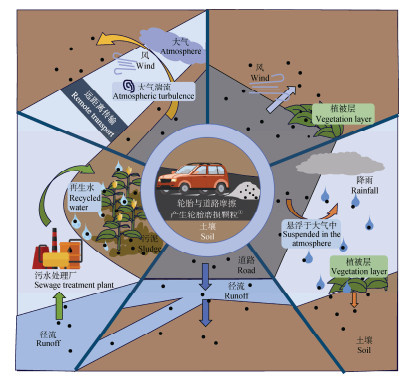
1 土壤中TWPs的来源TWPs主要产生于机动车在道路上行驶过程中。研究表明,在距离道路10 m范围内,TWPs主要靠风、重力以及雨水冲刷径流等方式沉积于土壤中;距离大于10 m处的土壤,大气传输和沉降是土壤中TWPs的主要输入方式[19]。除地表径流和大气沉降外,TWPs进入土壤的途径还包括污水灌溉和污泥农用[20]。土壤中TWPs的输入途径如图 1所示。
|
图 1 土壤中轮胎磨损颗粒(TWPs)的主要来源和输入途径 Fig. 1 Main sources and input pathways of tire wear particles(TWPs)in soil |
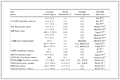
在机动车行驶过程中,TWPs广泛分布于道路扬尘或气溶胶中,最终这些颗粒大多数沉积在道路及其两侧的土壤中。TWPs在土壤中的浓度取决于土壤与道路的距离、土层深度、交通强度、路面/沥青类型、车辆速度以及道路径流和排水系统的设置[21]。随着与道路距离的增加,土壤中TWPs的浓度逐渐降低[22]。此外,随着土壤深度的增加,TWPs的浓度显著下降。表 1展示了不同类型道路旁以及不同距离和深度的土壤中TWPs的含量。例如,有研究发现,TWPs浓度最高出现在距离道路边0.3 m远的上层土壤,浓度为15 898 mg·kg–1,而在距离为5 m处仅为1 006 mg·kg–1[23]。
|
表 1 不同国家和地区道路旁土壤中TWPs的含量特征 Table 1 Characteristics of TWPs concentrations in roadside soils across different countries and regions |
这种空间分布也会受其他环境因素(如道路旁的植被层)的影响。例如,TWPs更容易沉积在低交通量、植物密集和地势低的土壤点位[25]。Rødland等[11]调查发现,在低交通量的农村道路周边土壤中具有高含量的TWPs。这可能是由于农村道路旁有较为茂密的植被,通过叶面和根系滞留TWPs,并在重力和风力作用下积累于植被下方的土壤。要想阐明相关机制,有必要系统研究路旁植被对TWPs的滞留作用,以及这种滞留对TWPs进入土壤的贡献。
1.2 间接来源 1.2.1 降雨及地表径流降雨能够将路面、空气中及道路旁植被叶面滞留的TWPs冲刷至土壤中。经过雨水冲刷,道路旁植被叶面滞留的TWPs滞留量减少约50%[27]。Mahjoub等[28]发现,降雨样品中TWPs可达到每升3.3~60.5个,并认为在交通量大的道路,降雨及其形成的径流对TWPs向土壤中输入有重要作用。道路上的TWPs通过降雨冲刷至道路径流中的过程受降雨强度和降雨时长等因素的影响。中、低强度降雨能够将路面上的大部分TWPs冲刷至径流水中[29],高强度降雨下进入径流的颗粒量反而较少[30]。
TWPs产生后,一部分最初会滞留于路面,随后被雨水径流带入不同的环境介质中[31],其中大部分TWPs最终聚集于道路两旁的土壤中。TWPs通过降雨冲刷及地表径流作用进入土壤的过程受TWPs自身形状、粒径和密度的影响。道路灰尘中的TWPs主要是粗颗粒,即尺寸大于100 μm的组分[32],这部分粗颗粒不易随径流发生迁移。相比之下,道路雨水径流中TWPs的粒径多集中于20~100 μm,这些较小粒径的TWPs更易随径流迁移而进入土壤[32]。
1.2.2 大气传输与沉降尺寸较小的TWPs通常会进入空气,对大气中的细颗粒物(PM2.5)和可吸入颗粒物(PM10)有显著贡献[33]。由于TWPs的尺寸可小于10 μm[34],因而可长时间停留在空气中,并随气流扩散而发生远距离传输[35]。Evangeliou等[35]构建了全球大气传输模型,研究表明,大气传输是偏远地区TWPs污染的主要途径。此外,强风可能会再次扬起路面上的TWPs,促进其向偏远地区输送,该现象在某种程度上类似于持久性有机污染物的“蚱蜢跳效应”[35],即TWPs可通过反复扬起和沉降在全球范围内实现跨纬度迁移。例如,在阿尔卑斯山和北极的雪中均发现了TWPs[36-37]。
1.2.3 再生水灌溉和污泥农用再生水灌溉和污泥农用是TWPs进入农业土壤的重要途径[7]。污水处理厂对TWPs的截留率达到90%以上,主要将其截留在污泥中,仅有约10%的TWPs随着出水排放[38]。Shi等[39]研究表明,含TWPs的污水经处理并回用于农业灌溉后,不同深度土壤及其孔隙水中均检出TWPs,以表层土壤含量最高。由于污泥农用导致TWPs在农业土壤中发生积累[5],成为农业土壤生态系统的新威胁[17]。
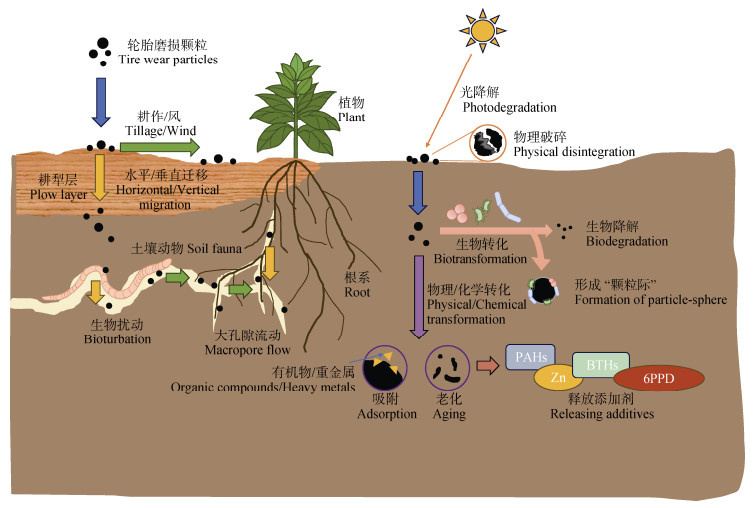
2 TWPs在土壤中的行为TWPs一旦进入土壤,就会发生迁移、转化、降解和释放添加剂等行为。通过水平和垂直迁移,TWPs能够到达距输入源更远和更深的土壤中。由于TWPs表面拥有大量的吸附位点,加之炭黑和橡胶成分的存在[17,40],容易成为其他污染物的载体。此外,TWPs在土壤中容易附着微生物,从而发生生物降解,并形成所谓“TWPs际”(TWP-sphere)(简称“颗粒际”)(图 2)。
|
注:PAHs:多环芳烃;Zn:锌;BTHs:苯并噻唑类化合物;6PPD:N-(1,3-二甲基丁基)-N'-苯基对苯二胺。Note:PAHs:Polycyclic aromatic hydrocarbons;Zn:Zinc;BTHs:Benzothiazoles;6PPD:N-(1,3-dimethylbutyl)-N'-phenyl-p-phenylenediamine. 图 2 TWPs在土壤中的行为 Fig. 2 Behavior of TWPs in soil |
目前,对于土壤中TWPs迁移的研究较少,有研究认为其迁移机制类似于其他类型微塑料[17]。TWPs进入土壤后,其迁移易受各种因素的影响,如道路旁的植被层、土壤质地以及TWPs自身的理化性质等[41]。此外,土壤的理化性质也能影响TWPs的迁移。例如,土壤中的腐殖酸能显著促进TWPs的迁移,且该促进作用在中性至碱性土壤环境中尤为显著[42-43]。此外,也有研究表明,老化过程使TWPs具有更强的亲水性,可促进其在土壤中的迁移[44]。
2.1.1 水平迁移在输入的初始阶段,TWPs多聚集于表层土壤,其中粒径小、质量轻的颗粒易受风力作用发生水平迁移;而粒径和质量较大的颗粒则因重力影响,长距离运输潜力较低[45]。对于农田土壤,耕作也能使TWPs发生水平迁移[17]。此外,土壤动物的行为也可能对TWPs的水平迁移产生影响。例如,弹尾虫能够移动土壤中的微塑料颗粒[46],但目前尚缺乏针对TWPs的研究证据。在实际土壤环境中,水平迁移与垂直迁移通常同步发生。蚯蚓等大型土壤动物凭借其在土壤中的活动,对其他类型微塑料的迁移分布有显著促进作用[47-48],但对TWPs是否也有类似作用尚待研究确认。
2.1.2 垂直迁移目前,关于TWPs在土壤中垂直迁移的研究较为有限。有研究表明,随着土壤深度的增加,TWPs的浓度显著降低,在土壤3 cm深度处其浓度仅为表层(0.5 cm)土壤的1/30[10]。影响TWPs的垂直迁移的因素包括耕作、生物扰动和大孔隙流动等。
耕作可使农田土壤表层的TWPs被转移至耕犁层以下[49]。土壤生物通过扰动土壤会使TWPs向下迁移。土壤生物除了通过直接扰动而促进TWPs垂直迁移外,还可通过大孔隙影响土壤的结构和性质,间接促进垂直迁移。大孔隙流动是由土壤生物挖掘的洞穴或根通道促进迁移,如蚯蚓通过挖掘洞穴增加了土壤孔隙率和水渗透率,使得微塑料可在水分的辅助下向更深的土层迁移[50]。植物的根系在向下生长过程中产生的空隙能促进微塑料迁移至土壤更深处[51]。然而,上述机制是否适用于TWPs,尚需系统地实验证实。
2.2 TWPs在土壤中的转化TWPs在土壤中的转化包括物理、化学和生物转化,主要体现在TWPs在土壤中的降解、老化和添加剂的释放等过程。因其含有较普通微塑料更复杂的成分,且在土壤中会释放具有较高毒性与持久性的添加剂,TWPs的转化机制不可简单套用一般微塑料的相关研究结论[17]。此外,TWPs在土壤中发生的老化和降解也影响其添加剂的释放。Chen等[52]研究表明,道路径流中的TWPs在光降解条件下,降低了降解速率,使其持续存在于环境中。鉴于道路径流是土壤中TWPs的重要来源之一,光降解作用对TWPs及其添加剂产生的效应机制不容忽视。
2.2.1 物理与化学转化TWPs在土壤中的物理转化主要表现为破碎与团聚。在高温条件下,TWPs中的橡胶成分会随着时间的推移变得干燥和易碎,破碎为更小的粒子[53]。然而,相较于化学与生物转化,土壤中TWPs的物理转化研究较少,这可能源于其在土壤中的行为是复杂的联合过程,难以单独呈现纯粹的物理转化。
TWPs的老化作为一种典型的化学行为,对土壤生态系统的健康有关键作用。Ding等[54]研究表明,橡胶老化会使表面O-H、C-O和C=O等含氧官能团强度相较于原始橡胶表面增加0.3%左右,还会影响活性氧(ROS)和溶解性有机质(DOM)的产生。而ROS和DOM在有机物降解过程中具有重要作用。可见,TWPs的老化行为会影响土壤中有机污染物的降解过程,对土壤中有机污染物的积累具有重要意义。
TWPs的老化及添加剂的释放对土壤生态系统的影响日益受到关注。土壤中TWPs的老化包括非生物和生物途径[55],目前研究较多的为非生物途径,主要包括机械挤压、氧化、光解等。例如TWPs光老化的过程,会促进环境持久性自由基(EPFRs)的形成[56],改变颗粒的物理化学特性(如形状、大小、表面化学和添加剂),进而影响其与生物体的相互作用,引发不同的毒性反应[43,56]。目前,对TWPs在土壤中的生物老化行为的研究较少,有必要开展进一步探索。
TWPs在土壤中可作为吸附有机物的载体[40],主要是将其结合至炭黑和橡胶中[57],这可能归因于TWPs表面具有更多的吸附位点和更低的电位[40]。这种吸附行为受土壤pH显著影响[43]。除潜在载体作用外,TWPs的老化过程还能促进污染物迁移。Zi等[58]研究表明,与原始TWPs相比,老化TWPs对重金属镉和镍的解吸速率降低,意味着老化后的TWPs更易载带重金属进行迁移,从而导致土壤中原有重金属污染物的重新分布。此外,TWPs也可作为其他微量元素的载体[59],从而导致高交通量道路附近的土壤动物因摄食TWPs而累积多种微量元素。
2.2.2 生物转化TWPs具有强疏水性表面,可作为土壤微生物的栖息地,易于从周围富集微生物,形成独特的“颗粒际”[17,60]。颗粒际上生物膜的形成受到土壤水分条件的影响,进而影响颗粒际内微生物群落的组成和结构。Xu等[61]研究表明,颗粒际内的微生物组成较周围土壤中的简单,主要由放线菌和变形菌组成,特定菌种可以硝酸盐作为电子受体,能够利用TWPs释放的有机污染物,从而促进颗粒际的氮循环。
TWPs主要由橡胶构成,作为典型的热固性微塑料[62],依靠其自然降解需要80~100年[63]。土壤中TWPs的降解途径主要为光降解和生物降解[8]。土壤中的微生物可将TWPs中的橡胶作为碳源,从而显著降低其在土壤中的含量[64]。研究表明,游动放线菌和链霉菌等菌属能分泌橡胶裂解酶,该酶可促进聚异戊二烯降解,生成含醛基和酮基的低聚物,最终转化为小分子酸[65]。但由于TWPs中添加剂的存在,生物降解过程可能会被抑制[66]。
2.3 TWPs添加剂的释放TWPs在自然环境中的老化会加速添加剂和有机碳的浸出[67]。TWPs的浸出物包括重金属(锌、铜等)和有机化合物(多环芳烃和苯并噻唑等)[68-70]。锌、苯并噻唑、N-(1,3-二甲基丁基)-N'-苯基对苯二胺(6PPD)等被广泛作为表征环境中TWPs的示踪标记物(图 2)。此外,在轮胎的生产过程中,会加入硫(硫化剂)、氧化锌(催化剂)以及二氧化硅或碳酸钙[11]。实验室和现场研究均发现TWPs中含有多种金属元素,除常见的锌以外,还有铁、钙、钛、铝、镍等[11,20,71]。Zeb等[72]对用TWPs处理过的土壤进行分析后均发现存在砷、铬、镍和锌,认为其主要源自TWPs的浸出。
有研究表明,在TWPs中检测到最多的有机化合物为多环芳烃[73]。多环芳烃具有较高的稳定性和疏水性,因此可在环境中持续存在[74]。此外,苯并噻唑类化合物(BTHs)作为轮胎主要的硫化促进剂,其在土壤中的浓度与TWPs的丰度呈正相关[75]。然而,土壤中锌、多环芳烃及BTHs的存在,并不能直接证明TWPs的存在[76]。
对苯二胺(PPD)是一类抗氧化剂,常被添加至轮胎橡胶中,以防止开裂和热氧化降解,并延长使用寿命[77]。在PPD中,6PPD是轮胎橡胶中使用最广泛的抗氧化剂。而6PPD臭氧氧化的主要产物是N-(1,3-二甲基丁基)-N'-苯基对苯醌(6PPDQ)[78],已被多项研究证明6PPDQ在土壤中的存在与TWPs含量有关[79],并主要来源于含有TWPs的大气颗粒物和道路灰尘的沉积[78]。释放至土壤中的6PPD转化为6PPDQ存在两条途径[55]。在早期老化阶段,6PPD通过微生物在Fe3+还原过程中转化为6PPDQ。随后,土壤中的环境持久性自由基(EPFRs)诱导超氧自由基O2•–的形成,从而促进了6PPDQ的形成[55]。目前对于6PPD及其转化产物6PPDQ对水生生物和哺乳动物的毒性研究较多,但对土壤生物的研究仍较为缺乏。
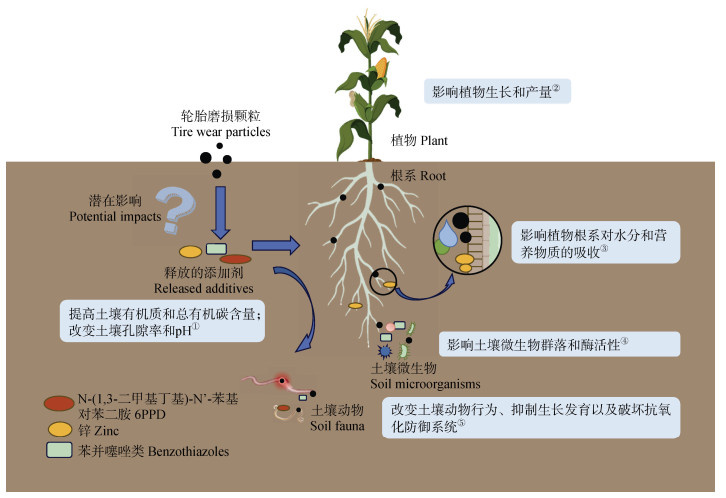
3 TWPs对土壤生态系统的影响土壤中的TWPs及其释放的重金属和有机污染物等可能会对植物、土壤动物和土壤微生物的生长和发育,甚至对繁殖行为产生危害效应(图 3)。TWPs及其释放的添加剂还会改变土壤理化性质[80]。如自然老化的TWPs可提高土壤有机质和总有机碳含量[72],改变土壤孔隙率和密度,影响水分和气体交换。TWPs中的碳酸钙成分会改变土壤pH[81],高浓度TWPs显著降低不同质地土壤的含水量[82]。TWPs中的重金属和难降解有机物,如多环芳烃,可能在土壤中累积并造成长期危害[17]。此外,光老化会加剧TWPs对土壤动物和微生物的负面影响,引发更严重的氧化应激反应[15,83]。
|
图 3 土壤中TWPs对植物和土壤生物产生的潜在影响 Fig. 3 Potential impacts of TWPs in the soil on plants and soil organisms |
TWPs在土壤中的行为会影响植物的根际环境[18],破坏植物的主要代谢过程,阻碍水分和养分吸收,进而威胁植物生长发育。老化的TWPs与原始颗粒对植物及其根际环境的作用效应不同。Zeb等[72]研究表明,原始的TWPs会对植物生长产生胁迫,而老化过程可能使TWPs在土壤中的毒性下降,甚至在一定条件下可促进植物生长,增加叶绿素的含量以及增强叶片和根中碳水化合物的代谢。
TWPs在土壤中的浸出物对植物生长有显著影响,其释放的重金属(如锌、镍等)和有机化合物(如BTHs、6PPD等)可能干扰植物代谢功能,阻碍水分和养分吸收。锌虽然是植物生长的必需元素,但TWPs在土壤中释放的过量锌会导致植物生长受到抑制[84]。此外,TWPs与其释放的镍共暴露可堵塞根孔,阻碍水分和养分吸收,进而抑制植物生长并降低作物产量[20]。
BTHs常被用作杀菌剂,能够影响土壤中的真菌群落[75]。目前尚无研究表明BTHs能直接影响植物生长,但其可能通过干扰土壤微生物群落进而间接影响植物生长[75]。然而,目前仍缺乏证据证明TWPs释放的BTHs浓度足以通过影响微生物菌群而影响植物生长。此外,6PPD及其氧化产物6PPDQ因其毒性逐渐受到关注,现有研究主要集中在其对水生生物的毒性[85–87],也有少量研究涉及对哺乳动物[88]和土壤生物[89]的毒性,但其对植物的毒性效应研究鲜见报道。因此,未来研究应关注TWPs在土壤中释放的6PPD、6PPDQ及BTHs对植物的潜在影响。
3.2 对土壤动物的影响TWPs对土壤动物会产生多方面影响,包括改变行为模式、抑制生长发育以及破坏抗氧化防御系统引发氧化应激损伤。Liu等[89]研究表明,0.1~10 μg·L–1的6PPDQ暴露会显著抑制秀丽隐杆线虫(Caenorhabditis elegans)的运动行为,长期暴露更会损害该线虫的运动和感觉神经元,导致运动异常和缺陷。Kim等[90]的短期暴露实验显示,TWPs本身同样会对该线虫的生长发育产生负面影响。
TWPs对土壤动物的影响还与暴露阶段有关。例如,有研究发现,在暴露初期,TWPs对隐跳虫(Enchytraeus crypticus)无显著影响,但随着颗粒在土壤中老化,其毒性逐渐增强[67]。老化过程显著增强TWPs对土壤动物的毒性。例如,Chen等[56]研究发现,光老化后的TWPs通过破坏蚯蚓的抗氧化防御系统引发氧化损伤,导致蚯蚓体重减轻和死亡率上升。此外,老化TWPs浸出物中所含的添加剂(如6PPD、锌、铬等)可诱导蚯蚓肠道微生物群失调,进而危害动物健康。这些浸出物的毒性已被证实会对土壤动物群产生毒性效应[67],且生物的致死率与浸出物中锌和苯并噻唑浓度呈显著正相关[91]。
目前,针对TWPs对土壤动物毒性的研究相对较少,尤其是对土壤动物摄食、繁殖等行为的影响及相关机制尚不清楚。现有研究多集中于蚯蚓、线虫等代表性土壤动物,而对其他土壤动物的研究相对缺乏。鉴于土壤动物在维持土壤结构和土壤生态系统中的关键作用,未来研究应关注TWPs及其添加剂对土壤动物的全周期影响,以及在土壤生态中的长期效应。
3.3 对土壤微生物的影响TWPs会对土壤微生物产生显著影响[17]。TWPs对土壤微生物的效应会受到土壤基本理化性质的影响。例如,土壤水分含量能促使老化的TWPs改变与土壤氮循环相关的微生物群落结构[61]。此外,TWPs渗滤液的毒性也是造成土壤微生物群落变化的一个因素。Peng等[75]研究指出,土壤中BTHs的丰度与真菌生物量呈显著负相关,表明BTHs是TWPs影响土壤真菌群落结构的关键因素。此外,有研究表明,6PPDQ的积累会导致土壤真菌群落多样性降低[92]。
TWPs进入土壤的方式和暴露时间也会影响土壤微生物。Zhu等[93]研究发现,向土壤中渐进式加入TWPs,对碳循环相关酶(β-葡萄糖苷酶和β-D-1,4-纤维二糖苷酶)的活性会产生负面影响,而一次性加入TWPs显著增加了氮循环相关的酶活性(β-1,4-N-乙酰氨基葡萄糖苷酶)。同样,Li等[94]研究表明,相较于短期暴露,土壤中TWPs的长期暴露会降低硝化细菌和反硝化细菌的相对丰度,从而减缓硝化速率。
TWPs的老化程度与其对土壤微生物的影响密切相关。有研究发现,老化的TWPs显著提高了nirK型反硝化菌的群落丰度并促进反硝化过程,同时诱导ROS累积,促使微生物分泌更多细胞外聚合物(EPS),并激活抗氧化系统以缓解氧化损伤[83]。另一项研究也表明,老化的TWPs会提高参与氮循环的微生物酶的活性[72]。可见,TWPs对土壤微生物群落的影响较复杂,各因素间的关联性值得深入探究。
4 结论与展望TWPs可通过道路直接沉积、降雨径流、大气传输与沉降、污水灌溉及污泥农用等途径输入土壤,使土壤成为TWPs重要的汇。TWPs成分复杂,含有多种添加剂,在土壤中会释放出具有毒性的有机污染物和重金属。本文归纳了TWPs输入土壤的主要来源和途径,描述了TWPs在土壤中的水平/垂直迁移、物理破碎、老化与生物降解、释放有毒添加剂(6PPD/6PPDQ、重金属、多环芳烃等)等行为。这些行为对植物、土壤动物和土壤微生物造成危害,如影响植物生长发育、干扰土壤动物行为和改变土壤微生物群落结构等。
基于土壤环境与TWPs性质的复杂性,目前尚缺乏TWPs在真实土壤中的迁移-转化-毒性的系统性研究。老化的TWPs与共存污染物的联合效应、长期田间观测和模型预测研究几乎为空白。为更全面地了解和阐释TWPs在土壤中的行为及其效应,未来的研究可关注几个方面:(1)探究不同土壤类型和土地利用方式下TWPs的时空分布、老化机制与添加剂释放规律;(2)揭示TWPs与共存污染物的联合暴露对土壤生态系统的长期效应和影响机制;(3)阐明TWPs及其添加剂与土壤理化性质的相互作用关系。
| [1] |
Hoang V H, Nguyen M K, Hoang T D, et al. Sources, environmental fate, and impacts of microplastic contamination in agricultural soils: A comprehensive review[J]. Science of the Total Environment, 2024, 950: 175276. DOI:10.1016/j.scitotenv.2024.175276
(  0) 0) |
| [2] |
Surendran U, Jayakumar M, Raja P, et al. Microplastics in terrestrial ecosystem: Sources and migration in soil environment[J]. Chemosphere, 2023, 318: 137946. DOI:10.1016/j.chemosphere.2023.137946
( 0) |
| [3] |
Tunali M, Nowack B. Towards including soil ecotoxicity of microplastics and tire wear particles into life cycle assessment[J]. Ecotoxicology and Environmental Safety, 2025, 303: 118856. DOI:10.1016/j.ecoenv.2025.118856
( 0) |
| [4] |
Kovochich M, Liong M, Parker J A, et al. Chemical mapping of tire and road wear particles for single particle analysis[J]. Science of the Total Environment, 2021, 757: 144085. DOI:10.1016/j.scitotenv.2020.144085
( 0) |
| [5] |
Kole P J, Löhr A J, Van Belleghem F, et al. Wear and tear of tyres: A stealthy source of microplastics in the environment[J]. International Journal of Environmental Research and Public Health, 2017, 14(10): 1265. DOI:10.3390/ijerph14101265
( 0) |
| [6] |
Unice K M, Weeber M P, Abramson M M, et al. Characterizing export of land-based microplastics to the estuary - part Ⅰ: Application of integrated geospatial microplastic transport models to assess tire and road wear particles in the seine watershed[J]. Science of the Total Environment, 2019, 646: 1639-1649. DOI:10.1016/j.scitotenv.2018.07.368
( 0) |
| [7] |
Baensch-Baltruschat B, Kocher B, Kochleus C, et al. Tyre and road wear particles - A calculation of generation, transport and release to water and soil with special regard to German roads[J]. Science of the Total Environment, 2021, 752: 141939. DOI:10.1016/j.scitotenv.2020.141939
( 0) |
| [8] |
Baensch-Baltruschat B, Kocher B, Stock F, et al. Tyre and road wear particles(TRWP)- A review of generation, properties, emissions, human health risk, ecotoxicity, and fate in the environment[J]. Science of the Total Environment, 2020, 733: 137823. DOI:10.1016/j.scitotenv.2020.137823
( 0) |
| [9] |
Luo Z X, Zhou X Y, Su Y, et al. Environmental occurrence, fate, impact, and potential solution of tire microplastics: Similarities and differences with tire wear particles[J]. Science of the Total Environment, 2021, 795: 148902. DOI:10.1016/j.scitotenv.2021.148902
( 0) |
| [10] |
Liu H W, Yuan Y X, Cao T C, et al. Key environmental behaviors of tire wear particles and their influencing mechanisms (In Chinese)[J]. Progress in Chemistry, 2025, 37(1): 103-111. [刘鸿玮, 袁语欣, 曹天池, 等. 轮胎磨损颗粒的关键环境行为及其影响机制[J]. 化学进展, 2025, 37(1): 103-111.]
( 0) |
| [11] |
Rødland E S, Heier L S, Lind O C, et al. High levels of tire wear particles in soils along low traffic roads[J]. Science of the Total Environment, 2023, 903: 166470. DOI:10.1016/j.scitotenv.2023.166470
( 0) |
| [12] |
Wang X Y, Li M, Xu M J, et al. Effects of tire wear particles on seedling growth of kidney bean(Phaseolus vulgaris L. )and soil antibiotic resistance gene abundance[J/OL]. Environmental Science, 2025, DOI: 10.13227/j.hjkx.202410064.[王欣怡, 栗敏, 徐梦娇, 等. 轮胎磨损颗粒对芸豆(Phaseolus vulgaris L. )幼苗生长及土壤抗生素抗性基因丰度的影响[J]. 环境科学, 2025, DOI: 10.13227/j.hjkx.202410064.]
( 0) |
| [13] |
Xu X Y, Deng Y W. Effects of microplastic pollution from tire wear on growth of rice at tillering stage (In Chinese)[J]. Asian Journal of Ecotoxicology, 2024, 19(2): 295-310. [徐新宇, 邓扬悟. 轮胎微塑料污染对分蘖期水稻生长的影响[J]. 生态毒理学报, 2024, 19(2): 295-310.]
( 0) |
| [14] |
Ding J, Lv M, Wang Q N, et al. Brand-specific toxicity of tire tread particles helps identify the determinants of toxicity[J]. Environmental Science & Technology, 2023, 57(30): 11267-11278.
( 0) |
| [15] |
Masset T, Breider F, Renaud M, et al. Effects of tire particles on earthworm(Eisenia andrei)fitness and bioaccumulation of tire-related chemicals[J]. Environmental Pollution, 2025, 368: 125780. DOI:10.1016/j.envpol.2025.125780
( 0) |
| [16] |
Kovochich M, Oh S C, Ferrari B J D, et al. Characterization of tire and road wear particles in experimental biota samples[J]. Scientific Reports, 2025, 15: 15372. DOI:10.1038/s41598-025-98902-3
( 0) |
| [17] |
Ding J, Lv M, Zhu D, et al. Tire wear particles: An emerging threat to soil health[J]. Critical Reviews in Environmental Science and Technology, 2023, 53(2): 239-257. DOI:10.1080/10643389.2022.2047581
( 0) |
| [18] |
Zeb A, Liu W T, Ali N, et al. Integrating metabolomics and high-throughput sequencing to investigate the effects of tire wear particles on mung bean plants and soil microbial communities[J]. Environmental Pollution, 2024, 340: 122872. DOI:10.1016/j.envpol.2023.122872
( 0) |
| [19] |
Sager M. Urban soils and road dust - Civilization effects and metal pollution - A review[J]. Environments, 2020, 7(11): 98. DOI:10.3390/environments7110098
( 0) |
| [20] |
Azeem I, Adeel M, Shakoor N, et al. Co-exposure to tire wear particles and nickel inhibits mung bean yield by reducing nutrient uptake[J]. Environmental Science: Processes & Impacts, 2024, 26(5): 832-842.
( 0) |
| [21] |
Kang H, Park S, Lee B, et al. Concentration of microplastics in road dust as a function of the drying period - A case study in G city, Korea[J]. Sustainability, 2022, 14(5): 3006. DOI:10.3390/su14053006
( 0) |
| [22] |
Rødland E S, Samanipour S, Rauert C, et al. A novel method for the quantification of tire and polymer-modified bitumen particles in environmental samples by pyrolysis gas chromatography mass spectroscopy[J]. Journal of Hazardous Materials, 2022, 423: 127092. DOI:10.1016/j.jhazmat.2021.127092
( 0) |
| [23] |
Müller A, Kocher B, Altmann K, et al. Determination of tire wear markers in soil samples and their distribution in a roadside soil[J]. Chemosphere, 2022, 294: 133653. DOI:10.1016/j.chemosphere.2022.133653
( 0) |
| [24] |
Unice K M, Kreider M L, Panko J M. Comparison of tire and road wear particle concentrations in sediment for watersheds in France, Japan, and the United States by quantitative pyrolysis GC/MS analysis[J]. Environmental Science & Technology, 2013, 47(15): 8138-8147.
( 0) |
| [25] |
[25] Pan W L, Liang L, Luo L L, et al. Spatial distribution characteristics of tire wear particles in bioretention zone from main traffic road (In Chinese)[J]. Acta Scientiae Circumstantiae, 2023, 43(10): 195-203. [潘伟亮, 梁琳, 罗玲利, 等. 交通干道生物滞留带中轮胎磨损颗粒的空间分布特征研究[J]. 环境科学学报, 2023, 43(10): 195-203.]
( 0) |
| [26] |
Polukarova M, Gaggini E L, Rødland E, et al. Tyre wear particles and metals in highway roadside ditches: Occurrence and potential transport pathways[J]. Environmental Pollution, 2025, 372: 125971. DOI:10.1016/j.envpol.2025.125971
( 0) |
| [27] |
Barwise Y, Kumar P, Abhijith K V, et al. A trait-based investigation into evergreen woody plants for traffic-related air pollution mitigation over time[J]. Science of the Total Environment, 2024, 914: 169713. DOI:10.1016/j.scitotenv.2023.169713
( 0) |
| [28] |
Mahjoub A, Hashemi S H, Petroody S S A. The role of baseflow and stormwater in transport of tire and bitumen particles in Tehran city: A dense urban environment[J]. Journal of Contaminant Hydrology, 2023, 256: 104180. DOI:10.1016/j.jconhyd.2023.104180
( 0) |
| [29] |
Liu Y H, Mei Y X, Liang X N, et al. Small-intensity rainfall triggers greater contamination of rubber-derived chemicals in road stormwater runoff from various functional areas in megalopolis cities[J]. Environmental Science & Technology, 2024, 58(29): 13056-13064.
( 0) |
| [30] |
Järlskog I, Strömvall A M, Magnusson K, et al. Occurrence of tire and bitumen wear microplastics on urban streets and in sweepsand and washwater[J]. Science of the Total Environment, 2020, 729: 138950. DOI:10.1016/j.scitotenv.2020.138950
( 0) |
| [31] |
Shafi M, Lodh A, Khajuria M, et al. Are we underestimating stormwater? Stormwater as a significant source of microplastics in surface waters[J]. Journal of Hazardous Materials, 2024, 465: 133445. DOI:10.1016/j.jhazmat.2024.133445
( 0) |
| [32] |
Klöckner P, Seiwert B, Eisentraut P, et al. Characterization of tire and road wear particles from road runoff indicates highly dynamic particle properties[J]. Water Research, 2020, 185: 116262. DOI:10.1016/j.watres.2020.116262
( 0) |
| [33] |
Giechaskiel B, Grigoratos T, Mathissen M, et al. Contribution of road vehicle tyre wear to microplastics and ambient air pollution[J]. Sustainability, 2024, 16(2): 522. DOI:10.3390/su16020522
( 0) |
| [34] |
Harrison R M, Jones A M, Gietl J, et al. Estimation of the contributions of brake dust, tire wear, and resuspension to nonexhaust traffic particles derived from atmospheric measurements[J]. Environmental Science & Technology, 2012, 46(12): 6523-6529.
( 0) |
| [35] |
Evangeliou N, Grythe H, Klimont Z, et al. Atmospheric transport is a major pathway of microplastics to remote regions[J]. Nature Communications, 2020, 11: 3381. DOI:10.1038/s41467-020-17201-9
( 0) |
| [36] |
Bergmann M, Mützel S, Primpke S, et al. White and wonderful? Microplastics prevail in snow from the Alps to the Arctic[J]. Science Advances, 2019, 5(8): eaax1157. DOI:10.1126/sciadv.aax1157
( 0) |
| [37] |
Jurkschat L, Gill A J, Milner R, et al. Using a citizen science approach to assess nanoplastics pollution in remote high-altitude glaciers[J]. Scientific Reports, 2025, 15: 1864. DOI:10.1038/s41598-024-84210-9
( 0) |
| [38] |
Obermaier N, Pistocchi A. A preliminary European-scale assessment of microplastics in urban wastewater[J]. Frontiers in Environmental Science, 2022, 10: 912323. DOI:10.3389/fenvs.2022.912323
( 0) |
| [39] |
Shi Q Y, Shen D H, Yates R, et al. Safe reuse of treated wastewater: Accumulation of contaminants of emerging concern in field-grown vegetables under different irrigation schemes[J]. Environmental Science & Technology, 2025, 59(12): 6261-6271.
( 0) |
| [40] |
Fan X L, Gan R, Liu J Q, et al. Adsorption and desorption behaviors of antibiotics by tire wear particles and polyethylene microplastics with or without aging processes[J]. Science of the Total Environment, 2021, 771: 145451. DOI:10.1016/j.scitotenv.2021.145451
( 0) |
| [41] |
Luo L L. Spatial distribution characteristics of tire wear particles in sponge facilities[D]. Chongqing: Chongqing Jiaotong University, 2022.[罗玲利. 海绵设施中轮胎磨损颗粒的空间分布特征研究[D]. 重庆: 重庆交通大学, 2022.]
( 0) |
| [42] |
Li K, Kong D Y, Chen X Y, et al. Influencing mechanisms of humic acid and pH on the migration behavior of typical tire wear particles (In Chinese)[J]. Acta Pedologica Sinica, 2024, 61(2): 456-468. DOI:10.11766/trxb202206200329 [李昆, 孔德跃, 陈星月, 等. 腐殖酸和pH对典型轮胎磨损颗粒迁移行为的影响机制[J]. 土壤学报, 2024, 61(2): 456-468.]
( 0) |
| [43] |
Yu J H, Liu C, Chen Z L, et al. Analysis of the migration mechanisms of tire wear particles in quartz sand: Insights into aging pathways and pH regulation effects[J]. Journal of Environmental Chemical Engineering, 2025, 13(3): 117135. DOI:10.1016/j.jece.2025.117135
( 0) |
| [44] |
Liu J, Wu D, Zhang Y T, et al. Study on the transport of tire wear particles in unsaturated porous media (In Chinese)[J]. Acta Scientiae Circumstantiae, 2025, 45(7): 340-350. [刘金, 吴迪, 张玉婷, 等. 轮胎磨损颗粒在非饱和多孔介质中迁移行为研究[J]. 环境科学学报, 2025, 45(7): 340-350.]
( 0) |
| [45] |
Goßmann I, Halbach M, Scholz-Böttcher B M. Car and truck tire wear particles in complex environmental samples - A quantitative comparison with "traditional" microplastic polymer mass loads[J]. Science of the Total Environment, 2021, 773: 145667. DOI:10.1016/j.scitotenv.2021.145667
( 0) |
| [46] |
Maaß S, Daphi D, Lehmann A, et al. Transport of microplastics by two collembolan species[J]. Environmental Pollution, 2017, 225: 456-459. DOI:10.1016/j.envpol.2017.03.009
( 0) |
| [47] |
Huerta Lwanga E, Gertsen H, Gooren H, et al. Microplastics in the terrestrial ecosystem: Implications for Lumbricus terrestris(Oligochaeta, Lumbricidae)[J]. Environmental Science & Technology, 2016, 50(5): 2685-2691.
( 0) |
| [48] |
Rillig M C, Ziersch L, Hempel S. Microplastic transport in soil by earthworms[J]. Scientific Reports, 2017, 7: 1362. DOI:10.1038/s41598-017-01594-7
( 0) |
| [49] |
Rehm R, Fiener P. Model-based analysis of erosion-induced microplastic delivery from arable land to the stream network of a mesoscale catchment[J]. Soil, 2024, 10(1): 211-230. DOI:10.5194/soil-10-211-2024
( 0) |
| [50] |
Helmberger M S, Tiemann L K, Grieshop M J. Towards an ecology of soil microplastics[J]. Functional Ecology, 2020, 34(3): 550-560. DOI:10.1111/1365-2435.13495
( 0) |
| [51] |
Demarta L, Hibbard B E, Bohn M O, et al. The role of root architecture in foraging behavior of entomopathogenic nematodes[J]. Journal of Invertebrate Pathology, 2014, 122: 32-39. DOI:10.1016/j.jip.2014.08.002
( 0) |
| [52] |
Chen J F, Tang T, Li Y X, et al. Non-targeted screening and photolysis transformation of tire-related compounds in roadway runoff[J]. Science of the Total Environment, 2024, 924: 171622. DOI:10.1016/j.scitotenv.2024.171622
( 0) |
| [53] |
Habib R Z, Al Kendi R, Ghebremedhin F, et al. Tire and rubber particles in the environment - A case study from a hot arid region[J]. Frontiers in Environmental Science, 2022, 10: 1009802. DOI:10.3389/fenvs.2022.1009802
( 0) |
| [54] |
Ding R, Ouyang Z Z, Dong P S, et al. Insights into the photoreactivity mechanisms of micro-sized rubber particles with different structure: The crucial role of reactive oxygen species and released dissolved organic matter[J]. Journal of Hazardous Materials, 2024, 477: 135250. DOI:10.1016/j.jhazmat.2024.135250
( 0) |
| [55] |
Zhu Y G, Xu Q, Li G, et al. Enhanced formation of 6PPD-Q during the aging of tire wear particles in anaerobic flooded soils: The role of iron reduction and environmentally persistent free radicals[J]. Environmental Science & Technology, 2023, 57(14): 5978-5987.
( 0) |
| [56] |
Chen L, Liu Z, Yang T H, et al. Photoaged tire wear particles leading to the oxidative damage on earthworms(Eisenia fetida)by disrupting the antioxidant defense system: The definitive role of environmental free radicals[J]. Environmental Science & Technology, 2024, 58(10): 4500-4509.
( 0) |
| [57] |
Hüffer T, Wagner S, Reemtsma T, et al. Sorption of organic substances to tire wear materials: Similarities and differences with other types of microplastic[J]. Trends in Analytical Chemistry, 2019, 113: 392-401. DOI:10.1016/j.trac.2018.11.029
( 0) |
| [58] |
Zi S X, Jiang X T, Chen Y, et al. Co-transport of tire wear particles with Cd2+ and Ni2+ in porous media: Impact of adsorption affinity and desorption hysteresis[J]. Water, Air, & Soil Pollution, 2024, 235(11): 727.
( 0) |
| [59] |
Naccarato A, Vommaro M L, Elliani R, et al. Tyre and road wear particles as carriers of metals and rare earth elements: Evidence of bioaccumulation in Tenebrio molitor[J]. Journal of Hazardous Materials, 2025, 494: 138556. DOI:10.1016/j.jhazmat.2025.138556
( 0) |
| [60] |
Ding J, Zhu D, Wang Y, et al. Exposure to heavy metal and antibiotic enriches antibiotic resistant genes on the tire particles in soil[J]. Science of the Total Environment, 2021, 792: 148417. DOI:10.1016/j.scitotenv.2021.148417
( 0) |
| [61] |
Xu Q, Wu Z Y, Xu Z H, et al. Soil moisture-dependent tire wear particles aging processes shift soil microbial communities and elevated nitrous oxide emission on drylands[J]. Science of the Total Environment, 2024, 952: 175948. DOI:10.1016/j.scitotenv.2024.175948
( 0) |
| [62] |
Hartmann N B, Hüffer T, Thompson R C, et al. Are we speaking the same language? Recommendations for a definition and categorization framework for plastic debris[J]. Environmental Science & Technology, 2019, 53(3): 1039-1047.
( 0) |
| [63] |
Cheng Z J, Li M, Li J T, et al. Transformation of nitrogen, sulfur and chlorine during waste tire pyrolysis[J]. Journal of Analytical and Applied Pyrolysis, 2021, 153: 104987. DOI:10.1016/j.jaap.2020.104987
( 0) |
| [64] |
Weyrauch S, Seiwert B, Voll M, et al. Long term biodegradation study on tire and road wear particles and chemicals thereof[J]. Science of the Total Environment, 2025, 975: 179240. DOI:10.1016/j.scitotenv.2025.179240
( 0) |
| [65] |
Basik A, Sanglier J J, Yeo C, et al. Microbial degradation of rubber: Actinobacteria[J]. Polymers, 2021, 13(12): 1989. DOI:10.3390/polym13121989
( 0) |
| [66] |
Ali Shah A, Hasan F, Shah Z, et al. Biodegradation of natural and synthetic rubbers: A review[J]. International Biodeterioration & Biodegradation, 2013, 83: 145-157.
( 0) |
| [67] |
Ding J, Liang Z Q, Lv M, et al. Aging in soil increases the disturbance of microplastics to the gut microbiota of soil fauna[J]. Journal of Hazardous Materials, 2024, 461: 132611. DOI:10.1016/j.jhazmat.2023.132611
( 0) |
| [68] |
Almansour K S, Arisco N J, Woo M K, et al. Playground lead levels in rubber, soil, sand, and mulch surfaces in Boston[J]. PLoS One, 2019, 14(4): e0216156. DOI:10.1371/journal.pone.0216156
( 0) |
| [69] |
Rhodes E P, Ren Z Y, Mays D C. Zinc leaching from tire crumb rubber[J]. Environmental Science & Technology, 2012, 46(23): 12856-12863.
( 0) |
| [70] |
Selbes M, Yilmaz O, Khan A A, et al. Leaching of DOC, DN, and inorganic constituents from scrap tires[J]. Chemosphere, 2015, 139: 617-623. DOI:10.1016/j.chemosphere.2015.01.042
( 0) |
| [71] |
Rausch J, Jaramillo-Vogel D, Perseguers S, et al. Automated identification and quantification of tire wear particles(TWP)in airborne dust: SEM/EDX single particle analysis coupled to a machine learning classifier[J]. Science of the Total Environment, 2022, 803: 149832. DOI:10.1016/j.scitotenv.2021.149832
( 0) |
| [72] |
Zeb A, Liu W T, Ali N, et al. Impact of pristine and aged tire wear particles on Ipomoea aquatica and rhizospheric microbial communities: Insights from a long-term exposure study[J]. Environmental Science & Technology, 2024, 58(48): 21143-21154.
( 0) |
| [73] |
Arole K, Velhal M, Tajedini M, et al. Impacts of particles released from vehicles on environment and health[J]. Tribology International, 2023, 184: 108417. DOI:10.1016/j.triboint.2023.108417
( 0) |
| [74] |
Bahrami R, Bagheri R. Effect of hybridization on crystallization behavior, mechanical properties, and toughening mechanisms in rubber-modified polypropylene flax fiber composites[J]. Journal of Composite Materials, 2022, 56(17): 2677-2693. DOI:10.1177/00219983221101434
( 0) |
| [75] |
Peng C, Wang Y, Sha X Y, et al. Adverse effect of TWPs on soil fungi and the contribution of benzothiazole rubber additives[J]. Journal of Hazardous Materials, 2024, 479: 135574. DOI:10.1016/j.jhazmat.2024.135574
( 0) |
| [76] |
Mayer P M, Moran K D, Miller E L, et al. Where the rubber meets the road: Emerging environmental impacts of tire wear particles and their chemical cocktails[J]. Science of the Total Environment, 2024, 927: 171153. DOI:10.1016/j.scitotenv.2024.171153
( 0) |
| [77] |
Hough P, van der Aar N, Qiu Z Y. Compounding and mixing methodology for good performance of EPDM in tire sidewalls[J]. Tire Science and Technology, 2020, 48(1): 2-21. DOI:10.2346/tire.18.460408
( 0) |
| [78] |
Hua X, Wang D Y. Tire-rubber related pollutant 6-PPD quinone: A review of its transformation, environmental distribution, bioavailability, and toxicity[J]. Journal of Hazardous Materials, 2023, 459: 132265. DOI:10.1016/j.jhazmat.2023.132265
( 0) |
| [79] |
Klöckner P, Seiwert B, Wagner S, et al. Organic markers of tire and road wear particles in sediments and soils: Transformation products of major antiozonants as promising candidates[J]. Environmental Science & Technology, 2021, 55(17): 11723-11732.
( 0) |
| [80] |
Li K, Ye Z D, Chen Z L, et al. Effects of tire wear particles on soil fertility and physicochemical properties: The role of typical aging patterns in the environment[J/OL]. Acta Pedologica Sinica, 2026, DOI: 10.11766/trxb202410300414.[李昆, 叶子栋, 陈张乐, 等. 轮胎磨损颗粒对土壤肥力和理化性质的影响: 环境中典型老化模式的作用[J/OL]. 土壤学报, 2026, DOI: 10.11766/trxb202410300414.]
( 0) |
| [81] |
Leifheit E F, Kissener H L, Faltin E, et al. Tire abrasion particles negatively affect plant growth even at low concentrations and alter soil biogeochemical cycling[J]. Soil Ecology Letters, 2022, 4(4): 409-415. DOI:10.1007/s42832-021-0114-2
( 0) |
| [82] |
Verdi A, Naseri M. Effects of tire wear particles on the water retention of soils with different textures in the full moisture range[J]. Journal of Contaminant Hydrology, 2024, 264: 104345. DOI:10.1016/j.jconhyd.2024.104345
( 0) |
| [83] |
Pu Y H, Hao Y M, Zeng Q Z, et al. Effects of UV-aged tire wear particles(TWPs)on soil microorganisms: Microbial community, microbial metabolism, cell defense and repair, and transmission of ARGs[J]. Journal of Environmental Chemical Engineering, 2025, 13(2): 115624. DOI:10.1016/j.jece.2025.115624
( 0) |
| [84] |
Kaur H, Garg N. Zinc toxicity in plants: A review[J]. Planta, 2021, 253(6): 129. DOI:10.1007/s00425-021-03642-z
( 0) |
| [85] |
Zhang S Y, Gan X F, Shen B G, et al. 6PPD and its metabolite 6PPDQ induce different developmental toxicities and phenotypes in embryonic zebrafish[J]. Journal of Hazardous Materials, 2023, 455: 131601. DOI:10.1016/j.jhazmat.2023.131601
( 0) |
| [86] |
Zhu J Q, Guo R Y, Ren F F, et al. Occurrence and partitioning of p-phenylenediamine antioxidants and their quinone derivatives in water and sediment[J]. Science of the Total Environment, 2024, 914: 170046. DOI:10.1016/j.scitotenv.2024.170046
( 0) |
| [87] |
Liao X L, Chen Z F, Ou S P, et al. Neurological impairment is crucial for tire rubber-derived contaminant 6PPDQ-induced acute toxicity to rainbow trout[J]. Science Bulletin, 2024, 69(5): 621-635. DOI:10.1016/j.scib.2023.12.045
( 0) |
| [88] |
Fang L Y, Fang C L, Di S S, et al. Oral exposure to tire rubber-derived contaminant 6PPD and 6PPD-quinone induce hepatotoxicity in mice[J]. Science of the Total Environment, 2023, 869: 161836. DOI:10.1016/j.scitotenv.2023.161836
( 0) |
| [89] |
Liu H L, Tan X C, Wu Y, et al. Long-term exposure to 6-PPD quinone at environmentally relevant concentrations causes neurotoxicity by affecting dopaminergic, serotonergic, glutamatergic, and GABAergic neuronal systems in Caenorhabditis elegans[J]. Science of the Total Environment, 2024, 922: 171291. DOI:10.1016/j.scitotenv.2024.171291
( 0) |
| [90] |
Kim S W, Leifheit E F, Maaß S, et al. Time-dependent toxicity of tire particles on soil nematodes[J]. Frontiers in Environmental Science, 2021, 9: 744668. DOI:10.3389/fenvs.2021.744668
( 0) |
| [91] |
Kim L, Kim H, Lee T Y, et al. Chemical toxicity screening of tire particle leachates from vehicles and their effects on organisms across three trophic levels[J]. Marine Pollution Bulletin, 2023, 192: 114999. DOI:10.1016/j.marpolbul.2023.114999
( 0) |
| [92] |
Wu W, Xu Q, Li J H, et al. The spatio-temporal accumulation of 6 PPD-Q in greenbelt soils and its effects on soil microbial communities[J]. Environmental Pollution, 2024, 358: 124477. DOI:10.1016/j.envpol.2024.124477
( 0) |
| [93] |
Zhu Y J, Kim S W, Li H Y, et al. Delivery rate alters the effects of tire wear particles on soil microbial activities[J]. Environmental Sciences Europe, 2024, 36: 97. DOI:10.1186/s12302-024-00918-5
( 0) |
| [94] |
Li Y Q, Tang Y H, Qiang W B, et al. Effect of tire wear particle accumulation on nitrogen removal and greenhouse gases abatement in bioretention systems: Soil characteristics, microbial community, and functional genes[J]. Environmental Research, 2024, 251: 118574. DOI:10.1016/j.envres.2024.118574
( 0) |