 2026, Vol. 63


2. 中国科学院大学, 北京 100049
2. University of Chinese Academy of Sciences, Beijing 100049, China
微塑料(microplastics,MPs)因粒径小、易在环境中迁移转化并进入食物链,进而对生态系统和人体健康产生风险,由其导致的环境污染与危害问题已受到全球广泛关注。农田土壤是陆地生态系统的重要组成部分,也是微塑料污染的主要汇聚地[1]。微塑料可通过雨水、地表径流、风力传输、大气沉降、农业活动、垃圾填埋场渗漏等途径进入农田土壤。我国农田土壤中微塑料的平均丰度高达4 537 items·kg–1,主要包括难降解塑料聚乙烯(polyethylene,PE)、聚丙烯(polypropylene,PP)、聚苯乙烯(polystyrene,PS)和可降解塑料聚乳酸(polylactic acid,PLA)和聚对苯二甲酸-己二酸丁二醇酯(poly(butyleneadipate- co-terephthalate),PBAT)等[2]。近年来,多项研究证实了微塑料在土壤中的转化会释放增塑剂、抗氧化剂、阻燃剂等添加剂[3],并且农作物能够吸收和传输微塑料及添加剂[4-6],进而加剧微塑料的环境风险。
与大气、水体等单相介质不同,土壤–作物系统是一个典型的多相态、多界面耦合的复杂生态系统。微塑料在该系统中的环境过程不仅包括物理迁移和空间分布,更伴随复杂的风化破碎和生物转化过程。研究表明,微塑料的迁移、赋存、添加剂释放、生物可吸收性及生态效应在很大程度上取决于其在不同界面上的转化过程:土–液界面主导微塑料与土壤矿物、有机质及水体组分的相互作用,影响其表面风化、迁移潜力以及添加剂的释放[7-9];土–根界面作为植物–土壤物质交换门户,植物可特异性调控微塑料的物理转化、生物膜定殖、生物膜降解、添加剂释放与根系吸收等过程[10];根–茎界面是微塑料及添加剂在植物体内迁移的关键通道,决定其传输分布、在可食部位的积累水平及对作物安全的影响[4,11]。
微塑料及其添加剂进入作物体内,可通过食物链向动物乃至人类传递,进而诱发肝肾损伤、免疫干扰、内分泌干扰和神经毒性等健康风险[12]。因此,微塑料在农田生态系统中的行为不仅是一种环境问题,更是关系到食品安全与人类健康的重要议题。为应对微塑料可能带来的多层次风险,我国《新污染物治理行动方案》已将其列为重点防控对象。目前已有部分文献综述了微/纳塑料在土壤–植物系统中的污染现状、来源途径及生态效应[3,10,13],但对微塑料在不同界面的转化机制缺乏系统阐释,同时较少将“界面过程”与“食物链风险”相结合。鉴于此,本文聚焦农田土壤–作物系统中微塑料的界面转化过程及其在食物链中的传递风险,系统梳理了微塑料在土–液界面、土–根界面和根–茎界面的转化和添加剂释放特征,深入分析其在植物体内的迁移路径及分布规律,并进一步探讨其沿“土壤–作物–动物”食物链的逐级传递机制及对人体健康的影响,旨在为农田微塑料污染的机制认知、风险评估及政策防控提供理论支撑与科学依据。
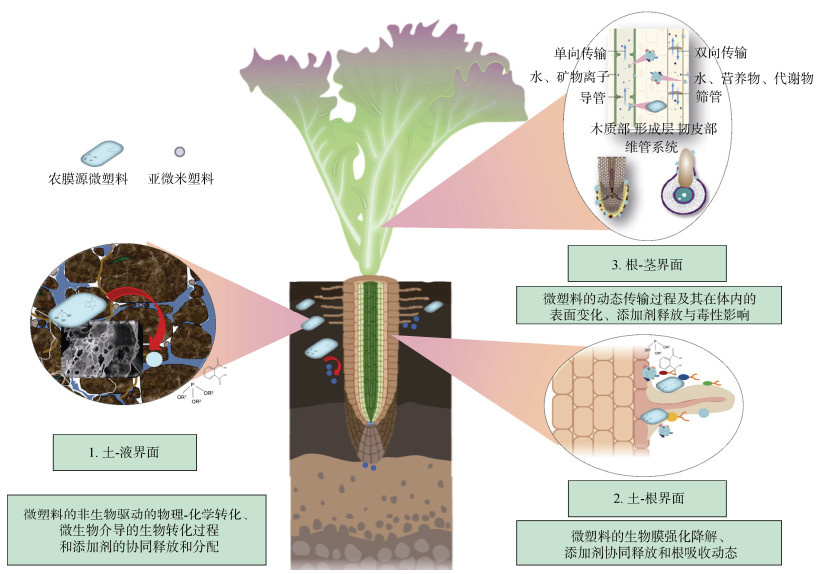
1 微塑料在土壤–作物系统中的界面转化过程在土壤–作物系统中,微塑料在不同界面会经历一系列复杂的转化过程,深刻影响其环境行为与生态风险。按照微塑料迁移与植物吸收的空间路径,其界面转化过程可分为土壤–液体界面、土壤–根界面以及根–茎界面,涉及微塑料的物理-化学转化和生物转化过程及其添加剂的协同释放和分配(图 1)。这些界面不仅决定了微塑料的赋存状态、迁移能力、分配过程和生物可吸收性,也直接关系到添加剂的协同释放、分配移动性,以及其是否能够被植物吸收并沿着食物链进一步传递,因此成为当前农田微塑料研究中的重要内容。
|
图 1 土壤–作物系统中微塑料在不同界面转移转化过程与添加剂协同释放研究 Fig. 1 Transformation of microplastics and synergistic release of additives at different interfaces in the soil–crop system |
土–液界面是农田土壤系统中物质迁移、能量交换与生物活动最为活跃的界面区域,也是微塑料进入土壤后发生环境行为变化的重要场所[13]。在这一界面上,微塑料不仅受到水动力扰动、土壤颗粒物包覆,还与溶液中的有机/无机胶体、溶解性有机质及微生物群落发生物理吸附、化学反应和生物转化过程,从而引发其表面结构与组成性质的连续变化[7,13-14]。
在土–液界面,微塑料首先经历一系列非生物过程驱动的物理–化学转化。微塑料表面长期暴露于光照、热力、水分波动和氧化剂等条件下,可能产生裂纹、断面和孔洞,导致表面粗糙度提升[15]。同时,塑料高分子链在水解、氧化等作用下断裂,形成更多的极性官能团(如羧基、羟基、羰基等),导致其电荷密度增强、亲水性升高[16]。这一系列表面变化不仅改变微塑料与水体中胶体颗粒的相互作用力,还可能促进其与重金属、有机污染物的复合吸附,进而影响其在土–液界面的分配、迁移与归趋模式[14]。微塑料表面粗糙度和极性官能团含量的增加也可能加速其内源性添加剂如邻苯二甲酸酯类(phthalate esters,PAEs)增塑剂、有机亚磷酸酯类抗氧化剂(organophosphite antioxidants,OPAs)的释放。微塑料的聚合物类型对其转化过程具有决定性作用,例如PLA和PBAT等含有酯键的可降解微塑料,在酸碱性条件或高湿度环境中易发生水解反应,生成更小粒径的次级微/纳米塑料[17]。相较而言,PE、PP等非极性聚烯烃结构稳定,化学惰性强,即便在高温或强氧化环境下,其降解过程也极为缓慢[18]。塑料中添加剂的含量和释放过程也受到不同类型聚合物的影响。例如,一项全国范围的地膜调查研究发现,PE和PBAT农膜中6种典型PAEs增塑剂(邻苯二甲酸二(2-乙基)己酯(DEHP)、邻苯二甲酸二丁酯(DBP)、邻苯二甲酸丁基苄基酯(BBP)、邻苯二甲酸二乙酯(DEP)、邻苯二甲酸二甲酯(DMP)和邻苯二甲酸二正辛酯(DNOP))的平均含量分别为13.4和32.5 mg·kg–1[19]。而地膜中OPAs抗氧化剂的含量范围达0.36×10⁻³~77.6 mg·kg–1[20]。黑龙江某区域土壤中的PE和PP农膜的添加剂双酚A释放动力学常数为0.89~1.34 d–1,而PBAT/PLA农膜则高达2.87~5.89 d–1,这表明PBAT/PLA农膜中双酚A相比PE和PP农膜释放更快[21]。
在土–液界面,微生物介导的生物转化过程同样在微塑料环境行为中扮演着重要角色。微生物可通过分泌多种胞外酶(如过氧化物酶、脂肪酶、酯酶等),对聚合物链进行生物降解,尤其是对含酯键或亲水基团的可降解塑料[22]。降解过程中,聚合物主链断裂,释放出低分子量的碎片与可溶性有机物,部分可作为碳源被微生物摄取、代谢甚至进一步矿化,转化为二氧化碳或生物质[23]。此外,土–液环境中微塑料表面常常被微生物群体迅速定殖并形成生物膜结构,该过程不仅改变了其表面理化性质,如电荷状态、粗糙度与亲水性,还增强了其在土壤胶体与矿物表面的粘附能力,从而影响添加剂的协同释放以及它们在土壤孔隙水中的迁移性和环境归趋[24-26]。
1.2 土–根界面微塑料转化过程土–根界面是土壤–作物系统中物质循环、生物代谢和界面交换最为活跃的微环境区域,同时也是微塑料发生生物转化与生物响应的关键场所[27-28]。该界面集成了植物根系、根系分泌物及高活性的微生物群落,在结构组成与代谢功能上均显著区别于非根际土壤。植物根系的伸展与穿透可对微塑料颗粒产生物理破碎作用,而根系分泌物则可调控微塑料表面官能团的形成与降解过程,加速其在根际环境中的转化、形态演变以及添加剂的协同释放[29-31]。
植物根系在穿透土壤基质过程中可对微塑料颗粒产生直接的物理扰动,尤其在根系快速伸展、分枝和加粗的过程中,容易对接触到的微塑料造成挤压、剪切、迁移甚至破裂等机械性破碎效应[32-33]。Li等[34]研究发现,当微塑料最初集中分布于土壤表层时,作物根系对其垂直迁移的影响较弱;而在微塑料沿剖面均匀分布的条件下,玉米根系的穿透活动可显著促进中层(7~12 cm)微塑料向表层迁移。植物根系诱导的物理破碎作用可显著加快微塑料粒径的细化,暴露更多表面活性位点,从而促进其后续的氧化、水解和微生物作用等转化过程。此外,根系的物理扰动作用可能具有显著的植物种属依赖性。不同作物根系在结构特征(如直根型、须根型)、穿透能力、根长密度和根毛分布等方面存在差异,因此也影响到添加剂的释放动力学[35],可能导致其对微塑料颗粒的破碎能力存在显著差异。目前针对不同植物根系特征如何影响微塑料物理破碎效率的研究仍较匮乏,尚缺乏系统的机制解析与比较评估。
植物根系在生长过程中可持续释放多种小分子有机物,如有机酸、氨基酸、多酚及糖类等,既可直接促进微塑料的水解与氧化反应,又能作为碳源刺激根际微生物活性,从而间接加速微塑料降解[36]。其中,有机酸类分泌物如柠檬酸、草酸等可通过螯合作用改变微塑料表面电荷状态,增强其与酶蛋白或土壤胶体的相互作用;天然有机质还可包覆或桥联微塑料颗粒,调节其疏水性与界面稳定性,影响其生物可利用性[37-38]。部分根际优势菌群表现出特异的塑料降解潜力。例如,铜绿假单胞菌(Pseudomonas aeruginosa)、蜡样芽孢杆菌(Bacillus cereus)等菌株已被证实可降解PE等常见聚烯烃类塑料[39]。同时,近年来研究发现,根际中存在的病毒群体也可能通过携带辅助代谢基因增强宿主细菌的降解能力,拓展了微塑料生物转化的潜在通路[40]。此外,不同类型的微塑料在根际中的生物转化表现出显著差异,以PLA为例,其易水解的酯键结构可被根际微生物分泌的脂肪酶、羧酸酯酶等快速切断,实现高效降解[41];而PBAT的转化过程则可能引起根际微生物群落结构变化,如放线菌、拟杆菌等特定功能类群的富集[42],反过来影响其降解机制与生态反馈路径。
微塑料的生物降解同样会伴随内源性添加剂的释放,释放到生物膜和土壤中的添加剂,会在微生物的作用下进一步发生微生物降解。例如,PAEs增塑剂可被生物膜中的酯酶和羧酸酯酶水解,生成邻苯二甲酸和相应的醇类[43];而阻燃添加剂氯化有机磷酸二酯则可被土壤微生物逐步水解为无机磷酸盐[44]。此外,经过生物膜降解的微塑料释放出的添加剂可能被植物根系吸收、转运和积累。研究表明,小麦根系对邻苯二甲酸二(2-乙基己基)酯(DEHP)的吸收是一个主动-被动共存、载体介导、耗能且依赖代谢的流入过程[45]。不同种类的PAEs在植物根系中的吸收效率存在差异[6],辛醇–水分配系数(logKow)与根的富集系数呈正相关。植物根产生的根系分泌物也能够影响微塑料和PAEs的生物可利用性[5,46]。在微塑料胁迫下,植物根系分泌的小分子有机酸等物质的含量发生变化,进而影响植物的三羧酸循环和光合作用等过程[47]。目前对根际环境中根系分泌物诱导下塑料添加剂的协同释放研究较少,需要进一步开展微塑料及其添加剂在土–根界面的协同释放与转化过程研究。
1.3 根–茎界面微塑料的传输及植物体内变化根–茎界面是微塑料由地下部向植物地上部迁移的关键节点,是连接根部吸收与茎叶传输分布的必经通道,对微塑料在植物体内的累积模式具有决定性作用。近年来,越来越多的研究发现,微塑料一旦被植物根系吸收,可通过特定路径进入维管组织,在蒸腾拉力的驱动下实现由根向茎叶的长距离运输[48]。然而,这一过程仍存在诸多认知盲区,尤其是在粒径门槛、界面行为及调控机制等方面,亟需系统阐明。
已有研究表明,亚微米级PS微塑料可通过植物侧根的细胞间隙进入木质部导管,随蒸腾流沿维管束向上移动,实现植物体内的纵向迁移。例如,利用Eu标记技术对PS–Eu微塑料进行定量示踪发现,该类颗粒主要富集于根部,向上运输至茎叶的转移系数约为3%[4]。PE等类型的微塑料在玉米体内也呈现出根 > 叶 > 茎的分布格局[49],提示其在根–茎界面的迁移效率具有明显的粒径与材料依赖性。此外,部分微塑料还可能通过韧皮部实现从叶到根的反向转移[50],表明其在植物体内的传输可能不仅限于蒸腾流路径,还涉及复杂的双向维管调控机制。但当前对其在维管系统中具体的空间分布、细胞穿越路径及转运动力机制仍缺乏明确证据支持,限制了对其在植物系统性分布的全面理解。微塑料添加剂在植物体内也呈现积累和传输特征。已有研究表明,PAEs增塑剂的辛醇–水分配系数logKow与其转运系数、土壤–植物富集系数呈负相关,其在作物体内积累和分布的差异与植物根系中质外体和共质体途径的比例相关[6]。
微塑料一旦进入植物体内,会暴露于植物体液环境,表面性质发生显著变化。研究显示,微塑料在与植物体液中的蛋白质、脂质、糖类等生物分子作用下,会迅速形成动态演化的生物分子层[5]。该分子层不仅改变微塑料的界面电荷、亲疏水性和稳定性,还可能决定其在植物不同器官中的转运效率与生物分布。例如,表面羧基修饰的纳米塑料更易被识别并向上运输,在茎和叶片中富集程度更高;而氨基修饰颗粒则更容易滞留于根系区域,形成“根部富集型”分布模式[51]。生物分子层的形成还可能触发植物抗氧化系统响应,调节体内活性氧水平及相关代谢过程,从而改变微塑料在植物体内的毒性表现[52-53]。微塑料与PAEs类添加剂的复合污染会加剧植物体内超氧阴离子(·O2-)和过氧化氢(H2O2)的积累,显著影响光合作用、糖代谢和抗氧化系统[54-55]。
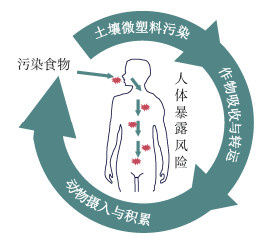
2 微塑料在土壤–作物–动物食物链中的传递及健康风险在农田生态系统中,微塑料可沿“土壤–作物–动物”路径逐级迁移与富集,构建起潜在的生物暴露链。微塑料在植物根部的吸收、向可食部位的转运以及动物摄食后的体内积累过程,共同推动其向更高营养级的传递(图 2)。这种逐级富集与累积效应不仅威胁生态系统功能,也会引发人体暴露风险,对食品安全与人类健康构成严峻挑战,已成为微塑料研究与风险防控中的重要方向。
|
图 2 微塑料在土壤–作物系统中的食物链传递及人体暴露风险示意图 Fig. 2 Schematic diagram of trophic transfer of microplastics in the soil–crop system and associated human exposure risks |
微塑料可在土壤–作物–动物食物链中迁移、富集甚至传递至人体,构成农业系统中潜在的生物暴露链,对生态安全和食品安全构成挑战。在“土壤—作物—动物”路径中,部分微塑料,尤其是粒径较小的纳米级塑料(< 1 μm),可通过植物根系的皮层空隙、根毛或伤口进入根部组织[48]。已有研究证实,植物可主动或被动从根部吸收微/纳塑料颗粒,并通过木质部在蒸腾流驱动下向上传输至地上部分[5]。Liu等[56]在模拟系统中发现,水稻根系能够吸收80 nm和1 μm的聚苯乙烯颗粒,并在茎叶及籽粒中积累。此外,叶面吸收也是微塑料进入植物的重要路径。Li等[57]利用质谱、高光谱、原子力显微镜–红外光谱联用等检测技术,实现了对真实环境中植物叶内微塑料的成功观测,揭示了叶片中微塑料与大气微塑料的关联,并在模拟暴露实验中阐明了叶片气孔吸收的微塑料能够通过质外体途径进入维管束,并在毛状体中积累的吸收和富集机制。这表明微塑料不仅可被作物吸收,还具有进入可食部位的潜力,动物通过摄食带微塑料的植物(如水稻籽粒、蔬菜叶片等)便可能摄入这些污染物,增加了通过饲料链暴露于牲畜或人类的风险[58]。Wu等[59]对我国南方地区畜禽饲料及其对应粪便中的微塑料污染水平进行了系统评估,发现在猪、蛋鸡和牛饲料中微塑料的丰度(以湿重计)分别为(139 ± 115)、(9.60 ± 10.9)和(3.60 ± 6.30)items·kg–1;在粪便样本中,猪、蛋鸡和牛粪便中的微塑料丰度(以湿重计)则分别为(902 ± 1 290)、(667 ± 990)和(7.40 ± 12.9)items·kg–1。除作物路径外,微塑料还可通过“土壤—土壤无脊椎动物—动物”路径在食物链中逐级迁移。Huerta Lwanga等[60]首次实验证实,蚯蚓可摄入土壤中的聚苯乙烯颗粒,进而被鸡摄食,微塑料最终在鸡的砂囊中富集,其浓度为原始土壤的5.1倍。总体而言,微塑料通过食物链的逐级迁移与富集,可能对农业生态系统功能、食品质量安全乃至人类健康造成累积性影响,亟需加强系统研究与风险管控。
2.2 微塑料经食物链传递引发的人体健康风险食品暴露是微塑料进入人体的重要途径,Xiao等[61]的研究发现东亚市售的海藻普遍检出微塑料,发现海藻摄入贡献中国人年均微塑料暴露量的45.5%(约1.7万颗粒·人–1·年–1),远超其他食物源。近年来,越来越多的研究证实,微/纳塑料可通过食物链实现逐级迁移,最终进入人体,带来潜在健康风险[62-64]。尤其值得注意的是,农田土壤是粮食作物的重要来源,农田中积累的微塑料可能通过根际吸收、食物链传递等途径进入农产品,进而增加人体暴露风险。一旦进入体内,微塑料可能在组织中残留、迁移,甚至引发系列毒理效应,如干扰代谢功能、损伤免疫系统以及影响神经与生殖健康,构成粮食安全与公共健康的重要隐患[12]。体内外实验研究表明,微/纳塑料可穿透消化道上皮屏障,进入循环系统并迁移至多个关键器官,其穿透机制主要包括跨细胞吞噬、紧密连接渗透等路径,使其能够在肝脏、肾脏、肺部、生殖器官等部位富集[65-66]。其中,纳米级颗粒由于粒径更小、比表面积更大,还可能突破血脑屏障、胎盘屏障及气–血屏障等生理防线,从而诱发更深层次的生物学效应[67]。例如,动物实验数据显示,小鼠摄入聚苯乙烯微塑料后,其肝脏中出现脂质代谢紊乱及炎症反应,并伴随肠道菌群结构改变,提示微塑料可能通过“肠–肝”或“肠–脑”轴途径诱发代谢综合征及神经免疫异常[68-69]。Huang等[70]首次实时追踪微塑料在小鼠体内的移动过程,微塑料被免疫细胞吞噬,随血流流动,最终滞留在大脑血管中。除实验研究外,近年来的人群暴露证据亦不断积累。Wu等[71]首次在人体血栓样本中发现了微塑料颗粒的存在;Zhang等[72]在健康成人粪便中检出微塑料颗粒,证实人类可通过食物链摄入并排出微塑料;Ragusa等[73]更是在人类胎盘中首次发现多种类型微塑料,提示其可通过母婴界面实现跨代暴露。更令人担忧的是,Leslie等[74]在人体血液中检出聚苯乙烯、聚甲基丙烯酸甲酯等多种塑料颗粒,表明微塑料可突破外周屏障进入血液循环系统。最新研究还发现,微塑料碎片可存在于动脉粥样硬化患者的颈动脉斑块中[75],提示其可能与慢性炎症性疾病及心血管风险存在关联。
3 研究挑战与展望1)聚焦微塑料在土壤–作物系统中的多界面转化机制,揭示其迁移与形貌演变规律。微塑料在农田土壤中通过土–液、土–根、根–茎等界面发生一系列复杂的理化变化和生物转化过程,直接影响其迁移能力和生物可吸收积累性。未来可结合稀土元素示踪、稳定同位素标记、荧光/量子点标记等可视化追踪技术,在原位和多尺度条件下模拟关键界面过程;同时利用高分辨成像(如同步辐射显微成像、原子力显微镜)与多源数据融合建模,解析微米级和纳米级塑料的吸附/解吸、水解、表面风化、生物膜形成与聚合物降解过程,形成基于聚合物类型与土壤环境特征的界面行为数据库,为环境行为建模与风险预测提供支撑。
2)强化作物对微塑料的吸收机制与体内运移路径研究,厘清其毒性与植物响应机制。现有研究多聚焦于微塑料进入植物与定量累积,缺乏对其在植物体内跨膜转运、组织分布和生理响应机制的深入探索。未来应结合纳米示踪、显微成像和多模态组学分析等,解析亚微米和微米塑料植物跨膜转运过程,明确其对植物营养吸收、代谢调控与抗氧化系统的干扰作用机制,为作物安全阈值的确定提供科学依据。
3)构建微塑料“土壤–作物–动物–人体”暴露链评估方法体系,推动微塑料污染防控政策与农业管理措施制定。微塑料通过农产品食用进入人体的路径逐渐明晰,但尚缺乏面向典型农业场景的系统暴露模型与健康风险评估框架。建议加强跨学科联合,整合生态暴露、毒理效应、高通量环境监测、食物链模型构建、组学与大数据分析等技术,建立面向微塑料(尤其是亚微米和纳米级塑料)的农田多级分类暴露评估方法,并引入体外消化模拟、动物模型及人群队列研究进行多维度验证。同时,推动污染防控政策的前移与协同治理:一方面加强对农用地塑料制品使用、回收与替代材料的制度化引导,另一方面鼓励发展源头减排、绿色生产、土壤修复等农业管理技术,以实现保障农业生态系统健康和食物链安全的可持续管理,并为制定差异化的区域微塑料限值标准与监管策略提供科技支撑。
| [1] |
Luo Y M, Zhou Q, Zhang H B, et al. Pay attention to research on microplastic pollution in soil for prevention of ecological and food chain risks (In Chinese)[J]. Bulletin of Chinese Academy of Sciences, 2018, 33(10): 1021-1030. [骆永明, 周倩, 章海波, 等. 重视土壤中微塑料污染研究防范生态与食物链风险[J]. 中国科学院院刊, 2018, 33(10): 1021-1030.]
(  0) 0) |
| [2] |
Yang J, Song K F, Tu C, et al. Distribution and weathering characteristics of microplastics in paddy soils following long-term mulching: A field study in Southwest China[J]. Science of the Total Environment, 2023, 858: 159774. DOI:10.1016/j.scitotenv.2022.159774
( 0) |
| [3] |
Yang J, Tu C, Yuan X Z, et al. Environmental processes and ecological effects of micro-and nano-plastics in soil-plant systems (In Chinese)[J]. Progress in Chemistry, 2025, 37(1): 89-102. [杨杰, 涂晨, 袁宪正, 等. 土壤-植物系统中微/纳塑料的环境过程和生态效应[J]. 化学进展, 2025, 37(1): 89-102.]
( 0) |
| [4] |
Luo Y M, Li L Z, Feng Y D, et al. Quantitative tracing of uptake and transport of submicrometre plastics in crop plants using lanthanide chelates as a dual-functional tracer[J]. Nature Nanotechnology, 2022, 17(4): 424-431. DOI:10.1038/s41565-021-01063-3
( 0) |
| [5] |
Sun X D, Yuan X Z, Jia Y B, et al. Differentially charged nanoplastics demonstrate distinct accumulation in Arabidopsis thaliana[J]. Nature Nanotechnology, 2020, 15(9): 755-760. DOI:10.1038/s41565-020-0707-4
( 0) |
| [6] |
Li Y, Yan H Q, Liu Q Y, et al. Accumulation and transport patterns of six phthalic acid esters(PAEs)in two leafy vegetables under hydroponic conditions[J]. Chemosphere, 2020, 249: 126457. DOI:10.1016/j.chemosphere.2020.126457
( 0) |
| [7] |
Wang Z X, He H K, Zhai Y B, et al. Photoaging processes and mechanisms of polyolefin microplastics[J]. Separation and Purification Technology, 2025, 353: 128314. DOI:10.1016/j.seppur.2024.128314
( 0) |
| [8] |
Qiu Y F, Niu J Y, Zhang C C, et al. Interpretable machine learning reveals transport of aged microplastics in porous media: Multiple factors co-effect[J]. Water Research, 2025, 274: 123129. DOI:10.1016/j.watres.2025.123129
( 0) |
| [9] |
Xu Y H, Wang X T, van der Hoek J P, et al. Natural organic matter stabilizes pristine nanoplastics but destabilizes photochemical weathered nanoplastics in monovalent electrolyte solutions[J]. Environmental Science & Technology, 2025, 59(3): 1822-1834.
( 0) |
| [10] |
Li X N, Ren C T, Sun J W, et al. Rhizosphere occurrence of particulate emerging contaminants (In Chinese)[J]. Scientia Sinica: Technologica, 2024, 54(10): 1904-1924. [李晓娜, 任春廷, 孙家伟, 等. 颗粒态新污染物的根际赋存[J]. 中国科学: 技术科学, 2024, 54(10): 1904-1924.]
( 0) |
| [11] |
Jiang M, Wang B Q, Ye R, et al. Evidence and impacts of nanoplastic accumulation on crop grains[J]. Advanced Science, 2022, 9(33): 2202336. DOI:10.1002/advs.202202336
( 0) |
| [12] |
Feng Y D, Tu C, Li R J, et al. A systematic review of the impacts of exposure to micro- and nano-plastics on human tissue accumulation and health[J]. Eco- Environment & Health, 2023, 2(4): 195-207.
( 0) |
| [13] |
Ren Z F, Gui X Y, Xu X Y, et al. Microplastics in the soil-groundwater environment: Aging, migration, and co-transport of contaminants–A critical review[J]. Journal of Hazardous Materials, 2021, 419: 126455. DOI:10.1016/j.jhazmat.2021.126455
( 0) |
| [14] |
Luo Y M, et al. Environmental microplastics: Occurrence, surface changes and bioaccumulation (In Chinese). Beijing: Science Press, 2025. [骆永明, 等. 环境微塑料赋存特征、表面变化和生物积累[M]. 北京: 科学出版社, 2025.]
( 0) |
| [15] |
Zhu J Y, Dong G W, Feng F, et al. Microplastics in the soil environment: Focusing on the sources, its transformation and change in morphology[J]. Science of the Total Environment, 2023, 896: 165291. DOI:10.1016/j.scitotenv.2023.165291
( 0) |
| [16] |
Dissanayake P D, Kim S, Sarkar B, et al. Effects of microplastics on the terrestrial environment: A critical review[J]. Environmental Research, 2022, 209: 112734. DOI:10.1016/j.envres.2022.112734
( 0) |
| [17] |
Cheng Y N, Wang F, Huang W W, et al. Response of soil biochemical properties and ecosystem function to microplastics pollution[J]. Scientific Reports, 2024, 14: 28328. DOI:10.1038/s41598-024-80124-8
( 0) |
| [18] |
Gao J T, Ju Z Q, Yang Q M, et al. Exploring different effects of biofilm formation and natural organic matter adsorption on the properties of three typical microplastics in the freshwater[J]. Science of the Total Environment, 2025, 958: 178156. DOI:10.1016/j.scitotenv.2024.178156
( 0) |
| [19] |
Ding W L, Liu Q, Liu Q Y, et al. Characteristics and safety of phthalates(PAEs)for plastic mulch films in China (In Chinese)[J]. Journal of Agro-Environment Science, 2021, 40(5): 1008-1016. [丁伟丽, 刘琪, 刘秋云, 等. 中国地膜产品塑化剂特点及风险评价[J]. 农业环境科学学报, 2021, 40(5): 1008-1016.]
( 0) |
| [20] |
Gong X Y, Zhang W J, Zhang S Y, et al. Organophosphite antioxidants in mulch films are important sources of organophosphate pollutants in farmlands[J]. Environmental Science & Technology, 2021, 55(11): 7398-7406.
( 0) |
| [21] |
Xu Y W, Xiong B Y, Huang Y M, et al. Exploring additives beyond phthalates: Release from plastic mulching films, biodegradation and occurrence in agricultural soils[J]. Science of the Total Environment, 2024, 918: 170763. DOI:10.1016/j.scitotenv.2024.170763
( 0) |
| [22] |
Zhang Y, Pedersen J N, Eser B E, et al. Biodegradation of polyethylene and polystyrene: From microbial deterioration to enzyme discovery[J]. Biotechnology Advances, 2022, 60: 107991. DOI:10.1016/j.biotechadv.2022.107991
( 0) |
| [23] |
Qiu X R, Ma S R, Pan J R, et al. Microbial metabolism influences microplastic perturbation of dissolved organic matter in agricultural soils[J]. The ISME Journal, 2024, 18(1): wrad017. DOI:10.1093/ismejo/wrad017
( 0) |
| [24] |
Tu C, Chen T, Zhou Q, et al. Biofilm formation and its influences on the properties of microplastics as affected by exposure time and depth in the seawater[J]. Science of the Total Environment, 2020, 734: 139237. DOI:10.1016/j.scitotenv.2020.139237
( 0) |
| [25] |
Wu C, Tanaka K, Tani Y, et al. Effect of particle size on the colonization of biofilms and the potential of biofilm-covered microplastics as metal carriers[J]. Science of the Total Environment, 2022, 821: 153265. DOI:10.1016/j.scitotenv.2022.153265
( 0) |
| [26] |
Chen Y, Wang X B, Wang X L, et al. Biofilm structural and functional features on microplastic surfaces in greenhouse agricultural soil[J]. Sustainability, 2022, 14(12): 7024. DOI:10.3390/su14127024
( 0) |
| [27] |
Song B, Shang S Y, Cai F M, et al. Microbial resistance in rhizosphere hotspots under biodegradable and conventional microplastic amendment: Community and functional sensitivity[J]. Soil Biology and Biochemistry, 2023, 180: 108989. DOI:10.1016/j.soilbio.2023.108989
( 0) |
| [28] |
Wang Y J, Zhao Z, Jiao M, et al. Rhizospheric bacterial communities against microplastics(MPs): Novel ecological strategies based on the niche differentiation[J]. Journal of Hazardous Materials, 2024, 480: 135806. DOI:10.1016/j.jhazmat.2024.135806
( 0) |
| [29] |
Wang L W, Li P F, Zhang Q, et al. Modeling the conditional fragmentation-induced microplastic distribution[J]. Environmental Science & Technology, 2021, 55(9): 6012-6021.
( 0) |
| [30] |
Gu G Y, Wu D, Liu Y N, et al. Quartz sand surface-bound rice root exudates decreased the transport of microplastics in porous media[J]. Environmental Science: Nano, 2025, 12(2): 1466-1476. DOI:10.1039/D4EN00984C
( 0) |
| [31] |
He Z A, Wang Y X, Fu Y Y, et al. Potential impacts of polyethylene microplastics and heavy metals on Bidens pilosa L. growth: Shifts in root-associated endophyte microbial communities[J]. Journal of Hazardous Materials, 2025, 490: 137698. DOI:10.1016/j.jhazmat.2025.137698
( 0) |
| [32] |
Tumwet F C, Richter A, Kleint T, et al. Vertical movement of microplastics by roots of wheat plant(Triticum aestivum)and the plant response in sandy soil[J]. Microplastics and Nanoplastics, 2024, 4(1): 15. DOI:10.1186/s43591-024-00092-8
( 0) |
| [33] |
Wang W, Hu K, Huang K, et al. Mechanical fragmentation of leaf litter by fine root growth contributes greatly to the early decomposition of leaf litter[J]. Global Ecology and Conservation, 2021, 26: e01456. DOI:10.1016/j.gecco.2021.e01456
( 0) |
| [34] |
Li H X, Lu X Q, Wang S Y, et al. Vertical migration of microplastics along soil profile under different crop root systems[J]. Environmental Pollution, 2021, 278: 116833. DOI:10.1016/j.envpol.2021.116833
( 0) |
| [35] |
Rogers E D, Benfey P N. Regulation of plant root system architecture: Implications for crop advancement[J]. Current Opinion in Biotechnology, 2015, 32: 93-98. DOI:10.1016/j.copbio.2014.11.015
( 0) |
| [36] |
Pang Z Q, Xu P. Probiotic model for studying rhizosphere interactions of root exudates and the functional microbiome[J]. The ISME Journal, 2024, 18(1): wrae223. DOI:10.1093/ismejo/wrae223
( 0) |
| [37] |
Zhao K, Wei Y M, Dong J H, et al. Separation and characterization of microplastic and nanoplastic particles in marine environment[J]. Environmental Pollution, 2022, 297: 118773. DOI:10.1016/j.envpol.2021.118773
( 0) |
| [38] |
Wu X W, Liu P, Gong Z M, et al. Humic acid and fulvic acid hinder long-term weathering of microplastics in lake water[J]. Environmental Science & Technology, 2021, 55(23): 15810-15820.
( 0) |
| [39] |
Kong Y, Wang R J, Zhou Q Y, et al. Recent progresses and perspectives of polyethylene biodegradation by bacteria and fungi: A review[J]. Journal of Contaminant Hydrology, 2025, 269: 104499. DOI:10.1016/j.jconhyd.2025.104499
( 0) |
| [40] |
Niu L H, Zhao S Q, Chen Y M, et al. Diversity and potential functional characteristics of phage communities colonizing microplastic biofilms[J]. Environmental Research, 2023, 219: 115103. DOI:10.1016/j.envres.2022.115103
( 0) |
| [41] |
Janczak K, Dąbrowska G B, Raszkowska-Kaczor A, et al. Biodegradation of the plastics PLA and PET in cultivated soil with the participation of microorganisms and plants[J]. International Biodeterioration & Biodegradation, 2020, 155: 105087.
( 0) |
| [42] |
Ren X W, Wang L, Tang J C, et al. Combined effects of degradable film fragments and micro/nanoplastics on growth of wheat seedling and rhizosphere microbes[J]. Environmental Pollution, 2022, 294: 118516. DOI:10.1016/j.envpol.2021.118516
( 0) |
| [43] |
de Witt J, Luthe T, Wiechert J, et al. Upcycling of polyamides through chemical hydrolysis and engineered Pseudomonas putida[J]. Nature Microbiology, 2025, 10(3): 667-680. DOI:10.1038/s41564-025-01929-5
( 0) |
| [44] |
Vila-Costa M, Sebastián M, Pizarro M, et al. Microbial consumption of organophosphate esters in seawater under phosphorus limited conditions[J]. Scientific Reports, 2019, 9: 233. DOI:10.1038/s41598-018-36635-2
( 0) |
| [45] |
Cheng Z P, Wang Y, Qiao B T, et al. Insights into mechanisms involved in the uptake, translocation, and metabolism of phthalate esters in Chinese cabbage(Brassica rapa var. chinensis)[J]. Science of the Total Environment, 2021, 768: 144945. DOI:10.1016/j.scitotenv.2021.144945
( 0) |
| [46] |
Du P P, Huang Y H, Lv H X, et al. Rice root exudates enhance desorption and bioavailability of phthalic acid esters(PAEs)in soil associating with cultivar variation in PAE accumulation[J]. Environmental Research, 2020, 186: 109611. DOI:10.1016/j.envres.2020.109611
( 0) |
| [47] |
Huang J W, Sun Y Y, Li Q S, et al. Increased risk of heavy metal accumulation in mangrove seedlings in coastal wetland environments due to microplastic inflow[J]. Environmental Pollution, 2024, 349: 123927. DOI:10.1016/j.envpol.2024.123927
( 0) |
| [48] |
Li L Z, Luo Y M, Li R J, et al. Effective uptake of submicrometre plastics by crop plants via a crack-entry mode[J]. Nature Sustainability, 2020, 3(11): 929-937. DOI:10.1038/s41893-020-0567-9
( 0) |
| [49] |
Yang S, Zhang Y, Chen Y, et al. Studies on the transfer effect of aged polyethylene microplastics in soil-plant system[J]. Chemosphere, 2024, 349: 141001. DOI:10.1016/j.chemosphere.2023.141001
( 0) |
| [50] |
Azeem I, Adeel M, Ahmad M A, et al. Uptake and accumulation of nano/microplastics in plants: A critical review[J]. Nanomaterials, 2021, 11(11): 2935. DOI:10.3390/nano11112935
( 0) |
| [51] |
Sun H F, Lei C L, Xu J H, et al. Foliar uptake and leaf-to-root translocation of nanoplastics with different coating charge in maize plants[J]. Journal of Hazardous Materials, 2021, 416: 125854. DOI:10.1016/j.jhazmat.2021.125854
( 0) |
| [52] |
Giri S, Christudoss A C, Chandrasekaran N, et al. The role of algal EPS in reducing the combined toxicity of BPA and polystyrene nanoparticles to the freshwater algae Scenedesmus obliquus[J]. Plant Physiology and Biochemistry, 2023, 197: 107664. DOI:10.1016/j.plaphy.2023.107664
( 0) |
| [53] |
Zhang S L, Zhang F C, Cai L, et al. Visual observation of polystyrene nano-plastics in grape seedlings of Thompson Seedless and assessing their effects via transcriptomics and metabolomics[J]. Journal of Hazardous Materials, 2024, 478: 135550. DOI:10.1016/j.jhazmat.2024.135550
( 0) |
| [54] |
Wang Y Y, Wang C, Geng S, et al. Effects of different particle size microplastics and di-n-butyl phthalate on photosynthesis and quality of spinach[J]. Environmental Technology & Innovation, 2024, 36: 103808.
( 0) |
| [55] |
Mou X L, Zhu H D, Dai R R, et al. Potential impact and mechanism of aged polyethylene microplastics on nitrogen assimilation of Lactuca sativa L.[J]. Ecotoxicology and Environmental Safety, 2025, 291: 117862. DOI:10.1016/j.ecoenv.2025.117862
( 0) |
| [56] |
Liu Y Y, Guo R, Zhang S W, et al. Uptake and translocation of nano/microplastics by rice seedlings: Evidence from a hydroponic experiment[J]. Journal of Hazardous Materials, 2022, 421: 126700. DOI:10.1016/j.jhazmat.2021.126700
( 0) |
| [57] |
Li Y, Zhang J J, Xu L, et al. Leaf absorption contributes to accumulation of microplastics in plants[J]. Nature, 2025, 641(8063): 666-673. DOI:10.1038/s41586-025-08831-4
( 0) |
| [58] |
Corte Pause F, Urli S, Crociati M, et al. Connecting the dots: Livestock animals as missing links in the chain of microplastic contamination and human health[J]. Animals, 2024, 14(2): 350. DOI:10.3390/ani14020350
( 0) |
| [59] |
Wu R T, Cai Y F, Chen Y X, et al. Occurrence of microplastic in livestock and poultry manure in South China[J]. Environmental Pollution, 2021, 277: 116790. DOI:10.1016/j.envpol.2021.116790
( 0) |
| [60] |
Huerta Lwanga E, Mendoza Vega J, Ku Quej V, et al. Field evidence for transfer of plastic debris along a terrestrial food chain[J]. Scientific Reports, 2017, 7: 14071. DOI:10.1038/s41598-017-14588-2
( 0) |
| [61] |
Xiao X Y, Liu S C, Li L Z, et al. Seaweeds as a major source of dietary microplastics exposure in East Asia[J]. Food Chemistry, 2024, 450: 139317. DOI:10.1016/j.foodchem.2024.139317
( 0) |
| [62] |
Vethaak A D, Legler J. Microplastics and human health[J]. Science, 2021, 371(6530): 672-674. DOI:10.1126/science.abe5041
( 0) |
| [63] |
Domenech J, Marcos R. Pathways of human exposure to microplastics, and estimation of the total burden[J]. Current Opinion in Food Science, 2021, 39: 144-151. DOI:10.1016/j.cofs.2021.01.004
( 0) |
| [64] |
Li B W, Li M, Du D W, et al. Characteristics and influencing factors of microplastics entering human blood through intravenous injection[J]. Environment International, 2025, 198: 109377. DOI:10.1016/j.envint.2025.109377
( 0) |
| [65] |
Dong X S, Liu X B, Hou Q L, et al. From natural environment to animal tissues: A review of microplastics(nanoplastics)translocation and hazards studies[J]. Science of the Total Environment, 2023, 855: 158686. DOI:10.1016/j.scitotenv.2022.158686
( 0) |
| [66] |
Enyoh C E, Devi A, Kadono H, et al. The plastic within: Microplastics invading human organs and bodily fluids systems[J]. Environments, 2023, 10(11): 194. DOI:10.3390/environments10110194
( 0) |
| [67] |
Lehner R, Weder C, Petri-Fink A, et al. Emergence of nanoplastic in the environment and possible impact on human health[J]. Environmental Science & Technology, 2019, 53(4): 1748-1765.
( 0) |
| [68] |
Du L X, Liu H, Song X, et al. Developments in the field of intestinal toxicity and signaling pathways associated with rodent exposure to micro(nano)plastics[J]. Toxicology, 2024, 507: 153883. DOI:10.1016/j.tox.2024.153883
( 0) |
| [69] |
Zhang Z C, Xu M K, Wang L, et al. Continuous oral exposure to micro- and nanoplastics induced gut microbiota dysbiosis, intestinal barrier and immune dysfunction in adult mice[J]. Environment International, 2023, 182: 108353. DOI:10.1016/j.envint.2023.108353
( 0) |
| [70] |
Huang H P, Hou J Q, Li M X, et al. Microplastics in the bloodstream can induce cerebral thrombosis by causing cell obstruction and lead to neurobehavioral abnormalities[J]. Science Advances, 2025, 11(4): eadr8243. DOI:10.1126/sciadv.adr8243
( 0) |
| [71] |
Wu D, Feng Y D, Wang R, et al. Pigment microparticles and microplastics found in human thrombi based on Raman spectral evidence[J]. Journal of Advanced Research, 2023, 49: 141-150. DOI:10.1016/j.jare.2022.09.004
( 0) |
| [72] |
Zhang J J, Wang L, Trasande L, et al. Occurrence of polyethylene terephthalate and polycarbonate microplastics in infant and adult feces[J]. Environmental Science & Technology Letters, 2021, 8(11): 989-994.
( 0) |
| [73] |
Ragusa A, Svelato A, Santacroce C, et al. Plasticenta: First evidence of microplastics in human placenta[J]. Environment International, 2021, 146: 106274. DOI:10.1016/j.envint.2020.106274
( 0) |
| [74] |
Leslie H A, van Velzen M J M, Brandsma S H, et al. Discovery and quantification of plastic particle pollution in human blood[J]. Environment International, 2022, 163: 107199. DOI:10.1016/j.envint.2022.107199
( 0) |
| [75] |
Marfella R, Prattichizzo F, Sardu C, et al. Microplastics and nanoplastics in atheromas and cardiovascular events[J]. The New England Journal of Medicine, 2024, 390(10): 900-910. DOI:10.1056/NEJMoa2309822
( 0) |