 2026, Vol. 63


水稻土是长期人为管理形成的特殊土壤,其特殊的氧化还原过程区别于旱地土壤[1]。长期水耕熟化促使稻田土壤有机质(SOM)积累,使其单位面积有机碳储量较旱地高20%[2]。作为重要的固碳生态系统,深入了解水稻土碳汇功能对推动我国农业的固碳减排及绿色可持续发展至关重要[3]。
长期水稻种植驱动土壤SOM的积累与土壤团聚体的形成稳定[4]。团聚体限制SOM与微生物和酶的接触,结合稻田淹水缺氧条件进一步抑制了微生物活性,共同延缓SOM的生物转化,形成物理保护机制[5]。此机制下不同粒径团聚体中有机碳含量呈现出显著差异:黑土区水稻土有机碳及其颗粒有机碳主要集中在 > 250 μm团聚体,以2 000~250 μm团聚体最为显著[6];长期秸秆还田下,> 250 μm团聚体中土壤有机碳、可溶性有机碳和微生物生物量碳含量均显著高于 < 250 μm团聚体[7]。深入研究团聚体有机质及其组分的分异规律,可揭示稻田SOM积累的分子调控机制,为优化土壤碳库稳定理论提供科学支撑。
有机质分子组成显著影响土壤碳的周转与固持。脂类和芳香类等难分解SOM具有较高的稳定性[8],而胡敏酸和富里酸类SOM通过形成有机-矿质复合物助力长期碳储存[9]。王慧等[10]利用傅里叶变换红外光谱(FTIR)分析发现紫云英还田会增加土壤团聚体中脂肪族和芳香族SOM。Xue等[11]通过FTIR分析发现稻油轮作下,土壤中 > 250 μm团聚体以烷烃、芳香烃和烯烃类SOM为主,而250~53 μm团聚体以多糖类SOM为主。三维荧光光谱(3D-EEM)分析显示,有机肥可提高类色氨酸可溶性有机质(DOM)和腐殖化指数,降低类酪氨酸DOM和生物学指数以及荧光指数[12]。Zhu等[13]发现施肥方式显著影响类蛋白质物质向类腐殖质物质的转化,促进大团聚体富里酸类DOM的增加。然而,长期植稻下土壤团聚体中有机碳组分如何变化以及不同粒径团聚体是否存在差异尚不明确。
因此,借助稻田土壤时间序列,采用FTIR探究土壤有机碳分子组成,应用3D-EEM研究可溶性有机质分子组成的变化,阐明长期植稻土壤团聚体中有机碳分子组成的变化特征并探讨潜在机制。研究结果将有助于更好地理解稻田土壤固碳过程,并为提升稻田土壤肥力和土壤质量提供理论依据。
1 材料与方法 1.1 供试土壤样地概述研究区域位于中国浙江省慈溪市,地处季风性气候区域,年均气温16.3 ℃,年均降水量1 325 mm。自公元25年起广泛种植水稻,之后根据海涂地形垒土筑塘向北推进,至今已建成十四座海塘。根据《慈溪市水利志》和《慈溪海堤集》对海塘植稻时间的记载,可以估算出特定区域内水稻的种植历史。由此选择植稻年限约为50、100、300、700、1 000年的稻田土壤时间序列作为研究对象(P50-P1000)。供试土壤有机碳含量15.6~21.8 g·kg–1,全氮1.6~2.3 g·kg–1,pH 5.2~7.7,详见本组最近的研究[3]。
1.2 土壤样品采集及预处理于2021年11月在水稻成熟时采集土壤样品。在每个植稻年限区域内,随机选取3个约600 m3小区。在每个小区内,按照“Z”字形随机采集五个原状表层土壤样本(20 cm)并放置在塑料小桶中(Φ18 cm×15 cm)。将采集的原状土在室温条件下风干至理想含水量(土壤塑性下限)[14],用手轻轻将土块破碎至5~7 mm大小,移除土壤内所有可见的植物根系和石块。用振荡筛将土壤筛分为大团聚体(> 250 μm)和微团聚体(< 250 μm)。
1.3 土壤有机碳含量及有机分子官能团的测定使用元素分析仪(Vario ELIII Elementar)测定不同粒径团聚体中的土壤有机碳(SOC)含量;有机碳官能团组分采用傅里叶变换红外光谱仪(Thermo Scientific Nicolet iS 50型)进行测定。将样品在60 ℃下烘干16 h,与KBr按1∶100比例在玛瑙研钵中充分研磨混匀,在20 MPa下压片,通过傅里叶变换红外光谱仪扫描并记录光谱图[15]。光谱范围为4 000~850 cm–1,分辨率为4 cm–1,扫描次数32次。
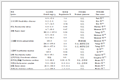
红外光谱数据导入OMNIC软件进行分析,根据吸收峰可将有机质分为四类(表 1)。用脂肪族碳与芳香族碳的比例来表征脂族化程度。低脂族化程度表明土壤中芳香族环状结构较为丰富,其分子结构较为复杂,这通常会增强土壤有机质的稳定性[16]。
|
表 1 官能团吸收峰分类 Table 1 Classification of functional group absorption peaks |
采用水土振荡法提取DOM[21],取3 g风干土按照固液比1︰10与超纯水混合,220 r·min–1振荡24 h后4 000 r·min–1离心30 min,取上清液过0.45 μm滤膜过滤,得到的滤液即为DOM溶液。
使用日立F-7100分光光度计对DOM样品的荧光光谱进行测量,设置激发波长(Ex)在200至500 nm,以5 nm为增量;发射波长(Em)在200至550 nm,增量为4 nm。测量过程的扫描速度设定为12 000 nm·min–1,狭缝宽度固定在5 nm。
通过MATLAB软件配合Delaunnay三角插值对土样荧光数据进行预处理,消除瑞利散射线和拉曼散射。利用DOM Fluor和dr EEM软件包对荧光光谱数据进行平行因子分析(Parallel Factor Analysis,PARAFAC)[22]。为验证PARAFAC模型的准确度,采用半分裂方法和残差检验评估模型可靠性,从而精确确定合适的荧光组分数。此外,利用荧光指数(FI)、自生源指数(BIX)和腐殖化指数(HIX)表征DOM来源的变化[23-24]。
1.5 数据分析利用Microsoft Excel 2019软件进行数据计算,SPSS 27软件进行显著性分析,使用Orign 2021绘图。
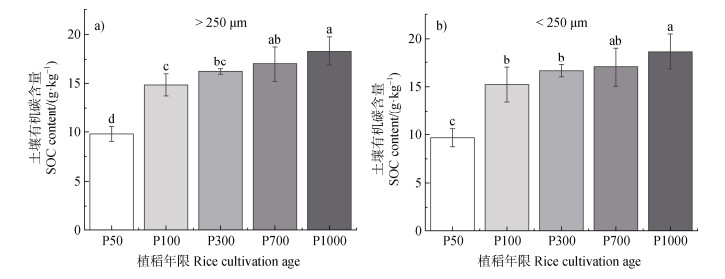
2 结果 2.1 长期植稻下不同粒径团聚体中有机碳含量的变化大团聚体和微团聚体中的有机碳(SOC)含量随着植稻年限的增加呈现出相似的变化趋势,且两者之间没有显著差异(P < 0.05),均在植稻100年前,SOC含量快速提高,之后增长速率减缓。大团聚体和微团聚体中的SOC含量从9.80和9.67 g·kg–1快速增至14.83和15.23 g·kg–1,之后逐渐增至18.28和18.66 g·kg–1(图 1)。
|
注:图中误差线为标准差;不同小写字母表示不同植稻年限间差异显著(P < 0.05)。下同。 Note:Error bars indicate standard deviation. Different lowercase letters indicate a significant difference between ages(P < 0.05). The same below. 图 1 不同粒径团聚体有机碳含量随植稻年限的变化 Fig. 1 Changes in SOC content of different size aggregates with rice cultivation ages |
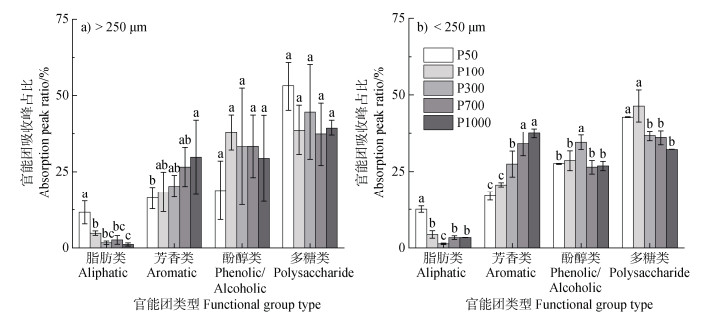
不同粒径团聚体中,多糖类SOM的相对含量最高,大团聚体为37%~53%,微团聚体为32%~46%;其次芳香族类SOM,大团聚体和微团聚体中分别占16%~30%、17%~38%;酚醇类SOM组分分别占10%~38%、26%~35%,而脂肪族类SOM组分的相对含量最低,分别占1%~12%和1%~13%(图 2)。
|
图 2 不同粒径团聚体中有机质官能团相对丰度随植稻年限的变化 Fig. 2 Changes in relative abundance of SOC functional groups in different size aggregates with rice cultivation ages |
随着植稻年限的增加,不同粒径团聚体中SOM分子组成变化基本一致。酚醇类SOM组分相对含量保持稳定;多糖类SOM组分在大团聚体中保持稳定,但在微团聚体中在植稻100年后显著降至36%后趋于稳定。脂肪族类SOM组分随植稻年限增加由12%和13%均快速降至1%,而芳香族类SOM组分随植稻年限增加由16%和17%逐渐增至30%和38%。
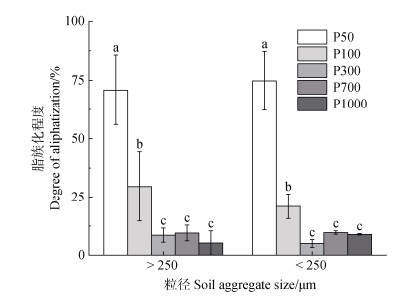
长期种植水稻下大团聚体和微团聚体的脂族化程度变化规律相同(图 3)。在种植水稻50年时,大团聚体和微团聚体脂族化程度最高分别为71%和75%。随着种植水稻年限的增加,脂族化程度在植稻1 000年时达到最小,分别为5%和8%。
|
图 3 不同粒径团聚体脂族化程度随植稻年限的变化 Fig. 3 Changes in aliphatization of different size aggregates with rice cultivation ages |
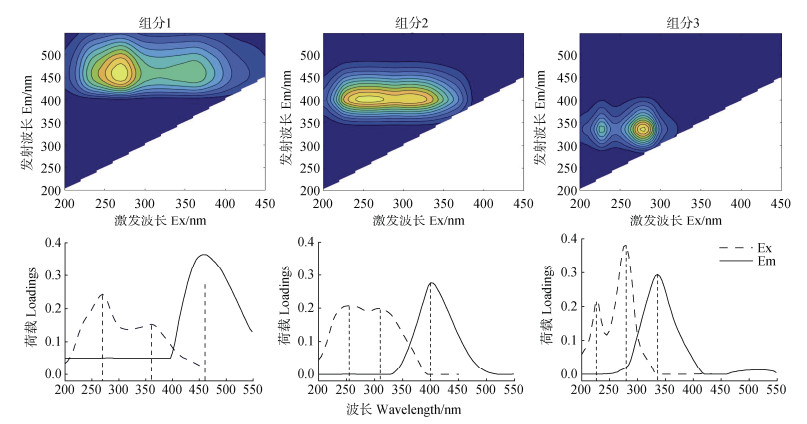
通过PARAFAC分析发现不同植稻年限土壤团聚体中主要存在三种SOM有机分子(图 4)。其中,C1组分分子量较大,是芳构化程度高的类胡敏酸结构[25–27]。C2组分相对分子质量大,是生物可降解性低的类富里酸[28-29]。C3组分为类色氨酸物质[30],可作为指示蛋白质结构特征的标志[31]。
|
图 4 通过PARAFAC模型识别出的三种DOM组分的激发-发射矩阵(EEMs)位置和荷载 Fig. 4 Excitation-emission matrix(EEMs)locations and loadings for the three DOM components identified by the PARAFAC model |
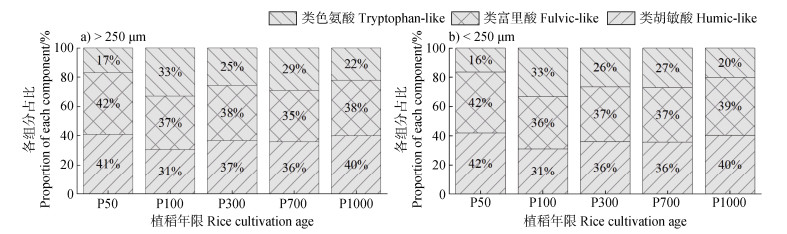
在不同粒径团聚体中,类色氨酸DOM相对含量在植稻50~100年间从16%~17%上升至33%,植稻100年后又逐渐下降至20%~22%;类富里酸和类胡敏酸DOM在植稻50~100年间分别从41%~42%降至36%~37%和31%,但在植稻100年后,类富里酸DOM相对含量处于动态平衡状态,而类胡敏酸在植稻100~300年显著增加至36%~37%后保持稳定(图 5)。
|
图 5 不同粒径团聚体中DOM分子组成相对丰度随植稻年限的变化 Fig. 5 Changes in the relative abundance of DOM components in different size aggregates with rice cultivation ages |
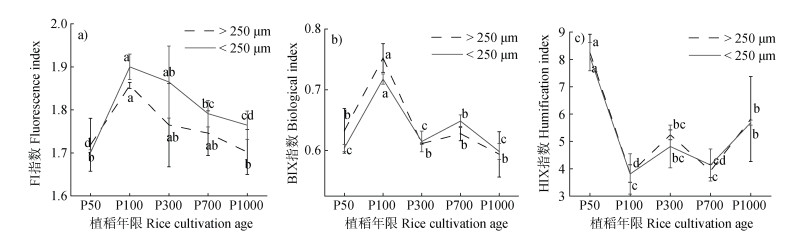
大团聚体DOM中FI均值为1.76(1.66~1.88),为外源和自生源混合特征,植稻100年时最高,在植稻50年和1 000年时最低。BIX数均值为0.64(0.57~0.77),在植稻100年时达到最大值,其余植稻年限稳定在0.6左右。HIX均值为5.41(3.46~9.01),在植稻100年时最小。微团聚体DOM的FI值变化趋势与大团聚体相似:FI均值为1.80(1.69~1.95),BIX均值为0.64(0.59~0.73),HIX均值为5.31(3.07~8.62)(图 6)。
|
图 6 不同粒径团聚体荧光光谱指数随植稻年限的变化 Fig. 6 Changes in fluorescence spectral index in different size aggregates with rice cultivation ages |
长期植稻下,各粒径团聚体中脂肪族类SOM均呈现下降趋势,而芳香族类SOM则逐步上升(图 2)。这是因为脂肪族类SOM可作为微生物的主要碳源被分解利用[32]。而芳香族类SOM具有较高的化学稳定性且难被降解,有助于其长期固持[33]。周萍等[34]利用核磁共振技术分析发现,稻田土壤团聚体中的芳香类SOM含量会逐渐积累。各粒径团聚体中酚醇类SOM随植稻时间的变化均不显著,可能是因为其分解和转化速率维持动态平衡。此外,大团聚体中的多糖类SOM随植稻年限没有显著变化,但小团聚体中多糖类SOM显著下降(图 2a),可能是因为微团聚体比表面积相对较大,吸附能力也较强,附着的多糖类SOM提高了微生物的捕食效率,导致多糖含量比例的下降[35]。
通过对长期植稻下不同粒径团聚体DOM分子组成分析后发现,类胡敏酸和富里酸DOM呈现先下降后上升趋势(图 5)。这主要是因为在滩涂开垦的早期阶段,农业活动加剧了两类比较稳定的DOM的分解[36]。而且大量植物残体的输入导致微生物的快速增殖,加速了胡敏酸和富里酸等有机大分子的分解[4]。当继续植稻超过100年,持续的有机质输入足以满足土壤微生物的需求,促使类胡敏酸和富里酸DOM开始逐渐积累(图 5)。随着时间的推移,长期的淹水厌氧环境为类胡敏酸和类富里酸持续积累创建了有利条件[37]。但色氨酸类DOM表现出先增后减的动态规律。植稻初期有机物的输入促进了微生物的增长,类色氨酸DOM作为代谢产物随着微生物丰度的增加而提升(图 5)。随着植稻时间的延长,土壤环境和微生物群落结构逐渐稳定[38],微生物开始有效地同化色氨酸这类小分子物质,同时减少对结构更加复杂稳定的类胡敏酸和富里酸的利用[25]。
3.2 土壤团聚体有机质随植稻年限积累的分子机制长期植稻过程中,不同粒径的土壤团聚体中有机碳随水稻种植年限的增加逐渐积累(图 1)。团聚体可以通过物理保护作用包裹作物残留物,减少被分解的风险,延长其滞留时间,从而促进了团聚体中有机碳的积累。微团聚体除了物理保护之外,由于其较大的比表面积,还对小分子有机质有较强的化学吸附作用,因而微团聚体较大团聚体的有机质积累作用更强一些(图 1)。此外,长期种植水稻的持续耕作和施肥提高了土壤微生物丰度,从而也会提升团聚体中的微生物生物量碳[39]。
随着植稻年限的增加,SOM脂族化程度逐渐降低,具体表现为脂肪族类SOM下降而芳香族类SOM增加(图 2)。这主要是因为化学结构相对简单的脂肪族类SOM被微生物和酶分解转化为更为稳定的芳香族类SOM[40],而芳香族类SOM的逐渐增加,正是稻田土壤SOM不断积累的物质基础[41]。然而,在植稻1 000年间,大团聚体和微团聚体中SOM组分的丰度并没有表现出显著差异(图 2)。这一结果进一步证实了大团聚体是微团聚体的弱结合,大团聚体对有机质的保护作用主要通过微团聚体起主要作用[5]。
作为SOM中最活跃的部分,DOM是土壤微生物活动的能源和土壤养分周转的驱动力[42]。本研究通过对千年尺度水稻土壤时间序列的DOM进行PARAFAC分析和计算荧光光谱指数发现:在植稻初期(< 50年),FI值和BIX值均最小(图 6),表明此时水稻及其他植物(残体和根系分泌物等)和其他外源性输入(有机肥或其他有机物料等)占主导地位;而HIX值最大,且类胡敏酸和类富里酸DOM相对含量较高,类色氨酸相对含量较少(图 5和图 6),表明这一时间腐殖化程度已经较高。在植稻初期,土壤微生物丰度相对较低[4],但由于持续的外源碳输入导致微生物有大量容易利用的碳源,而不必去矿化性质稳定的腐殖质类DOM,进而导致腐殖质类DOM相对较高。植稻100年后,FI值和BIX值均达到最大(图 6),说明经过一个世纪的水稻种植,微生物代谢等内源性过程产生的有机组分显著积累。这与此前对微生物丰度演变过程的研究结果相一致,微生物细菌丰度在植稻100年后达到最大值[4],因而会产生较多的微生物代谢物,出现新近自生源特征[43]。这些类色氨酸新近自生源物质相对积累,导致了HIX指数的下降,类胡敏酸和富里酸DOM相对较低,即腐殖化程度变低(图 5和图 6)。在此之后,随着土壤微生物群落结构和土壤环境的稳定,微生物主导的有机碳周转过程逐步转化成更为复杂稳定的腐殖化过程,类胡敏酸和类富里酸DOM含量上升,使得SOM持续积累,表现为HIX指数增加(图 6)。苏打盐碱型水稻土中DOM的相关研究也证实了这一点,类富里酸和腐殖物质以及含有不饱和双键的芳香族化合物含量均随种植年限的增加而增加[44]。与此同时,长期植稻引起的土壤养分限制和微生物代谢活性的变化,可能促使FI和BIX值下降,以及活性物质类色氨酸的下降(图 5和图 6)。因此,本研究结果可以进一步说明,稻田土壤中有机碳的积累,除了团聚体的物理保护和化学结合作用,微生物的转化为作用也是土壤有机碳积累的重要机制。
4 结论基于滩涂围垦形成的稻田时间序列,本研究发现随着植稻年限的增加,在土壤团聚体中有机碳持续积累的同时,不同粒径团聚体中有机质分子组成及可溶性有机质分子的差异并不大。土壤有机质中芳香类有机碳组分持续积累,但脂肪类有机质组分持续下降,酚醇类有机质组分保持相对稳定。而可溶性有机质中,色氨酸类物质在植稻100年内显著增加,类富里酸和胡敏酸类可溶性有机质在100年内显著下降,此后均保持相对稳定。由此可知,随着植稻年限的增加,微生物将类脂肪和色氨酸等活性有机物质转化为类芳香和富里酸及胡敏酸等稳定物质,促进了稻田有机碳的持续积累。进一步证实稻田土壤有机碳的积累不仅受团聚体的化学吸附和物理保护的作用,微生物的转化作用同样重要。
| [1] |
Zhang G L, Gong Z T. Classification of paddy soil as anthropogenic soil (In Chinese)[J]. Advances in Soil Science, 1991, 19(4): 30-36. [张甘霖, 龚子同. 水稻土作为人为土的分类研究[J]. 土壤学进展, 1991, 19(4): 30-36.]
(  0) 0) |
| [2] |
Liu Y L, Ge T D, Zhu Z K, et al. Carbon input and allocation by rice into paddy soils: A review[J]. Soil Biology & Biochemistry, 2019, 133: 97-107.
( 0) |
| [3] |
Liu Y L, Wang P, Cai G, et al. Divergent accumulation of microbial and plant necromass along paddy soil development in a millennium scale[J]. Soil & Tillage Research, 2023, 232: 105769.
( 0) |
| [4] |
Liu Y L, Wang P, Ding Y J, et al. Microbial activity promoted with organic carbon accumulation in macroaggregates of paddy soils under long-term rice cultivation[J]. Biogeosciences, 2016, 13(24): 6565-6586. DOI:10.5194/bg-13-6565-2016
( 0) |
| [5] |
Liu Y L, Wang P, Wang J K. Formation and stability mechanism of soil aggregates: Progress and prospect (In Chinese)[J]. Acta Pedologica Sinica, 2023, 60(3): 627-643. DOI:10.11766/trxb202112180686 [刘亚龙, 王萍, 汪景宽. 土壤团聚体的形成和稳定机制: 研究进展与展望[J]. 土壤学报, 2023, 60(3): 627-643.]
( 0) |
| [6] |
Xu W J, Cong Y H, Zhang Y L, et al. Distribution of organic carbon and particulate organic carbon in water-stable aggregates of paddy soil in black soil area (In Chinese)[J]. Journal of Soil and Water Conservation, 2016, 30(4): 210-215. [徐文静, 丛耀辉, 张玉玲, 等. 黑土区水稻土水稳性团聚体有机碳及其颗粒有机碳的分布特征[J]. 水土保持学报, 2016, 30(4): 210-215.]
( 0) |
| [7] |
Li X Y, Li B, Wang C Q, et al. Effects of long-term straw returning on organic carbon and extracellular enzymes in paddy soil aggregates (In Chinese)[J]. Acta Pedologica Sinica, 2024, 61(1): 235-246. DOI:10.11766/trxb202206170325 [李新悦, 李冰, 王昌全, 等. 长期秸秆还田对水稻土团聚体有机碳及胞外酶的影响[J]. 土壤学报, 2024, 61(1): 235-246.]
( 0) |
| [8] |
Xu J H, Sun Y, Gao L, et al. A review of the factors influencing soil organic carbon stability (In Chinese)[J]. Chinese Journal of Eco-Agriculture, 2018, 26(2): 222-230. [徐嘉晖, 孙颖, 高雷, 等. 土壤有机碳稳定性影响因素的研究进展[J]. 中国生态农业学报, 2018, 26(2): 222-230.]
( 0) |
| [9] |
Mai F S, Li X W, Lü R, et al. Adsorption and sequestration of soil-dissolved organic matter by ferrihydrite (In Chinese)[J]. Journal of Agro-Environment Science, 2024, 43(3): 627-635. [麦富生, 李晓雯, 吕睿, 等. 水铁矿对土壤溶解性有机质的吸附固持作用[J]. 农业环境科学学报, 2024, 43(3): 627-635.]
( 0) |
| [10] |
Wang H, Han S, Tang S, et al. Continuous multi-year application of Chinese milk vetch in paddy soil and its effect on soil aggregates distribution and their carbon and nitrogen content (In Chinese)[J]. Acta Pedologica Sinica, 2023, 60(3): 868-880. DOI:10.11766/trxb202106090303 [王慧, 韩上, 唐杉, 等. 紫云英翻压还田对稻田土壤团聚体组成及其碳氮的影响[J]. 土壤学报, 2023, 60(3): 868-880.]
( 0) |
| [11] |
Xue B, Huang L, Huang Y N, et al. Effects of organic carbon and iron oxides on soil aggregate stability under different tillage systems in a rice–rape cropping system[J]. Catena, 2019, 177: 1-12.
( 0) |
| [12] |
Liu J, Chen X F, Li D M, et al. Variation of soil dissolved organic carbon under long-term different fertilizations and its correlation with maize yields[J]. Journal of Soils and Sediments, 2020, 20(7): 2761-2770. DOI:10.1007/s11368-020-02631-1
( 0) |
| [13] |
Zhu Y C, Zhang M, Han X Z, et al. Evaluation of the soil aggregate stability under long term manure and chemical fertilizer applications: Insights from organic carbon and humic acid structure in aggregates[J]. Agriculture, Ecosystems & Environment, 2024, 376: 109217.
( 0) |
| [14] |
Kristiansen S M, Schjønning P, Thomsen I K, et al. Similarity of differently sized macro-aggregates in arable soils of different texture[J]. Geoderma, 2006, 137(1/2): 147-154.
( 0) |
| [15] |
Chang H D, Wang J, Zhang F H. Effects of continuous cropping with straw return on particulate organic carbon and Fourier transform infrared spectroscopy in cotton field (In Chinese)[J]. Chinese Journal of Applied Ecology, 2019, 30(4): 1218-1226. [常汉达, 王晶, 张凤华. 棉花长期连作结合秸秆还田对土壤颗粒有机碳及红外光谱特征的影响[J]. 应用生态学报, 2019, 30(4): 1218-1226.]
( 0) |
| [16] |
Spaccini R, Mbagwu J S C, Conte P, et al. Changes of humic substances characteristics from forested to cultivated soils in Ethiopia[J]. Geoderma, 2006, 132(1/2): 9-19.
( 0) |
| [17] |
Stevenson F J. Humus chemistry: Genesis, composition, reactions . 2nd ed[M]. New York: Wiley, 1994.
( 0) |
| [18] |
Tivet F, de Moraes Sá J C, Lal R, et al. Assessing humification and organic C compounds by laser-induced fluorescence and FTIR spectroscopies under conventional and no-till management in Brazilian Oxisols[J]. Geoderma, 2013, 207: 71-81.
( 0) |
| [19] |
Madari B E, Reeves J B, Machado P L O A, et al. Mid- and near-infrared spectroscopic assessment of soil compositional parameters and structural indices in two Ferralsols[J]. Geoderma, 2006, 136(1/2): 245-259.
( 0) |
| [20] |
Ellerbrock R H, Kaiser M. Stability and composition of different soluble soil organic matter fractions–evidence from δ 13C and FTIR signatures[J]. Geoderma, 2005, 128(1/2): 28-37.
( 0) |
| [21] |
Fan T T, Yao X, Sun Z L, et al. Properties and metal binding behaviors of sediment dissolved organic matter(SDOM)in lakes with different trophic states along the Yangtze River Basin: A comparison and summary[J]. Water Research, 2023, 231: 119605. DOI:10.1016/j.watres.2023.119605
( 0) |
| [22] |
Shi C Q, Li Y, Hu Y, et al. Fluorescence spectral characteristics of soil dissolved organic matter in the river wetland of northern cold region, China (In Chinese)[J]. Spectroscopy and Spectral Analysis, 2023, 43(5): 1517-1523. [史传奇, 李艳, 胡钰, 等. 北方寒区河流湿地土壤溶解性有机质荧光光谱特征[J]. 光谱学与光谱分析, 2023, 43(5): 1517-1523.]
( 0) |
| [23] |
Huguet A, Vacher L, Relexans S, et al. Properties of fluorescent dissolved organic matter in the Gironde Estuary[J]. Organic Geochemistry, 2009, 40(6): 706-719. DOI:10.1016/j.orggeochem.2009.03.002
( 0) |
| [24] |
Inamdar S, Finger N, Singh S, et al. Dissolved organic matter(DOM)concentration and quality in a forested mid-Atlantic watershed, USA[J]. Biogeochemistry, 2012, 108(1): 55-76.
( 0) |
| [25] |
Wen Y L, Xiao J, Goodman B A, et al. Effects of organic amendments on the transformation of Fe(oxyhydr)oxides and soil organic carbon storage[J]. Frontiers in Earth Science, 2019, 7: 257. DOI:10.3389/feart.2019.00257
( 0) |
| [26] |
Li Y, Bai Y, Wei D, et al. Fluorescence spectrum characteristics of fulvic acid in black soil under different ratios of organic-inorganic fertilizers combined application (In Chinese)[J]. Spectroscopy and Spectral Analysis, 2021, 41(11): 3518-3523. [李艳, 白杨, 魏丹, 等. 不同比例有机无机肥配施条件下黑土富里酸荧光光谱特征[J]. 光谱学与光谱分析, 2021, 41(11): 3518-3523.]
( 0) |
| [27] |
Li W, Jia X X, Li M, et al. Insight into the vertical characteristics of dissolved organic matter in 5-m soil profiles under different land-use types on the Loess Plateau[J]. Science of the Total Environment, 2019, 692: 613-621. DOI:10.1016/j.scitotenv.2019.07.339
( 0) |
| [28] |
Stedmon C A, Markager S, Bro R. Tracing dissolved organic matter in aquatic environments using a new approach to fluorescence spectroscopy[J]. Marine Chemistry, 2003, 82(3/4): 239-254.
( 0) |
| [29] |
Ishii S K L, Boyer T H. Behavior of reoccurring PARAFAC components in fluorescent dissolved organic matter in natural and engineered systems: A critical review[J]. Environmental Science & Technology, 2012, 46(4): 2006-2017.
( 0) |
| [30] |
Cao J R, Gong K Y, Bie Y J, et al. Analysis of dynamics of soil dissolved carbon and nitrogen fractions and its three-dimensional fluorescence characteristics during restoration of soil and water conservation forests (In Chinese)[J]. Acta Ecologica Sinica, 2021, 41(19): 7679-7688. [曹佳锐, 龚可杨, 别宇静, 等. 水土保持林恢复土壤可溶性碳氮组分动态与三维荧光特征分析[J]. 生态学报, 2021, 41(19): 7679-7688.]
( 0) |
| [31] |
Stedmon C A, Markager S. Resolving the variability in dissolved organic matter fluorescence in a temperate estuary and its catchment using PARAFAC analysis[J]. Limnology and Oceanography, 2005, 50(2): 686-697. DOI:10.4319/lo.2005.50.2.0686
( 0) |
| [32] |
Pan G X, Ding Y J, Chen S T, et al. Exploring the nature of soil organic matter from humic substances isolation to SOMics of molecular assemblage (In Chinese)[J]. Advances in Earth Science, 2019, 34(5): 451-470. [潘根兴, 丁元君, 陈硕桐, 等. 从土壤腐殖质分组到分子有机质组学认识土壤有机质本质[J]. 地球科学进展, 2019, 34(5): 451-470.]
( 0) |
| [33] |
Sui P X, Luo Y, Zheng H B, et al. Effects of long-term tillage practices on the stability of soil aggregates and organic carbon in black soil farmland (In Chinese)[J]. Chinese Journal of Applied Ecology, 2023, 34(7): 1853-1861. [隋鹏祥, 罗洋, 郑洪兵, 等. 长期耕作对农田黑土团聚体和有机碳稳定性的影响[J]. 应用生态学报, 2023, 34(7): 1853-1861.]
( 0) |
| [34] |
Zhou P, Piccolo A, Pan G X, et al. Soc enhancement in three major types of paddy soils in a long-term agro-ecosystem experiment in south China Ш. Structural variation of particulate organic matter of two paddy soils (In Chinese)[J]. Acta Pedologica Sinica, 2009, 46(3): 398-405. DOI:10.11766/trxb200704230304 [周萍, Alessandro Piccolo, 潘根兴, 等. 三种南方典型水稻土长期试验下有机碳积累机制研究Ⅲ. 两种水稻土颗粒有机质结构特征的变化[J]. 土壤学报, 2009, 46(3): 398-405.]
( 0) |
| [35] |
Zhang J C, Liu Y Y, He H Z, et al. Research advances on mechanism of organic carbon sequestration in soil aggregates (In Chinese)[J]. Fujian Journal of Agricultural Sciences, 2016, 31(3): 319-325. [张家春, 刘盈盈, 贺红早, 等. 土壤团聚体与有机碳固定关系研究进展[J]. 福建农业学报, 2016, 31(3): 319-325.]
( 0) |
| [36] |
Kölbl A, Schad P, Jahn R, et al. Accelerated soil formation due to paddy management on marshlands(Zhejiang Province, China)[J]. Geoderma, 2014, 228: 67-89.
( 0) |
| [37] |
Liu S N, Zhao L P. Effects of different rice cultivation years on humus content and composition of soda saline-alkaline soil[J]. Journal of Jilin Agricultural University, 2018, 40(6): 707-715.
( 0) |
| [38] |
Liu Y L, Wang P, Pan G X, et al. Functional and structural responses of bacterial and fungal communities from paddy fields following long-term rice cultivation[J]. Journal of Soils and Sediments, 2016, 16(5): 1460-1471. DOI:10.1007/s11368-015-1343-8
( 0) |
| [39] |
Wang P, Liu Y L, Li L Q, et al. Long-term rice cultivation stabilizes soil organic carbon and promotes soil microbial activity in a salt marsh derived soil chronosequence[J]. Scientific Reports, 2015, 5: 15704. DOI:10.1038/srep15704
( 0) |
| [40] |
Kamimura N, Sakamoto S, Mitsuda N, et al. Advances in microbial lignin degradation and its applications[J]. Current Opinion in Biotechnology, 2019, 56: 179-186. DOI:10.1016/j.copbio.2018.11.011
( 0) |
| [41] |
Bagheri Novair S, Cheraghi M, Faramarzi F, et al. Reviewing the role of biochar in paddy soils: An agricultural and environmental perspective[J]. Ecotoxicology and Environmental Safety, 2023, 263: 115228. DOI:10.1016/j.ecoenv.2023.115228
( 0) |
| [42] |
Liu D, Du Y X, Yu S J, et al. Human activities determine quantity and composition of dissolved organic matter in lakes along the Yangtze River[J]. Water Research, 2020, 168: 115132. DOI:10.1016/j.watres.2019.115132
( 0) |
| [43] |
Wang J, Zhuang S Y, Zhu Z L. Soil organic nitrogen composition and mineralization of paddy soils in a cultivation chronosequence in China[J]. Journal of Soils and Sediments, 2017, 17(6): 1588-1598. DOI:10.1007/s11368-016-1629-5
( 0) |
| [44] |
Li Y N, Wu J N, Gao Q, et al. Three-dimensional fluorescence spectral characteristics of water extractable organic matter in soda saline-alkaline paddysoil with different planting years of rice (In Chinese)[J]. Journal of South China Agricultural University, 2017, 38(1): 44-49. [李亚男, 武俊男, 高强, 等. 不同种植年限苏打盐碱型水稻土水溶性有机物三维荧光光谱特征分析[J]. 华南农业大学学报, 2017, 38(1): 44-49.]
( 0) |