 2018, Vol. 55


作物秸秆作为农作物最主要的副产品,含有大量有机质和丰富的氮、磷、钾等营养元素[1]。秸秆还田是增加农田土壤有机碳的重要途径之一,可以改善农田土壤理化性状,提高土壤质量和养分循环利用效率,增加作物产量,是农田生态系统中物质循环和再利用的良好形式,在农业生产中已广泛应用[2]。但是,在秸秆还田利用方面存在较多问题,如秸秆腐解难、利用率低,产生还原性有毒物质,易发生与作物争氮和诱发病虫害等现象[3],从而影响作物生长发育和土壤质量的转变方向与强度。因此,如何优化作物秸秆利用方式,缓解秸秆还田对作物生长和生态环境的负面影响,对保障我国粮食安全和土壤质量提高具有重要意义。
在秸秆还田过程中,不同利用方式对秸秆腐解、水稻生产发育的影响不同[4]。目前,农业生产中秸秆还田常与耕作措施配合实施,不仅可以改善土壤的水、肥、气、热状况,同时还可以增加作物产量,并能够提高良好的生态、社会及经济效益,是确保农业可持续发展的有效措施和重要途径[5]。田慎重等[6]研究了不同耕作方式和秸秆还田对麦田土壤有机碳含量的影响,表明秸秆还田下各耕作方式土壤有机碳均显著提高,但不同耕作方式存在显著差异。赵亚丽等[7]表明,与常规耕作秸秆不还田相比,秸秆还田后深耕和深松均提高冬小麦和夏玉米成熟期干物质积累,周年产量也分别增加18.0%和19.3%。虽然秸秆还田与耕作措施配合实施对农田土壤和作物产量的研究较多[8-10],但主要集中在旱地或者稻麦轮作系统,而在双季稻系统中研究较少。
双季稻种植模式是中国南方稻区重要的农业生产模式,秸秆资源丰富且相对集中。然而,针对南方双季稻区秸秆还田与耕作制度的最佳组合方式目前并不明确。为此,本文通过秸秆全量还田条件下设置不同耕作方式,旨在研究耕作方式和秸秆还田对水稻生长发育、产量及对土壤理化性质的影响,为实现南方双季稻区秸秆合理利用、水稻高产和提高农田土壤质量提供科学依据。
1 材料与方法 1.1 试验区概况试验地点位于江西省进贤县温圳镇杨溪村(116°5'28"E,28°20'10"N)。供试土壤为第四纪红色黏土发育的潴育型水稻土(酸性简育水耕人为土)。试验前0~20 cm耕层土壤有机碳含量21.8 g kg-1,全氮3.74 g kg-1,有效磷24.5 mg kg-1,速效钾98.0 mg kg-1,pH 5.31。
1.2 试验设计试验时间为2012年11月至2015年11月。试验设计4种处理方式,(1)翻耕与秸秆不还田(CT):水稻收获后秸秆全部移出田间,水稻抛秧前用铧式犁翻地1遍,再用旋耕机旋地2遍,耕深约15 cm;(2)翻耕与秸秆还田(CTS):水稻收获后秸秆粉碎全量还田,水稻抛秧前用铧式犁翻地1遍,再用旋耕机旋地2遍,耕深约15cm;(3)旋耕与秸秆还田(RTS):水稻收获后秸秆粉碎全量还田,水稻抛秧前用旋耕机旋地4遍,耕深约8 cm;(4)免耕与秸秆还田(NTS):水稻收获后秸秆全量粉碎覆盖还田,不进行整地,水稻免耕抛秧。每个处理分别设3次重复,各小区面积均为54 m2,随机区组排列。双季稻种植供试早稻和晚稻品种分别为中嘉早17和五丰优T025,水分管理及其他大田栽培措施均按高产技术规程[11]进行。
本试验中氮肥、磷肥和钾肥分别为尿素(含N 46.4%)、过磷酸钙(含P2O5 12%)和氯化钾(含K2O 60%)。早稻N、P2O5和K2O用量分别为150 kg hm-2、75 kg hm-2和135 kg hm-2,其中氮肥按基肥:分蘖肥:穗肥=5:2:3施用,磷肥做基肥一次性施用,钾肥按基肥:穗肥=7:3施用。晚稻N、P2O5和K2O用量分别为180 kg hm-2、75 kg hm-2和150 kg hm-2,其中氮肥按基肥:分蘖肥:穗肥=4:2:4施用,磷肥和钾肥施用比例同早稻。试验前稻田为当地常规双季稻生产区,于2012年冬季开始至2015年晚稻收获结束,开展为期三年的定位试验研究。秸秆采用全量还田方式,水稻秸秆由久保田半喂入式联合收割机收割水稻时同步进行粉碎,其切割长度为5 cm左右。早稻收获后,将各小区水稻秸秆粉碎施入相应小区中作晚稻基肥,晚稻收获后各小区水稻秸秆粉碎施入相应小区表层作次年早稻基肥。
1.3 测定项目及方法产量及其构成因素:在成熟期,每处理调查3个重复,每重复调查100蔸有效穗数。按平均有效穗选取考种样,每小区分别取样5蔸,调查每穗粒数、结实率及千粒重。每小区选取6 m2进行实际测产。
茎蘖动态:水稻移栽后每小区定点20蔸,每5天调查一次茎蘖数,直至抽穗期。
土壤理化性状测定:晚稻成熟收获期进行土壤采集,各小区按S形路线随机取5个点的土样,采样深度为0~20 cm。土样充分混匀后拣去植物残根和石砾等,经风干、磨碎过筛,按照《土壤农化分析》[12]进行土壤容重、pH、全氮、有效磷、速效钾和有机碳等的测定。
基于主成分分析的土壤质量评价研究[13-14]:对不同年份不同处理的6个土壤理化性状指标(容重、pH、全氮、有效磷、速效钾和有机碳)组成矩阵进行主成分分析,选取累计百分率≥85%的主成分因子,选取主成分的特征向量构建主成分方程计算出各处理各因子主成分分值,再用各公因子的特征值贡献率作为权数进行加权求和,即得各处理土壤质量综合得分。
1.4 数据处理试验数据均采用Microsoft Excel 2010和DPS 7.05软件进行分析和处理,方差分析采用最小显著差异法(LSD)多重比较。
2 结果 2.1 秸秆还田与耕作方式对双季稻产量及其构成因素的影响与CT处理相比,2013-2015年CTS处理早稻和晚稻平均产量分别增加3.6%和3.8%。与CTS处理相比,NTS处理早稻和晚稻平均产量分别降低5.2%和6.4%,其中,晚稻产量显著降低;相反,RTS处理早稻和晚稻平均产量分别增加6.1%和3.1%(表 1)。

|
表 1 秸秆还田条件下不同耕作方式的产量及其构成因素 Table 1 Grain yield and yield components in paddy fields incorporated with rice straw, relative to tillage pattern |
与CT处理相比,2013-2015年CTS处理早稻平均有效穗数增加2.3%,但晚稻平均有效穗数降低4.0%,其中2014年显著低于CT处理。与CTS处理相比,RTS处理早稻和晚稻平均有效穗数分别增加3.9%和1.3%(除2015年晚稻外);NTS处理早稻和晚稻平均有效穗数分别降低5.8%和7.9%,其中2013年和2015年有效穗数显著降低(p<0.05)。
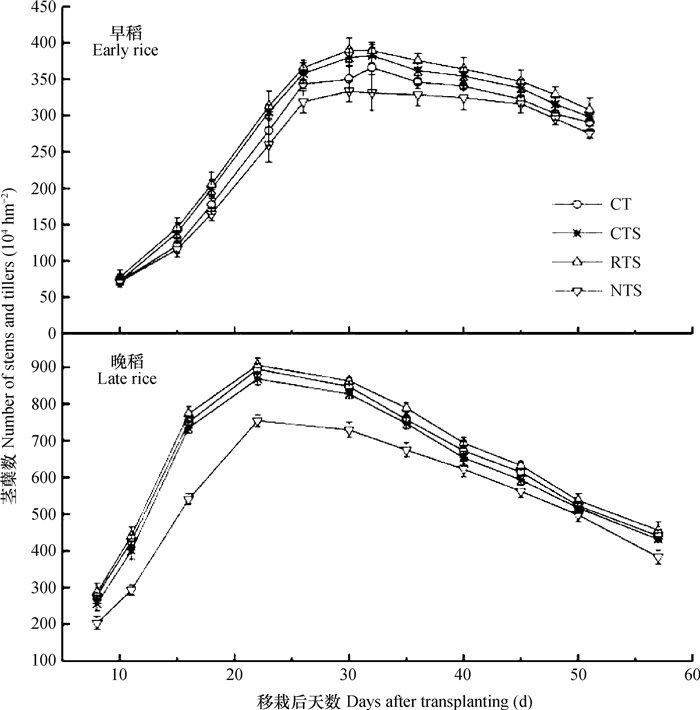
2.2 秸秆还田与耕作方式对双季稻茎蘖动态的影响秸秆还田对早稻和晚稻茎蘖动态的影响不同(图 1)。与CT处理相比,早稻CTS处理群体分蘖能力强,高峰苗数增加,而无效分蘖多,成穗率降低,群体最终有效穗数仍然高;而晚稻中,与CT处理相比,CTS处理群体分蘖能力弱,高峰苗数减少,而无效分蘖少,成穗率增加,最终群体有效穗数降低。
|
图 1 秸秆还田条件下不同耕作方式水稻茎蘖动态变化(以2013年为例) Fig. 1 Dynamics of rice tillering in paddy fields incorporated with rice straw, relative to tillage pattern(in 2013) |
在秸秆还田下,不同耕作方式早稻和晚稻茎蘖动态变化趋势一致,RTS和CTS处理移栽后分蘖能力高于NTS处理,早稻和晚稻高峰苗数均增加,而RTS和CTS处理早稻和晚稻分蘖下降较为迅速,但由于高峰苗数多,最终RTS和CTS处理群体有效穗数均高于NTS。
2.3 秸秆还田与耕作方式对双季稻土壤理化性质的影响2013年,各处理间土壤各项指标均无显著差异(p>0.05,表 2)。2013-2015年,CT处理土壤有机碳(SOC)和全氮(TN)、有效磷(AP)和速效钾(AK)含量呈降低趋势,相反,CTS、RTS和NTS处理SOC、TN、AP和AK含量显著增加。CT处理土壤容重无显著变化,而秸秆还田下各处理土壤容重均呈现降低趋势。
|
|
表 2 秸秆还田条件下不同耕作方式对土壤理化性状的影响 Table 2 Soil physical and chemical properties of the field incorporated with rice straw relative to tiilage patern |
2015年,与CT处理相比,CTS处理土壤SOC、TN、AP和AK含量分别增加9.7%、7.5%、24.8%和28.7%(p<0.05)。与CTS处理相比,NTS处理土壤SOC、TN、AP和AK含量分别降低3.0%、0.8%、3.1%和6.5%,而RTS处理分别增加1.3%、0.5%、1.7%和4.4%。与CT相比,CTS处理土壤容重(BD)降低4.1%;与CTS相比,NT处理BD增加9.7%(p<0.05),而RTS处理BD降低1.1%。与CT相比,CTS处理土壤pH降低1.9%(p<0.05);与CTS相比,NT处理土壤pH降低0.6%,而RTS处理土壤pH增加0.4%。
2.4 双季稻田土壤肥力质量评价本文分别选择BD、pH、AP、AK、SOC和TN等6个指标衡量土壤肥力质量状况。将累积贡献百分率≥85%作为提取原则,得到2个主成分,累积贡献率为96.69%(表 3),因子1和因子2的特征值分别为4.642和1.160,贡献率分别为77.36%和19.33%。第1主成分因子(F1)与AP、AK、SOC及TN等指标上的载荷系数较大,可以设为土壤养分因子;第2主成分因子(F2)在BD和pH的载荷系数最大,该主成分可认定为土壤容重因子和pH因子。
|
|
表 3 土壤肥力质量性状的主成分提取及旋转因子载荷矩阵 Table 3 Principal component extraction and rotated component matrix of soil fertility quality |
通过因子1和因子2得分与各因子的特征值百分率作为权数进行加权求和计算得出土壤肥力质量得分(表 4)。2013-2015年,CT处理土壤肥力质量呈下降趋势,秸秆还田条件下各处理土壤肥力质量均呈增加趋势,其中,2015年RTS处理分别高于CTS和NTS处理16.4%和80.4%。
|
|
表 4 各因子得分及土壤肥力质量得分 Table 4 Scores of principal components and general scores of soil fertility quality relative to treatment |
秸秆还田是农业生产过程中重要的有机肥来源之一,大多数研究者认为秸秆还田利于提高作物产量[6, 15]。本研究也表明,与秸秆不还田相比,秸秆还田处理早稻和晚稻三年平均增产分别为3.6%和3.8%。秸秆还田对土壤质量提升有积极影响,有效增加土壤全氮、有效磷、速效钾和有机碳含量,而秸秆不还田条件下土壤肥力质量呈下降趋势。但在本研究条件下,秸秆还田后不同耕作方式对产量的影响显著。结果表明,与常规翻耕相比,秸秆还田条件下免耕处理早稻和晚稻平均产量分别降低5.2%和6.4%,其中,晚稻产量显著降低(p<0.05);相反,旋耕处理早稻和晚稻平均产量分别增加6.1%和3.1%。这与许菁等[16]和陈敏等[17]研究结果相似,可能因为耕作方式改变了土壤肥力质量从而影响作物生长发育状况。
在秸秆还田条件下,旋耕和常规翻耕均能有效改良土壤[8],但是翻耕处理土壤耕层较深,土温和土壤含水率较低,秸秆还田腐解速度下降,旋耕处理土壤养分含量提升幅度高于常规耕作[18]。姬强等[19]研究认为,秸秆还田条件下,与传统耕作相比旋耕土壤矿质结合态有机碳提高23.0%,对土壤颗粒有机碳的影响也表现同样规律。陈敏等[17]研究认为,旋耕处理土壤速效养分高于传统翻耕,土壤有效养分供应能力得到提高,土壤质量高是水稻高产的基础,因而旋耕达到增产作用。本研究结果与之相同,与常规翻耕处理相比,旋耕处理水稻茎蘖易早发快发,分蘖能力和有效穗数均高于常规翻耕,旋耕处理土壤养分含量也高于常规翻耕,最终得到高产。旋耕相对常规翻耕具有增产优势,是旋耕处理土壤肥力质量好的表现。
与传统耕作相比,在免耕与秸秆覆盖还田条件下,微生物种类与数量少,导致免耕秸秆腐解速度慢、利用效率低[20],秸秆氮素等养分渗漏损失成倍增加[21],同时,免耕处理土壤易板结,连续免耕土壤质量相对下降,水稻生长受到抑制,从而产量低于常规耕作[22]。本研究表明,免耕处理产量低于常规翻耕处理,产量下降主要受有效穗数的影响,早稻和晚稻有效穗数平均分别降低5.8%和7.9%,其中2013年和2015年显著降低。连续免耕土壤养分含量降低、容重显著增加以及土壤酸化加剧是导致免耕处理产量下降的主要原因。这与一些研究报道不同,吴建富等[23]研究认为稻田实行免耕前两年产量与翻耕无显著差异,之后免耕产量呈现下降趋势,这主要与连续免耕土壤物理性质变差、土壤养分在表层土壤富集不利于土壤水分的保持有关。莫亚丽[24]研究表明,短期连续免耕水稻产量高于常规翻耕,直至第5年免耕产量才呈现下降趋势。甚至还有连续免耕11年不减产的报道[25]。连续免耕作物产量降低存在年限差异,同时存在与之截然相反的免耕增产报道,这可能与不同土壤质量、生态环境、作物类型及栽培措施等相关,对此尚有待进一步研究。
3.2 耕作方式对南方双季稻区秸秆还田的影响中国南方双季稻区秸秆资源丰富,但在秸秆利用过程中存在一系列的问题,通过何种方式合理利用秸秆资源是目前南方双季稻生产最重要问题之一。何虎等[26]研究表明,水稻秸秆全量还田后配施适量氮肥可以提高晚稻产量,配施纯氮180 kg hm-2产量最高,其中,在总施氮量相同条件下,以基肥:分蘖肥:穗肥为5:2:3的施氮比例水稻产量最高,其可作为双季稻区秸秆全量还田后的推荐施氮比例。胡诚等[27]研究表明,在南方双季稻区秸秆还田配施秸秆腐熟剂可以提高双季稻产量,提高土壤肥力、改善土壤结构以及增加土壤腐殖质含量与活性。据张武益等[28]报道,与持续淹水处理相比,干湿交替灌溉能够有效缓解秸秆还田的负面影响,增加水稻后期干物质积累量和产量。本研究表明,通过耕作方式也可以合理有效地利用秸秆,在秸秆全量还田条件下旋耕处理在产量和土壤肥力质量方面表现优于翻耕和免耕处理。这与李静等[29]、汤文光等[30]研究结果较为一致。不同耕作方式下秸秆还田效益的差异,应与不同耕作方式下土壤环境如土壤结构及土壤微生物性状等不同有关[31]。耕作改变土壤的物理结构,影响稻秆在耕层土壤中的分布和数量,使秸秆腐解与利用不同,从而直接或间接影响土壤肥力和水稻生长发育[26, 28]。
3.3 主成分分析法对土壤肥力质量评价的有效性土壤质量综合评价是对目标土壤生产力等方面进行综合鉴定,近年来,对土壤质量评价的指标体系和评价方法开展了大量的研究工作,但迄今为止尚无统一的土壤质量评价方法,目前,研究者多采用主成分分析法来定量评价土壤质量[32]。本文采用主成分分析法对不同耕作制度进行评价发现,RTS处理土壤肥力质量综合得分和产量均表现最好,因此,采用主成分分析结果基本能够客观反映不同耕作模式的土壤肥力质量,有助于分析不同耕作措施对土壤肥力质量的影响。CT处理的土壤肥力质量综合得分表现最低,但产量表现并非最差,土壤肥力质量评价的高低并不能完全反映农田的真实生产力水平,且本试验仅对6个土壤理化指标进行综合评价,并未能体现出土壤肥力质量的完整信息,从而造成CT处理土壤肥力质量综合评价结果与作物生产力不一致。
4 结论在南方红壤双季稻区,秸秆还田能提高水稻产量和稻田土壤有机碳、全氮、有效磷和速效钾等含量,连续定位试验3年后显著提升稻田土壤肥力质量,但秸秆还田条件下不同耕作方式对水稻产量和土壤理化性质的影响存在差异。与常规耕作相比,旋耕处理早稻和晚稻平均产量分别增加6.1%和3.1%,而免耕处理早稻和晚稻平均产量分别降低5.2%和6.4%。秸秆还田条件下不同耕作方式土壤有机碳、全氮、有效磷和速效钾等含量以及土壤肥力质量均呈增加趋势,其中,旋耕处理土壤肥力质量高于常规翻耕和免耕处理。因此,秸秆还田条件下双季稻生产适宜采用机械旋耕的种植方式。
| [1] |
赵金花, 张丛志, 张佳宝. 激发式秸秆深还对土壤养分和冬小麦产量的影响. 土壤学报, 2016, 53(2): 438-449. Zhao J H, Zhang C Z, Zhang J B. Effect of straw returning via deep burial coupled with application of fertilizer as primer on soil nutrients and winter wheat yield (In Chinese). Acta Pedologica Sinica, 2016, 53(2): 438-449. (  0) 0) |
| [2] |
王晓波, 车威, 纪荣婷, 等. 秸秆还田和保护性耕作对砂姜黑土有机质和氮素养分的影响. 土壤, 2015, 47(3): 483-489. Wang X B, Che W, Ji R T, et al. Effects of straw returning and conservation tillage patterns on the contents of organic matterand nitrogen nutrient in the lime concretion black soil (In Chinese). Soils, 2015, 47(3): 483-489. ( 0) |
| [3] |
陈春兰, 侯海军, 秦红灵, 等. 南方双季稻区生物质炭还田模式生态效益评价. 农业资源与环境学报, 2016, 33(1): 80-91. Chen C L, Hou H J, Qin H L, et al. Emergy evaluation of a double rice system with biochar-returning in south China (In Chinese). Journal of Agricultural Resources and Environment, 2016, 33(1): 80-91. ( 0) |
| [4] |
Gwenzi W, Gotosa J, Chakanetsa S, et al. Effects of tillage systems on soil organic carbon dynamics, structural stability and crop yields in irrigated wheat(Triticum aestivum L.)rotation in semi-arid Zimbabwe . Nutrient Cycling in Agroecosystems, 2009, 83(3): 211-221. DOI:10.1007/s10705-008-9211-1
( 0) |
| [5] |
Malhi S S, Nyborg M, Goddard T, et al. Long-term tillage, straw and N rate effects on quantity and quality of organic C and N in a Gray Luvisol soil . Nutrient Cycling in Agroecosystems, 2011, 90(1): 1-20. DOI:10.1007/s10705-010-9399-8
( 0) |
| [6] |
田慎重, 宁堂原, 王瑜, 等. 不同耕作方式和秸秆还田对麦田土壤有机碳含量的影响. 应用生态学报, 2010, 21(2): 373-378. Tian S Z, Ning T Y, Wang Y, et al. Effects of different tillage methods and straw-returning on soil organic carbon content in a winter wheat field (In Chinese). Chinese Journal of Applied Ecology, 2010, 21(2): 373-378. ( 0) |
| [7] |
赵亚丽, 郭海斌, 薛志伟, 等. 耕作方式与秸秆还田对冬小麦-夏玉米轮作系统中干物质生产和水分利用效率的影响. 作物学报, 2014, 40(10): 1797-1807. Zhao Y L, Guo H B, Xue Z W, et al. Effects of tillage and straw returning on biomass and water use efficiency in a winter wheat and summer maize rotation system (In Chinese). Acta Agronomica Sinica, 2014, 40(10): 1797-1807. ( 0) |
| [8] |
朱利群, 张大伟, 卞新民. 连续秸秆还田与耕作方式轮换对稻麦轮作田土壤理化性状变化及水稻产量构成的影响. 土壤通报, 2011, 42(1): 81-85. Zhu L Q, Zhang D W, Bian X M. Effects of continuous returning straws to field and shifting different tillage methods on changes of physical-chemical properties of soil and yield components of rice (In Chinese). Chinese Journal of Soil Science, 2011, 42(1): 81-85. ( 0) |
| [9] |
王淑娟, 李有兵, 吴玉红, 等. 耕作措施与秸秆还田对小麦-玉米轮作体系土壤质量的影响. 干旱地区农业研究, 2015, 33(4): 8-15. Wang S J, Li Y B, Wu Y H, et al. Effects of tillage and residue management on soil quality in a wheat-maize cropping system(InChinese) (In Chinese). Agricultural Research in the Arid Areas, 2015, 33(4): 8-15. DOI:10.7606/j.issn.1000-7601.2015.04.02 ( 0) |
| [10] |
王丹丹, 周亮, 黄胜奇, 等. 耕作方式与秸秆还田对表层土壤活性有机碳组分与产量的短期影响. 农业环境科学学报, 2013, 32(4): 735-740. Wang DD, Zhou L, Huang S Q, et al. Short-term effects of tillage practices and wheat-straw returned to the field on topsoil labile organic carbon fractions and yields in central china (In Chinese). Journal of Agro-Environment Science, 2013, 32(4): 735-740. ( 0) |
| [11] |
潘晓华, 李木英, 曾勇军, 等. 江西双季稻主要种植方式及其配套栽培对策. 江西农业大学学报, 2013, 35(1): 1-6. Pan X H, Li M Y, Zeng Y J, et al. Main planting patterns and their relevant cultivation practices for the double rice in Jiangxi Province (In Chinese). Acta Agriculturae Universitatis Jiangxiensis, 2013, 35(1): 1-6. ( 0) |
| [12] |
鲍士旦. 土壤农化分析. 第三版. 北京: 中国农业出版社, 2000. BaoS D. Soil and agricultural chemistry analysis (In Chinese). 3rd ed. Beijing: China Agriculture Press, 2000. ( 0) |
| [13] |
吴玉红. 基于田块尺度的土壤质量评价指标体系及方法探讨. 陕西咸阳: 西北农林科技大学, 2010. Wu Y H. The study of soil quality indicators and its assessment based on field scale (In Chinese). Xianyang, Shaanxi: Northwest A & F University, 2010. ( 0) |
| [14] |
陈欢, 曹承富, 张存岭, 等. 基于主成分-聚类分析评价长期施肥对砂姜黑土肥力的影响. 土壤学报, 2014, 51(3): 609-617. Chen H, Cao C F, Zhang C L, et al. Principal component-cluster analysis of effects of long-term fertilization on fertility of lime concretion black soil (In Chinese). Acta Pedologica Sinica, 2014, 51(3): 609-617. ( 0) |
| [15] |
马超, 周静, 郑学博, 等. 秸秆促腐还田对土壤养分和小麦产量的影响. 土壤, 2012, 44(1): 30-35. Ma C, Zhou J, Zheng X B, et al. Effects of returning rice straw into field on soil nutrients and wheat yields under promoting decay condition (In Chinese). Soils, 2012, 44(1): 30-35. ( 0) |
| [16] |
许菁, 贺贞昆, 冯倩倩, 等. 耕作方式对冬小麦-夏玉米光合特性及周年产量形成的影响. 植物营养与肥料学报, 2017, 23(1): 101-109. Xu J, He Z K, Feng Q Q, et al. Effect of tillage method on photosynthetic characteristics and annual yield formation of winter wheat-summer maize cropping system (In Chinese). Journal of Plant Nutrition and Fertilizer, 2017, 23(1): 101-109. DOI:10.11674/zwyf.16102 ( 0) |
| [17] |
陈敏, 胡雄伟, 鲁霞飞, 等. 不同耕作方式下稻草还田的土壤肥力与产量效应研究. 湖南农业科学, 2010(23): 48-50. Chen M, Hu X W, Lu X F, et al. Soil fertility and yield effects of rice straw returning under different cultivation methods (In Chinese). Hunan Agricultural Sciences, 2010(23): 48-50. DOI:10.3969/j.issn.1006-060X.2010.23.015 ( 0) |
| [18] |
李纯燕, 杨恒山, 萨如拉, 等. 不同耕作措施下秸秆还田对土壤速效养分和微生物量的影响. 水土保持学报, 2017, 31(1): 197-201. Li C Y, Yang H S, Sa R L, et al. Effect of straw returning on soil available nutrients and microbe biomass under different tillage methods (In Chinese). Journal of Soil and Water Conservation, 2017, 31(1): 197-201. ( 0) |
| [19] |
姬强, 孙汉印, 王勇, 等. 土壤颗粒有机碳和矿质结合有机碳对4种耕作措施的响应. 水土保持学报, 2012, 26(2): 132-137. Ji Q, Sun H Y, Wang Y, et al. Responses of soil particulate organic carbon and mineral-bound organic carbon to four kinds of tillage practices (In Chinese). Journal of Soil and Water Conservation, 2012, 26(2): 132-137. ( 0) |
| [20] |
梁天锋, 徐世宏, 刘开强, 等. 耕作方式对还田稻草氮素释放及水稻氮素利用的影响. 中国农业科学, 2009, 42(10): 3564-3570. Liang T F, Xu S H, Liu K Q, et al. Influence of tillage patterns on incorporated straw nitrogen release and nitrogen utilization of rice (In Chinese). Scientia Agricultura Sinica, 2009, 42(10): 3564-3570. DOI:10.3864/j.issn.0578-1752.2009.10.0023 ( 0) |
| [21] |
刘开强. 不同耕作方式下稻草分解与养分释放特点及对水稻氮素利用的影响. 南宁: 广西大学, 2008. Liu K Q. Decomposition and release characteristics of incorporated rice straw and influence on nitrogen use in rice under different tillage patterns (In Chinese). Nanning: Guangxi University, 2008. ( 0) |
| [22] |
陈畅. 连续免耕与秸秆还田对土壤养分含量和水稻产量的影响. 江苏扬州: 扬州大学, 2015. Chen C. The effects of no tillage and straw returning continuously on soil nutrient content and rice yield (In Chinese). Yangzhou, Jiangsu: Yangzhou University, 2015. ( 0) |
| [23] |
吴建富, 潘晓华, 王璐, 等. 双季抛栽条件下连续免耕对水稻产量和土壤肥力的影响. 中国农业科学, 2010, 43(15): 3159-3167. Wu J F, Pan X H, Wang L, et al. Effects of continuous no-tillage on crop yield and soil fertility in double rice cropping system (In Chinese). Scientia Agricultura Sinica, 2010, 43(15): 3159-3167. DOI:10.3864/j.issn.0578-1752.2010.15.013 ( 0) |
| [24] |
莫亚丽. 不同耕作方式对超级杂交稻生理生长和产量形成的影响. 长沙: 湖南农业大学, 2009. Mo Y L. Effects of different tillage and cultivation methods on the yield and physiology characteristics in super hybrid rice (In Chinese). Changsha: Hunan Agricultural University, 2009. ( 0) |
| [25] |
王碧胜, 蔡典雄, 武雪萍, 等. 长期保护性耕作对土壤有机碳和玉米产量及水分利用的影响. 植物营养与肥料学报, 2015, 21(6): 1455-1464. Wang B S, Cai D X, Wu X P, et al. Effects of long-term conservation tillage on soil organic carbon, maize yield and water utilization (In Chinese). Journal of Plant Nutrition and Fertilizer, 2015, 21(6): 1455-1464. DOI:10.11674/zwyf.2015.0610 ( 0) |
| [26] |
何虎, 吴建富, 曾研华, 等. 稻草全量还田下氮肥运筹对双季晚稻产量及其氮素吸收利用的影响. 植物营养与肥料学报, 2014, 20(4): 811-820. He H, Wu J F, Zeng Y H, et al. Effects of nitrogen management on yield and nitrogen utilization of double cropping late rice under total rice straw incorporation (In Chinese). Journal of Plant Nutrition and Fertilizer, 2014, 20(4): 811-820. DOI:10.11674/zwyf.2014.0403 ( 0) |
| [27] |
胡诚, 陈云峰, 乔艳, 等. 秸秆还田配施腐熟剂对低产黄泥田的改良作用. 植物营养与肥料学报, 2016, 22(1): 59-66. Hu C, Chen Y F, Qiao Y, et al. Effect of returning straw added with straw-decomposing inoculants on soil melioration in low-yielding yellow clayey soil (In Chinese). Journal of Plant Nutrition and Fertilizer, 2016, 22(1): 59-66. DOI:10.11674/zwyf.14311 ( 0) |
| [28] |
张武益, 朱利群, 王伟, 等. 不同灌溉方式和秸秆还田对水稻生长的影响. 作物杂志, 2014(2): 112-118. Zhang W Y, Zhu L Q, Wang W, et al. Effect of wheat straw returning under different irrigation methods on rice growth (In Chinese). Crops, 2014(2): 112-118. ( 0) |
| [29] |
李静, 陶宝瑞, 焦美玲, 等. 秸秆还田下我国南方稻田表土固碳潜力研究--基于Meta分析. 南京农业大学学报, 2015, 38(3): 351-359. Li J, Tao B R, Jiao M L, et al. Assessment on topsoil carbon sequestration potential under straw return modes in paddy fields in south China-Based on a Meta-analysis (In Chinese). Journal of Nanjing Agricultural University, 2015, 38(3): 351-359. DOI:10.7685/j.issn.1000-2030.2015.03.001 ( 0) |
| [30] |
汤文光, 肖小平, 唐海明, 等. 长期不同耕作与秸秆还田对土壤养分库容及重金属Cd的影响. 应用生态学报, 2015, 26(1): 168-176. Tang W G, Xiao X P, Tang H M, et al. Effects of long-term tillage and rice straw returning on soil nutrient pools and Cd concentration (In Chinese). Chinese Journal of Applied Ecology, 2015, 26(1): 168-176. ( 0) |
| [31] |
陈冬林, 易镇邪, 周文新, 等. 不同土壤耕作方式下秸秆还田量对晚稻土壤养分与微生物的影响. 环境科学学报, 2010, 30(8): 1722-1728. Chen D L, Yi Z X, Zhou W X, et al. Effects of straw return on soil nutrients and microorganisms in late rice under different soil tillage systems (In Chinese). Acta Scientiae Circumstantiae, 2010, 30(8): 1722-1728. ( 0) |
| [32] |
李有兵, 李硕, 李秀双, 等. 不同秸秆还田模式的土壤质量综合评价. 西北农林科技大学学报(自然科学版), 2016, 44(10): 133-140. Li Y B, Li S, Li X S, et al. Comprehensive evaluation of soil quality under different straw returning modes (In Chinese). Journal of Northwest A & F University(Natural Sciences Edition), 2016, 44(10): 133-140. ( 0) |